

Most roofing companies don't have a safety problem. They have a safety system problem. The toolbox talks happen, the harnesses are in the truck, the foreman means well — and yet the near-miss from three weeks ago never made it past a shrug in the parking lot. Nobody wrote it down. Nobody adjusted anything. Then a version of that same near-miss becomes a real fall, and suddenly everyone's scrambling to reconstruct what happened from memory and a couple of blurry phone photos.
The gap isn't caring. Crews care. The gap is that safety usually lives as a collection of disconnected moments — a morning talk here, a random inspection there — instead of a governed loop where inspections feed data, data surfaces patterns, patterns trigger action, and competency is verified before someone gets put in a position they're not ready for.
This article lays out a staged rooftop safety SOP built around four moving parts that actually connect: inspection cadences, near-miss capture, incident escalation, and competency gates. Not as separate checklists, but as one system where each part feeds the next.
Why safety programs break the moment you add a second crew
With one crew and an owner on the roof most days, safety runs on presence. The owner sees the sketchy tie-off, corrects it, moves on. It works because the person who cares most is physically there.
That model collapses the instant you can't be everywhere. Companies scaling from one crew to three or four hit a wall where the owner is now managing bids and estimates and can no longer be the walking safety inspection. Knowledge that used to live in one person's head — "we always anchor the ladder on this kind of fascia" — never got written down, so it doesn't travel to the new foreman running a job across town.
A few predictable failure points show up as this happens:
-
Inspections become theater. The foreman signs the daily checklist without walking the site, because the checklist has 40 items and he's got a delivery arriving in ten minutes.
-
Near-misses evaporate. A guy slips, catches himself, everyone laughs, and the information dies. No record means no pattern, and patterns are the only thing that predicts serious incidents.
-
Escalation is improvised. When something bad does happen, nobody's sure who to call first, what to document, or how long they have before the insurer needs a report.
-
Competency is assumed, not verified. A crew member gets handed a nail gun on a steep pitch because he's "been around a while," even though nobody ever checked whether he understands fall-arrest anchor ratings.
The through-line is that safety got treated as a set of one-time events instead of a governed cycle. Fixing it means staging it.
The four stages, and how they feed each other
Think of it as a loop. Inspections generate signals. Near-misses add early-warning signals. Incidents force escalation and learning. Competency gates decide who's allowed into which situations based on what all that data shows. Each stage produces an artifact that the next stage uses.
Keep every roofing job on track and on time.
Roofyly helps you manage, schedule, and communicate every roofing project with precision and ease.
- Centralized project planning
- Real-time crew notifications
- Integrated scheduling & client updates
No credit card required
| Stage | Trigger | Who owns it | Output artifact | Feeds into |
|---|---|---|---|---|
| Inspection cadence | Time-based (daily/weekly/job-phase) | Foreman + rotating safety lead | Dated inspection log | Near-miss trends, competency review |
| Near-miss capture | Event-based (anytime) | Whoever saw it | 60-second near-miss note | Weekly review, cadence adjustments |
| Incident escalation | Injury or property damage | Foreman → owner → insurer | Escalation packet | Root-cause + competency gate changes |
| Competency gates | Role change or promotion | Owner/lead foreman | Signed competency checklist | Who gets assigned to what |
No single stage carries the whole weight. A missed inspection gets caught by a near-miss note. A cluster of near-misses forces a cadence change before it becomes an incident. Competency gates make sure the person you're trusting on a 12/12 pitch has actually demonstrated the skills the incident data says matter.
Stage 1: Inspection cadences that people actually complete
The most common mistake with roofing inspections is making the checklist so long that it stops being done. A 40-point list feels thorough on paper and gets rubber-stamped in the field. The fix is layering cadences by frequency, so no single moment is overwhelming.
Split your inspections into three tiers:
-
Daily (crew-actionable, under 5 minutes) - Ladders footed, tied off, extending 3 ft above the eave - Anchor points rated and documented for today's setup - PPE present and worn — harnesses, hard hats, eye protection - Ground zone marked for falling debris - Weather check: wind, moisture, heat index against your stop-work thresholds
-
Weekly (foreman or rotating safety lead, 15 minutes) - Harness and lanyard wear inspection — cuts, fraying, date stamps - Fleet and tool condition tied to your broader upkeep routine - Review of the week's near-miss notes and any patterns - Fall-protection anchor hardware audit
-
Job-phase (at tear-off, dry-in, and load-out) - Structural condition changes that affect footing - Debris and material staging that could create trip or fall hazards - Rigging and layout sanity check before heavy phases
That job-phase tier connects directly to how you set up the site in the first place. If your layout and rigging plan is dialed in from the start, phase inspections become confirmations rather than firefighting. These checkpoints line up well with the thinking behind a solid one-page site layout and rigging plan checklist — the safety inspection and the layout plan are looking at the same hazards from different angles.
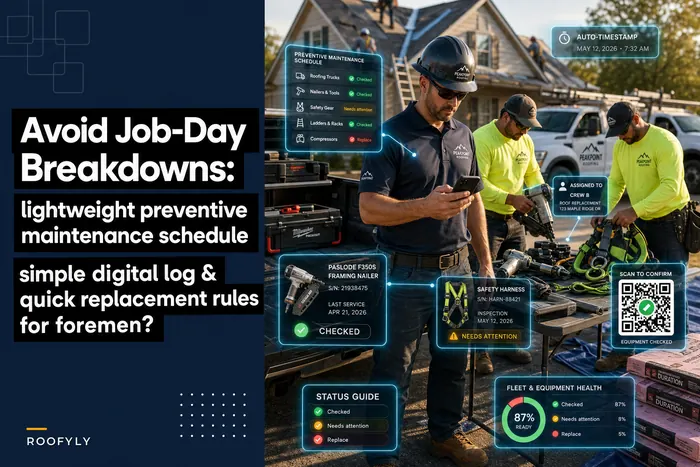
Same goes for equipment. A frayed lanyard or a ladder with a cracked rung is a safety failure and a maintenance failure. Folding gear checks into a lightweight preventive maintenance schedule means you're not inspecting the same harness twice under two different systems.
One thing most teams miss: an inspection that produces no record and triggers no action isn't an inspection. It's a ritual. Every completed inspection should be timestamped and stored somewhere retrievable, because six months later when an adjuster or an attorney asks "can you show me the fall-protection inspection from that day," a verbal "yeah we always check" is worth nothing.
Stage 2: Near-miss capture — the cheapest safety data you'll ever get
Near-misses are the single most underused signal in roofing operations. They're free warnings. A guy whose harness wasn't clipped when he leaned over the edge, but nothing happened — that's the exact incident that hospitalizes someone next month, delivered to you at zero cost.
The problem is friction. If reporting a near-miss takes a form, a login, and a five-minute writeup, it won't happen on a jobsite where everyone's trying to beat the rain. The capture mechanism has to be almost insultingly simple.
A near-miss note only needs five fields:
-
What almost happened (one sentence)
-
Where on the roof / site
-
What conditions contributed (wet, steep, rushed, tired, gear issue)
-
Who was involved
-
What we'd change
That's it. Sixty seconds, ideally voice-to-text so a guy can dictate it walking to the truck. The point isn't a beautiful report — it's a datapoint.
Enable voice-to-text on crew phones and standardize a five-field template so a near-miss can be captured in under a minute.
Near-misses only matter in aggregate. One slip is noise. Four slips in three weeks, all on wet OSB during morning dry-in, is a pattern — and that pattern tells you to change your cadence before anyone gets hurt. This is usually where the whole system either earns its keep or falls apart, because if nobody reviews the notes weekly, you've collected warnings and ignored every one of them.
A real example: a mid-size crew running roughly 8–10 reroofs a month started logging near-misses on a shared voice thread. Within about two months they'd logged around 20 notes. Nearly half clustered around ladder movement during material loading. That single insight led them to assign one person as a dedicated ground and ladder controller during loads — a small staffing tweak that came directly out of data they'd previously been throwing away.
Stage 3: Incident escalation that doesn't fall apart under pressure
When something goes wrong, the worst time to figure out your process is in the moment. Adrenaline is high, everyone's focused on the injured person (correctly), and documentation is the last thing on anyone's mind. That's exactly why the escalation path has to be pre-built and dead simple.
Escalation has two jobs running in parallel: take care of the person, and preserve the record. The first is obvious. The second is what protects your company weeks later when the claim, the OSHA question, or the insurer inquiry lands.
A workable escalation flow:
-
Secure the person and the scene. Medical first, always. Stop-work on that area.
-
Notify up the chain immediately. Foreman calls owner within a set window — many teams use 30 minutes for anything beyond first-aid.
-
Capture the scene before it changes. Photos of the setup, anchor points, ladder position, weather conditions, and PPE state — before anyone cleans up or resets.
-
Log witness statements while memory is fresh. Short, factual, same day.
-
Determine reporting obligations. Recordable? Reportable to insurer? OSHA thresholds for fatality or in-patient hospitalization have hard clocks — hours, not days.
-
Root-cause review within the week. Not blame — cause. What in the system allowed this?
The escalation packet — the artifact this stage produces — should be a standardized bundle: incident summary, timeline, scene photos, witness notes, the relevant inspection logs from that day, and the competency records of the people involved. When you can hand an insurer a coherent packet instead of a scramble, everything moves faster and your credibility holds.
One pattern worth flagging: teams that skip the root-cause step almost always repeat the incident. The escalation isn't finished when the paperwork is filed. It's finished when the loop closes back into your cadence or competency gates and something actually changes. If the review reveals a crew member was working outside his demonstrated skill level, that's not a discipline issue — that's a broken competency gate.
Stage 4: Competency gates — who's allowed to do what
This is the stage most companies never formalize, and it's the one that quietly causes the most serious incidents. "He's been doing this for years" is not a competency verification. Years of exposure without verified skill just means someone's been lucky.
A competency gate is a checkpoint: before a crew member is assigned to a certain class of work — steep pitch, high work, powered equipment near edges, leading a crew — they have to demonstrate specific, checkable skills. Not attend a class. Demonstrate.
A sample steep-pitch / fall-protection competency checklist:
-
- [ ] Correctly selects and rates an anchor point for the substrate
-
- [ ] Inspects harness and lanyard and identifies a planted defect
-
- [ ] Calculates fall clearance / demonstrates understanding of swing fall
-
- [ ] Sets up and repositions on a steep pitch under observation
-
- [ ] Explains stop-work thresholds for wind and surface moisture
-
- [ ] Responds correctly to a simulated suspension scenario
Each item gets signed off by a lead foreman or owner, dated, and stored. That record does double duty — it's your assurance the person's ready, and it's evidence in your escalation packet if something ever happens.
Competency gates connect straight into how you develop people. The same verification logic that governs who works a steep pitch should govern who runs a crew. If you're building a pipeline of foremen, safety competencies belong right alongside the operational ones in your 90/180-day onboarding and competency-gate framework. Promoting someone into leadership without a safety-competency gate is how you end up with a foreman who can hit production numbers but doesn't catch an unclipped harness.
When this framework actually makes sense — and when it's overkill
When it makes sense: You're running two or more crews, the owner can't be on every site, and you're taking on steep or complex work where fall exposure is real. At that scale, the informal "I'll just watch everyone" model has already broken — you're just not paying for it yet.
When it's overkill: A solo operator or a tight two-person crew doing low-slope residential work probably doesn't need the full four-stage governance loop with formal escalation packets. The daily inspection habit and near-miss capture still pay off, but elaborate competency gates for two people who've worked together for a decade is friction without return.
Who should not do this halfway: Companies that implement the inspections and gates but skip the near-miss review and root-cause loop. That's the worst version — you generate paperwork that looks like a safety program in a lawsuit but doesn't actually change behavior, so you get the cost with none of the protection. If you're going to build it, build the feedback loop, because the loop is the whole point.
Where the data-handling part gets real
All four stages produce records, and records are useless if they're scattered across text threads, a foreman's phone, a clipboard in a truck, and someone's memory. The value of this whole framework depends on the artifacts being retrievable and connected — the inspection log from the incident day, the competency record of the person involved, the near-miss notes that predicted it.
This is where operational software genuinely helps, not as a gimmick but as connective tissue. A platform that timestamps inspections, lets crews dictate a near-miss in under a minute, standardizes the escalation packet, and stores signed competency checklists against each person means the data actually flows between stages instead of dying in a group chat. AI-assisted tagging can surface near-miss patterns — flagging that four recent notes all mention wet decking — so a human doesn't have to manually read back through weeks of notes to spot the cluster. The system does the pattern-watching so the foreman can do the roofing.
Here's how the data flows between stages.
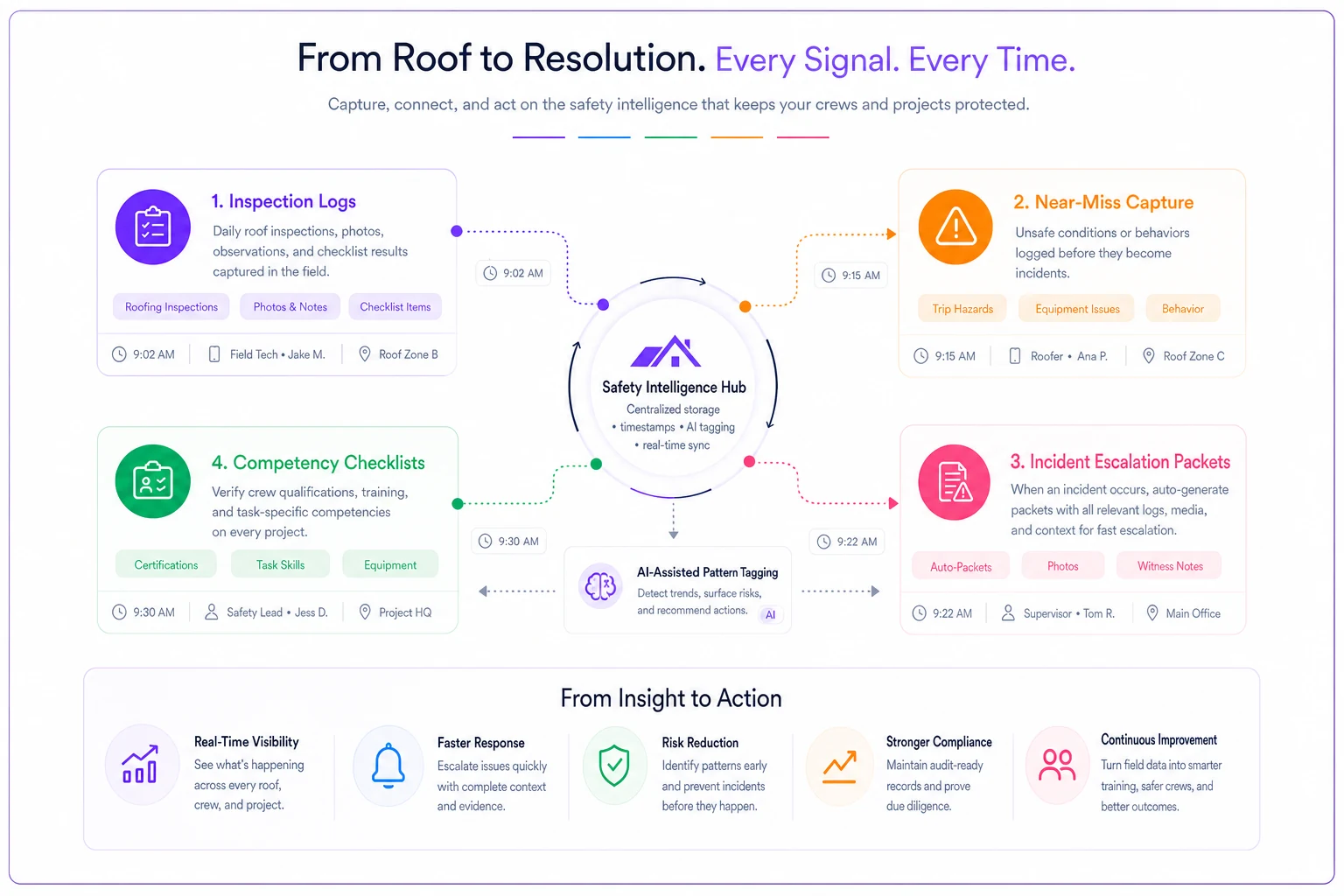
That's the practical difference between a safety program that exists on paper and one that actually catches the incident before it happens. The tooling isn't the safety. It's what keeps the safety loop from quietly falling apart the third time you're too busy to review the notes.
The real scenario
A residential roofing outfit running four crews across a metro area had a decent-on-paper safety setup — toolbox talks, harnesses, a laminated checklist. Over about a year they'd had two lost-time injuries and a handful of near-misses nobody had recorded. Their insurance experience rating was creeping the wrong direction, and one foreman had quietly stopped doing the daily checklist because it was too long.
They rebuilt it as a staged loop. Daily inspections got trimmed to five items. Near-miss capture went to a 60-second voice note. They started a weekly 15-minute review of the notes and added competency sign-offs before anyone worked steep pitch. Over the following six to eight months, logged near-misses actually went up — which is what you want, because it means people are reporting — while recordable incidents dropped to zero over that window. When an adjuster questioned a minor property-damage claim, they handed over a clean escalation packet with the day's inspection log attached and closed it in a fraction of the usual back-and-forth. The safety improvement and the paperwork discipline turned out to be the same thing.
Closing thought
The companies that stay safe as they grow aren't the ones with the most safety rules. They're the ones who built a loop where each part checks the others — inspections that produce records, records that surface patterns, patterns that change behavior, and gates that keep people out of situations they haven't proven they can handle.
A rooftop safety SOP isn't a binder. It's a cycle that keeps running whether or not the owner is standing on the roof that day. Get the stages connected, keep the friction low enough that crews actually use it, and the program starts protecting people and the business at the same time — which was always the point.
Ready to elevate your roofing operations?
Join hundreds of roofing contractors using Roofyly to streamline workflows, improve crew coordination, and enhance client satisfaction.