


Most roofing companies promote foremen the same way: your best installer has been around three or four years, he knows the material, the crew respects him, and one Monday you hand him a truck and a job packet and say "you've got this one." No template. No gates. No plan for the first 90 days. Just a raise and a prayer.
That works maybe half the time. The other half, you find out three weeks later that your new foreman is technically excellent but can't run a crew, can't read a schedule, forgets to document tear-off conditions, and creates more callbacks than the guy you promoted him over. And by then it's awkward to walk it back.
The problem isn't that your people aren't good. It's that "foreman" is a completely different job than "great installer," and almost nobody trains for the gap. This is a walkthrough of how to build a real roofing foreman onboarding system — one with phased expectations, coaching that actually happens, and clear competency gates so you know before the job blows up whether someone is ready.
Why the "best installer gets promoted" model quietly breaks
Worth naming early: installing a roof is a task-execution job. Running a roof is a coordination job. The skills barely overlap.
A great installer optimizes for his own hands — speed, clean cuts, tight flashing details. A great foreman optimizes for a system: the crew's sequencing, the homeowner's expectations, the material staging, the documentation trail, the schedule handoff to the next job. You can be elite at the first and genuinely bad at the second.
What breaks at scale is subtle. With one or two crews, the owner is still on-site enough to catch a weak foreman's mistakes — re-checking photos, smoothing over the homeowner, catching the missed step flashing. The foreman looks fine because the owner is quietly acting as a safety net. Add a third and fourth crew, and that net disappears. Now the weak foreman is unsupervised, and every gap in his judgment turns into a callback, a supplement fight, or a schedule slip that cascades into the next three jobs.
The companies that scale cleanly aren't the ones with naturally gifted foremen. They're the ones who turned "becoming a foreman" into a repeatable process instead of a personality test.
The three things a foreman onboarding system has to do
Before templates and scripts, it helps to be clear on what the system is actually for. A real onboarding program does three things at once:
Keep every roofing job on track and on time.
Roofyly helps you manage, schedule, and communicate every roofing project with precision and ease.
- Centralized project planning
- Real-time crew notifications
- Integrated scheduling & client updates
No credit card required
-
Transfer judgment, not just tasks. New foremen usually know how to do the work. What they lack is the decision-making — when to call the office, how much buffer to build in, when a "small" structural surprise needs a stop-and-document.
-
Make readiness visible before it's tested live. You want to know a foreman can handle a complex tear-off before you send him to a complex tear-off alone. Gates do this.
-
Protect quality and schedule during the ramp. Customers shouldn't be able to tell the foreman is new. That means shadowing, phased responsibility, and close coaching in the early weeks.
If your promotion process doesn't do all three, you're not onboarding — you're just relabeling someone and hoping.
The competency matrix: keep it lightweight or nobody uses it
The mistake companies make with competency matrices is building a 40-row spreadsheet that looks impressive and gets opened exactly once. A foreman matrix should fit on one page and cover the areas where new foremen actually fail. In practice, that's about six domains.
| Competency domain | What "not ready" looks like | What "ready to run solo" looks like |
|---|---|---|
| Crew coordination & sequencing | Crew stands around waiting for direction; tasks overlap badly | Crew flows through tear-off → dry-in → install with minimal idle time |
| Schedule & pace management | Job runs long, no early warning to office | Flags slippage by mid-morning, adjusts crew, protects next-day start |
| Documentation & photo trail | Missing before/after shots, no tear-off condition photos | Complete defensible photo set without being reminded |
| Homeowner communication | Avoids the homeowner or over-promises | Sets expectations, handles small concerns, escalates the right ones |
| Quality self-checks | Relies on QA/owner to catch defects | Runs his own flashing, fastener, and penetration checks |
| Safety & site setup | Reactive; deals with hazards after they appear | Sets up staging, fall protection, ground protection before work starts |
Each domain gets a simple rating: shadowing → assisted → solo-with-review → solo. Four levels, six rows. A foreman doesn't graduate a phase until every row hits the target level for that phase. This is what turns a vague "he seems ready" into an actual conversation you can have with evidence.
The 90-day template: from crew member to running easy jobs
The first 90 days is about establishing that the person can run a straightforward reroof solo — a rectangular ranch, single layer, no weird structural surprises, cooperative homeowner. Not the hard stuff yet.
Days 1–15 — Shadow with a purpose. The new foreman runs his normal install work but shadows the current foreman on everything around the install: the morning huddle, the material check, the homeowner intro, the photo documentation, the end-of-day wrap. The goal here isn't to teach roofing. It's to make the invisible coordination work visible. Have him keep a running note of every decision the lead foreman made that he wouldn't have thought to make. That list is the real curriculum.
Days 16–45 — Assisted runs. Now he runs the crew with the experienced foreman present but hands-off. He calls the huddle. He sequences the crew. He talks to the homeowner. The senior foreman only steps in if quality or safety is at risk, and debriefs afterward instead of correcting live. This is where a time-motion baseline is incredibly useful — if you've already built standard task times for your crews, the new foreman has a target to run against instead of guessing whether his pace is acceptable. Our breakdown on building a foreman time-motion benchmark and standard task times pairs directly with this phase.
Days 46–90 — Solo with review. He runs easy jobs alone, but every job gets reviewed after the fact — photos, documentation, homeowner feedback, schedule adherence. The review is short but non-negotiable. By day 90 you should have real data across five to eight jobs, not a gut feeling.
Phase KPIs to track through day 90:
-
Callback rate on his jobs (target
at or below crew average)
-
Documentation completeness (target
95%+ of required photos/forms without reminder)
-
Schedule adherence on easy jobs (target
within your standard buffer)
-
Homeowner complaint count (target
zero escalations to the office)
Pro-tip: Use your time-motion baseline as an objective target during assisted runs to provide clear pace feedback.
Visual workflow of the 90/180-day onboarding phases:
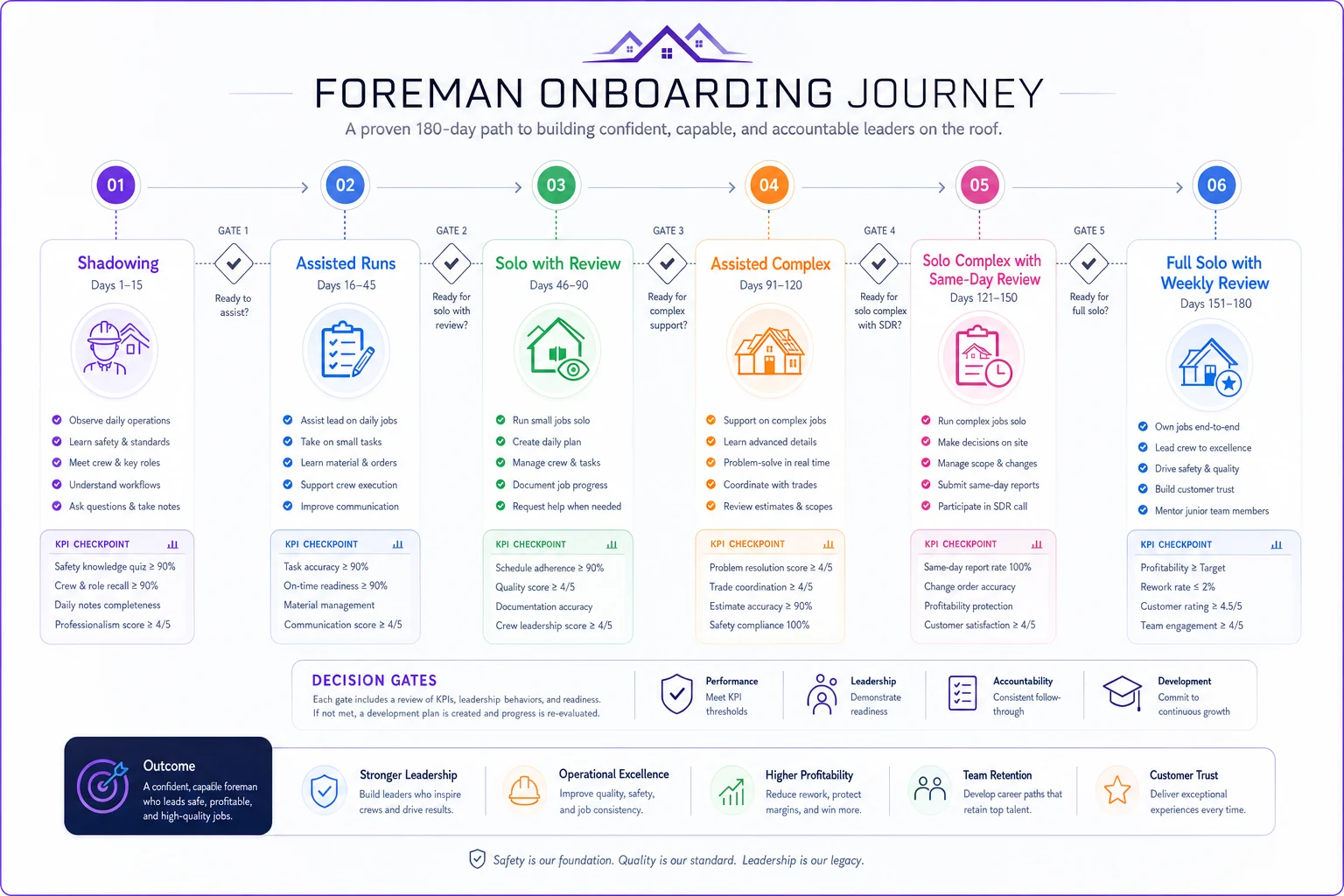
If any of these are off at day 90, he doesn't move to the 180-day track. He repeats the phase. That's not a punishment — it's the entire point of having gates.
The 180-day template: complexity, judgment, and the hard calls
Days 91–180 are where you build the foreman who can handle the jobs that actually make you money and the ones that can actually hurt you — steep pitches, multi-layer tear-offs, hidden structural surprises, difficult homeowners, tight scheduling windows.
The structure mirrors the first 90 but on harder terrain:
-
Days 91–120 Assisted runs on complex jobs. The focus shifts almost entirely to judgment under uncertainty — what to do when tear-off reveals rot, when weather threatens a dry-in, when the material delivery is short. He's making the calls; the senior foreman is validating them afterward.
-
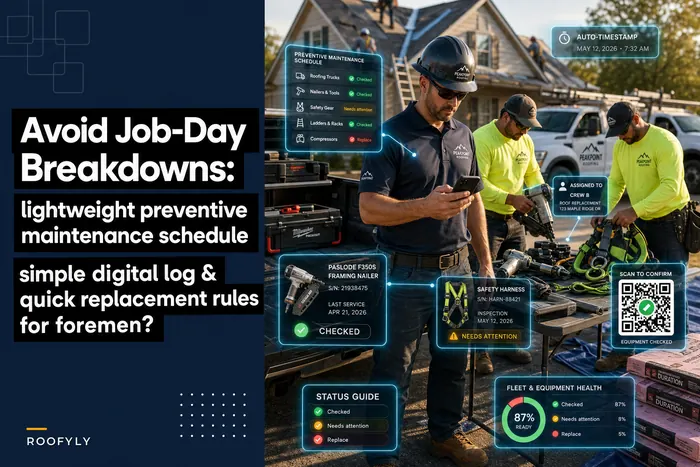
Days 121–150 Solo on complex jobs with same-day review. This is also where you fold in the operational habits that separate a good foreman from a great one — keeping tools and equipment job-ready. Foremen who ignore equipment condition create their own downtime, which is why a simple preventive maintenance schedule and digital log for fleet and tools belongs in his weekly routine, not just the shop's.
-
Days 151–180 Full solo across all job types, with weekly (not per-job) review. If he's clearing the gates here, he's a real foreman.
Phase KPIs for the 180-day track:
-
Callback and warranty-claim rate on complex jobs
-
Supplement documentation quality (are his tear-off surprises documented well enough to actually get paid?)
-
Crew retention and morale on his jobs — a good foreman keeps a crew; a bad one bleeds them
-
Gross margin variance on his jobs vs. estimate
That last one matters more than people realize. A foreman who consistently runs jobs 8–12% under estimated margin isn't ready, even if his roofs look great. Quality and economics have to hold.
Weekly coaching scripts: the part everyone skips
The honest truth about most foreman "development" — the coaching never happens. The owner intends to sit down weekly, then a storm hits, three crews need dispatching, and the coaching gets pushed. Six weeks later the new foreman has developed bad habits nobody corrected.
-
"Walk me through the job that went best this week and why." (Reinforces good judgment by making him articulate it.)
-
"Where did you have to make a call you weren't sure about?" (Surfaces the judgment gaps without shaming.)
-
"What slowed the crew down that you didn't expect?" (Builds his eye for bottlenecks.)
-
"Show me two photos you're proud of and one you'd redo." (Keeps documentation standards live.)
-
"What do you need from me this week?" (Signals that he's supported, not just evaluated.)
The magic is in question two. New foremen hide uncertainty because they think admitting it makes them look unready. If your weekly script rewards naming uncertainty, you get an early warning system for the mistakes that would otherwise become callbacks. The foremen who never mention a single uncertain call are usually the ones about to blow up a job.
Write these down. Give the questions to whoever is running the coaching so it's consistent across foremen. A scripted 15 minutes that actually happens beats a heartfelt hour that happens twice a quarter.
A real scenario: what changes when you gate the process
A mid-sized residential roofer running four crews had been promoting the classic way — best installer gets the truck. Over about a year and a half they'd promoted three foremen. Two worked out. One didn't, and the fallout was expensive: a run of callbacks, two supplement claims that got denied partly because tear-off conditions were poorly documented, and a crew that lost two guys because the foreman couldn't hold the group together.
They built a version of the system above — one-page matrix, 90/180 gates, and a scripted weekly 15-minute check-in run by the ops lead. The next two promotions went through it.
The difference showed up in a few places. One candidate cleared the 90-day gate cleanly but stalled at the 121–150 mark on complex jobs; his documentation on structural surprises was weak. Because there was a gate, they caught it and held him on easier jobs another five weeks instead of learning about the problem through a denied supplement. The other candidate turned out stronger than expected and cleared the full track early.
The numbers weren't dramatic in a headline way — callback rate on new-foreman jobs dropped to roughly the crew average within the first ramp instead of running well above it, and they stopped eating the surprise cost of a promotion that didn't take. The bigger win was quieter: the owner stopped being the safety net. He could actually let a new foreman run a job without re-checking everything himself.
Where this holds together — or falls apart — operationally
The templates only work if the information behind them is actually captured. This is the part that trips up companies with good intentions. If a foreman's photos, forms, schedule adherence, and job outcomes live scattered across text threads, a whiteboard, and someone's memory, your competency matrix is guesswork. You think he's at 95% documentation completeness, but nobody actually knows.
The companies that run this well have their field documentation and job data flowing into one place, so the weekly review is looking at real records instead of anecdotes. When photo sets, completion forms, and schedule data are centralized, tracking a foreman's progress against the matrix stops being a manual chore and starts being something you can glance at. Lightweight automation helps here too — flagging a foreman whose jobs are trending over on schedule, or whose documentation is consistently missing tear-off shots, before it shows up as a denied claim. The point isn't the software; it's that the system needs a reliable memory, and human memory across four busy crews isn't it.
When this makes sense — and when it doesn't
This makes sense when you're running two or more crews and the owner can no longer personally cover every job. That's the threshold where a weak foreman does real damage, and where a repeatable promotion process pays for itself fast.
This is overkill when you're a single owner-operator crew and you're on every roof anyway. You don't need a 180-day gated program to promote the one guy you work beside daily. Build the habits informally and formalize them when you add the second crew.
Who should not rush this: any company promoting purely to solve a staffing shortage. Promoting an unready installer because you're short a foreman doesn't fix the shortage — it moves the failure downstream to callbacks, supplements, and crew turnover, which cost more than the gap you were trying to fill. If someone isn't clearing the 90-day gates, the answer is more time in-phase, not a battlefield promotion.
Bringing it together
Foreman development fails at most roofing companies for a boring reason: it's treated as an event — a raise and a truck — instead of a process with phases, gates, and coaching that actually happens on the calendar. The installers who get promoted are usually plenty capable. They just get dropped into a coordination job with no map.
A one-page competency matrix, a 90/180-day template, and a scripted weekly 15 minutes won't guarantee every promotion works. But it will tell you which ones aren't working while you can still do something about it — before the callback, before the denied supplement, before the crew walks. You're not trying to manufacture perfect foremen. You're trying to make readiness visible early enough that quality and schedule never have to be the thing that finds out for you.
Ready to elevate your roofing operations?
Join hundreds of roofing contractors using Roofyly to streamline workflows, improve crew coordination, and enhance client satisfaction.