


Most roofing pay plans are built backwards. Somebody looked at what competitors were paying, added a few bucks, threw in a vague "quality bonus," and called it a compensation strategy. Then two years later the owner is staring at a spreadsheet trying to figure out why the fastest crew is also the one generating the most callbacks, and why the incentive pool keeps growing while margins keep shrinking.
The problem isn't that incentives don't work. It's that most incentives reward the wrong thing, get measured over the wrong window, and can be gamed by anyone who understands how the payout math works. A roofing incentive pay framework only holds up when it's tied to metrics you can actually measure in the field, wrapped in controls that make cheating harder than just doing the job right.
This is a systems problem, not a pay-rate problem. Compensation touches scheduling, QA, estimating, and closeout all at once. Change how you pay and you change crew behavior across all of those areas — usually in ways you didn't intend. So before getting into sample pay tables, it's worth being honest about how these plans quietly fall apart.
Why speed-based pay quietly wrecks your operation
The most common roofing pay model is some flavor of production pay: crews get paid per square installed, or a flat rate per completed job. It feels fair. It rewards output. And it's the single biggest driver of hidden operational cost in the trade.
Here's the mechanism. When pay is tied purely to volume or speed, every decision a crew makes on the roof gets filtered through "how do I finish faster." That means shortcuts on flashing details, rushed nailing patterns, skipped underlayment overlaps, and photos taken carelessly — or not at all — because documentation slows them down. None of that shows up on payday. All of it shows up 60 to 180 days later as warranty callbacks, supplement rejections, and homeowner complaints.
What tends to happen in production-pay shops is a strange split: the crew with the best per-square numbers is often the crew generating 30–40% of the callback volume. They're not bad installers. They're responding rationally to the incentive you built. You told them speed pays, so they optimized for speed.
The failure compounds at scale. With one or two crews, an owner can eyeball quality and catch problems personally. Add a third and fourth crew, and the owner is no longer on every roof. Now the pay plan is the quality control system, because it's the only signal telling crews what matters. If that signal says "go fast," you've effectively automated the production of defects.
The three metrics that actually belong in a pay plan
A defendable framework rewards the outcomes you actually care about, and it does it with metrics that are objective enough to survive an argument. In roofing, three metrics carry most of the weight:
Keep every roofing job on track and on time.
Roofyly helps you manage, schedule, and communicate every roofing project with precision and ease.
- Centralized project planning
- Real-time crew notifications
- Integrated scheduling & client updates
No credit card required
Utilization — the share of paid crew time that turns into productive installed work. This catches the gap between "on the clock" and "on the roof producing." If you've built standard task times for your crews, utilization becomes measurable rather than a gut feeling. If you haven't, the foreman time-motion approach to standard task times is the foundation you need before any of this works.
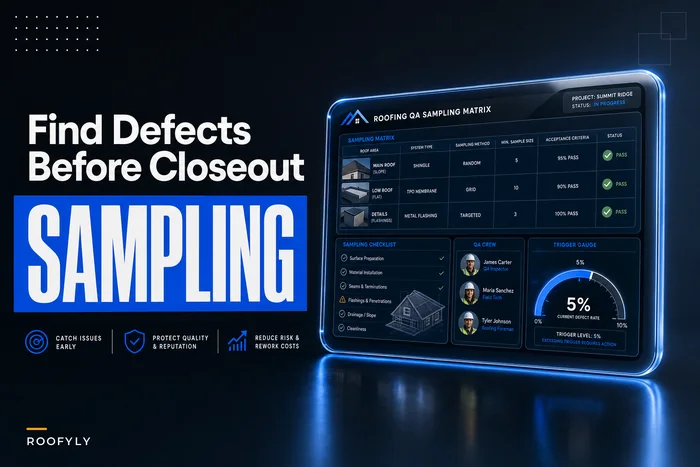
QA pass rate — the percentage of jobs that clear your quality inspection on the first pass, no rework required. This is the counterweight to speed. It only works if your QA process is consistent, which is why a statistically defensible QA sampling plan matters so much here. A pass rate is meaningless if inspections are random and subjective.
On-time finish — did the job close within the scheduled window, including cleanup, closeout photos, and homeowner sign-off. Not "did they stop working," but "did they actually complete everything the job required."
These three metrics are in tension with each other on purpose. You can't max utilization by cutting corners, because QA pass rate drops. You can't chase QA perfection by taking forever, because on-time finish drops. A well-built framework forces crews to balance all three — which is exactly the behavior you want but can never get from a single-metric plan.
Structuring base plus incentive so it's defendable
The base needs to be genuinely livable on its own. This is the part shops get wrong when they copy an aggressive incentive model — they push too much pay into the variable side, and crews start treating the incentive as survival money rather than a bonus. When that happens, any month where metrics dip because of weather or a bad batch of material feels like a pay cut, and you get resentment plus turnover.
A defendable split usually keeps base at 70–80% of a crew's realistic total earnings, with incentive making up the remaining 20–30%. That's enough upside to change behavior without making people desperate. The exact split depends on your market and role, but the principle holds: base should cover a decent living, incentive should reward the crew that consistently balances the three metrics.
Here's a sample structure for a lead installer / crew lead in a mid-cost market. Treat the numbers as illustrative — your labor market will shift them:
| Component | Structure | Notes |
|---|---|---|
| Base pay | ~$26–$30/hr | Livable regardless of incentive |
| Utilization incentive | Up to ~$1.50/hr equivalent | Paid when crew hits utilization target for the window |
| QA pass-rate bonus | ~$200–$400 per window | Full amount at 95%+ first-pass, scaled down below |
| On-time finish bonus | ~$150–$300 per window | Requires closeout complete, not just "done working" |
| Callback penalty offset | Deducted from bonus pool | Documented, capped, never touches base |
The callback offset deserves attention. It should reduce the incentive pool, never the base pay — you cannot claw back someone's living wage for a callback, both legally and practically. It also has to be capped so a single bad job doesn't wipe out a month of otherwise solid work. The point is directional pressure, not punishment.
Measurement windows: the detail that makes or breaks trust
The window you measure over changes crew behavior more than the dollar amounts do. Measure weekly and you get panic and short-term gaming. Measure yearly and the incentive is so disconnected from the actual work that nobody links the two.
For most roofing operations, a monthly measurement window with a rolling quality tail works best. The tail matters because QA pass rates and callbacks don't fully surface until weeks after a job closes. If you pay out the full quality bonus at month-end, you're paying before you actually know whether the work held up.
A practical structure:
-
Utilization and on-time finish
measured and paid monthly, because those are known by month-end.
-
QA pass rate
measured on a rolling 60-day window, so recent work has time to surface defects before its bonus locks.
-
Callback offset
applied to a holdback pool — a small percentage of each month's incentive held for 90 days, then released if no qualifying callbacks appear.
The holdback is the part crews grumble about at first and then appreciate later, because it protects the honest crews from getting lumped in with the corner-cutters. Once a crew realizes the holdback exists specifically to reward durable work, the objection usually fades.
Fraud controls, because every incentive gets tested
The moment money is tied to a number, someone will look for the shortcut to move the number without doing the work. This isn't cynicism — it's just what happens. Your job is to make the honest path the easiest path.
Common gaming patterns in roofing incentive plans, and how to close them:
-
Utilization inflation — logging travel, breaks, or standby as productive time. Close it by tying utilization to verifiable job stages and timestamped field data, not self-reported hours.
-
QA self-inspection — a crew "passing" its own work. QA must be done by someone who doesn't share in that crew's incentive pool. Separation of duties, roofing edition.
-
Photo staging — documenting a small, clean section to represent the whole roof. Tie QA to standardized, location-tagged shot lists so coverage is verifiable, not cherry-picked.
-
Job splitting — breaking one job into pieces to hit on-time targets on paper. Define "job complete" by closeout artifacts, not by internal scheduling entries.
-
Callback laundering — reclassifying a genuine callback as "new work" or a "homeowner request" to dodge the offset. Require a documented root-cause tag on every return visit.
When your field data already flows into consistent, rules-driven measurements, the pay plan reads from a source of truth instead of a self-report.
The pattern across all of these: fraud controls fail when measurement depends on the same people who get paid based on the measurement. Build your framework so the data comes from the field process itself — timestamps, tagged photos, closeout gates — rather than from someone typing a number into a form they benefit from.
This is also where a rules-based metrics framework earns its keep. When your field data already flows into consistent, rules-driven measurements, the pay plan reads from a source of truth instead of a self-report. AI-assisted operational tools help here in the background — auto-tagging photos to the right job stage, flagging when a callback gets reclassified, surfacing a crew whose utilization jumped 15 points overnight. You're not asking software to decide pay; you're using it to make the numbers hard to fake.
A real scenario: mid-size reroof shop, four crews
A residential reroof contractor running four crews had been paying flat per-square production rates for years. Revenue was fine, but callbacks were eating roughly 6–7% of completed job value in rework and warranty labor, and the owner was personally driving out to inspect problem roofs most weekends.
They shifted to a base-plus-incentive model over about four months. Base moved up so crews weren't losing income, with incentive tied to the three metrics and a 90-day quality holdback. First month, two crews complained loudly — those turned out to be the two with the highest prior callback rates, which told the owner everything he needed to know.
By the end of the second quarter on the new plan, first-pass QA rates climbed from the low 80s to the mid 90s. Callback-related rework dropped to around 3% of job value. On-time finish improved too, mostly because crews stopped leaving closeout for "later" once it was tied to the bonus. Total labor cost per job barely moved — the incentive spend was roughly offset by the rework they stopped paying for. The real win was the owner getting his weekends back and stopping the slow bleed of homeowner trust.
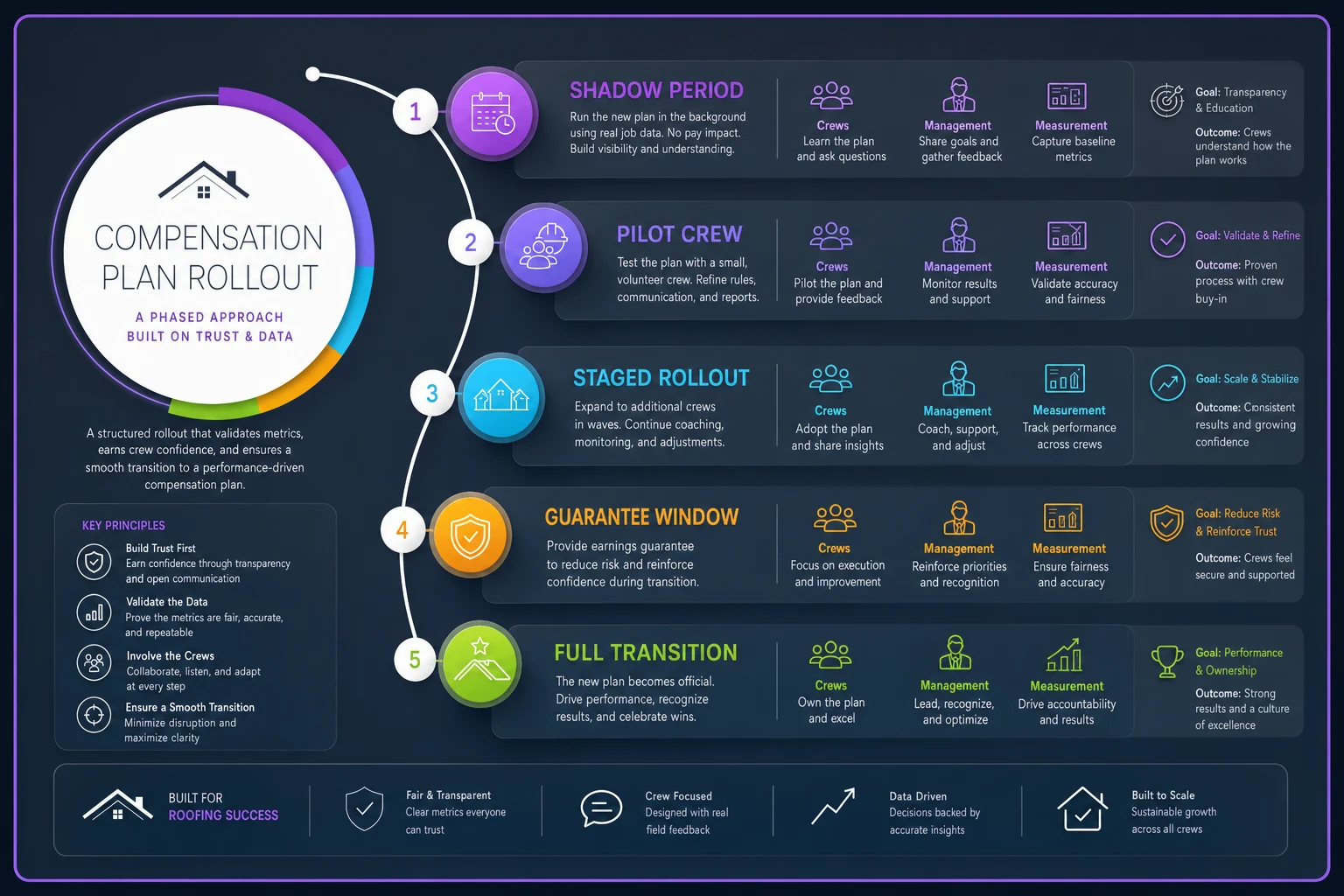
Phased rollout, because launching all at once fails
Dropping a new compensation model on your whole company in one pay period is how you trigger a walkout. Crews assume any change is a pay cut until proven otherwise. Roll it out in phases so people see the math work before their income depends on it.
-
Shadow period (30–45 days). Run the new metrics alongside existing pay. Nobody's check changes. Crews see what they would have earned. This builds trust and surfaces measurement bugs before real money is involved.
-
Pilot crew (30–60 days). Pick one respected crew — ideally a strong performer — to go live first. When the best crew comes out ahead, the rest stop assuming it's a scheme.
-
Staged company rollout. Bring crews on in waves, not all at once. Keep the shadow data running for each new group so they've already seen their numbers before going live.
-
Guarantee window. For the first 60–90 days a crew is live, guarantee they won't earn less than their old plan would have paid. This removes the "pay cut" fear entirely and costs very little if the plan is designed right.
-
Full transition. Once every crew has cleared its guarantee window without issue, retire the old model.
This visual lays out the phased rollout steps so teams can see timing and who is involved at each stage.
Before you launch, run through this checklist:
-
Base pay is livable without any incentive
-
All three metrics have objective, field-sourced measurement
-
QA is done by someone outside the crew's incentive pool
-
Measurement windows account for the quality tail (callbacks surface late)
-
Callback offset touches only the incentive pool, capped, never base
-
Every fraud pattern above has a specific control
-
Shadow-period data has been validated against real jobs
-
Crews can see their own numbers in near-real-time, not once a quarter
-
Guarantee window is documented in writing
Guarantee window is documented in writing
When this framework makes sense — and when it doesn't
When it makes sense: you're running three or more crews, the owner can't personally inspect every job, and callbacks or inconsistent quality are eating into margin. That's the sweet spot. The framework replaces the oversight you can no longer provide in person.
When it's a bad idea: if your field measurement is a mess — no consistent QA, no reliable time data, no standardized photos — building an incentive plan on top of that just automates bad decisions. Fix the measurement layer first. A pay plan reading from garbage data will pay for garbage behavior.
Who should not do this yet: a single-crew operation where the owner is on every roof. You already have the tightest quality control possible — your own eyes. Adding metric-based incentives here creates administrative overhead for a problem you don't actually have. Wait until you're delegating, then build the plan as part of that handoff.
The part most owners underestimate
A compensation framework isn't a document you write once and file. It's a live system that shapes behavior every day, and it interacts with everything else in your operation. Change the pay plan and your scheduling assumptions shift, your QA workload shifts, your closeout process gets more or less attention depending on where the money points.
The shops that get this right treat the pay plan as one gear in a connected machine — measurement feeds pay, pay drives behavior, behavior shows up in QA and callbacks, and that data feeds back into the next measurement window. When those pieces are wired together with consistent, hard-to-game data flowing between them, the plan largely runs itself and you spend your energy on growth instead of refereeing pay disputes.
Get the metrics honest, keep base livable, control the ways it can be gamed, and roll it out slowly enough that crews trust it before it touches their income. Do that, and a roofing incentive pay framework stops being a source of conflict and starts doing what compensation is actually supposed to do: quietly point everyone at the same goal.
Get the metrics honest, keep base livable, control the ways it can be gamed, and roll it out slowly enough that crews trust it before it touches their income. Do that, and a roofing incentive pay framework stops being a source of conflict and starts doing what compensation is actually supposed to do: quietly point everyone at the same goal.
Ready to elevate your roofing operations?
Join hundreds of roofing contractors using Roofyly to streamline workflows, improve crew coordination, and enhance client satisfaction.