

Nobody has time to inspect every nail, every flashing, every valley on every job. And yet the callback that shows up three weeks later — the one where the homeowner points at a ridge cap that lifted in the first windstorm — always feels like something you should have caught. The problem isn't that you missed one bad nail. The problem is that one bad nail usually means the crew was setting the whole ridge that way all day.
That's the gap most roofing QA lives in. Either you check everything (impossible at scale) or you eyeball a couple of things and hope. A real roofing QA sampling plan sits in the middle: you check a defensible sample of items, and the sample is designed so that if there's a systemic problem — a crew habit, a training gap, a bad patch of decision-making — it shows up before closeout instead of on a warranty claim.
This post is about building that sampling logic. Not vague "spot-check a few things," but an actual matrix keyed to crew size and job volume, plus the checklists, escalation triggers, and retraining loop that turn a caught defect into a fixed process.
Why random spot-checks miss the thing that actually hurts you
Worth understanding before you build anything: defects on a roof are almost never randomly distributed. They cluster.
When a crew nails high on every course because the new guy learned it that way and nobody corrected him, you don't get one high nail — you get an entire slope of them. When a foreman is rushing to beat rain, the shortcuts land on the last two hours of work, usually the same components (step flashing, pipe boots, the back valley nobody photographs). When a supplier ships a slightly off-spec sealant, it hits every penetration from that day.
Systemic problems are correlated. That's actually good news for sampling, because it means you don't need to inspect 100 items to find a 30%-defect-rate problem. A handful of well-chosen checks will surface it. But it also means the wrong sampling — like always checking the front slope because it's easy to see from the driveway — will systematically miss the crews that hide their weak work where it's hard to reach.
A common example: a mid-size residential outfit was doing "QA" by having the sales rep glance at the roof during final money collection. Front-facing slopes looked clean every time. Their callbacks were overwhelmingly on rear slopes and low-visibility penetrations. The QA process wasn't wrong exactly — it was just aimed at the part of the roof that was never the problem.
The sampling matrix: what to check, keyed to crew size and job volume
Inspection intensity should scale with two things:
Keep every roofing job on track and on time.
Roofyly helps you manage, schedule, and communicate every roofing project with precision and ease.
- Centralized project planning
- Real-time crew notifications
- Integrated scheduling & client updates
No credit card required
-
Crew size — more hands means more independent chances to introduce a defect, and more people who might not have gotten the same training.
-
Job volume in the period — the more jobs a crew closes, the more you can (and should) rotate deeper audits so no single crew goes too long uninspected.
Instead of "inspect 10% of everything," you set a number of sampled items per job and a fraction of jobs that get a deep audit, and both move with those two variables.
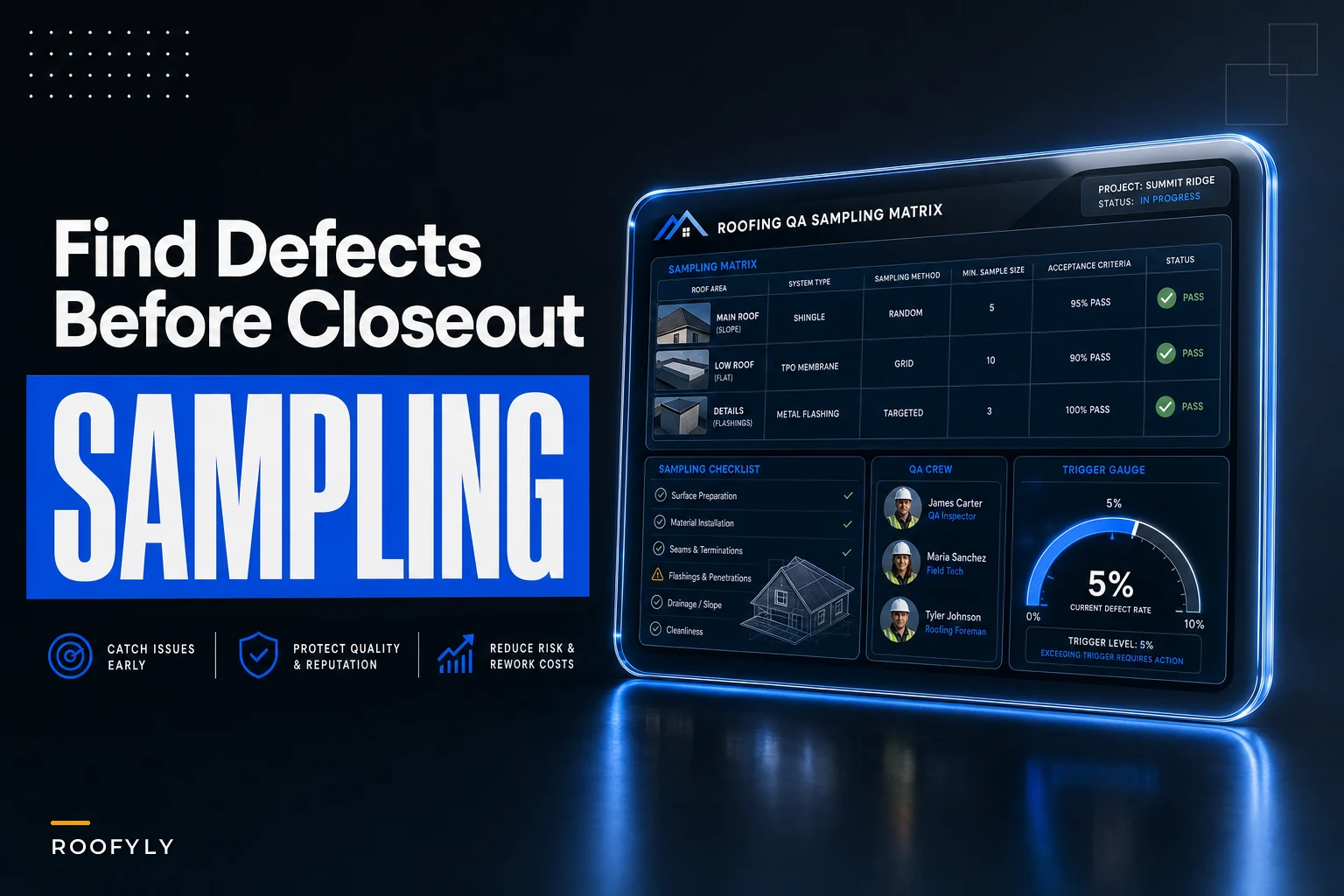
Here's a working matrix you can adapt. "Sampled items" means individual QA checkpoints pulled from your checklist (defined in the next section), not entire slopes.
| Crew size | Jobs per week (that crew) | Sampled items per job | Deep-audit frequency | Notes |
|---|---|---|---|---|
| 2–3 (small) | 1–2 | 6–8 items | 1 in 4 jobs | Small crews = one person's habit affects everything; sample penetrations heavily |
| 2–3 (small) | 3+ | 6–8 items | 1 in 3 jobs | Higher volume, raise deep-audit rate |
| 4–6 (standard) | 1–3 | 8–10 items | 1 in 3 jobs | Rotate which slope gets sampled each time |
| 4–6 (standard) | 4+ | 8–10 items | 1 in 2 jobs | Volume + more hands = more variance |
| 7+ (large / split tasks) | any | 10–14 items | every job, deep on 1 in 2 | Task specialization hides who owns a defect; sample by component, not by person |
| New/probationary crew | any | 12+ items | every job | First ~5 jobs, inspect heavily regardless of size |
Two rules make this matrix actually work in the field:
-
Rotate the location. For each sampled job, pre-assign which slope or elevation gets the deeper look, and cycle it. Front slope this job, rear slope next, then the side with the most penetrations. This is the single fix for the "driveway inspection" blind spot.
-
Weight toward penetrations and transitions. Field-of-shingle failures are rare and usually cosmetic. Leaks and callbacks live at flashings, valleys, boots, chimneys, and wall transitions. Sampled items should over-index there. If you've already built defensible measurement and labor rules around those components — the kind covered in defensible labor allowances for penetrations and flashings — that same component list becomes your QA sampling frame.
Rotate the location and weight toward the high-risk components and your sample will stop being a driveway-show and start being a signal for real problems.
What a "sampled item" actually is: the checklist
A sampled item has to be binary-ish. "Does the roof look good" is not an item. "Pipe boot: storm collar present, sealed, and shingle-lapped correctly — pass/fail" is an item. The whole point is that different inspectors reach the same answer.
Build your item pool by component. Pull your per-job sample from this pool, weighting toward the high-risk ones. A workable pool for residential asphalt:
Penetrations & flashings (sample heavily)
-
Pipe boots
correct size, storm collar sealed, shingles lapped over the flange uphill
-
Step flashing
one piece per course, no face-nailing through the vertical leg into the wall
-
Kick-out flashing present where roof meets wall above a gutter
-
Chimney
counterflashing set into a reglet or properly surface-mounted and sealed, not just caulked to brick
-
Valley
metal or woven/closed per spec, no exposed nails in the water path
Field & fastening (sample moderately)
-
Nail placement
in the nail zone, not high, not overdriven/underdriven (check 4–5 shingles in the sampled slope)
-
Course exposure consistent (no racking drift)
-
Starter course at eaves and rakes present and adhesive-forward
Edges & ventilation
-
Drip edge
eave under underlayment, rake over, properly lapped
-
Ridge vent nailing and end caps
-
Exhaust/intake balance matches what was specced
Cleanup & closeout adjacency
-
Magnet sweep completed (spot-check a strip of yard)
-
No fastener debris in gutters
Each sampled job pulls its items from this pool according to the matrix count. A deep audit isn't a longer list — it's the same items checked on more of the roof (multiple penetrations, both valleys, several slopes) plus a physical touch-test on flashings rather than a visual-only pass.
The closeout side of this is a different animal. The final homeowner-facing walkthrough has its own purpose and format — that's documented separately in the roofing final-walkthrough QA checklist. Sampling QA is the internal check that happens before you'd ever put the homeowner in front of the roof.
Escalation triggers: when a sample becomes a full inspection
Sampling is only defensible if a failed sample does something. Otherwise you're just collecting data on your own future callbacks. The rule is simple: a sample result should either close the job or open a bigger inspection. Never "note it and move on."
A clean trigger logic:
-
0 failures in the sample → job passes QA, proceed to closeout.
-
1 failure, cosmetic/field category (e.g., one slightly high nail) → fix on the spot, re-check 2 adjacent items, pass.
-
1 failure in a penetration/flashing category → escalate to a full inspection of that component across the entire roof. One bad boot means check every boot. This is the correlation rule in action.
-
2+ failures in a single job → full deep audit of the whole roof before anyone leaves, plus the crew's previous job that period gets a re-check within 48 hours.
-
Same failure type on the same crew twice in a rolling 30-day window → that's a systemic flag. It stops being a job problem and becomes a training problem (next section).
The 48-hour re-check on the previous job is the part most teams skip, and it's probably the highest-value trigger on the list. If a crew is setting step flashing wrong today, they almost certainly set it wrong yesterday. Catching it while you can still send someone back for a quick fix is far cheaper than a warranty truck roll six months later.
Linking results to retraining: the SOP that makes this worth doing
Finding defects is the easy half. The half that actually moves your callback rate down is connecting a pattern of defects to a specific corrective action for a specific person or crew — and then verifying it stuck.
This is where a lot of QA programs quietly die. Someone logs failures in a notebook, nobody aggregates them, and by the time anyone notices Crew B fails kick-out flashing constantly, it's been eight months of callbacks. Failures have to roll up, not just get recorded per-job.
-
Aggregate weekly by crew and by defect type. You're looking for the same failure category clustering on the same crew, not one-off misses.
-
Set a threshold that triggers retraining. A practical one
same defect type, same crew, 2+ times in 30 days — or any single job with 3+ failures.
-
Match the defect to a specific micro-training, not a generic "be more careful" talk. A step-flashing failure gets a 20-minute hands-on redo of a mock wall, not a lecture. Keep a short library of these tied one-to-one to your checklist categories.
-
Re-sample that crew at elevated intensity for the next 4–5 jobs (drop them back to the "new/probationary" row of the matrix temporarily).
-
Close the loop only when elevated sampling comes back clean. If the same defect reappears during that window, it's no longer a training gap — it's a tooling, spec, or supervision problem, and you escalate to the foreman, not the installer.
That last distinction matters more than it sounds. If retraining doesn't fix it, the problem was never the installer's knowledge. It's usually a rushed schedule, a foreman who doesn't check the same things, or a spec that's ambiguous in practice. Sampling data lets you tell those apart instead of defaulting to blaming the newest guy on the crew.
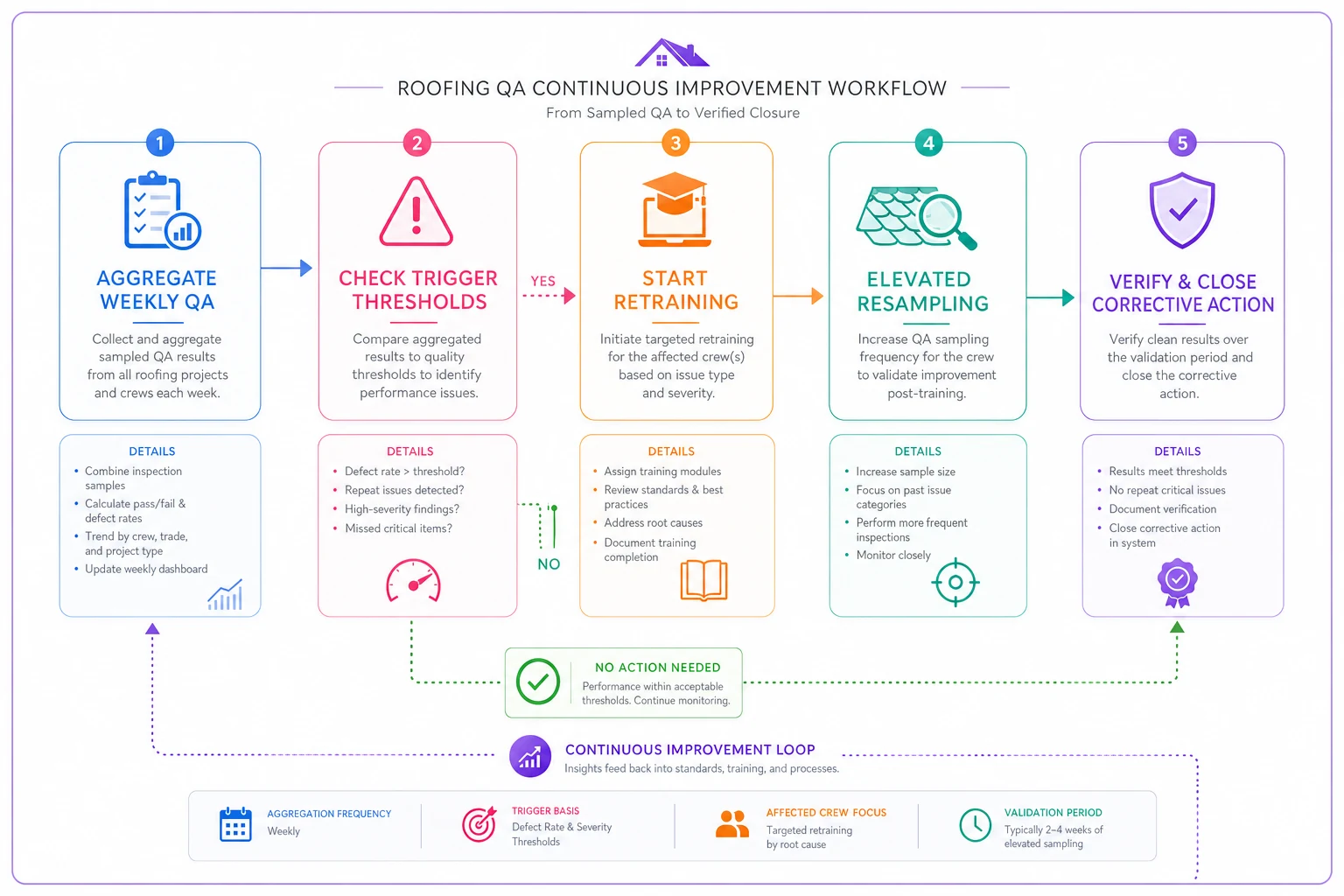
The diagram above walks through the SOP from aggregation to retraining and back to verification.
That last distinction matters more than it sounds. If retraining doesn't fix it, the problem was never the installer's knowledge. It's usually a rushed schedule, a foreman who doesn't check the same things, or a spec that's ambiguous in practice. Sampling data lets you tell those apart instead of defaulting to blaming the newest guy on the crew.
A real scenario: rear-slope penetrations on a 5-person crew
A residential reroof company running two crews was seeing a steady drip of callbacks — not a flood, somewhere around 6–8% of jobs coming back within the first season, almost all leaks around pipe boots and one recurring kick-out issue. Their "QA" was a foreman glance and the sales rep's closeout visit.
They set up sampling on the standard-crew row: 8–10 items per job, deep audit on 1 in 2 jobs, rear slope forced into rotation, penetrations weighted heavily. Within the first three weeks the data was obvious: one crew failed the kick-out flashing item on nearly half its sampled jobs, and boot sealing failures clustered on the same two installers.
The escalation triggers did the near-term work — a couple of full-roof boot inspections caught problems before closeout on jobs that would've been callbacks otherwise. The retraining loop did the durable work: a short hands-on session on kick-outs plus a spec clarification (turned out the crew genuinely didn't know kick-outs were required on that builder's detail).
Over the next couple of months, first-season callbacks on that crew dropped from the 6–8% range down to roughly 2%. The more interesting outcome was that the deep-audit rate on that crew came back down once elevated sampling stayed clean, freeing up QA time for the other crew. The sampling paid for itself by not requiring them to inspect everything forever.
When heavy sampling makes sense — and when it doesn't
When to lean into it:
-
New crews, new subs, or crews that just changed a key member
-
After any spike in callbacks or warranty claims tied to a component
-
High job volume where a single systemic habit multiplies fast
-
Complex roofs with lots of penetrations and transitions
When lighter sampling is fine:
-
A seasoned crew with a long clean sampling history — drop them to the low end of their matrix row
-
Simple, low-penetration roofs where the failure surface is small
-
Very low volume where you're realistically present on most of the work anyway
Who should skip the full matrix:
If you're a two-person shop doing a handful of jobs a month and you personally touch every roof, a formal sampling matrix is overkill. Use the checklist and the escalation triggers, skip the volume-scaling. The matrix earns its keep the moment you can't personally be on every roof — that's the real transition point where systemic defects start hiding from you.
Keeping the data honest without drowning in paperwork
The failure mode of every sampling program is that logging becomes a burden and people stop doing it accurately. Paper checklists get filled out in the truck after the fact, all passes, because the inspector already knows the roof "looked fine." At that point you're generating fiction, not QA data.
The practical fix is capturing sampled-item results at the point of inspection — ideally on a phone, with the item pre-loaded from the matrix so the inspector isn't deciding what to check on the fly, and with a photo required on any fail so the escalation is defensible. Operational software can quietly help here: it can pull the right sample count based on crew size and volume, enforce the location rotation so nobody defaults to the front slope again, and roll failures up by crew and defect type automatically so the retraining trigger fires without anyone manually tallying a notebook. The point isn't the software — it's that aggregation and escalation have to happen on their own, or they won't happen at all.
Require a photo on any failed sampled-item at the point of inspection to make escalations defensible.
You can absolutely run this on a spreadsheet and a shared photo folder if you're disciplined. Just know that the discipline is the program. The matrix, the triggers, and the retraining loop are only worth anything if results actually roll up and actually change what a crew does next week.
Bringing it together
A defensible sampling plan isn't about catching more defects for their own sake. It's about catching the systemic ones early — the crew habit, the ambiguous spec, the rushed last two hours — while a quick fix is still possible and before a homeowner is the one who finds the problem.
Key the sample to crew size and job volume so your effort lands where variance is highest. Weight it toward penetrations and transitions where failures actually hurt. Make failed samples escalate instead of just getting logged. And close the loop back to specific, targeted retraining so the same defect doesn't keep showing up under a different job number.
Do that consistently, and QA stops being a nervous walk with a homeowner at closeout and becomes something you actually trust — a small, repeatable process that tells you the truth about how your crews are building, in time to do something about it.
Do that consistently, and QA stops being a nervous walk with a homeowner at closeout and becomes something you actually trust — a small, repeatable process that tells you the truth about how your crews are building, in time to do something about it.
Ready to elevate your roofing operations?
Join hundreds of roofing contractors using Roofyly to streamline workflows, improve crew coordination, and enhance client satisfaction.