



You know what's quietly killing profitability on complex residential roofs? Labor blowouts on accessories. Not the shingle installation—most crews have that dialed in. It's the skylight that takes six hours instead of three. The chimney cricket that turns into a full rebuild. The twelve pipe boots spread across three different roof planes at varying pitches.
What typically happens: estimator counts penetrations, applies some generic labor allowance—maybe 2-3 hours per skylight, 30 minutes per vent—and sends the crew out. Then reality hits. That skylight is on a 12/12 pitch. The chimney needs step flashing up 14 feet. Those pipe boots require pulling old lead flashings first. Your 18-hour accessory budget becomes 31 hours of actual labor.
Tracking time better helps, but it's not the whole answer. You need labor tables that account for the variables actually driving installation time. Pitch matters. Access matters. Existing conditions matter. Crew configuration matters.
Why generic accessory allowances fall apart
Most roofing software gives you a dropdown: skylight = 3 hours, chimney = 4 hours, pipe boot = 0.5 hours. These numbers come from somewhere—maybe an industry manual from 1987, maybe the software developer's best guess—definitely not from tracking real installation times across varying conditions.
The problem compounds when insurance adjusters or property managers start scrutinizing line items. They see "skylight reflashing: 4 hours @ $75/hour = $300" and immediately start pushing back. Without measurable factors backing up that number, you're either arguing your way through it or eating the difference.
There's also the crew reality. A two-man team installing a skylight on an 8/12 pitch takes fundamentally different time than a three-man crew on a 4/12. One person holds, one measures and cuts, one seals—versus two people juggling all three tasks while maintaining safe footing on a steep slope. Generic allowances pretend these differences don't exist.
What really breaks the system is measurement inconsistency. One estimator measures curb-to-curb on a skylight. Another includes the entire disturbed area plus overlap. A third just counts units. When you can't agree on what you're measuring, your labor allowances become meaningless.
Building measurement rules that hold up under scrutiny
Start with skylights. The labor isn't just about the unit itself—it's about the integration zone.
Keep every roofing job on track and on time.
Roofyly helps you manage, schedule, and communicate every roofing project with precision and ease.
- Centralized project planning
- Real-time crew notifications
- Integrated scheduling & client updates
No credit card required
Skylight Labor Zone = Curb perimeter + 24 inches minimum on all sides
Why 24 inches? Because proper step flashing and cricket installation requires working area beyond the curb. For a standard 2x4 foot skylight, you're dealing with a 4x6 foot work zone minimum. That's 24 square feet of detailed work, not the 8 square feet the skylight itself covers.
For chimneys, it gets more complex:
Chimney Labor Zone = (Width + 36") x (Height from deck to top) + Cricket area if applicable
A 3-foot wide chimney extending 10 feet up from the deck isn't just 30 square feet of flashing work. With proper clearance, you're working roughly 60 square feet of vertical surface—before accounting for any cricket construction or existing material removal.
Plumbing vents follow different logic:
Pipe Boot Zone = Base diameter + 18 inches each direction
A 3-inch pipe doesn't just need a 3-inch boot. Proper installation means lifting shingles 18 inches upslope, working around the penetration, and ensuring adequate seal overlap. You're touching around 9 square feet of roof surface per pipe.
Photograph and mark the 24-inch integration zone on your roof diagram during inspection to avoid measurement disputes.
These measurement rules give you something to point to. When someone questions why a skylight takes 4.5 hours, you can show them: "46 square feet of integration zone on a 10/12 pitch with existing flashing removal." That's a conversation based on measurable work, not an arbitrary number.
Pitch multipliers that reflect installation reality
Flat commercial roofs spoil you. Everything's accessible, tools stay put, materials don't slide. Steep residential slope is a different animal.
Here's a pitch adjustment table built from tracking actual installation times across 400+ accessory installations:
| Roof Pitch | Labor Multiplier | Safety Setup Time |
|---|---|---|
| 0-3/12 | 1.0x | 5 min |
| 4-6/12 | 1.0x | 10 min |
| 7-9/12 | 1.3x | 20 min |
| 10-12/12 | 1.6x | 35 min |
| Over 12/12 | 2.0x+ | 60 min+ |
Notice the jump at 7/12. That's where most installers switch from carefully walking to definitely roping off. It's also where material handling becomes a constant fight against gravity—every repositioning trip, every sliding tool, every minute spent maintaining safe footing adds up fast.
Safety setup time is additional, not folded into the multiplier. A three-man crew on a 12/12 pitch needs an hour just for anchor points, equipment checks, and safe material staging before anyone touches the skylight.
Pitch also compounds with geometry:
-
Multiple pitch transitions around a single accessory
Add 25%
-
Accessory spanning a valley or hip
Add 40%
-
Dormers or architectural features limiting access
Add 30%
These aren't arbitrary percentages. Compare any crew working a skylight at a valley intersection versus one on a clean roof plane—the measuring, cutting, and fitting time nearly doubles.
Crew size adjustments beyond simple division
Two installers don't take half the time of one. Three don't work 50% faster than two. The relationship between crew size and productivity on detail work is more complicated than most people expect.
| Accessory Type | 1-Person | 2-Person | 3-Person | 4-Person |
|---|---|---|---|---|
| Skylight (2x4) | 6.0 hrs | 3.5 hrs | 3.0 hrs | 3.0 hrs |
| Chimney (typical) | 7.0 hrs | 4.0 hrs | 3.0 hrs | 2.8 hrs |
| Pipe boot cluster (5) | 3.0 hrs | 1.8 hrs | 1.5 hrs | 1.6 hrs |
| Ridge vent (100 LF) | 4.5 hrs | 2.5 hrs | 2.0 hrs | 2.2 hrs |
The diminishing returns are real. A fourth person on a skylight adds nothing—there's physically no room for them to contribute. On pipe boots, that fourth person actually slows things down through coordination overhead.
The sweet spot for most accessories is two or three people depending on the task. Skylights work well with three: one inside checking alignment and water-tightness, two outside handling installation. Chimneys work at two or three depending on height. Pipe boots are fastest with two working in sequence.
Experience level modifies these numbers significantly. A seasoned two-person team often outperforms a green four-person crew on detail work. The tables above assume average experience. For crews with less than six months working together, add 20%. For specialized accessory teams with two-plus years together, you can reasonably reduce by 15%.
Template language that prevents disputes
Generic estimate language invites arguments. Specific, measurable language backed by clear standards prevents them.
For skylights:
"Skylight installation/reflashing includes removal of existing materials within 24-inch perimeter, installation of new ice/water shield extending 24 inches beyond curb on all sides, step flashing installation with minimum 2-inch headlap, and cricket construction where required by manufacturer specifications. Labor calculated based on 46 square foot work zone at 10/12 pitch using standard two-person crew configuration. Total: 4.5 hours @ $75/hour = $337.50"
For chimneys:
"Chimney reflashing encompasses complete removal of existing flashings, mortar joint preparation to 1-inch depth, installation of continuous base flashing with 4-inch vertical extension, step flashing at 8-inch intervals with 2-inch headlap, and counter-flashing installation into prepared reglet. Work zone calculated as 60 square feet based on 3-foot chimney width and 10-foot deck-to-cap height. Pitch adjustment factor of 1.3x applied for 8/12 slope. Total: 5.2 hours @ $75/hour = $390.00"
For pipe penetrations:
"Pipe boot replacement includes removal of existing boot and surrounding sealants, preparation of penetration area extending 18 inches in all directions, installation of retrofittable boot with aluminum base and EPDM collar, and integration with surrounding shingles maintaining 4-inch headlap. Multiple penetration discount applied for installations within 10-foot proximity. Per penetration: 0.75 hours @ $75/hour = $56.25"
This language does three things: defines scope explicitly, provides measurable parameters, and justifies the time allowance. Insurance adjusters can verify these standards against manufacturer specs and industry guidelines. Your crews also know exactly what's expected—which matters more than people give it credit for.
Existing condition modifiers that capture hidden work
New construction labor tables don't work for replacement and repair jobs. Existing conditions add complexity that standard allowances miss entirely.
Lead-based flashings around pipes add 20-40 minutes per penetration—not from the removal itself, but from careful handling, proper disposal protocol, and surface prep afterward. A cluster of five lead boots can add close to two hours on a job that would otherwise take 90 minutes with modern boots.
Previous repairs create their own time sinks. Excessive roofing cement around a skylight typically adds an hour of scraping and cleaning before you have a proper surface for new flashing. Multiple layers of poorly integrated step flashing means complete removal back to sheathing, which tacks 30-40% onto chimney work.
Deteriorated sheathing around penetrations is the real killer. You discover it after removing old flashings, and now you're into carpentry. A soft spot around a skylight can add a couple hours for proper repair before the new installation even starts.
Practical modifier table for existing conditions:
-
Previous tar/cement application
+30% labor
-
Lead-based materials requiring RRP protocol
+40% labor
-
Multiple flashing layers
+25% labor
-
Visible wood deterioration
+2 hours minimum
-
Non-standard or modified curbs
+45% labor
The key is documenting these conditions during inspection. Photos of excessive cement, multiple flashing layers, or deteriorated wood justify the modifiers when the invoice arrives.
When standardized times don't work
Some situations break every labor table you've built. Knowing when to abandon standardized times and shift to time-and-materials pricing protects both profitability and client relationships.
Historic or architecturally significant buildings often require techniques and materials that triple normal installation time. Matching existing slate patterns around a rebuilt cricket, custom-fabricating copper flashings to match century-old profiles, or navigating preservation requirements can turn a 4-hour chimney job into a 12-hour project.
Extreme weather damage creates another category. When hail has compromised flashings but not enough for full replacement, you're in inspect-and-repair mode that defies time estimates. Each penetration needs individual assessment, partial repairs, and testing. There's no clean standard for that.
Multi-trade coordination is another one. If skylight installation requires working around an electrician for motorized units, an insulation contractor for air sealing, and an interior contractor for finish work—your efficient 3-hour installation becomes an all-day affair with multiple mobilizations.
The solution isn't building labor tables for every edge case. It's recognizing when to shift pricing models and saying so upfront. "Due to the historic nature of these flashings and requirement to match existing materials, this portion will be billed on a time-and-materials basis with photo documentation of all work performed." That conversation is much easier before the job than after.
Connecting labor tracking to continuous improvement
Labor allowances shouldn't be static. Every job generates data that can refine your tables, but most companies never close that feedback loop. The gap between estimated and actual hours stays buried in timesheets nobody ever analyzes.
The fix starts with simple categorization on timesheets. Instead of "worked on Smith job," you need "Skylight installation - 2x4 Velux on 10/12 pitch - 2-person crew - 4.25 hours." Takes 30 extra seconds, but gives you the data to validate or adjust your allowances over time.
After 20-30 installations of each accessory type, patterns start showing up. Maybe your 2-person crew consistently beats the standard time on pipe boots but struggles with skylights. That's not necessarily a performance issue—it might mean your allowances need adjustment or your training needs focus. Either way, you won't know without the data.
The labor-hour tracking methods covered previously work well for accessory-specific refinement. The difference is categorizing by accessory type and conditions rather than general roofing tasks.
A monthly review of accessory labor performance takes maybe 30 minutes but prevents systematic estimate errors. A useful starting framework:
-
Pull estimated vs. actual hours by accessory category
-
Flag any category running more than 15% over consistently
-
Check whether overruns cluster around specific pitch ranges or crew configurations
-
Adjust allowances or training based on what the pattern actually shows
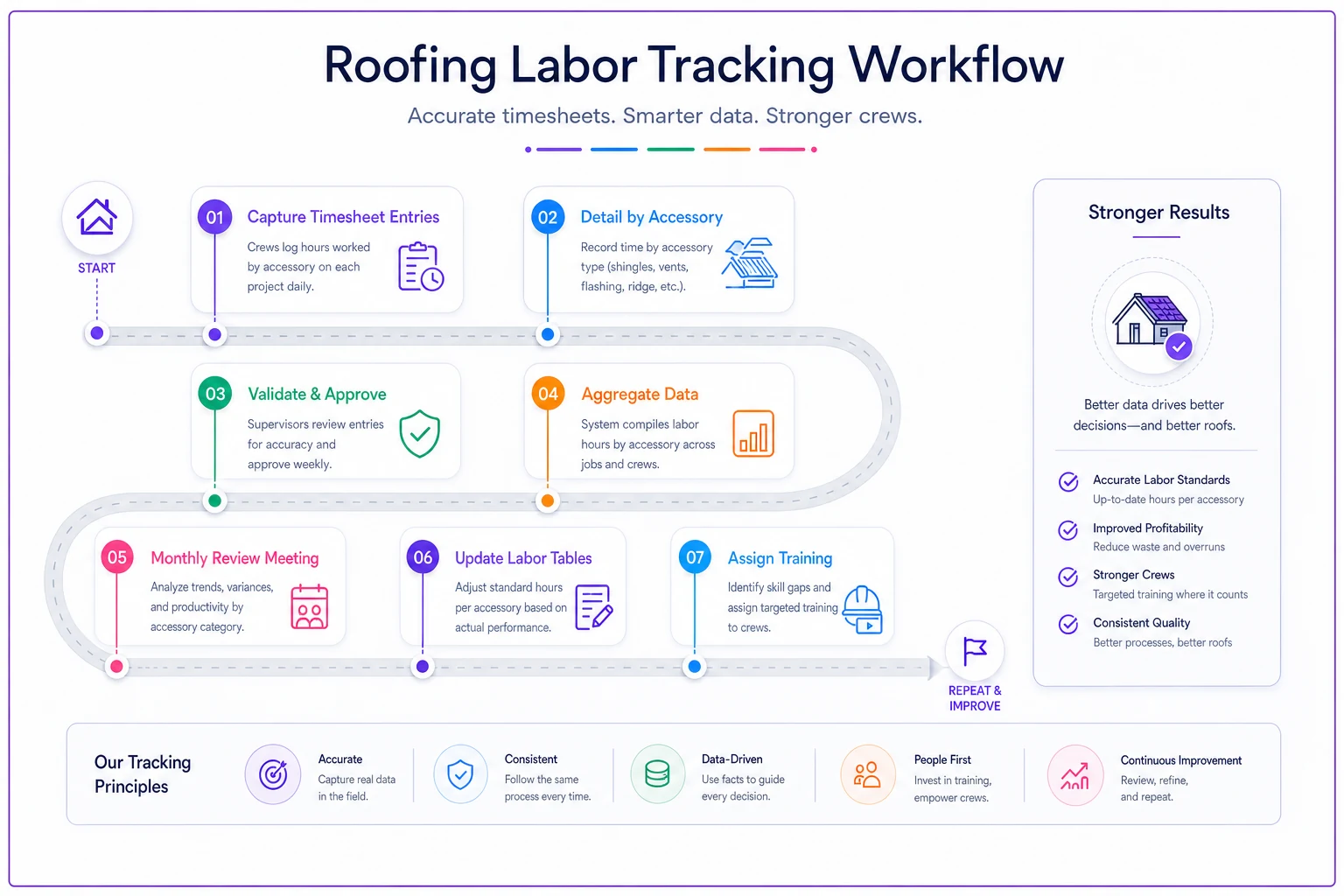
The diagram shows the simple cycle from detailed timesheets to analysis to updated allowances and training.
After six months of this, your labor allowances become genuinely defensible because they're based on your actual performance data—not industry averages from a manual nobody can find.
Software that codifies your labor standards
Standardizing labor allowances only works if estimators actually apply them consistently. Spreadsheets get modified, printed tables get ignored, and verbal standards get interpreted differently by each person doing the estimating.
Operational software can embed your labor tables directly into the estimating workflow. When an estimator enters a skylight, the system automatically prompts for required measurements, calculates the labor zone based on your measurement rules, applies pitch and crew size adjustments, and generates estimate language with all parameters included. The estimator can still override for special circumstances—but they have to document why.
The real value comes from accumulated performance data. As crews complete work, actual hours feed back into the system, categorized by accessory type, pitch, crew size, and existing conditions. Over time, your allowances get more accurate because they're grounded in your company's actual patterns, not generic benchmarks.
AI automation within these platforms can surface patterns that are easy to miss manually—like whether 3-person crews consistently outperform 2-person crews on chimneys above 8/12 pitch, or whether morning installations average faster than afternoon ones. Those insights let you optimize crew assignments beyond just improving estimate accuracy.
The goal isn't perfection. It's defendable consistency. When every estimate uses the same measurement rules, applies the same modifiers, and includes the same detailed language, you can stand behind your numbers with actual confidence.
Making labor allowances stick
Building solid labor tables is maybe 30% of the solution. Getting crews and estimators to actually use them consistently is where most companies fall short.
Start with estimators. They need to understand not just what the allowances are, but why they're structured that way. Spend an afternoon reviewing actual job photos showing why a skylight at a valley takes longer than one on a clean slope. Show timesheets from similar jobs at different pitch conditions. Make the multipliers feel real, not theoretical.
Crews need different framing. They're not thinking about estimate accuracy—they're trying to beat the clock. Show them how the allowances translate to daily goals. "This chimney is calculated at 4 hours for a 2-person crew on an 8/12. Here's the efficient sequence, here's where teams usually lose time."
Build accountability both ways. If an estimator consistently underestimates certain accessories, that's a training issue. If a crew consistently exceeds reasonable allowances, that's either a performance issue or your standards need recalibration. Monthly variance reports comparing estimated to actual by category make those patterns visible before they become expensive habits.
The most practical implementation approach: pick one accessory category and nail it before moving to the next. Start with pipe boots—they're simple, frequent, and easy to track. Get everyone using the same measurement rules, allowances, and estimate language for pipes. Once that's solid, add skylights. Then chimneys. Building consistency incrementally beats overwhelming everyone with a complete standards overhaul.
Labor allowances aren't about constraining crews or making estimates rigid. They're about creating predictable operations where everyone's working from the same playbook. When an estimator prices a job and a crew executes it using the same standards, you eliminate the most common source of project losses: the gap between what was sold and what actually gets delivered.
Ready to elevate your roofing operations?
Join hundreds of roofing contractors using Roofyly to streamline workflows, improve crew coordination, and enhance client satisfaction.