

Most roofing companies don't fail at new processes because the process is bad. They fail because they roll it out to every crew on Monday, nobody measured anything, and by Friday half the foremen have quietly gone back to doing it their own way. Three weeks later the owner says "that new system didn't work" — but the truth is it was never tested. It was just announced.
Operational change management in roofing lives or dies on one thing: whether you can run a small, controlled version of the change, prove it moved a number you actually care about, and then expand it in a way that survives contact with real jobsites. That's what a pilot-to-scale playbook does. Not a memo. Not a kickoff meeting. A sequence with gates, measurements, and a clear rule for when you back out.
This is the part most contractors skip, and it's why their software, their photo standards, their new QA checklists, and their comp changes all end up half-adopted.
Why most roofing rollouts quietly die
The pattern is almost always the same. Someone — usually the owner or a GM who just came back from a conference — decides the company needs a new closeout photo standard, or a new routing tool, or a stricter material acceptance process. The intention is good. The execution is a company-wide email and a 20-minute Friday meeting.
-
No baseline. Nobody wrote down what the current callback rate, re-measure rate, or closeout time actually was. So when someone asks "is this working?" there's no answer, just vibes.
-
Too many crews at once. You changed the workflow for six crews simultaneously, so when problems show up you can't tell if it's the process, the training, a specific foreman, or just a bad week of weather.
-
No rollback rule. When friction hits, there's no agreed-upon "if X happens, we pause and fix it." So the change either limps along broken or gets abandoned entirely.
The deeper issue is that roofing is a coordination business. A single change touches sales handoffs, the estimator, procurement, the foreman, the crew, QA, and billing. Flip one gear and you feel it three departments down. A new photo standard sounds like a field thing, but it changes what the office can invoice against and what the warranty team can defend later. That's exactly why you can't test it everywhere at once — you can't isolate what you broke.
The companies who scale changes successfully treat every rollout like a small experiment with a kill switch, not a decree.
The shape of a good pilot
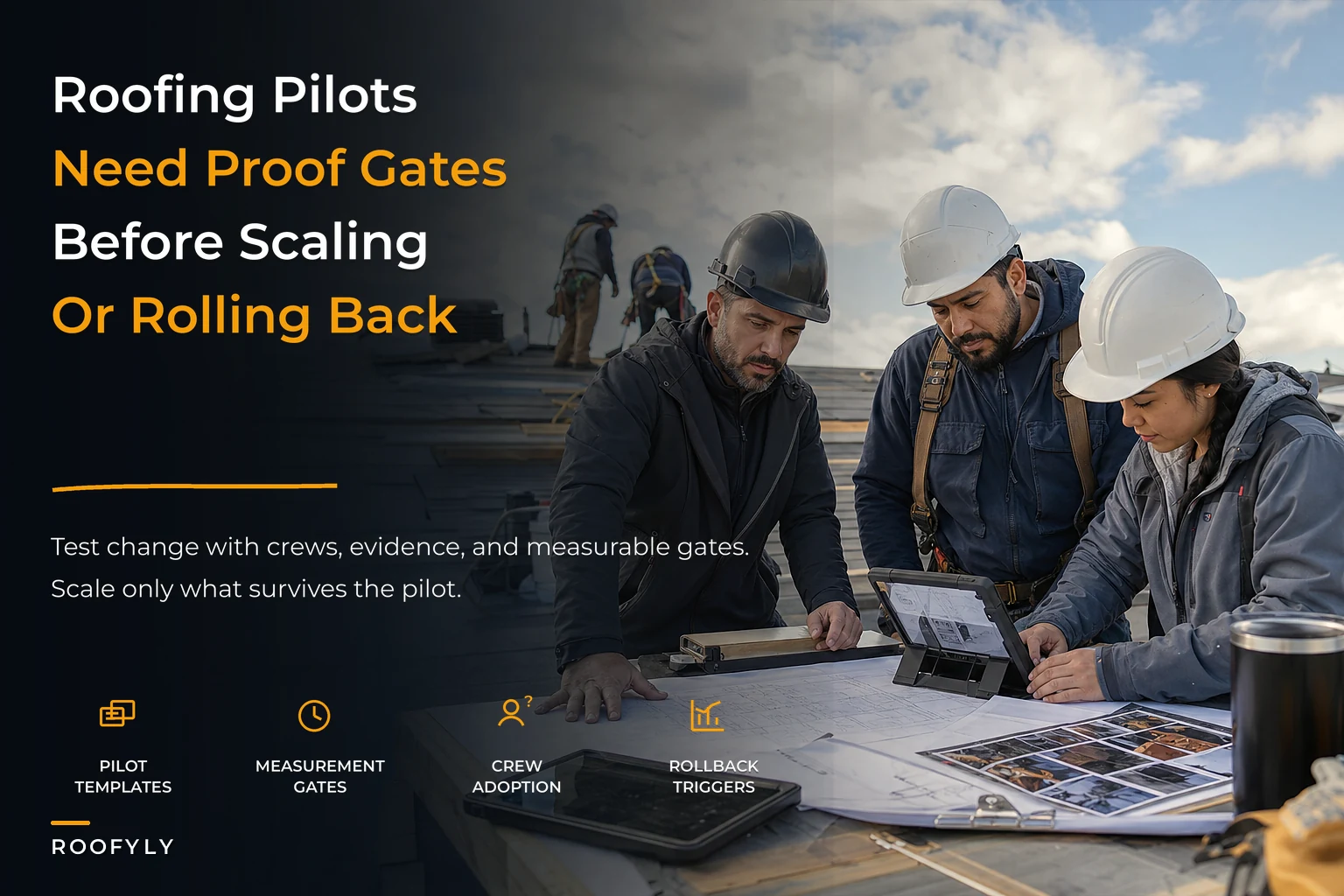
A pilot isn't "let's try it and see." A pilot is a bounded test with four fixed parts decided before you start:
Keep every roofing job on track and on time.
Roofyly helps you manage, schedule, and communicate every roofing project with precision and ease.
- Centralized project planning
- Real-time crew notifications
- Integrated scheduling & client updates
No credit card required
-
Scope — exactly which crew(s), which job types, how many jobs, over what window.
-
The metric gate — the specific number that tells you it worked, and the threshold it has to hit.
-
The evidence — what artifacts prove the process actually happened (not just that people say it did).
-
The rollback rule — the condition that forces you to pause or revert.
Here's a concrete example of scoping a pilot for a new material delivery acceptance process:
-
Scope One crew, residential reroofs only, next 8 jobs or 3 weeks (whichever comes first).
-
Gate Material discrepancies caught at delivery instead of mid-tear-off go from roughly 1-in-4 jobs to under 1-in-10.
-
Evidence Timestamped delivery photos + a signed acceptance line per job.
-
Rollback If the process adds more than ~15 minutes to delivery handling per job and catches nothing new across the first 3 jobs, pause and redesign.
Notice how small that is. One crew. Eight jobs. A single number. You're not trying to transform the company — you're trying to generate trustworthy evidence that this change does what you think it does, under real conditions, with a real foreman who has real opinions about it.
Pick the right pilot crew (this matters more than the process)
The instinct is to run your pilot on your best crew because they'll execute cleanly. That's a trap. Your best foreman will make almost any process look good, which tells you nothing about whether it survives with an average crew.
The better choice is a solid, middle-of-the-road crew with a foreman who'll actually tell you when something's annoying. You want honest friction, not polished compliance. If the process works for your median crew, it'll scale. If it only works for your star, you've proven nothing.
| Crew type | Good pilot choice? | Why |
|---|---|---|
| Top performer | No | Makes everything look good; hides real friction |
| Solid median crew | Yes | Honest signal, representative, good internal advocate |
| Struggling crew | No | Too many confounding variables; can't isolate the change |
| Brand-new foreman | No | You'll measure their inexperience, not the process |
Picking the wrong crew is one of those mistakes that doesn't show up until you're three waves into a rollout and wondering why it's falling apart.
Measurement gates: the number has to come first
The single most common mistake is picking the metric after the pilot. You run the thing, it feels better, and then you reverse-engineer a stat to justify it. That's not measurement, that's rationalization.
Before the pilot starts, you write down the baseline. If you're piloting a tighter closeout QA process, you need to know your current callback rate on comparable jobs. Not estimated — pulled from actual job history. "We think it's around 12%" isn't a baseline. "Across the last 40 reroofs this crew ran, 7 had callbacks within 90 days" is a baseline.
A workable gate has three components:
-
The metric (callback rate, re-measure rate, change-order cycle time, delivery discrepancy rate, days-to-invoice).
-
The threshold (what counts as success — usually a meaningful move, not perfection).
-
The window (how many jobs or how many weeks before you judge it).
Tie these gates into the metrics you already track so the pilot isn't a one-off science project. If you've built a rules-based metrics framework that turns field data into decisions, your pilot gate should plug straight into that system — same definitions, same owner, same reporting cadence. A pilot that invents brand-new metrics nobody else uses dies the day the pilot ends, because nothing in the business keeps measuring it.
One more thing on thresholds: don't demand a huge swing. If a new process moves your delivery discrepancy rate from 25% to 12%, that's worth scaling even if it's not zero. Setting the bar too high kills changes that were actually working.
Evidence artifacts: proof the process actually happened
This is where roofing pilots fall apart in a way most industries don't deal with. Your process happens on a roof, 30 feet up, with no manager watching. So "did the crew follow the new process?" is genuinely hard to answer unless you built proof into the process itself.
That's what evidence artifacts are for. They're the byproducts that only exist if the step was done:
-
Photo bundles — a defined set of shots per stage (pre-tear-off, decking, underlayment, flashing details, final). If the bundle's incomplete, the step wasn't done, full stop.
-
QA gate sign-offs — a timestamped check at the transition point between stages, not a retroactive checklist filled out in the truck.
-
Acceptance lines — delivery accepted, estimate-to-production handoff accepted, closeout accepted.
Design evidence artifacts to be useful to the business permanently, not just for judging the pilot.
Your evidence artifacts should do double duty. They prove the pilot process ran and they're useful to the business permanently. A photo bundle protects you on warranty claims and supplements. A QA gate catches defects before closeout. If your evidence is only useful for judging the pilot, you've created busywork. If it's useful forever, crews will keep doing it after the pilot ends because it saves them grief.
A typical failure looks like this: a company pilots a new process, declares success based on the foreman's verbal report, scales it — and discovers six months later that nobody's actually been generating the photos. There was never an artifact proving the step happened, so it silently decayed. Evidence isn't bureaucracy. It's the thing that keeps a scaled process from rotting.
The longer-term benefit is that these artifacts start building an operational history across jobs. Over time that history is what lets you spot whether a process is holding, degrading, or was never really adopted in the first place.
Crew adoption scripts: how you talk about the change
This part gets ignored and it's probably the highest-leverage piece. How the change is introduced to the crew determines whether you get real adoption or malicious compliance.
Bad version: "Corporate wants us to do photos differently now, so just do it." That framing tells the crew it's someone else's priority, there's no reason behind it, and nobody will check. You've basically pre-announced that it's optional.
Better version frames three things: why it exists, what's in it for the crew, and what happens next.
> "Quick thing on this job. We're testing a tighter photo set at closeout — it's five extra shots, takes maybe four minutes. Reason is we got burned on two callbacks last quarter where we couldn't prove the flashing was done right and we ate the cost. This protects us. We're trying it on our crew first for the next few weeks, and if it's a pain or it's dumb, I'm telling the office and we change it. So if something about it sucks, tell me."
That does a lot of work. It's honest, it's time-bounded, it gives a real reason, it signals that feedback is wanted, and it positions the crew as the testers rather than the enforced. Crews adopt things they helped shape and resist things done to them.
This is also where your onboarding structure matters. If you've invested in developing foremen through structured 90/180-day onboarding, those foremen are the ones who can actually carry a new process to their crews credibly. A green foreman can't sell a change — he's still establishing himself. An established one can.
The rollback rule nobody writes down
Every pilot needs a documented condition under which you stop. Not "if it feels bad" — a specific trigger.
Rollback triggers usually fall into three buckets:
-
Safety regression — the change introduces any new hazard. Instant rollback, no debate.
-
Hard cost or time blowout — the process adds significant time per job without delivering the metric. (Define "significant" up front — e.g., more than 20 minutes per job.)
-
Metric failure at the gate — the window closes and the number didn't move.
The reason you write this down beforehand is that in the moment, sunk cost takes over. You've invested effort, the foreman's finally used to it, and reverting feels like admitting failure. A pre-written rollback rule removes the emotion. The condition either hit or it didn't.
There's a middle option too, and it's usually the right one: pause and redesign rather than full revert. If the process is directionally right but clunky, you don't scrap it — you fix the specific friction the pilot exposed and run a second short pilot. Most good processes take two cycles before they're ready to scale. Expecting version one to be perfect is how you throw away ideas that just needed tuning.
Scaling: the stage after the pilot is where people get cocky
A successful pilot creates a dangerous confidence. "It worked on crew A, let's roll it to all eight crews next week." That's the exact move that kills it.
-
Pilot crew (proof it works at all) → 1 crew, tight measurement.
-
Expansion wave (proof it works beyond your pilot foreman) → 2–3 crews, including one weaker one, keep measuring the same gate.
-
Full rollout (proof it holds under volume and variation) → everyone, with measurement shifting from "does it work" to "is adoption holding."
-
Standardization → the process becomes the default SOP, baked into onboarding so new hires learn it as the only way, not the new way.
Here's a simple workflow to follow when expanding a pilot.
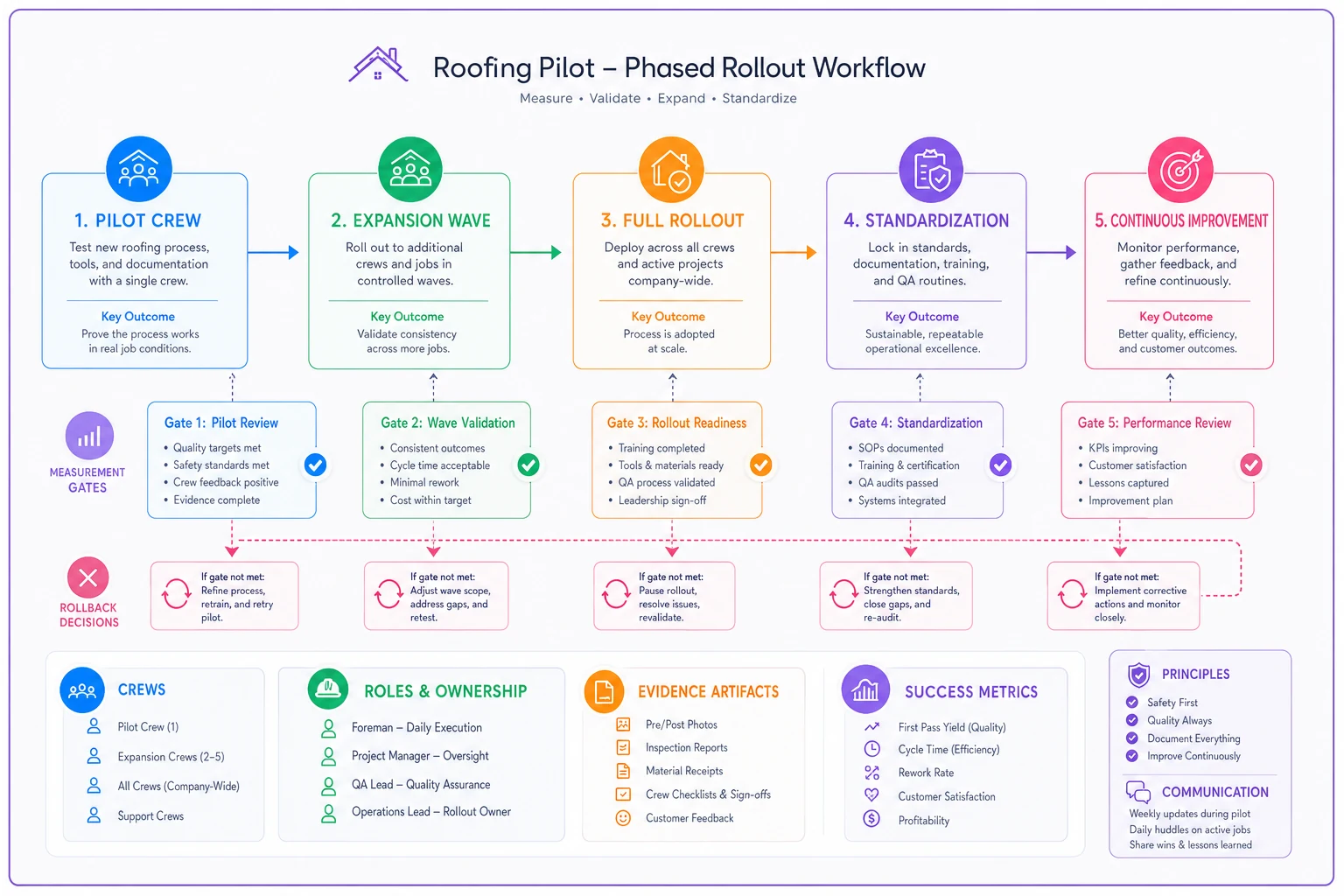
What changes between stages is what you're measuring. Stage one measures effectiveness. Stage two measures transferability — does it survive a different foreman. Stage three measures adoption decay — are crews still generating the evidence artifacts, or has it started slipping. Each stage answers a different question, and skipping stage two is the most common error. A process that works for the foreman who helped build it is not the same as a process that works company-wide.
One coordination point people miss: when you scale an operational change, you often have to adjust how crews are paid or evaluated, or the change competes with their existing incentives. If your new QA gate slows a crew down but they're still paid purely on speed, you've built a conflict into the system. Aligning the change with your compensation framework tied to field metrics is often the difference between a process that sticks and one that erodes the moment the owner stops watching.
A real scenario
A mid-size residential roofing company — around five crews, roughly 300–350 reroofs a year — kept eating callbacks on flashing and penetration details. Their callback rate on comparable jobs was sitting somewhere around 11–13%, and each callback was costing them a half-day crew trip plus material, call it a few hundred dollars a pop plus the reputational hit.
Instead of mandating a new QA process across all crews, they piloted. One median crew, residential reroofs, next 10 jobs. Baseline pulled from that crew's actual history: 4 callbacks in their last 35 jobs. The new process was a stage-gate photo bundle at flashing completion plus a foreman sign-off before moving on. Rollback rule: if it added more than ~15 minutes per job and caught nothing, pause.
Over the 10 pilot jobs, the foreman flagged two flashing issues before closeout that would've become callbacks. Zero callbacks came back on those jobs in the following months. The process added about 10 minutes per job. The foreman's feedback — "the sign-off part felt like busywork until I actually caught something" — got baked into the adoption script for the next wave.
They expanded to three crews, held the gate, then went company-wide over about a quarter. Callback rate across all crews settled into the 5–7% range over the following two seasons. Not zero. But cutting callbacks roughly in half on 300-plus jobs a year added up fast, and the crews stopped treating the photo bundle as office nonsense because it had visibly saved them from redo trips.
The thing that made it work wasn't the checklist. Plenty of companies have that checklist. It was that they proved it on one crew, fixed the friction before scaling, and had a rollback rule that gave everyone permission to be honest about what wasn't working.
When this makes sense — and when it doesn't
Run a phased pilot when:
-
The change touches field execution and you can't directly supervise it.
-
It affects coordination between departments (sales→estimate→production→billing).
-
You've tried to roll something out before and it quietly died.
-
The change has a measurable outcome you already track or can baseline.
Skip the formal pilot when:
-
It's a genuinely trivial change (new photo naming convention with no workflow impact — just announce it clearly).
-
It's a safety or legal requirement that's non-negotiable regardless of the metric. You still train and verify, but you don't "pilot" whether to comply.
-
The change is urgent enough that a storm or season won't wait for a 3-week window — though even then, a fast 3-job test beats a blind company-wide flip.
Who should NOT do this: a company with no baseline data at all. If you can't pull your current callback rate, re-measure rate, or cycle times from somewhere, fix your data capture first. A pilot without a baseline is theater — you'll end up judging the change on feelings, which is exactly the problem you were trying to escape.
Where the system holds together
The reason phased rollouts work isn't the templates. It's that they force every operational change to connect back to a number, an owner, and an artifact. A change that can't be measured, can't be proven to have happened, and can't be rolled back isn't a change — it's a hope.
Roofing runs on handoffs, and every new process is really a change to a handoff somewhere in the chain. Treating each one as a scoped experiment with gates and a kill switch is what lets you keep improving without the constant whiplash of "new system this month, abandoned by next." The companies that scale cleanly aren't the ones with the most processes. They're the ones who got good at testing small, measuring honestly, and expanding only what actually earned it.
Start with one crew. Pick one number. Write down the rule for when you'd stop. Everything else is just discipline from there.
Ready to elevate your roofing operations?
Join hundreds of roofing contractors using Roofyly to streamline workflows, improve crew coordination, and enhance client satisfaction.