

Most roofing cancellations don't happen because the price was wrong. They happen in the gap between the day someone signs and the day the crew shows up — that stretch of five to fifteen days where the homeowner hears nothing, starts second-guessing, and either calls a competitor for a "quick comparison" or just goes cold.
Callbacks are the same story, just flipped in time. They rarely come from bad workmanship. They come from a homeowner who was never told the attic would smell like tar for a day, that the tarp would stay up overnight, or that finding a few nails in the driveway is normal and gets swept — not a sign the crew was careless.
Both of these are communication failures wearing operational costumes. And the reason they're so hard to fix is that communication in most roofing companies isn't really a system — it's a set of personal habits scattered across a salesperson's phone, a coordinator's inbox, and whatever the foreman remembers to mention when he pulls into the driveway.
The handoff nobody owns
Walk the timeline of a typical residential reroof and count how many times the "owner" of the homeowner relationship changes.
The salesperson builds the trust. They sit at the kitchen table, handle the objections, and close. Then the file moves to a coordinator or office manager who schedules the job, orders material, pulls permits. Then it moves to a foreman who runs tear-off and install. Then weeks or months later, it moves to whoever handles warranty when the homeowner calls about a drip near the chimney.
Four owners. Three handoffs. Context leaks at every one.
The salesperson promised the crew would "be careful about the rose bushes on the east side." That note lived in a text thread. The coordinator never saw it. The foreman parked the dump trailer right on top of them. Now you've got an angry homeowner on day one of a two-day job, and the roof hasn't even come off yet.
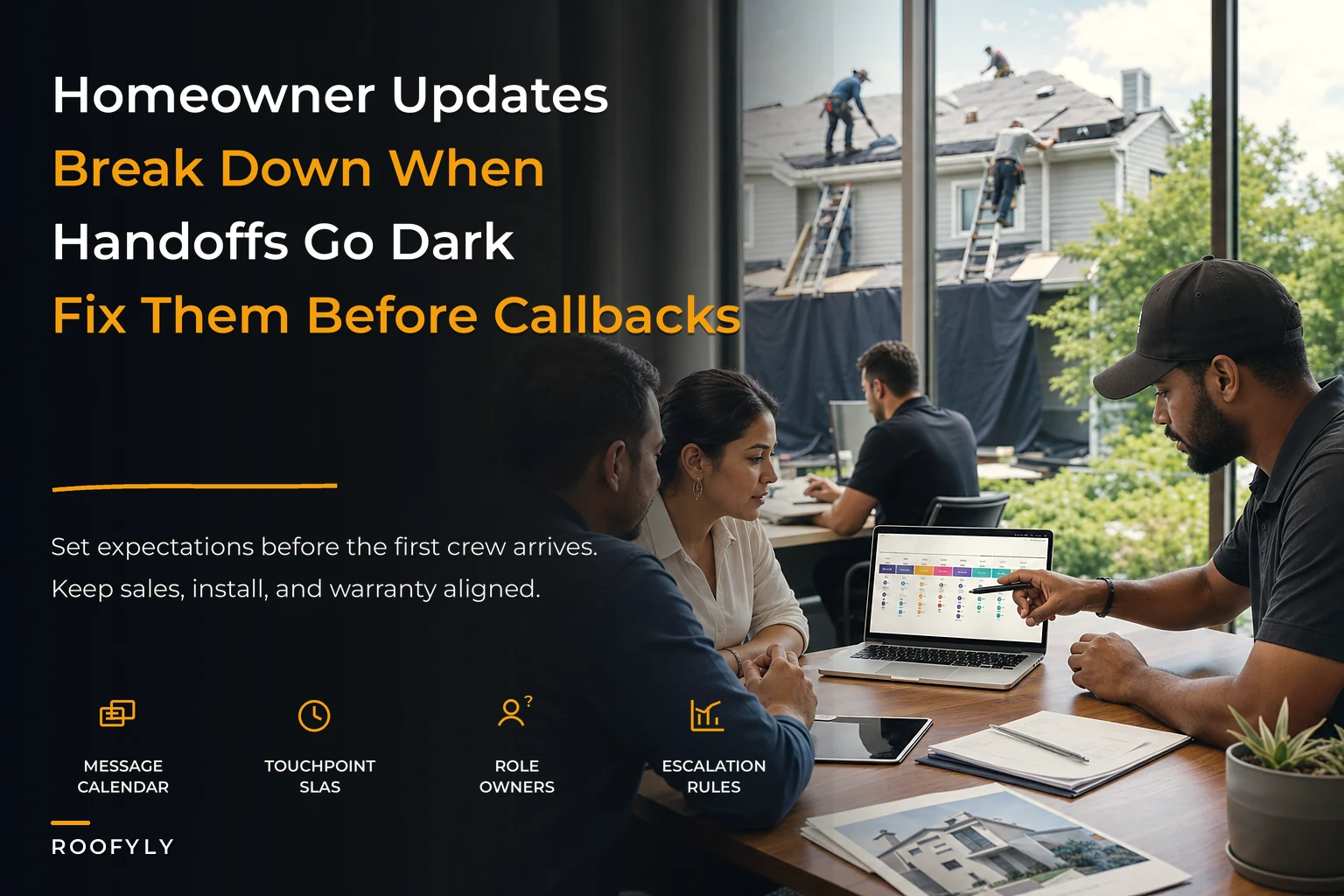
This is the core problem: the homeowner experiences one continuous relationship with your company, but internally that relationship is a relay race where the baton keeps getting dropped. A real homeowner communication system exists to carry context across those handoffs so the homeowner never feels the seams.
Why the silence between sign and start costs you deals
The most expensive silence in the whole process is the one right after the contract is signed.
Keep every roofing job on track and on time.
Roofyly helps you manage, schedule, and communicate every roofing project with precision and ease.
- Centralized project planning
- Real-time crew notifications
- Integrated scheduling & client updates
No credit card required
Think about where the homeowner's head is at. They just committed to spending fifteen, twenty, thirty grand on something they can't see being built. They're a little nervous. They told their spouse it was the right call. And then — nothing. No confirmation the material was ordered. No install date. No name of who's showing up. Just quiet.
In that quiet, doubt grows. A neighbor mentions they got a lower quote somewhere else. A relative asks if they "checked around." By the time your coordinator calls three days later to schedule, the homeowner is already halfway out the door mentally.
What we've seen across a lot of these operations is that cancellation rates spike hardest in that first 72-hour window. The companies that keep cancellations low aren't doing anything complicated — they're just filling the silence with structured, expected touchpoints. A same-day thank-you. A next-day "here's what happens next." A material-ordered confirmation. The homeowner doesn't spiral because they're never left alone long enough to invent a reason to doubt.
Send a same-day thank-you and a next-day "here's what happens next" message to close the 72-hour gap.
The mistake is treating post-sale communication as reactive — you reach out when there's something to report. The fix is treating it like a calendar. Messages go out on a schedule whether or not there's "news," because the message is the reassurance.
Mapping the message calendar to real touchpoints
A message calendar isn't a list of emails. It's a map that pins specific communications to specific operational moments, with a clear trigger, a clear owner, and a clear deadline.
Here's the backbone most reroofs can run on:
| Stage | Trigger | Message | Owner | SLA (send within) |
|---|---|---|---|---|
| Signed | Contract executed | Thank-you + what happens next | Sales | Same day |
| Pre-schedule | Material ordered | "Your order is placed" + rough date window | Coordinator | 1 business day |
| Scheduled | Install date locked | Confirmed date, crew lead name, prep checklist | Coordinator | Same day as booking |
| T-minus 2 days | 48 hrs before install | Full homeowner-prep script (noise, tarp, cars, pets) | Coordinator | By 5pm, 2 days out |
| Morning of | Crew en route | "We're on the way" + foreman contact | Foreman/dispatch | Before arrival |
| Mid-tear-off | Deck exposed | Status + any surprises found | Foreman | Real-time on discovery |
| Install complete | Final walk done | Closeout summary + warranty registration | Foreman/office | Same day |
| Warranty active | Job closed | Warranty terms, what's covered, how to file | Office | Within 3 days |
| 30-day check | 30 days post-install | "How's everything holding up?" | Office | Day 30 ± 2 |
The SLA column is the part that matters most. A message calendar without deadlines is just a suggestion. "Send a prep message before install" gets skipped when things get busy. "Send the prep script by 5pm two days out" either happened or it visibly didn't — there's no gray area. That's the difference between a system and a good intention.
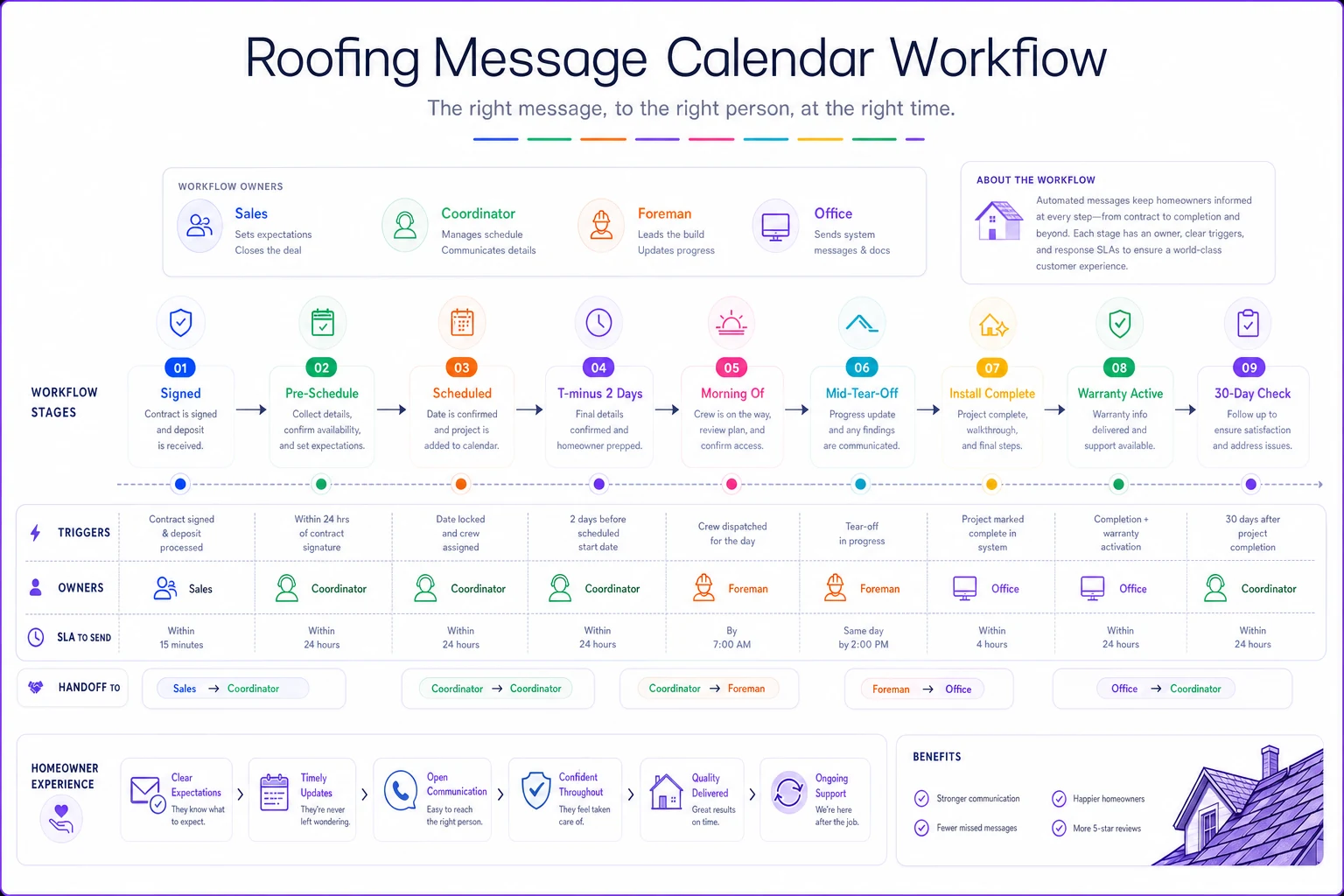
Also worth noting: this ties directly into your existing closeout and warranty flow. If you've already built out acceptance gates for the permit-to-warranty lifecycle, the message calendar is just the homeowner-facing layer sitting on top of the same milestones. You're not inventing new stages — you're adding a communication trigger to stages you already track.
Homeowner education is a callback-prevention tool
The majority of "was something wrong?" callbacks are actually education gaps, not workmanship issues.
A homeowner who was never told what tear-off sounds like will call at 8:15am convinced the crew is destroying the house. One who wasn't warned the tarp stays up overnight during a two-day job will assume the roof got left open to weather. One who didn't know about nail cleanup will find one in the yard a week later and decide the whole job was sloppy.
None of these are real defects. They're expectation problems. And every single one is preventable with a templated prep message sent before the moment it addresses.
The templated homeowner-prep script should cover, in plain language:
-
- Noise and timing — "Tear-off is loud. It usually runs from about 7:30am to early afternoon. Prep any pets or work-from-home calls accordingly."
-
- The tarp — "On multi-day jobs, we tarp and secure the roof each evening. You may see it overnight — that's normal and your home is protected."
-
- Debris and nails — "We run magnetic sweeps of the driveway and yard, but if you spot a stray nail after we leave, let us know and we'll come get it."
-
- Cars and access — "Please move vehicles out of the driveway by 7am so the crew has dump and material access."
-
- Landscaping and windows — "We cover shrubs and plants near the work zone. Close windows to keep dust out; the attic may smell like asphalt for a day or two."
-
- Kids and the work zone — "Please keep children and pets inside during active work hours."
Send it 48 hours out, not the morning of. The homeowner needs time to move cars and warn the household. A prep message that lands at 6:45am the morning of tear-off is worse than useless — now they're scrambling and annoyed before the crew even gets there.
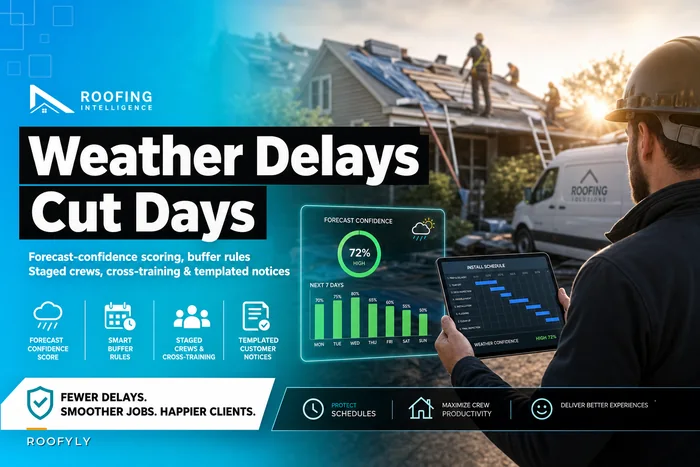
The tarp and weather piece connects to how you handle install timing overall. If your schedule is already built around forecast-confidence rules and buffers, the prep script should reflect the honest possibility of a weather pause. Telling a homeowner up front that "if the forecast turns, we may split this across days to keep your deck protected" is a lot better than scrambling to explain a delay after they've already gotten anxious.
Acceptance checkpoints: getting the homeowner to say "yes, this is good"
The quiet killer of warranty disputes months later is that nobody ever got the homeowner to explicitly agree the work was acceptable at the moments that mattered.
Acceptance checkpoints fix that. They're specific points where you stop and get a documented confirmation from the homeowner before moving on. Not a legal ceremony — just a clear, recorded "yes."
Three checkpoints carry most of the weight:
-
1. Pre-install acceptance — Before the first shingle comes off, the homeowner confirms the scope: colors, sections, extras like ridge vent or skylights. This catches the "I thought you were also doing the garage" conversation before the crew is halfway through the job.
-
2. Discovery acceptance — When the deck is exposed and something unexpected shows up — rot, bad decking, an old layer nobody knew about — the homeowner accepts the change and the cost before you proceed. This is where a fast, documented approval loop saves you from eating the repair or fighting about it later.
-
3. Final walkthrough acceptance — The homeowner walks the job with the foreman, confirms the cleanup, and signs off. This is your strongest defense against a callback that's really just buyer's remorse.
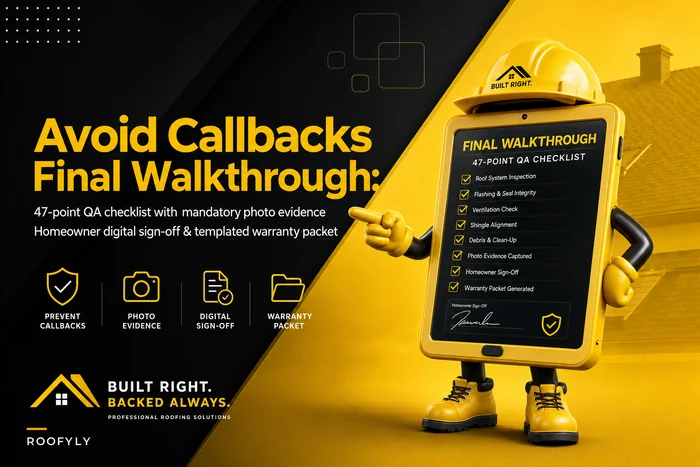
That last step is worth building out properly. A structured final-walkthrough QA checklist with a templated closeout packet turns a vague "looks good, thanks" into a documented acceptance you can pull up if a dispute surfaces later. The homeowner who explicitly accepted the finished roof — on camera or in a signed digital form — almost never becomes a warranty problem three months down the road.
Escalation rules: what happens when a homeowner goes quiet or gets upset
A message calendar tells you what to send. Escalation rules tell you what to do when the normal flow breaks.
Two situations need pre-defined rules:
The homeowner goes silent. If the pre-install acceptance message gets no response within 24 hours, that's not "no news is good news" — that's a risk flag. Someone should call, not text again. The silent homeowner is often the one quietly shopping around or having second thoughts. A rule that says "no response in 24 hours → phone call from the coordinator" catches drift before it becomes a cancellation.
The homeowner gets upset. Something goes sideways — a plant got crushed, the crew ran late, a discovery cost more than expected. The foreman shouldn't be improvising the response. A clear escalation rule says: acknowledge on-site immediately, log it, and if it involves money or a threat to cancel, it goes to the project manager or owner the same day. The worst outcomes happen when a foreman tries to smooth over a problem he doesn't have authority to fix, while the homeowner's frustration compounds in the background.
The pattern to avoid is letting escalation depend on whoever happens to notice. A homeowner emails the office upset, the office assumes the salesperson is handling it, the salesperson assumes the foreman mentioned it, and three days later nobody has called back. A fixable irritation is now a one-star review. Escalation rules exist to make sure a problem always has exactly one owner and a clock attached to it.
A real scenario
A mid-sized residential roofer running three to four crews was closing well but bleeding at both ends — cancellations after signing and callbacks after install.
Before making changes: roughly 8–10% of signed jobs cancelled before the crew ever showed up, and around one in six installs generated a homeowner callback within the first month. Most of those callbacks were nails, tarp confusion, or "I didn't know it would be this loud" — not actual defects.
They didn't hire anyone new. They built a message calendar with hard SLAs, a templated 48-hour prep script, three acceptance checkpoints, and simple escalation rules for silence and upset homeowners.
Over the following few months, post-sign cancellations dropped into the 4–5% range — mostly because the 72-hour silence disappeared. Callbacks fell noticeably too; the education-driven ones nearly vanished because homeowners now knew what to expect. The foreman stopped spending the first hour of every job managing anxiety. The office stopped fielding "is something wrong?" calls that were really just uninformed panic.
The interesting part: none of it required better roofing. It required the homeowner to feel informed and heard at the points where they were previously left guessing.
When this system is worth building — and when it's overkill
This makes the most sense once you're running more than one crew and the person who sold the job is no longer the person standing on the roof. That's the moment context starts leaking at handoffs, and structured communication stops being nice-to-have and starts protecting real revenue.
It also matters more the higher your average ticket and the longer your gap between sign and start. A one-day repair scheduled for next week has less silence to manage than a two-day reroof scheduled three weeks out with material on backorder.
Where it's overkill: a solo operator doing a handful of jobs a month, where the same person sells, installs, and warranties every roof. There's no handoff to protect. Building a nine-stage message calendar for four jobs a month is process for its own sake — a shared notes doc and a habit of texting the homeowner will do fine until volume forces the issue.
One warning though: don't build the calendar and then let it run on autopilot with generic, robotic messages. A homeowner can tell when a template wasn't written for them. The scripts should be templated for consistency, but a good coordinator still personalizes the details — the dog's name, the rose bushes, the work-from-home schedule. The system carries the structure; the human carries the warmth.
Where the tools fit
Once you've mapped the calendar, the manual version works — until volume makes it fragile. Somebody forgets the 48-hour prep message because they were slammed with three other jobs that day. The SLA slips and nobody notices until a homeowner's already frustrated.
This is where operational software that ties messages to job stages earns its keep. When your platform knows the install date is locked, it can automatically queue the prep script for 48 hours out, flag the coordinator when a homeowner hasn't responded to an acceptance checkpoint, and route an upset-homeowner note to the project manager without anyone having to remember to do it. AI-assisted workflow tools can even draft a personalized version of a templated message from the job's notes, so the coordinator edits instead of writes from scratch — keeping the consistency of a template with the specificity of a real human touch.
Use workflow software to queue messages and flag missed SLAs so the calendar runs even when the team is slammed.
The goal isn't to remove the people. It's to make sure the calendar actually runs when everyone's slammed, because that's exactly when communication breaks and cancellations creep back in.
The bottom line for your operation
The homeowner never sees your org chart. They see one company that either kept them informed or left them guessing. Every cancellation in the silent window and every education-gap callback traces back to the same root: the relationship changed hands internally and the context didn't come with it.
A message calendar tied to your real install and warranty touchpoints — with prep scripts, acceptance checkpoints, and escalation rules — is how you carry that context across the handoffs. Build it around milestones you already track, attach real deadlines, and give every message a clear owner. Do that, and the two most expensive communication failures in residential roofing quietly stop happening.
The homeowner never sees your org chart. They see one company that either kept them informed or left them guessing. Every cancellation in the silent window and every education-gap callback traces back to the same root: the relationship changed hands internally and the context didn't come with it.
Ready to elevate your roofing operations?
Join hundreds of roofing contractors using Roofyly to streamline workflows, improve crew coordination, and enhance client satisfaction.