

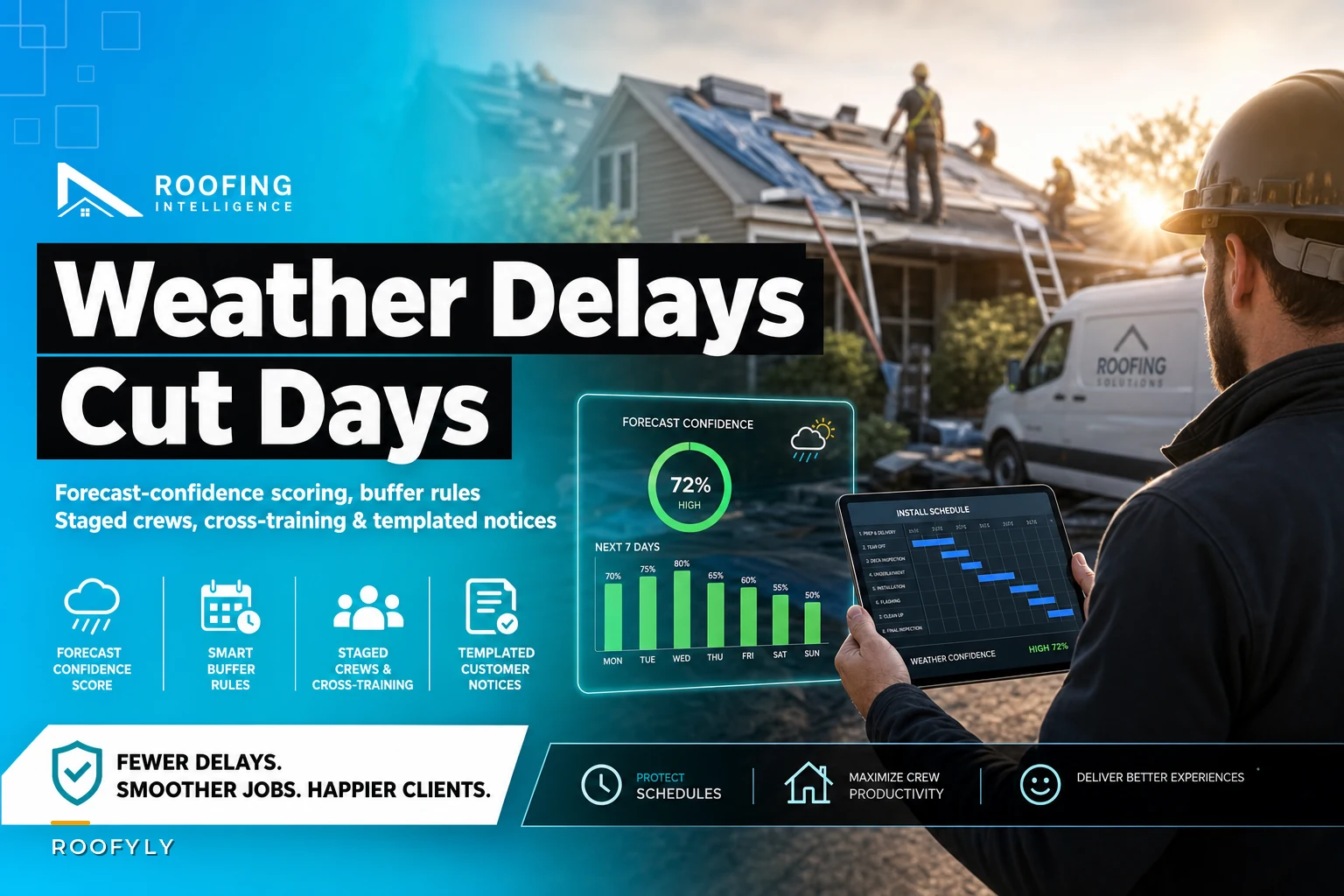

Every roofing contractor knows the Wednesday problem. You check the forecast Monday morning, see 30% rain chance for Wednesday, and now you're stuck. Cancel the jobs and eat the scheduling gap? Push through and risk crews showing up to wet roofs? Most contractors end up making the wrong call about half of the time — either losing productive days to phantom storms or sending crews home after driving to jobsites.
The real issue isn't weather itself. It's operating without clear decision rules for different forecast scenarios. When you're juggling 15-20 jobs across multiple crews, making weather calls based on gut feeling creates cascading delays that compound through your entire schedule.
Forecast confidence scoring beats percentage guessing
Standard weather apps show you a rain percentage, maybe an hourly breakdown. That's not enough to make solid scheduling decisions. What actually matters for roofing work is forecast stability — how much the prediction has shifted over the past 48 hours and how far apart different weather models are sitting.
Here's what an operational forecast confidence system looks like in practice.
-
Primary forecast source (usually weather.gov for your area)
-
Secondary commercial source (Weather Underground, Dark Sky API)
-
48-hour forecast variance (how much predictions have shifted)
When forecasts align and stay stable, you have high confidence. When they diverge or keep changing, you need different rules.
A contractor running 8 crews in Tampa started scoring forecast confidence last year. High confidence days — all sources within 10% agreement, stable for 48 hours — had 92% workable conditions. Low confidence days, where sources differed by 30% or more with changing predictions, were only workable 61% of the time. That data completely changed how they built their weekly schedule.
The confidence scoring table
| Confidence Level | Forecast Agreement | 48hr Stability | Scheduling Action |
|---|---|---|---|
| High | All sources within 10% | <15% variance | Schedule normally |
| Medium | Sources within 25% | 15-30% variance | Apply buffer rules |
| Low | Sources differ 30%+ | >30% variance | Trigger contingency |
Most contractors only look at rain percentage. But a stable 40% chance often means brief afternoon showers you can work around. An unstable 20% chance might mean models can't agree whether a front is actually coming through — which is a much riskier scenario for scheduling.
Buffer policies that match forecast uncertainty
Generic weather policies waste productive days. "No work if rain over 30%" sounds reasonable until you realize it cancels most Florida summer afternoons, the majority of which are 20-minute downpours at 3pm that blow through before you've even packed up.
Keep every roofing job on track and on time.
Roofyly helps you manage, schedule, and communicate every roofing project with precision and ease.
- Centralized project planning
- Real-time crew notifications
- Integrated scheduling & client updates
No credit card required
Buffer policies need to scale with forecast confidence and job type. A tear-off can't handle morning moisture. New construction sheathing needs 6 hours of dry time. Repairs might only need a 2-hour window.
For medium confidence days, here's a staging approach that holds up:
Morning assessment protocol (5am): Check radar movement, not just current conditions. If cells are isolated and moving predictably, you can often route crews around them. Frontal systems are a different situation entirely.
Staged crew deployment: Instead of sending everyone at 7am, stagger based on job flexibility. Repair crews go first — they can bail quickly if conditions turn. Full replacements wait until around 8:30am after the morning radar check. New construction waits until you've confirmed conditions are actually clear.
The 10am commitment rule: By 10am, you need a firm call on the afternoon. Either crews push through with covers ready, or you redirect to indoor and prep work. No more "wait and see" past 10am — that's when you lose any real chance of recovering the day.
One Miami contractor tracking their staging metrics found that staggered deployment on medium-confidence days recovered about 70% of potentially lost production. They went from losing entire days to losing maybe 2-3 hours of optimal work time.
Cross-training for weather pivot operations
Weather delays hurt most when crews have nowhere else to go. A shingle installer sitting at home during rain is pure lost capacity. With basic cross-training, that same person could be cutting materials in the warehouse, prepping job packets, or doing customer callbacks.
The pivot doesn't need to be complicated. Most roofing operations have plenty of indoor work that gets neglected until it becomes urgent: inventory counts, truck maintenance, material staging for upcoming jobs, estimate follow-ups. The problem is crews aren't set up to switch tasks smoothly when weather hits.
Set up weather pivot stations in your shop:
-
Material prep station with cutting templates for common jobs
-
Phone bank for customer check-ins and schedule confirmations
-
Inventory zone for cycle counts and organization
-
Paperwork station for permit applications and documentation
Each crew member should know their primary and secondary pivot roles before weather ever becomes an issue. When conditions go sideways, they already know where to report and what to work on.
A 12-person roofing company in Houston built out their pivot system last spring. During weather delays, they now hold around 60% productivity through indoor work. More importantly, they're catching up on backlog tasks that used to pile up and create separate downstream delays.
Common pivot task assignments
Lead installers handle estimate reviews and material lists. They know exactly what upcoming jobs need and can flag issues before crews ever show up on-site.
Newer crew members tackle inventory and truck organization — they're learning where everything lives while keeping equipment ready.
Experienced workers who know the customer base handle follow-up calls and schedule confirmations. They can field technical questions and keep homeowners confident.
Everyone else rotates through material prep: cutting shingles, staging underlayment, pulling together what upcoming jobs will need. That work directly speeds up future installations.
Customer notification templates by weather risk level
Nothing burns through customer trust faster than schedule chaos with no communication. Sending individual texts about maybe-delays is a time sink and often creates more confusion than it resolves.
Build three notification templates tied to your confidence levels:
Green level (proceeding as scheduled): "Tomorrow's work at [address] is on schedule. Crew arrives between 7-8am. Current forecast shows [brief description]. We're prepared for conditions."
Yellow level (monitoring conditions): "We're tracking weather for tomorrow's work at [address]. Final call by 6am tomorrow. If we need to reschedule, next available date is [date]. You'll receive confirmation either way by 6:30am."
Red level (rescheduling required): "Due to weather conditions, we need to reschedule tomorrow's work at [address]. New date: [date]. This ensures proper installation and warranty coverage. Reply with any concerns."
Send these at consistent times. Green notifications go out by 4pm the day before. Yellow alerts by 6pm. Red rescheduling notices as soon as the call is made — never later than 7pm.
An Orlando contractor using this system cut weather-related complaints by roughly 80%. Customers can handle schedule changes. What they can't handle is finding out at 7am that work is cancelled with no explanation and no new date.
The Monday morning weather planning session
Most contractors check forecasts randomly throughout the week and make calls on the fly. That inconsistency is where a lot of productive days quietly disappear.
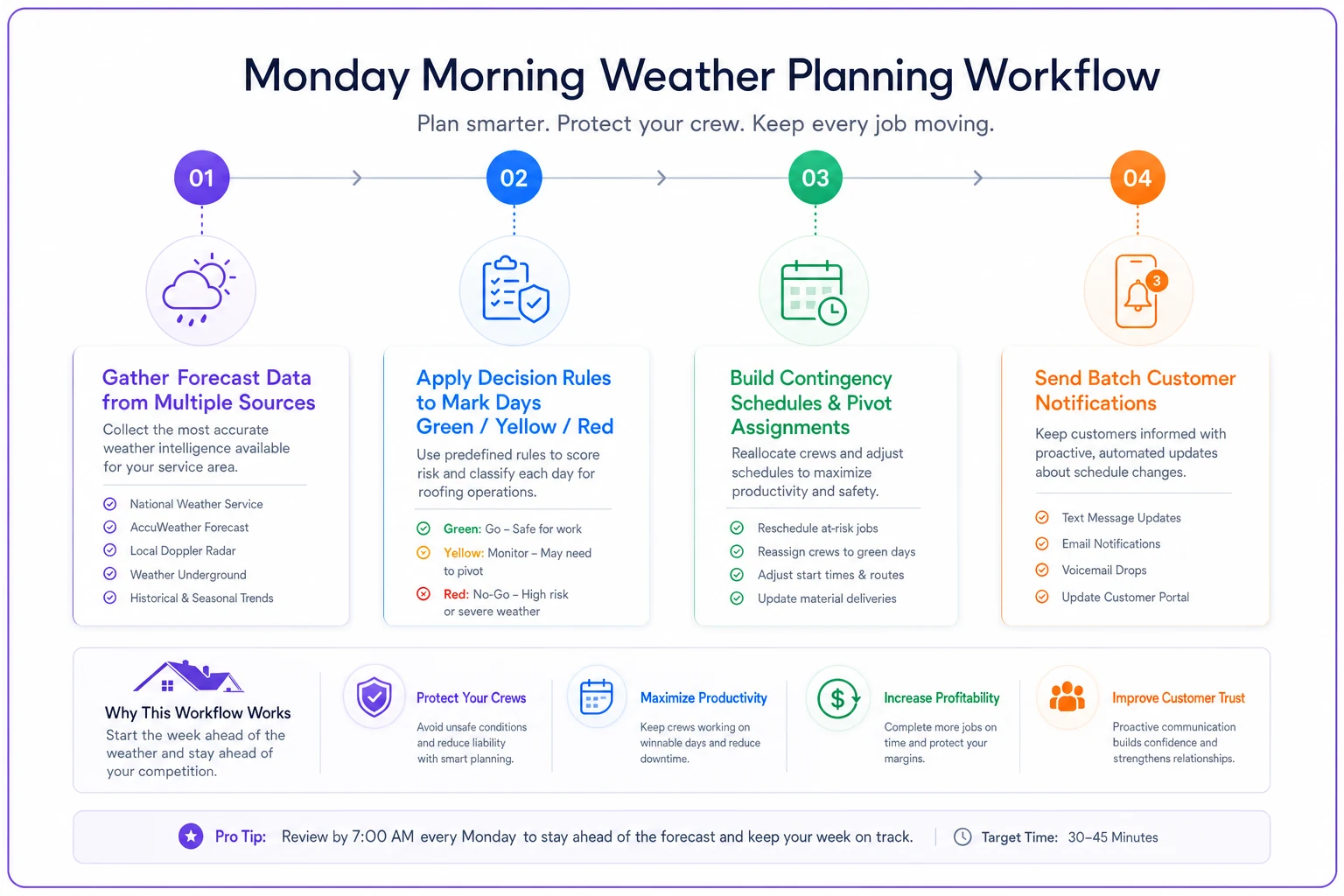
Here's a quick visual of the Monday morning weather planning workflow.
-
7
00–7:15am: Gather forecast data
— Pull predictions from your three sources. Note confidence levels for each day. Flag anything showing divergent forecasts or rapid shifts. -
7
15–7:30am: Apply decision rules
— Mark each day green (proceed), yellow (monitor), or red (likely reschedule). For yellow days, identify the specific trigger points for final calls. -
7
30–7:45am: Build the contingency schedule
— For every yellow and red day, map out crew pivot assignments. Indoor work tasks, material prep, alternate job sites that might hold up despite conditions. You want these decided now, not scrambled together Wednesday morning. -
7
45–8:00am: Send customer notifications
— Batch all weather-related notices for the week at once. Customers get maximum lead time, you handle it in one sitting.
This 60-minute session eliminates most of the daily weather stress. Everyone knows the plan going in, customers are already informed, and when conditions shift mid-week, you're executing pre-built decisions instead of scrambling.
Real weather impact scenario
A Fort Lauderdale contractor with 6 crews was losing around 35 days a year to weather delays — some legitimate, many precautionary cancellations for storms that never materialized. Their weather policy was essentially "check the forecast and make a call," which meant different supervisors made different decisions depending on who was in that morning.
They put in forecast confidence scoring and staged deployment rules. High-confidence clear days ran normally. Medium-confidence days used staggered crew deployment and the 10am commitment rule. Low-confidence days immediately triggered pivots to warehouse and material prep work.
After one season, weather delays dropped to about 22 days — recovering 13 productive days. Partial weather days, where they lost morning work but recovered afternoons, improved productivity by roughly 40% through better staging decisions.
Customer complaints about scheduling also dropped significantly. Consistent notifications meant homeowners got real information at predictable times. Even when jobs moved, they knew the new date immediately.
Software coordination for weather operations
Managing weather decisions across multiple crews, customer notifications, and pivot tasks through text chains and phone calls falls apart fast. When forecast conditions shift mid-week, updating everyone manually turns into a scrambling mess of missed calls and stale information.
Operational software built for contractors closes that gap. Instead of tracking forecast data by hand and making individual calls to each crew lead, you centralize weather decisions in one place. Crew schedules update based on the weather rules you've already set. Customer notifications go out when you flag a delay. Pivot assignments populate automatically for affected crews.
The coordination improvement is immediate. Your Monday planning session updates everyone's schedule at once. When you make a weather call, affected customers get notified within minutes. Crews see their pivot assignments on their phones without waiting around for instructions.
AI automation handles the repetitive parts well — pulling forecast data from multiple sources, flagging confidence score changes, triggering notifications based on rules you've already defined. You still make the actual decisions about when to work and when to pull back. The system just makes sure those decisions reach the right people quickly and consistently.
For contractors still managing weather coordination manually, that shift alone typically recovers a meaningful chunk of annual productive capacity through faster pivots and cleaner communication.
Stop letting weather uncertainty drain productivity
Weather will always affect roofing work. But the gap between losing 40 days a year and losing 20 comes down to operational discipline — better forecast assessment, clear decision rules, and fast pivots when conditions change.
The contractors who handle weather best aren't predicting perfectly. They build systems that adapt quickly when predictions prove wrong. Forecast confidence scoring gives you better data. Buffer policies and staging rules maximize partial-day productivity. Cross-training keeps crews useful even when they can't install. Consistent customer communication maintains trust through schedule changes.
Start with forecast confidence scoring next Monday. Add buffer policies for medium-confidence days. Build out one or two pivot stations in your shop. Within a few weeks, you'll notice weather causing less disruption — crews staying productive, customers complaining less, and fewer days evaporating for reasons that were at least partially preventable.
Weather delays don't have to cost you weeks of production every year. With clear operational rules and the right systems behind them, you can cut weather-related losses significantly while keeping customers informed and crews working.
Ready to elevate your roofing operations?
Join hundreds of roofing contractors using Roofyly to streamline workflows, improve crew coordination, and enhance client satisfaction.