


Your materials guy just texted you. Again. The GAF Timberline HDZ shingles you need for tomorrow's tear-off won't arrive until Thursday. The homeowner took the day off work. Your crew of six is already at the supply house loading underlayment. And now you're scrambling to find replacement stock from three different suppliers while your project manager reshuffles the entire week.
This happens because most roofing contractors treat procurement like a reaction game instead of a forecasting system. You order when you're low, expedite when you're out, and hope your suppliers come through when you really need them. But the chaos isn't just stockouts—it's how material delays ripple through your entire operation, from sales promises you can't keep to crews sitting idle on job sites.
The contractors who run smooth operations don't have better suppliers or bigger warehouses. They've built procurement systems that connect their sales pipeline to their ordering triggers, track vendor performance beyond just price, and account for seasonal swings that throw everyone else into emergency mode.
The procurement problem nobody talks about
Most roofing contractors focus on the obvious stuff—better prices, payment terms, cash flow. The real operational killer is the disconnect between what your sales team is selling and what your procurement system is actually ordering.
Your sales team closes a big commercial job with 180 squares of modified bitumen for an April install. Your operations manager doesn't find out until the contract hits their desk two weeks later. By then, your regular supplier is backordered until May, the alternate vendor wants 40% more, and your crew schedule is already locked in because you've committed to three residential jobs that same week.
This creates a cascade of problems. Emergency orders eat into margins. Expedited shipping destroys budgets. Crews show up to jobs without the right materials. Everyone points fingers while the actual problem—the lack of a connected procurement system—goes unaddressed.
The contractors who avoid this mess understand something fundamental: roofing materials forecasting isn't about predicting the future. It's about connecting your current sales activity to your future material needs while accounting for variables that actually matter.
Why vendor scorecards matter more than price sheets
Nothing kills profitability faster than crews standing around because your "cheapest" vendor missed another delivery window. Paying 5% more for materials hurts a lot less.
Keep every roofing job on track and on time.
Roofyly helps you manage, schedule, and communicate every roofing project with precision and ease.
- Centralized project planning
- Real-time crew notifications
- Integrated scheduling & client updates
No credit card required
Vendor performance in roofing isn't just about on-time delivery percentages. A supplier might deliver 95% on time during slow season but drop to 60% when spring hits and everyone needs materials at once. Their lead time might jump from 3 days to 12 days for certain products during peak season but stay consistent for others. They might be rock-solid on shingles but unreliable on specialty flashings.
Smart contractors track vendor performance across dimensions that actually affect operations.
Lead time consistency by product category
Not just average lead time, but the variance. A vendor with a 5-day average and 2-day variance is more reliable than one with a 4-day average and 5-day variance. You need to know which suppliers you can count on for rush orders versus planned purchases.
Seasonal reliability patterns
Some vendors maintain inventory depth year-round. Others run lean and can't handle spring demand spikes. Track their performance during your busy seasons, not their annual average.
Order accuracy and quality issues
Wrong color deliveries, damaged bundles, incorrect quantities—these create job site delays that cascade through your schedule. A vendor who's 10% cheaper but screws up 15% of orders isn't saving you anything.
Communication and problem resolution
When issues arise (and they always do), which vendors proactively notify you about delays? Who has account reps who actually answer their phones? Who can expedite when you're really stuck?
Build these metrics into an actual scorecard system. Weight them based on what matters most to your operation and use the scores to guide ordering decisions, not just chase the lowest bid. Your weather-related scheduling systems won't mean much if materials don't show up when expected.
Connecting sales pipeline to reorder triggers
The biggest procurement mistake contractors make is treating ordering like a warehouse problem instead of a sales pipeline problem. They wait until inventory is low, ignoring jobs already sold but not yet scheduled.
A functional roofing materials forecasting system starts with visibility into what's coming, not what's currently in stock. Your procurement triggers need to account for:
Signed contracts not yet scheduled
That 50-square residential reroof might not install for three weeks, but you need those materials ordered based on lead times, not install dates. Your reorder trigger should fire when signed contracts exceed current inventory plus incoming orders, adjusted for typical fallout rates.
Pipeline probability adjustments
Not every estimate becomes a job. But if you're closing 30% of residential estimates and 15% of commercial bids, you can forecast material needs based on active proposals. A strong pipeline of 500 squares in estimates suggests ordering for roughly 100–150 squares of near-term demand.
Seasonal close rate variations
Your close rate in October for spring installs differs from your close rate in March for immediate work. Storm damage creates demand spikes with 70%+ close rates. Build these patterns into your procurement planning.
Product mix forecasting
If 60% of your June installs use architectural shingles, 25% use designer shingles, and 15% use metal, you can pre-position inventory accordingly. Don't wait until you've sold specific jobs to order common materials.
A practical trigger framework:
| Pipeline Stage | Weight | Trigger Action | Lead Time Buffer |
|---|---|---|---|
| Signed contracts | 100% | Order immediately if beyond standard lead time | Standard vendor lead time |
| Verbal commits | 75% | Include in 2-week forecast | Standard + 3 days |
| Hot proposals (follow-up scheduled) | 40% | Include in monthly planning | Standard + 7 days |
| Standard estimates | 15% | Quarterly bulk order planning | Bulk order minimums |
The key is making these triggers automatic, not manual checks someone does when they remember. Your sales data needs to flow directly into procurement planning.
Season-adjusted lead time buffers that actually work
Standard lead times are a fantasy during roofing season. The same materials that arrive in 3 days in January can take two weeks in May. Your procurement system needs to account for these swings or you'll constantly fight shortages.
Real seasonal adjustment goes beyond tacking a few extra days onto orders during busy season. Different products face different seasonal pressures. Shingles might see 2x lead times in spring while synthetic underlayment stays consistent. Metal panels back up during commercial construction season but flow freely in winter. Each product category needs its own seasonal adjustment factor.
Track your actual lead time data by month and product category. Typical seasonal patterns for residential roofing materials:
Spring surge (March–May)
Shingles: 8–14 day lead times (vs. 3–5 in winter) Underlayment: 5–7 days (vs. 2–3 in winter) Ridge vents: 10–14 days (vs. 5–7 in winter) Fasteners: Usually stable at 2–3 days
Storm season (June–August)
Add 20–30% to spring lead times for common materials. Specialty items can jump to 3–4 week lead times. Tarps and emergency supplies are often completely unavailable.
Fall wind-down (September–November)
Lead times gradually return to normal. Good window for bulk orders at better prices and pre-positioning inventory for spring.
Winter planning (December–February)
Shortest lead times of the year. Best pricing on bulk orders. Time to stockpile for the busy season.
Don't just adjust your lead times—adjust your reorder triggers too. If April lead times run 12 days instead of 4, your reorder point needs roughly 3x the runway. This compounds when you factor in crew capacity and scheduling commitments.
Your adjusted trigger formula: Base reorder point × Seasonal multiplier × Vendor reliability factor = Actual trigger
For example, if you typically reorder GAF shingles at 100 squares remaining, your April trigger might be: 100 squares × 2.5 (spring multiplier) × 1.2 (vendor variance factor) = 300 squares
This feels like over-ordering until you're in the middle of May with crews scheduled wall-to-wall and every supplier quoting two-week lead times.
PO batching rules that reduce costs without creating shortages
Ordering materials every time you close a job will bury your office staff in administrative work. But batching POs incorrectly creates its own problems—stockouts, emergency orders, and cash flow crunches.
Effective PO batching considers multiple factors at once: order frequency, minimum quantities, volume discounts, storage capacity, and cash flow. Start by categorizing materials by ordering logic:
High-volume standardized items (common shingles, felt, nails)
Batch weekly or bi-weekly based on typical consumption rates. These should rarely require emergency orders if you're tracking pipeline properly. Set up standing orders with primary vendors when possible.
Project-specific materials (special colors, custom trim, specific membranes)
Order immediately upon contract signing if lead time exceeds the installation buffer. Don't batch these—the risk of ordering wrong specifications outweighs any batching benefit.
Accessories and consumables (caulk, screws, safety equipment)
Monthly batching works for most contractors. These have stable consumption patterns and longer shelf life. Track usage rates and set par levels.
Seasonal or specialty items (snow guards, solar mounting)
Quarterly or annual batching depending on predictability. These often have volume requirements that make frequent ordering impractical anyway.
Your batching cadence should shift by season, not stay fixed year-round. During peak season you might batch high-volume items twice weekly. During slower months, once a month might be enough. The goal is eliminating both emergency orders and excess inventory.
A basic operational rhythm that works:
-
Every Monday morning
Review all signed contracts from the previous week against current inventory and incoming orders. Generate POs for anything beyond standard lead time.
-
Every Thursday
Batch order for standard materials based on the next two weeks of scheduled work plus pipeline probability. Include buffer for weather delays and add-ons.
-
First of month
Full inventory count, consumables reorder, specialty items review. Place bulk orders for predictable monthly consumption.
-
Quarterly
Analyze vendor performance, adjust preferred vendor list, negotiate volume agreements for the upcoming season. Pre-position inventory for seasonal shifts.
During peak season, set standing orders for high-volume standardized items to reduce emergency pickups.
This eliminates the "oh crap we're out of underlayment" moments while avoiding the "why do we have 400 squares sitting in inventory" cash flow problems.
Real workflow: How one contractor fixed their procurement mess
A roofing contractor in Denver was burning $30k–$45k annually in expedited shipping charges. Their crews averaged one materials-related delay per week. Customer complaints about rescheduling were climbing. The owner was personally handling emergency material runs at least twice a week.
The problem wasn't their vendors or their crews. Their procurement system was completely disconnected from their sales and scheduling operations. Sales closed jobs without checking material availability. Ops scheduled jobs assuming materials would arrive. Procurement ordered when someone mentioned they were running low on something.
They rebuilt their system around forecast-based triggers.
First, they connected their sales pipeline directly to procurement planning. Every signed contract automatically triggered a material requirement check against current inventory and incoming orders. If materials weren't available within the scheduling window, POs generated automatically with appropriate lead time buffers.
Second, they built real vendor scorecards tracking on-time percentage, order accuracy, and seasonal reliability. They discovered their primary vendor was actually their worst performer during busy season, while their "backup" vendor maintained consistent lead times year-round. They flipped their ordering priorities based on data, not relationships.
Third, they created season-specific reorder triggers. Instead of ordering shingles when inventory hit 75 squares year-round, triggers adjusted monthly based on historical lead time data. April triggers fired at 200 squares. December triggers stayed at 50.
Fourth, they batched POs on a fixed operational rhythm—Monday pipeline reviews, Thursday standard orders, monthly consumables. PO processing time dropped by around 60% and most emergency orders disappeared.
Results after six months:
-
Expedited shipping dropped to under $8k (from $30k–$45k)
-
Materials-related delays fell from weekly to roughly once a month
-
Crew utilization improved by approximately 15%
-
Customer rescheduling complaints nearly eliminated
-
Owner stopped making emergency material runs entirely
The key wasn't sophisticated software or complex spreadsheets. They built simple, connected systems that linked sales activity to material planning while accounting for seasonal patterns that actually affect roofing operations.
Here's a simple workflow visualization.
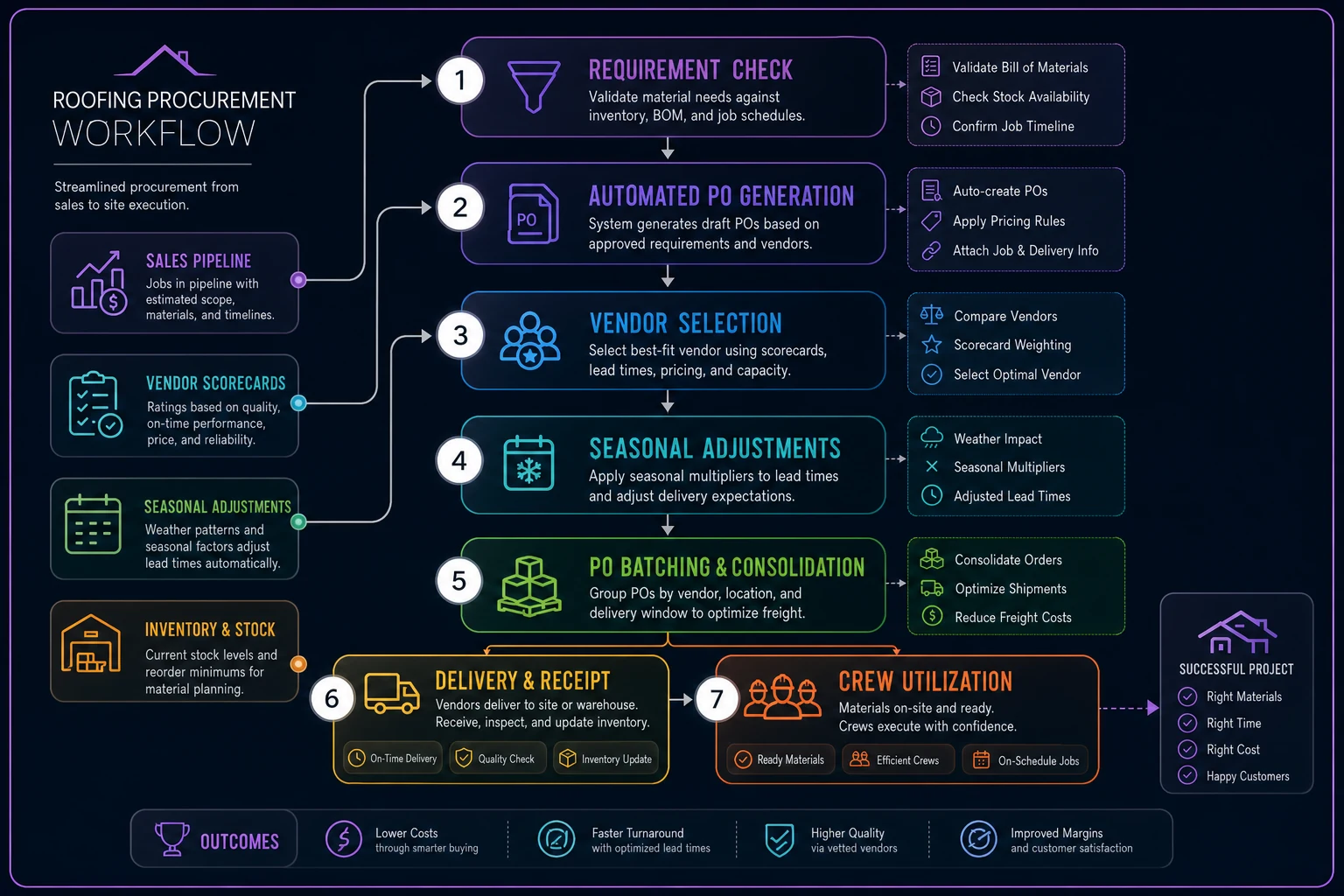
Results after six months summarized the operational improvements and cost reductions they achieved.
Templates and tools to implement immediately
Vendor Scorecard Template
Track these metrics monthly for each vendor:
Delivery Performance
-
On-time percentage (promised vs. actual)
-
Average delay when late (days)
-
Communication rating (proactive updates on delays)
-
Damage rate (% of deliveries with issues)
Order Accuracy
-
Correct items delivered (%)
-
Correct quantities (%)
-
Documentation accuracy (%)
Seasonal Reliability
-
Peak season performance vs. off-season
-
Lead time consistency by month
-
Availability during demand spikes
Service Quality
-
Response time to inquiries
-
Problem resolution speed
-
Account rep accessibility
-
Flexibility on rush orders
Score each area 1–5, weight by importance to your operation, calculate a composite score. Review quarterly and adjust vendor preferences accordingly.
Reorder Trigger Calculator
For each material category, calculate:
Base reorder point = (Daily usage rate × Standard lead time) + Safety stock
Seasonal adjustment = Base reorder point × Seasonal multiplier
Pipeline adjustment = Upcoming confirmed jobs + (Pipeline opportunities × Close rate)
Final trigger = Seasonal adjustment + Pipeline adjustment
Update multipliers monthly based on actual lead time data. Annual averages will mislead you during critical seasons.
PO Batching Schedule
Monday AM: Pipeline review meeting
-
Review all weekend sales
-
Check material requirements against inventory
-
Generate immediate POs for long-lead items
Thursday AM: Standard materials batch
-
Calculate two-week forward requirements
-
Add weather buffer (see your weather delay patterns)
-
Place consolidated orders with preferred vendors
Month-end: Full procurement review
-
Physical inventory count
-
Consumables restock
-
Vendor scorecard updates
-
Seasonal adjustment review
Quarterly: Strategic procurement planning
-
Volume negotiations for upcoming season
-
Vendor relationship reviews
-
Process improvement based on delay patterns
Materials Forecast Tracker
Build a simple spreadsheet with these five tabs:
-
Sales Pipeline Tab
All opportunities with close probability
-
Confirmed Jobs Tab
Signed contracts with material requirements
-
Current Inventory Tab
What's on hand and incoming
-
Trigger Dashboard Tab
Visual alerts when reorder points are hit
-
Vendor Performance Tab
Monthly scorecard data
Link these together so sales data flows automatically into trigger calculations. Ops checks the dashboard daily and executes indicated orders. When this is working well, it also makes invoice delays and handoff breakdowns a lot easier to trace and fix.
Making procurement systems scale with growth
The procurement system that works at $2M in revenue breaks at $5M and completely fails at $10M. As volume grows, manual triggers become impossible to maintain, vendor relationships get more complex, and materials forecasting becomes critical to profitability rather than just a nice operational habit.
Small operations can survive with reactive ordering and relationship-based vendor selection. Once you're running multiple crews and juggling dozens of active jobs, systematic procurement isn't optional anymore. The contractors who scale successfully build procurement infrastructure before they desperately need it.
Growth changes procurement fundamentals in a few specific ways.
Volume shifts vendor dynamics. At $2M revenue, you're buying at retail-plus pricing. At $10M, you should have volume agreements, dedicated account support, and priority delivery slots—but only if you concentrate purchases strategically instead of spreading them across too many vendors.
Multiple crews complicate forecasting. One crew's material needs are predictable. Five crews working different job types across multiple sites create complex material flows. Your triggers need to account for crew-specific burn rates and scheduling patterns.
Cash flow requires inventory optimization. Larger operations can't afford to tie up $100k+ in excess inventory, but they also can't risk crews standing idle. Forecasting accuracy becomes a financial requirement, not just an operational convenience.
Geographic expansion multiplies complexity. Operating across multiple regions means managing different vendors, varying lead times, and regional material preferences. Your system needs to handle that complexity without creating administrative burden.
The key to scaling procurement is building systems that get smarter with more data instead of more complicated with more rules. Every job should improve your forecasting accuracy. Every season should refine your triggers. Every vendor interaction should sharpen your scorecards.
This is where AI-powered operational software becomes genuinely useful—not as a magic solution, but as a tool that processes patterns across hundreds of jobs, automatically adjusts triggers based on real performance data, and flags anomalies before they turn into emergencies. The better platforms connect to your sales pipeline, track vendor performance automatically, and adjust forecasts based on seasonal patterns without someone manually updating spreadsheets every week.
Bottom line
Material chaos doesn't happen because vendors are unreliable or because forecasting is impossible. It happens because most contractors treat procurement as a reactive administrative task instead of a strategic operational system.
The roofing companies running smooth operations have figured out that procurement success requires three connected elements: triggers based on sales pipeline (not just inventory levels), vendor management based on performance data (not just price), and seasonal adjustments based on actual patterns (not rough estimates).
Building these systems isn't complicated, but it does require consistency. Track your data, adjust your triggers, score your vendors, and batch strategically. Start with simple spreadsheets and basic rules. As patterns emerge and volume grows, consider operational software that can automate the repetitive parts while preserving the intelligence you've built into your system.
Your crews are only as productive as your material flow allows. Your scheduling systems and labor tracking mean nothing if materials don't show up when needed. Stop treating procurement like a back-office function and start treating it like the operational foundation it actually is.
The difference between contractors who scramble through every season and those who execute smoothly isn't luck or better supplier relationships. It's whether a real forecasting system connects every part of the operation. Build that system, maintain it consistently, and watch how many other problems simply disappear.
The difference between contractors who scramble through every season and those who execute smoothly isn't luck or better supplier relationships. It's whether a real forecasting system connects every part of the operation. Build that system, maintain it consistently, and watch how many other problems simply disappear.
Ready to elevate your roofing operations?
Join hundreds of roofing contractors using Roofyly to streamline workflows, improve crew coordination, and enhance client satisfaction.