



Three months ago, a roofing contractor in Dallas showed me their accounting spreadsheet. They had $47,000 in unbilled work from the previous quarter. Not disputed work. Not bad debt. Just... unbilled. Jobs completed, materials used, labor paid — but no invoice sent.
The worst part? They thought their problem was unique.
It's not. Working with roofing operations over the years, the pattern keeps showing up: the gap between completed work and collected payment is where profitable roofing companies become struggling ones. Not because of bad work or unhappy customers, but because information gets lost between the field and the office.
The roofing estimate to invoice workflow should be straightforward. Someone requests a quote, you assess the job, provide an estimate, get approval, do the work, send an invoice, get paid. Simple, right?
Except it never actually works that way.
Why roofing operations break differently than other trades
Roofing has a particularly nasty combination of operational challenges that other trades don't face. Your crew can't work in the rain. Insurance adjusters change scope mid-project. Material costs fluctuate weekly. Emergency repairs interrupt scheduled jobs. Unlike plumbers or electricians who can often complete jobs in a day, roofing projects stretch across weeks with multiple inspection points, weather delays, and scope changes.
Each of these creates a handoff point. Each handoff point creates an opportunity for information to disappear.
Take a typical residential re-roof project. The sales rep captures initial measurements and damage assessment. That information needs to reach the estimator who adds material calculations and labor hours. The estimate goes to the customer for approval. Once approved, someone needs to order materials. The production manager schedules crews. The foreman documents actual work performed and any changes. The office processes the final invoice based on... what exactly?
By the time that invoice gets created, it's traveling through a game of telephone involving at least six different people, each with their own version of what happened on that roof.
That Dallas contractor? Their average job involved 11 separate handoffs between estimate and invoice. Eleven opportunities for critical billing information to vanish.
The three-week invoice mystery
Once you pass about 15 jobs per month, this pattern usually emerges:
Keep every roofing job on track and on time.
Roofyly helps you manage, schedule, and communicate every roofing project with precision and ease.
- Centralized project planning
- Real-time crew notifications
- Integrated scheduling & client updates
No credit card required
Week one after job completion: The foreman has photos and notes about additional work performed — extra decking replacement, upgraded vents, whatever. These live in his phone or truck. He'll "get them to the office tomorrow."
Week two: The office manager asks about the Johnson job invoice. The foreman handed off some notes, but they don't match what's in the original estimate. Someone needs to check with sales about what was actually approved. Sales is out on appointments. The production manager thinks he remembers approving a change order, but can't find the documentation.
Week three: Accounting finally pieces together enough information to create an invoice. Now the customer disputes the additional charges because they don't remember approving them. The approval was verbal, on-site, during the project. No one documented it properly.
This isn't a people problem. Your foreman isn't lazy. Your office manager isn't incompetent. Your sales team isn't trying to sabotage billing. It's a system problem. Or more accurately, it's the absence of a system.
Mapping the money trail: where revenue actually disappears
Revenue leakage in roofing happens at predictable points. The same five places, over and over:
The estimate-to-contract conversion The signed contract doesn't match the final estimate. Maybe the customer negotiated. Maybe sales offered a discount. Maybe someone forgot to add the permit fees. The contract amount becomes the ceiling for what you can bill, regardless of what the estimate said.
The material order variance Estimated 35 squares of shingles. Ordered 40 to be safe. Used 38. Who tracks that the extra 3 squares should become a credit or get allocated to another job? Usually nobody. That's margin walking out the door.
The undocumented scope creep Found rotten decking that needs replacement. Customer verbally approves the additional $1,200 in work. Crew does the work. No written change order. Good luck collecting that money 30 days later when the customer "doesn't remember" that conversation.
The inspection fail recovery Job fails inspection. Crew returns to fix issues. Additional labor and possibly materials. Who captures these costs? Who ensures they're billed appropriately? In most companies, these become phantom costs that eat profit but never appear on invoices.
The warranty callback gap Some work is warranty. Some is new billable work. The crew doesn't always distinguish. The office doesn't always know to ask. Billable work gets miscategorized as warranty, and there goes more revenue.
Building the handoff system that actually works
Working with roofing operations over the years, there's a clear pattern to what fixes this. It's not about better people or working harder. It's about creating deliberate connection points where information must be captured and verified before moving forward.
Start with defining the five critical handoff points in your roofing estimate to invoice workflow:
-
1. Estimate approval → Contract creation
-
2. Contract signing → Material ordering
-
3. Job start → Daily progress tracking
-
4. Scope change → Change order processing
-
5. Job completion → Invoice generation
Each handoff needs three things: a clear trigger (what initiates the handoff), required artifacts (what information must be present), and verification rules (who confirms completeness).
The Dallas contractor implemented this system. Their unbilled work dropped from $47,000 to under $8,000 within 60 days. Not through heroic effort. Through systematic handoffs.
The field-to-office bridge that eliminates delays
The biggest gap in roofing operations isn't between estimate and contract. It's between what happens on the roof and what gets recorded in the office.
Your foreman knows exactly what extra work was needed. Your crew lead knows precisely how much material was actually used. Your field team has photos of every problem they encountered. But none of this information naturally flows to the person creating invoices.
Traditional solutions don't work here. Paperwork gets lost or damaged. Phone calls aren't documented. Text messages create confusion. Email threads become archaeological expeditions.
What does work is creating a single source of truth that both field and office can access. This doesn't mean expensive enterprise software. It means having one place where job information lives and gets updated in real-time.
-
Daily job status (takes 2 minutes) - Percentage complete - Weather delays (yes/no) - Change orders needed (yes/no) - Photos uploaded (required for progress billing)
-
Change order documentation (takes 5 minutes) - Photo of the issue - Description of additional work - Customer signature (digital or photo of written) - Cost estimate
-
Completion checklist (takes 3 minutes) - Final photos uploaded - Punch list items completed - Customer walkthrough done - Warranty information provided
Require photo uploads before progress is accepted to make progress billing and change order verification simple.
Better to have three things tracked daily than twenty things tracked randomly.
Change orders: the $2,300 problem hiding in plain sight
The average roofing change order is worth $2,300. The average roofing company fails to properly document and bill for about 30% of their change orders. Do the math on your annual volume. That's probably a six-figure problem.
Change orders fail for three predictable reasons:
First, verbal approvals without documentation. The customer agrees on-site to additional work, but there's no written record. When the invoice arrives with extra charges, selective memory kicks in.
Second, scope creep disguised as goodwill. "While we're up there, we'll just fix that one little thing." Those little things add up to big unbilled costs.
Third, delayed processing. The change order happens on Tuesday. The office doesn't hear about it until Friday. By the time paperwork gets created the following week, details are fuzzy and the customer questions the charges.
Change Order Process That Actually Gets Followed:
-
1. Identify the change — Foreman spots additional work needed
-
2. Document with photos — Before condition clearly shown
-
3. Estimate the cost — Even if rough, get a number
-
4. Get written approval — Digital signature, photo of signed paper, or email confirmation
-
5. Flag for billing — Mark the job file immediately
-
6. Execute the work — Only after approval confirmed
-
7. Document completion — After photos showing work done
The companies that capture change order revenue don't have better customers. They have better processes.
Scaling from 10 to 50 jobs: where the wheels come off
At 10 jobs per month, you can hold the entire operation in your head. You remember who's working on what, which permits are pending, what materials were ordered. The owner can personally verify every invoice before it goes out.
At 50 jobs per month, that mental inventory system collapses. You're juggling multiple crews, overlapping projects, various stages of permitting, and complex material logistics. Information that used to flow naturally through daily conversation gets lost in the noise.
Most roofing companies hit this ceiling around here. Not because they can't sell more jobs or complete more work, but because their administrative systems can't keep pace with production.
The breakdown follows a predictable pattern:
Weeks 1-2: Jobs get sold and scheduled normally. Everything seems fine.
Weeks 3-4: Permitting delays stack up. Material orders get confused. Crew scheduling becomes a daily crisis.
Weeks 5-6: Completed jobs sit unbilled because the office can't determine what was actually done versus what was estimated.
Weeks 7-8: Cash flow tightens because invoicing is 30+ days behind. Vendors want payment. Payroll is due. The owner starts using credit lines to cover gaps.
Week 9+: Growth stalls because the operation can't handle current volume, let alone more.
The solution isn't hiring more office staff. It's building information flows that scale.
The technology bridge (without the technology dependency)
Modern roofing operations need some level of digital coordination. Not because technology is magic, but because information needs to move faster than paper allows.
Most software vendors won't tell you this: the tool doesn't matter nearly as much as the workflow it supports. A simple shared spreadsheet with the right process beats sophisticated software with no process. Every time.
Roofing operations benefit from AI-powered operational software that can track jobs from initial estimate through final payment. Not because AI is trendy, but because it can catch the patterns humans miss — like change orders that weren't invoiced, materials ordered but not allocated to jobs, or warranties about to expire.
The most effective roofing operations use technology to create automatic checkpoints:
-
Estimates cannot convert to contracts without complete pricing
-
Jobs cannot start without permits confirmed
-
Change orders cannot proceed without customer approval
-
Invoices cannot generate without completion photos
-
Payment terms automatically escalate when overdue
These aren't restrictions — they're guardrails that prevent revenue from disappearing into operational chaos.
The monthly revenue recovery audit
Even with good systems, money leaks through cracks. Companies that maintain healthy margins run a monthly recovery audit.
This isn't a complex forensic accounting exercise. It's a simple check of five things:
-
1. Unbilled completed work Pull every job marked complete in your system. Compare against invoices sent. Anything missing? That's immediate revenue sitting on the table.
-
2. Approved but uninvoiced change orders Review all change orders from the past 60 days. Check which ones appear on invoices. The gaps are pure profit waiting to be collected.
-
3. Material variance reconciliation Compare materials ordered versus materials estimated for all jobs. Significant overages without corresponding change orders suggest scope creep you didn't bill for.
-
4. Warranty versus billable classification Audit all warranty calls from the past month. How many included billable work that got miscategorized? This is often 10-15% of callback volume.
-
5. Permit and inspection fees Check that all permit costs and re-inspection fees made it onto the appropriate invoices. These small amounts add up to thousands monthly.
One mid-sized roofing company in Phoenix started doing this audit monthly. First month, they found $23,000 in unbilled work. Second month, $16,000. By month six, the number was down to $3,000 — not because they got better at finding it, but because their system got better at preventing it.
Building your estimate-to-invoice blueprint
Every roofing company needs its own version of this blueprint, but the framework remains consistent:
Define your handoff points. Where does information need to transfer between people or departments?
Create required artifacts. What documentation must exist before moving to the next stage?
Establish escalation rules. What happens when something gets stuck?
Build templates. Standard formats for estimates, change orders, and invoices reduce errors.
Track the gaps. Measure time between job completion and invoice creation.
Basic blueprint that works for most residential roofing operations:
A quick visual of the blueprint workflow.
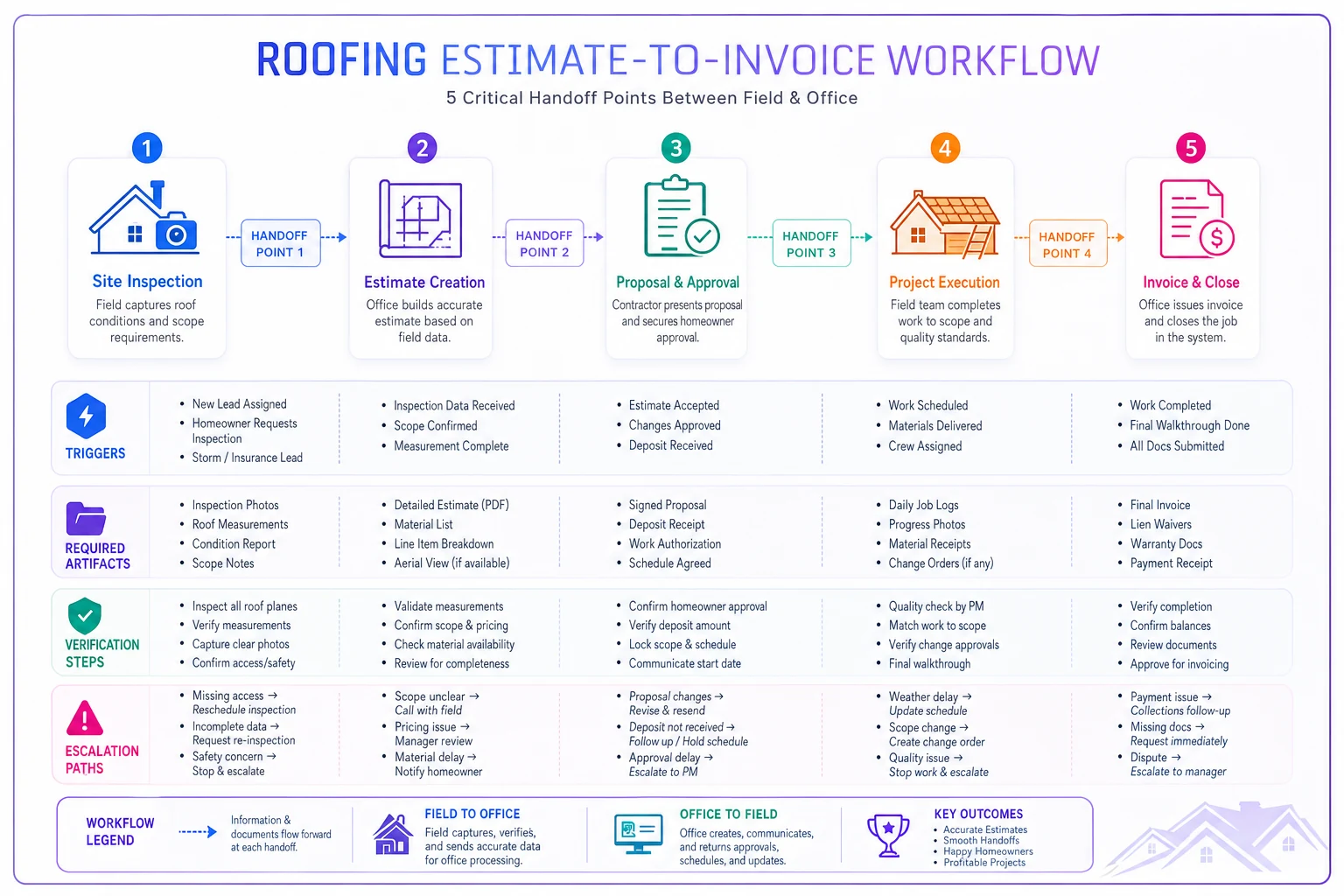
| Stage | Owner | Required Artifacts | Next Step Trigger | Escalation (if delayed 48hrs) |
|---|---|---|---|---|
| Lead Received | Sales | Contact info, project type | Sales contact made | Notify sales manager |
| Estimate Created | Estimator | Measurements, photos, pricing | Sent to customer | Notify sales |
| Contract Signed | Sales | Signed agreement, deposit | Scheduling requested | Notify operations |
| Permits Filed | Office | Permit applications, fees paid | Permits received | Notify production manager |
| Materials Ordered | Purchasing | PO created, delivery scheduled | Materials confirmed | Notify foreman |
| Job Started | Foreman | Crew assigned, customer notified | Work commenced | Notify operations |
| Change Order Identified | Foreman | Photos, description, cost | Customer approval | Notify office |
| Job Completed | Foreman | Final photos, punch list done | Completion reported | Notify office manager |
| Invoice Created | Office | All job documentation | Sent to customer | Notify controller |
| Payment Received | Accounting | Payment processed | Books updated | Notify owner |
This isn't meant to be bureaucratic. It's meant to prevent $47,000 from sitting unbilled for three months.
The compound effect of operational discipline
The difference between struggling roofing companies and profitable ones isn't usually about sales volume or pricing. It's about operational efficiency — specifically, how much revenue actually makes it from estimate to bank account.
A typical roofing company loses 12-15% of revenue to operational gaps. Not bad debt or warranty work — just poor handoffs and missing documentation. On $2 million in annual revenue, that's $240,000 to $300,000 vanishing into thin air.
Fix the handoffs, and that money reappears. No additional sales needed. No price increases required. Just better operational discipline.
The roofing estimate to invoice workflow isn't exciting. It's not what most contractors got into business to think about. But it's the difference between owning a job and owning a business. Companies thriving in today's market aren't necessarily the best roofers. They're the ones who've built systems that ensure every dollar of work completed becomes a dollar collected.
Start with one handoff point. Fix it. Move to the next. Within 90 days, you'll have recovered enough revenue to wonder why you didn't do this sooner.
Your next big profit increase isn't on another roof. It's hiding in the gap between your completed work and your bank account. Time to close that gap.
Ready to elevate your roofing operations?
Join hundreds of roofing contractors using Roofyly to streamline workflows, improve crew coordination, and enhance client satisfaction.