



Most roofing companies don't have a data problem. They have a keeping problem. Photos get taken. Forms get filled. Signatures get captured. Then all of it scatters across text threads, a foreman's camera roll, three different Gmail accounts, and a shared drive nobody has cleaned out since 2021. When you need a specific tear-off photo eighteen months later because an adjuster reopened a claim or a homeowner filed in small claims, the question isn't "did we take it?" It's "can we find it, prove when it was taken, and prove nobody touched it since?"
That second question is what governance is actually about. Not more paperwork. Not a compliance binder sitting in a drawer. It's the set of rules that decides whether your field data holds up when money is on the line — and whether you're paying storage fees on 400,000 blurry photos you'll never look at again.
This is the layer that sits underneath everything else your crews do. Your shot lists, your closeout packets, your supplement evidence — none of it matters if the underlying data can't be found, dated, or trusted. So let's talk about how the whole system works when it's built right, and the specific places it falls apart when it isn't.
Why field data governance breaks (and it's rarely the crew's fault)
The instinct is to blame the guys on the roof. "They didn't label it." "They saved it to the wrong folder." But when you look at how the breakdown actually happens, it's almost always a systems gap, not a discipline gap.
Here's the pattern. A one-crew operation captures maybe 60–80 photos a day across two or three jobs. The owner remembers most of it in his head. Naming is loose but it works because the volume is small and the person who took the photo is the same person filing the invoice. Governance is invisible because it lives inside one brain.
Then the company grows. Four crews, a couple of subs, an office coordinator, a sales team feeding jobs in. Suddenly nobody owns the full picture of any single job. The foreman took the deck photos, the sub did the flashing, the office pulled the permit, and the salesperson has the original inspection shots on his personal phone. When a warranty issue surfaces two years later, reconstructing that timeline means texting four people — two of whom don't work there anymore.
What you see across a lot of growing contractors is that the exact moment governance becomes critical — somewhere around the third or fourth crew — is the same moment nobody has time to build it. So it gets skipped, and the company runs on tribal memory until a bad claim forces the issue.
The other thing that quietly breaks: retention. Nobody decides how long to keep anything, so the default becomes "forever, everywhere." That feels safe. It isn't. Keeping everything forever means you can't find the important stuff, you're paying for dead storage, and — this is the part people miss — you're holding onto material that could actually be used against you in a dispute if it was never meant to be part of the record.
The four rules every governance system needs
You don't need a fifty-page policy. You need four decisions made once and enforced quietly in the background.
Keep every roofing job on track and on time.
Roofyly helps you manage, schedule, and communicate every roofing project with precision and ease.
- Centralized project planning
- Real-time crew notifications
- Integrated scheduling & client updates
No credit card required
1. Minimal metadata. Every piece of field data needs enough context attached that a stranger could understand it in five years. Not more. The mistake companies make is either capturing nothing (a photo with no job number) or demanding a 12-field form the crew won't fill out.
2. Retention schedule. A written answer to "how long do we keep this, and what happens when the clock runs out." Different data types have different clocks. Deleting on schedule is part of governance, not a failure of it.
3. Chain of custody. A record of who captured a piece of data, when, and every hand it passed through afterward. This is what makes evidence defensible instead of just present.
4. Redaction practice. Rules for stripping out things that shouldn't leave your walls — homeowner personal info, faces of people who didn't consent, sensitive interior shots — before data goes to an adjuster, a sub, or a court.
That's the whole framework. The work is in making each one lightweight enough that it survives contact with a busy crew.
Minimal metadata: the smallest tag set that actually works
The single biggest failure point in field data is a photo you can't attach to anything. It exists, it's timestamped by the phone, but there's no job number, no location on the roof, no reason it was taken. In a dispute, an untagged photo is nearly worthless because you can't prove what it shows.
The fix is a tag floor — the minimum every capture must carry. Keep it to five fields. More than that and the crew starts skipping.
-
Job ID — ties everything back to one address and one contract
-
Capture stage — inspection, tear-off, deck, dry-in, install, closeout, callback
-
Roof zone — front slope, rear slope, valley 2, north penetration, etc.
-
Captured by — the person, not just the device
-
Timestamp — automatic, never manually entered
Notice what's not on that list: reason, weather, material lot, measurements. Those matter sometimes, but they belong on specific stage forms, not on every photo. If you make crews describe every shot, they'll describe none of them.
The naming and tagging discipline behind this deserves its own deep dive, and we covered the field-level mechanics in detail in our breakdown of roofing-specific shot lists, naming conventions and automated tagging. The governance layer here sits on top of that — it's the rulebook that says what has to be tagged and why it matters legally, not just how to name a file.
One thing worth flagging: the companies that get metadata right almost never rely on crews to type it in. The Job ID and stage get set once when the job is opened, and every capture that day inherits them automatically. The human only confirms the roof zone. That's the difference between a rule that works and a rule that lives on a laminated card nobody reads.
Automate Job ID and stage inheritance so crews only confirm the roof zone.
The human only confirms the roof zone. That's the difference between a rule that works and a rule that lives on a laminated card nobody reads.
Retention schedules: how long is long enough
"Keep everything forever" is not a policy. It's an absence of one. And it creates two real problems — you can't find what matters, and you carry legal and storage liability on data you should have let go.
The right retention length is driven by three things: your state's statute of limitations for construction defect claims, your warranty length, and insurance claim reopening windows. Those set the floor. Here's a practical schedule that works for most residential reroofers. Adjust the numbers to your state — this is a starting frame, not legal advice.
| Data type | Minimum retention | Why | What triggers deletion |
|---|---|---|---|
| Full job photo set (inspection → closeout) | Warranty term + 2 years | Warranty callbacks + defect claims | Scheduled purge after retention date |
| Signed contracts & change orders | 7–10 years | Contract statute of limitations | Manual legal review, never auto |
| Insurance claim evidence & supplements | 5–7 years after claim close | Claim reopening + subrogation | Scheduled, with legal hold override |
| Homeowner communication logs | Warranty term + 1 year | Dispute defense | Scheduled purge |
| Permit & inspection records | 7 years | Municipal + liability | Scheduled purge |
| Safety & incident documentation | 5 years minimum (check OSHA) | Regulatory | Manual review |
| Routine internal photos (staging, logistics) | 90 days | No evidentiary value | Auto-purge |
That last row is the one people forget. A huge share of what crews capture — the truck parked in the driveway, material staged out front, a shot that ended up in the job folder by accident — has zero long-term value. Letting it auto-purge at 90 days keeps your archive clean and searchable. You want the important 15% to be easy to find, not buried under the disposable 85%.
The critical concept underneath the whole table is the legal hold. The moment a dispute becomes credible — a demand letter, a claim reopening, a lawyer's name on an email — retention rules freeze for that job. Nothing gets purged, even if the clock says it should. If you don't have a way to flag a job for hold and stop the automatic deletion, your retention policy can actually destroy evidence you're legally required to preserve. That's a mistake that turns a good policy into a liability.
Chain of custody without the bureaucracy
Chain of custody sounds like something from a crime show, and roofers tend to roll their eyes at it. Strip away the jargon though and it's pretty simple: can you prove who took this, when, and that nobody changed it afterward?
Here's why it matters in a way that shows up on real invoices. An adjuster disputes a supplement. You send over tear-off photos showing rotted decking. The adjuster's response: "How do I know these are from this roof, on this date, and not edited?" If your photos live in a shared drive where anyone can rename, re-date, or replace a file, you have no answer. If they were captured through a system that locks the original, timestamps it server-side, and logs every access — you do.
The evidence-first approach to supplements lives or dies on this. We walked through the negotiation side of it in the evidence-first insurance supplement workflow, and chain of custody is the invisible foundation that makes that evidence stick instead of getting waved off.
-
Capture is attributed. The person and device are recorded automatically at the moment of capture. No manual sign-in per photo.
-
The original is locked. The first version is preserved untouched. Any markup, cropping, or annotation creates a copy, and the original stays intact and retrievable.
-
Handoffs are logged. When data moves — foreman to office, office to adjuster, office to sub — the transfer is recorded with a timestamp. This is where most companies lose the thread.
-
Access leaves a trail. Who opened it, who downloaded it, who exported it. You rarely need this log, but when you need it, nothing else substitutes.
The handoff step is worth sitting on. In most operations, data disappears not at capture but at transfer. The foreman did take the photos, but they went to his phone, then never made it to the job file, then his phone got wiped when he upgraded. This is exactly the failure mode we dug into around mobile offline capture and sync rules — the data existed and then simply vanished in the gap between the roof and the office. A handoff protocol that syncs automatically closes that gap. One that depends on someone remembering to upload does not.
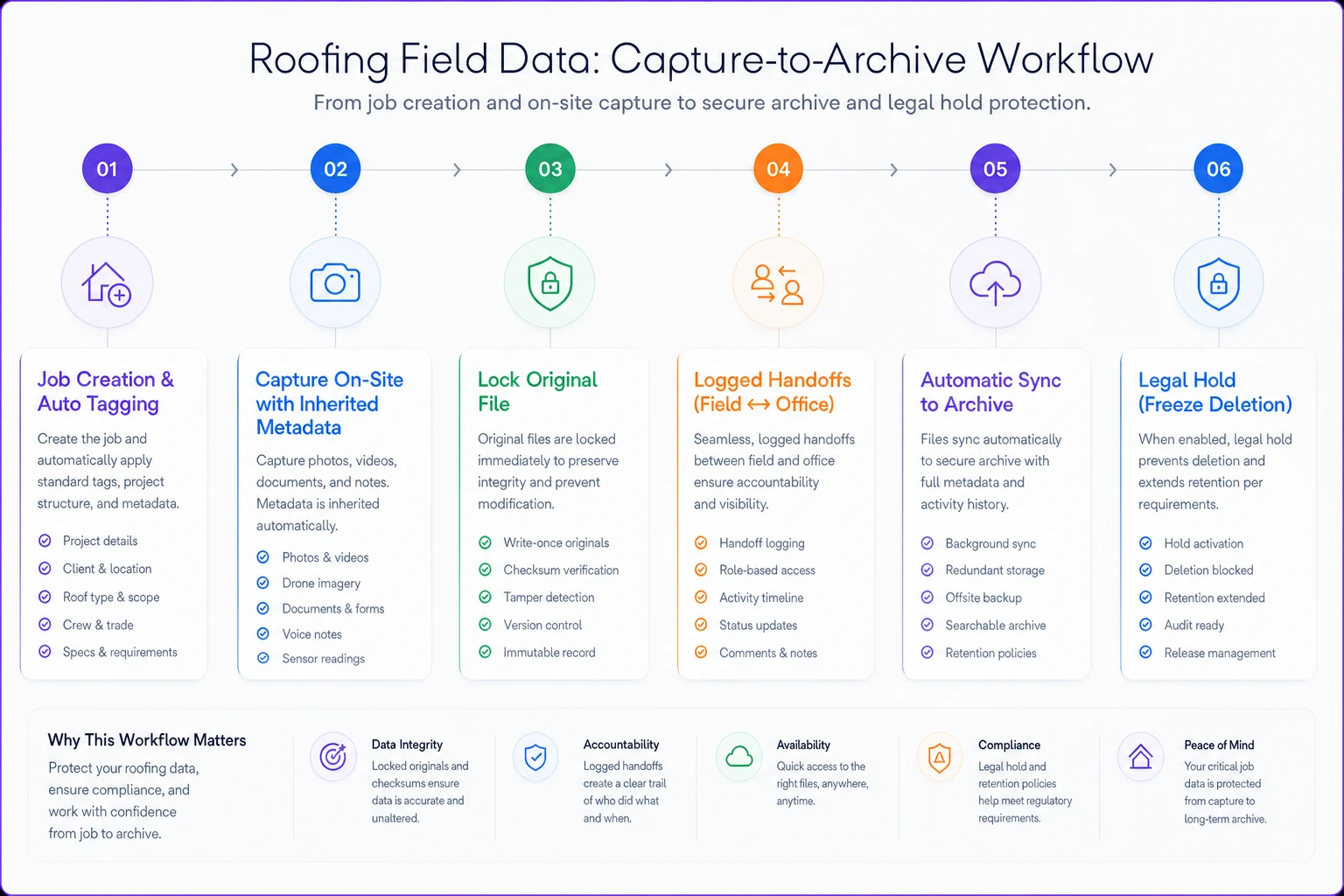
Here's a simple visual of that capture-to-archive flow.
The overall flow from capture to archive tends to break down at the same two spots for most crews — the moment data leaves the field, and the moment it gets handed off between people. Building automatic sync and logged transfers into your process directly addresses both without adding steps for the crew.
Redaction: what leaves your walls, and what shouldn't
Redaction is the part nobody thinks about until it bites them. Your job files are full of things that should never travel outside your company — a homeowner's full name and address in a filename, a shot of the interior showing valuables, a neighbor's kid in the background of a driveway photo, a signature block with personal details.
When you send an evidence packet to an adjuster, or hand job history to a sub, or produce documents in a dispute, that material goes with it unless someone strips it out first. The mistake is treating redaction as a one-off scramble under deadline pressure. It should be a standing rule tied to where data is going.
-
Going to an adjuster or insurer Remove homeowner personal contact info beyond what the claim requires. Keep all technical evidence. Blur faces of bystanders.
-
Going to a subcontractor Job address and technical scope only. Strip homeowner financials, contract pricing, and communication logs.
-
Going to a court or attorney Nothing gets redacted without legal guidance — over-redaction in litigation can look like concealment. This is the one case where you stop and ask a lawyer.
-
Going into a marketing portfolio Written homeowner consent required. Faces, addresses, and identifying details removed.
That fourth one catches people. Posting a great before-and-after shot of a roof with the house number visible, without consent, is a small thing that occasionally turns into an ugly thing. Build the consent step into your closeout and it becomes a non-issue.
The legal-defensibility checklist
Before you consider your governance system done, run it against this. If you can't check every box, you have a specific, fixable gap — not a vague sense of unease.
-
[ ] Every capture carries Job ID, stage, zone, capturer, and automatic timestamp
-
[ ] Timestamps come from a source the crew can't edit
-
[ ] Original files are locked; edits create copies
-
[ ] Every data handoff is logged with time and recipient
-
[ ] A written retention schedule exists for each data type
-
[ ] Automatic purge is running for low-value and expired data
-
[ ] A legal hold mechanism can freeze retention on any job instantly
-
[ ] Redaction rules exist by destination and someone owns them
-
[ ] Homeowner consent is captured for any external or marketing use
-
[ ] You can produce a complete, dated, attributed job file in under 15 minutes
That last box is the real test. If pulling a full defensible job history takes a day of texting people, your system is a filing cabinet on fire — everything's technically in there, but you can't get it out when it counts.
A real scenario: what changes when governance is in place
A mid-sized residential reroofer running five crews had photos and forms spread across a shared drive, two crew leads' phones, and the office coordinator's email. Nothing was labeled consistently. When a homeowner filed a defect complaint roughly two years after install, it took the office manager the better part of two days to reconstruct the job — and even then, several tear-off photos were missing because the foreman who took them had left the company and his phone was gone.
They lost that dispute. Not because the work was bad — the work was fine — but because they couldn't prove it on a timeline. Somewhere in the range of $9k–$12k between the settlement, the office time, and the callback labor. For a single job that should have been easily defensible.
After that, they set a tag floor, a retention table, and an automatic sync so field captures landed in the right job file the same day. The next time a claim surfaced — about fourteen months later — the office manager pulled the complete, dated, attributed job file in under ten minutes and sent the adjuster a clean packet with locked originals. The claim closed in their favor without a fight. The difference wasn't better roofing. It was that the data could speak for itself.
When to build this — and when to wait
Governance costs effort, and there's a real question of timing. Building a full chain-of-custody system when you're a one-truck operation is over-engineering. You'll spend energy on structure you don't need yet.
When it makes sense to build it now:
-
You're running three or more crews, or adding one this year
-
You use subs regularly and data crosses company lines
-
You do meaningful insurance or supplement volume
-
You've had even one dispute where you couldn't find or prove something
-
You operate in a state with long defect-claim windows
When you can keep it lightweight:
-
One or two crews, owner-operated, tight loop between field and invoice
-
Low claim volume, mostly straightforward retail work
-
You can still reconstruct any job from memory in a few minutes
The small shop that reads this and immediately builds a 12-field capture form and a 40-page policy is the one to watch out for. That system will collapse under its own weight because nobody has time to feed it. Start with the five-field tag floor and the retention table. Add chain-of-custody rigor as your crew count and claim exposure grow. Governance should scale with the operation, not ahead of it.
Bringing it together
Field data governance isn't a separate initiative you bolt on. It's the connective tissue between everything your crews already do — the shot lists, the closeout packets, the supplement evidence, the offline sync. Each of those systems produces data. Governance decides whether that data is findable, dateable, and trustworthy when someone challenges it.
The companies that handle this well don't have more disciplined crews. They have systems that make the right thing automatic: tags inherited at job creation, originals locked on capture, handoffs synced instead of remembered, low-value data purged on schedule, and a legal hold that can freeze it all when a dispute goes live. The crew barely notices any of it, which is exactly the point.
Start with the tag floor and the retention table. Get those two right and you've solved most of what actually goes wrong. The rest is refinement you can add as you grow into needing it.
Ready to elevate your roofing operations?
Join hundreds of roofing contractors using Roofyly to streamline workflows, improve crew coordination, and enhance client satisfaction.