



Every roofing contractor knows the drill. You finish documenting additional work that wasn't in the original scope, submit the supplement request, and then wait. Two weeks later, rejection. Not enough evidence. Pricing disputes. Missing documentation. Meanwhile, you've already completed the work, materials are paid for, and your crew has moved on to the next job.
The real kicker? Most supplement rejections aren't about whether the work was legitimate. They're about how you packaged and presented the evidence. After watching contractors grind through supplement negotiations over and over, the pattern becomes obvious — adjusters aren't saying no to the work itself, they're saying no to incomplete documentation that makes their job harder.
What actually moves the needle is treating supplement approvals like a courtroom case where evidence quality determines the verdict. Not charm, not relationships (though those help), but organized, irrefutable documentation that makes approval the path of least resistance for the adjuster.
Why traditional supplement workflows fail at the worst possible moment
The typical supplement process looks something like this: crew discovers additional damage during tear-off, project manager snaps a few photos with their phone, someone writes up a change order, and the office submits it whenever they get around to it. Maybe it includes measurements, maybe not. Pricing pulled from somewhere. Previous supplement approvals stuffed in a filing cabinet nobody can find.
Timing gaps destroy your leverage. When you submit a supplement three weeks after discovering the damage, the adjuster wonders why it wasn't caught initially. Your photos show a completed repair, not active damage. The homeowner has already forgotten the conversation about additional work. Every day between discovery and submission weakens your position.
Evidence fragmentation makes legitimate claims look suspicious. Your decking photos are on the foreman's phone. Measurements scribbled on lumber wrap. The pricing spreadsheet on someone's laptop. When the adjuster asks for supporting documentation, you're scrambling to piece together a coherent story from scattered fragments. Even valid claims appear questionable when presented as a disorganized mess.
The negotiation happens in slow motion. Each back-and-forth cycle takes days. The adjuster requests additional photos — another week. They question pricing — you dig up comparable invoices from six months ago. By the time you've addressed everything, you're 30-45 days past completion and cash flow has taken a serious hit.
The worst part is this chaos compounds with volume. A company running 15-20 insurance jobs per month might have 30-40 active supplement requests in various stages of rejection, revision, and resubmission. Without a systematic roofing insurance supplement workflow, you're essentially gambling on which ones get approved.
The evidence-first framework that changes everything
Smart contractors flip the entire supplement process. Instead of treating documentation as an afterthought, they build evidence packets from day one, knowing exactly what adjusters need before they even ask.
Keep every roofing job on track and on time.
Roofyly helps you manage, schedule, and communicate every roofing project with precision and ease.
- Centralized project planning
- Real-time crew notifications
- Integrated scheduling & client updates
No credit card required
The foundation starts with supplement categorization. Not all supplements carry equal weight or require the same evidence standard. Structural repairs need different documentation than cosmetic upgrades. Emergency work follows different approval timelines than planned additions.
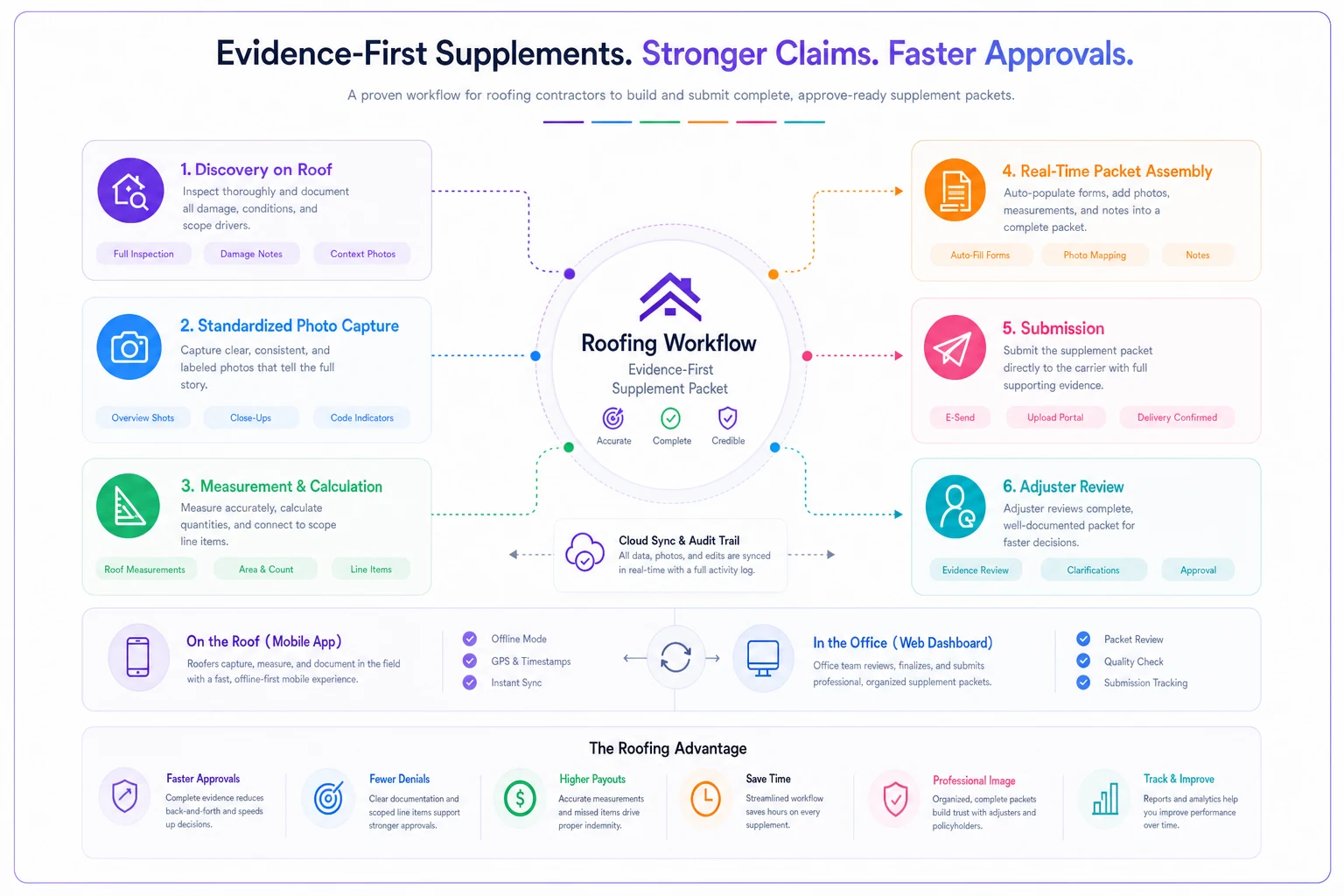
This diagram shows the workflow from discovery through submission.
Here's the hierarchy that actually works:
Priority 1: Safety and structural items These get immediate documentation and same-day submission. Think rotted decking, damaged trusses, compromised structural elements. The evidence standard is straightforward — if failure to repair creates liability, it gets top priority. Package these with detailed structural photos following established standards and submit within 24 hours of discovery.
Priority 2: Code-required updates Building code changes that weren't apparent during initial inspection. New ventilation requirements, ice dam protection in expanded zones, updated flashing standards. These require code documentation alongside field evidence. Include the specific code section, implementation date, and why it applies to this property.
Priority 3: Scope additions Additional vents, extended drip edge, extra layers of underlayment discovered during tear-off. These need comparative evidence — what was estimated versus what actually exists. The key is showing the discrepancy clearly with both measurements and photos.
Priority 4: Betterment items Upgrades the homeowner wants but insurance might not fully cover. These require different framing — you're seeking partial coverage for necessary portions while the homeowner covers the aesthetic side.
Each category demands specific evidence types, submission timelines, and negotiation strategies. A rotted deck board discovered at 2 PM on Tuesday gets documented and submitted differently than upgraded ridge vents the homeowner requested.
Building evidence packets that adjusters actually approve
The difference between approved and rejected supplements often comes down to evidence quality and presentation. Adjusters review dozens of supplements daily — yours needs to be the easiest one to approve.
A complete evidence packet for structural supplements includes the following photo evidence at a minimum of six shots:
-
Wide establishing shot showing location on roof
-
Medium shot showing the affected area in context
-
Close-up of the specific damage
-
Measurement photo with tape measure in frame
-
Repair-in-progress shot
-
Completed repair documentation
Always capture a measurement photo with the tape measure in frame, timestamped, and named per your photo protocol.
But here's what most contractors miss — photos need context and annotation. A picture of rotted decking means nothing without scale, location reference, and severity indicators. Smart operations use standardized photo protocols with consistent naming that tell the complete story even before the adjuster reads your description.
Measurement documentation matters just as much. Raw measurements plus calculation methodology. Don't just say "42 square feet of decking replaced." Show the calculation: "7 sheets of 4x8 decking (224 sq ft) with 15% waste factor due to damage pattern = 257.6 sq ft total material requirement." Include a simple sketch showing where each sheet was installed.
Pricing breakdown needs to be airtight. Material costs with supplier invoices attached. Labor hours with your standard rate sheet. Disposal fees with dump receipts. The goal isn't just showing a total — it's demonstrating that every dollar has backup documentation.
Timeline verification shuts down the "why wasn't this in the original scope" objection before it starts. When was damage discovered? Who made the call to proceed? When was the homeowner notified? When was temporary protection installed?
For code-compliance supplements, add the specific code citation with effective date, permit requirements showing the upgrade is mandatory, and inspector communication if available.
The packet should be assembled in real-time, not retroactively. When your foreman discovers additional damage at 10 AM, they should know exactly what photos to take, what measurements to document, and how to package it for immediate submission. This isn't about creating more paperwork — it's about creating the right paperwork once, instead of chasing documentation for weeks after the fact.
Adjuster meeting scripts that protect margins while maintaining relationships
The supplement negotiation conversation determines whether you eat the costs or maintain your margin. Yet most contractors wing it, hoping their relationship with the adjuster will carry the day. Relationships matter, but structured negotiation matters more.
Before any adjuster interaction, know your numbers cold. Not just the supplement amount — your break-even point, your ideal approval, and your walk-away number. If you're seeking $3,200 for decking replacement, know that $2,800 covers materials and labor, $3,200 maintains standard margin, and anything below $2,600 means you're in the red.
"Hi Sarah, I'm submitting a Priority 1 structural supplement for the Johnson property on Maple Street. During yesterday's tear-off, we discovered 18 sheets of OSB with advanced rot that wasn't visible during your initial inspection. I'm sending over our complete evidence packet now — it includes six angles of photo documentation, moisture readings showing 40% saturation, and our standard decking replacement pricing. The total supplement request is $3,240. Given the structural nature, we've already completed the replacement to maintain weather protection. When can we schedule a brief review?"
Notice what this does — it establishes urgency, provides specific evidence counts, shows the work is complete, and asks for a clear next step.
"I understand the pricing seems high compared to your database. Lumber costs are up significantly from earlier this year, and I'm including three comparable invoices from other jobs this month. The labor hours reflect the complexity of working around two skylights and a valley. Would it help if I broke down the specific complications that increased the time requirement?"
For partial denials, negotiate components separately:
"I appreciate you approving the materials cost. On the labor side, can we discuss what made this situation different from standard installation? The damaged boards were under HVAC equipment that had to be temporarily relocated — that added about 4 hours of coordination with the homeowner's HVAC contractor. Here's documentation of that additional work..."
The key is never making it adversarial. You're problem-solving together. When adjusters feel like you're helping them justify the approval to their supervisors, they work with you instead of against you.
Escalation timelines that prevent profit erosion
Sometimes the initial adjuster says no, and you need a structured escalation path that doesn't burn bridges or drag on for months. The timing of each step determines whether you recover costs or write off losses.
| Timeframe | Action | Notes |
|---|---|---|
| Day 1–3 | Initial submission | Complete evidence packet within 24 hrs of discovery. Follow up by phone to confirm receipt. |
| Day 4–7 | First response window | No response by day 4 — call, don't email. If denied, request specific reasoning in writing. |
| Day 8–14 | Revision and resubmission | Address specific concerns only. Label supplemental items clearly with adjuster request date. |
| Day 15–21 | Supervisor escalation | Request supervisor review procedurally, not as a threat. |
| Day 22–30 | Formal appeal | Submit complete documentation package with formal letter outlining timeline and safety implications. |
| Day 31+ | Alternative resolution | Public adjuster, state insurance commission, or legal consultation based on supplement value. |
Most contractors give up after the first denial, or they escalate too aggressively too quickly. The measured timeline above maintains professionalism while creating appropriate urgency — and it provides clean documentation if you need to involve attorneys or public adjusters later.
Track escalation success rates by adjuster and insurance company. Patterns show up pretty fast. Maybe approvals at supervisor level jump significantly with one carrier. Maybe another company responds better to code-compliance framing. That data shapes how you approach every future negotiation.
Office packet templates that eliminate back-and-forth delays
The fastest way to kill supplement approvals is making adjusters hunt for information. Each round of back-and-forth adds at least 3-5 days minimum.
Comprehensive packet templates anticipate every possible adjuster request. These aren't just document collections — they're structured presentations that guide adjusters toward approval.
Cover sheet with executive summary includes property address and claim number, supplement category, discovery date and responsible party, total supplement request, a one-paragraph explanation, and direct contact information.
Evidence index gives adjusters a photo manifest with descriptions, measurement summary table, pricing breakdown overview, and a supporting document list — all upfront before they dig in.
Photo documentation section needs every photo labeled with location, timestamp, and relevance. Annotations pointing out specific damage. Before, during, and after progression where applicable.
Measurement and calculation section should include a hand-drawn diagram of affected areas, calculation breakdown with waste factors, and material cut lists showing exact usage.
Pricing justification section should have a line-item breakdown matching Xactimate categories where possible, material receipts or supplier quotes, labor hour justification with task breakdown, and comparable job invoices for anything unusual.
Code and permit section when applicable needs relevant code sections highlighted, permit requirements from local jurisdiction, and inspector notes if available.
Timeline documentation covers discovery timestamp, homeowner notification record, temporary protection measures, and work completion confirmation.
Signature section should have homeowner acknowledgment of additional work, your company's certification of completion, and supervisor review sign-off.
Templates alone aren't enough. You need assembly workflows that ensure consistency. When damage gets discovered at 2 PM on a Tuesday, everyone should know their role. The foreman captures photos following the template. The project manager pulls measurements and starts the calculation sheet. The office manager assembles pricing documentation. By 4 PM, a complete packet should be ready for submission.
Store packets digitally with consistent naming conventions. "2024-11-15JohnsonMapleStructuralSupplement_v1" tells you everything at a glance. When adjusters request revisions, save as v2, v3, and so on. Version control prevents confusion and creates a clean record of the negotiation history.
Common supplement killers hiding in plain sight
Even with solid documentation and clear processes, certain mistakes consistently tank supplement approvals. These aren't obvious failures — they're subtle issues that give adjusters easy reasons to deny or reduce payments.
The timing trap catches a lot of contractors. Submitting supplements after final payment means the insurance company has little motivation to keep the claim open. The claim feels closed, adjusters move on, and your legitimate supplement faces extra scrutiny. Always submit before final settlement, ideally within 48 hours of discovery.
The mixed-scope problem trips up even experienced teams. Bundling insurance-covered repairs with homeowner upgrades in the same supplement gives adjusters a reason to question everything. Keep them separate — covered repairs as one supplement, upgrades through a separate homeowner contract.
The documentation mismatch is surprisingly common. Your photos show 6 damaged boards, but you're claiming 12. Maybe the other 6 were underneath and couldn't be photographed, but the adjuster sees a discrepancy. Every quantity claimed needs corresponding visual evidence or a clear explanation of why photo documentation wasn't possible.
The pricing surprise happens when you use premium material pricing and the original estimate specified standard grade. If the initial scope included standard architectural shingles, your supplement for premium shingles needs explicit justification.
The communication gap creates chaos fast. Different people calling the adjuster with conflicting information — your foreman says 200 square feet of decking, the project manager says 250, the office says 300. Designate one person as the insurance contact. No exceptions.
These patterns show up repeatedly across supplement rejections. Companies that catch and fix them typically see approval rates climb from around 60% to somewhere above 85%.
Technology transformation: from paper chaos to automated workflows
This entire roofing insurance supplement workflow gets easier when you add intelligent automation to the mix — not replacing human judgment, but handling the repetitive tasks that cause delays and errors.
Modern operational software platforms manage the routine parts automatically. When your foreman marks damage in their mobile app, it triggers the supplement workflow. Photos get tagged with location and type. Measurements sync to calculation templates. Pricing pulls from current rate sheets. The evidence packet starts assembling while your crew is still on the roof.
The real value isn't just speed — it's consistency. Every supplement follows the same evidence standards. Every packet includes the required components. Every submission meets your timing rules. AI-powered workflow tools catch missing photos before submission, flag pricing discrepancies before adjusters see them, and handle version control automatically.
Over time, these platforms also surface patterns from your own history — which evidence types lead to approvals, which adjusters respond to specific arguments, which insurance companies require particular documentation. That institutional knowledge usually lives in someone's head. Systematizing it means it doesn't walk out the door when a project manager leaves.
The biggest shift is in coordination. When damage gets discovered on the roof, everyone knows immediately. The foreman sees photo requirements on their phone. The office sees the supplement request in the queue. The project manager gets measurement templates pre-populated with job details. No more surprise rejections three weeks later because someone forgot to document something.
The path forward: from reactive scrambling to proactive profit protection
The roofing companies winning the supplement game aren't the ones with the best adjuster relationships or the smoothest talkers. They're the ones who treat supplement management as a core operational competency, not an afterthought.
They know their numbers — average supplement value, approval rates by category, time to payment by insurance company. They track patterns — which adjusters approve structural supplements quickly, which companies fight code requirements, which evidence types drive approvals. They invest in processes — standardized documentation, clear escalation paths, consistent negotiation strategies.
Every rejected supplement is pure profit walking out the door. The work is done, materials are installed, labor is paid. That supplement money is the difference between breaking even and building real margin.
Start with one simple change: track every supplement from discovery through payment. Note what evidence you provided, what objections came up, how you overcame them, and what ultimately drove approval or rejection. Within 20-30 supplements, clear patterns emerge. Those patterns become your playbook.
Then systematize what works. Build your evidence templates. Create your escalation timelines. Train crews on documentation standards. Whether you're using paper forms, spreadsheets, or a full operational platform, consistency matters more than the technology itself.
The supplement game isn't going away. Insurance companies will keep pushing back, adjusters will keep demanding documentation, and margins will keep getting squeezed. But contractors who master the evidence-first approach turn this into a competitive edge. While competitors absorb costs and fight rejections, you collect what you're owed.
Your crews already do the hard work on the roof. Make sure you're getting paid for every square foot of it.
Ready to elevate your roofing operations?
Join hundreds of roofing contractors using Roofyly to streamline workflows, improve crew coordination, and enhance client satisfaction.