



The shingles come off clean. Then your lead installer spots it: soft plywood, maybe some rotten rafters, definitely not part of the original estimate. The homeowner's at work. Your crew's standing around burning labor hours. The production manager's phone is going straight to voicemail.
This scenario kills profit margins on residential tear-offs — not because of the repair itself. Structural issues during tear-offs show up on roughly 15–20% of jobs once you're dealing with homes built before 2000. The profit killer is the decision paralysis that follows discovery.
Most roofing companies handle hidden damage reactively. Crew finds damage, calls the office, waits for someone to drive out, waits for photos to get reviewed, waits for pricing, waits for customer approval. Meanwhile, you've got a partially exposed roof deck and a forecast showing rain in 48 hours.
The operational breakdown of discovery decisions
Hidden structural damage creates a cascading problem that most contractors underestimate. Your crew discovers damage at 10:30 AM. By the time anyone with real decision authority actually sees those photos, it's past lunch. The customer doesn't pick up until 5 PM. Now you're either looking at an overnight exposure situation or sending the crew home early with a half-finished job.
The cost compounds fast — labor sitting idle, potential weather damage liability, tomorrow's job shifting because today ran long. And customer trust erodes the moment they think you're inventing problems to justify an upcharge. Then comes the paperwork: change orders, signatures, permit updates, material deliveries for repairs that were never planned.
What makes it worse is that everyone involved has different information and different priorities. The crew wants clear direction. The production manager wants to keep schedules intact. The salesperson wants to protect both margin and the relationship. The customer wants to understand why their $12,000 roof just became $14,500.
Without a structured decision flow, those competing priorities can stretch a two-hour decision into a two-day ordeal. That's the real damage.
Photo documentation standards that eliminate arguments
The biggest failure point in structural damage decisions is bad documentation. Your installer takes three blurry photos in poor lighting. The office can't assess severity. The customer thinks you're exaggerating. Someone has to drive back out for better documentation, burning another two hours.
Keep every roofing job on track and on time.
Roofyly helps you manage, schedule, and communicate every roofing project with precision and ease.
- Centralized project planning
- Real-time crew notifications
- Integrated scheduling & client updates
No credit card required
Here's what actually works — a consistent photo sequence crews can follow every time:
-
Full affected area visible from 6–8 feet away
-
Something included for scale (tape measure, hammer, boot)
-
Multiple angles showing the extent of damage
-
Clear view of the transition between damaged and sound material
Close-up requirements:
-
Probe or screwdriver showing material softness
-
Any visible rot, mold, or water staining
-
Fastener failures or structural separations
-
Adjacent areas that might also be compromised
Context requirements:
-
Relationship to roof penetrations (chimneys, vents, skylights)
-
Distance from the roof edge or other critical areas
-
Any visible interior damage if accessible from above
The documentation needs to answer three questions immediately: How bad is it? How much needs to come out? Is there an immediate weather protection issue?
Create a simple numbered photo checklist crews can pull up on their phones. Train them to take photos in the same sequence every time. That consistency means office staff can assess damage in under five minutes instead of playing photo detective for half an hour.
A clear, complete documentation set also matters more than most contractors realize when customers later dispute the change order. Having timestamped photos that follow a standard sequence makes the conversation a lot easier.
Always include a tape measure or other object for scale in every overview photo to speed assessment and avoid back-and-forths.
A clear, complete documentation set also matters more than most contractors realize when customers later dispute the change order. Having timestamped photos that follow a standard sequence makes the conversation a lot easier.
Temporary stabilization decision matrix
Once damage is documented, the immediate question is whether you can safely pause or whether you need to stabilize right now. That decision cannot wait for customer approval — weather exposure is a real liability issue, and waiting for a callback isn't an acceptable strategy when rain is in the forecast.
Your on-site decision flow needs clear triggers:
Proceed with temporary protection when:
-
Exposed area exceeds 100 square feet
-
Rain probability over 30% within 72 hours
-
Structural members are exposed, not just sheathing
-
Damage extends into the living space ceiling below
Acceptable temporary measures:
-
Tarping with proper ballast (sandbags, not just loose bricks)
-
Temporary dry-in with felt or synthetic underlayment
-
Emergency sheathing patches for small areas
-
Plastic sheeting for interior protection if needed
Stop work triggers:
-
Damage exceeds 25% of the roof deck area
-
Structural engineer assessment is required
-
Situation looks like a potential insurance claim
-
Cost is likely to exceed a predetermined threshold — typically around $2,500
Give crews explicit authority to make stabilization decisions without waiting on anyone. If $200 in materials and labor tarp an exposed area, that's a far better outcome than a $20,000 interior damage claim because three approval levels couldn't connect before a storm came through.
Change order language that prevents payment disputes
Most change order disputes trace back to language that's either too vague or too technical. "Additional wood replacement as needed" doesn't hold up when a customer pushes back. Neither does a paragraph full of construction jargon the homeowner can't follow. You need templated language that's both legally protective and clear to a non-contractor.
Structure your change order templates around these components:
-
Discovery description "During tear-off, damaged [decking/rafters/fascia] discovered in [location]. Damage not visible during initial inspection due to existing roofing materials."
-
Scope of additional work "Replace [X square feet] of [material type] at [location]. Work includes removal of damaged materials, installation of new [specific materials], and integration with existing structure."
-
Pricing breakdown - Materials: $X (itemized if over $500) - Labor: $X (hourly rate × estimated hours) - Disposal: $X - Total additional cost: $X
-
Critical inclusions - Photos referenced by number - Statement that damage was concealed and not reasonably discoverable - Timeline impact if any - Payment terms (due with final invoice, not as a separate transaction) - Customer authorization via signature or recorded verbal approval
Keep pre-written templates ready for your most common scenarios: decking replacement, rafter repairs, fascia and soffit work, and unexpectedly extensive underlayment replacement. A good template turns a 45-minute admin task into a five-minute one.
Customer communication scripts that maintain trust
How you handle the initial conversation about unexpected damage determines whether customers see you as honest or opportunistic. Most crews fumble it by being either too technical or too vague — both create suspicion.
Train your team on a consistent communication sequence:
Initial notification:
-
"Hi [Name], this is [Installer] from [Company]. We've started your tear-off and found some damaged [decking/structure] that wasn't visible before. I'm sending you photos now so you can see exactly what we found. The affected area is about [size] and located [location]."
Explanation phase:
-
"This type of damage typically comes from [simple explanation — nail pops creating water entry points, inadequate ventilation, normal age deterioration]. We caught it before it caused any interior damage, which is the good news. The issue is it needs to be repaired before we can install your new roof."
Options presentation:
-
"There are two paths here. We can do a proper repair for around $[amount], which covers [brief scope]. Or we can do a temporary patch that might hold for [timeframe] but carries some risk of early failure. The full repair would add [timeline impact] to completion."
Urgency without pressure:
-
"We need a decision by [specific time] to keep your project on track. If we haven't heard back by then, we'll apply temporary protection and may need to adjust the completion date depending on material availability."
Avoid terms like "extensive damage," "major structural failure," or "serious problem" unless they're accurate. Inflated language makes customers defensive before you've even gotten to pricing.
Approval time targets that keep projects moving
The repair itself rarely kills a schedule. Waiting for approval does. Setting explicit time targets for each decision level keeps everything from grinding to a halt.
Standard approval timeline:
| Stage | Target Time |
|---|---|
| Photo documentation complete | 30 minutes from discovery |
| Office assessment and pricing | 45 minutes from photo receipt |
| Customer notification | 15 minutes from pricing completion |
| Customer decision deadline | 2 hours from notification |
| Proceed or pause decision | Immediate upon deadline |
Escalation triggers:
-
No customer response within 1 hour
Second attempt via text and email
-
No response within 2 hours
Proceed with stabilization only
-
No response by end of day
Project pause and reschedule discussion
Pre-authorized repair thresholds:
-
Under $500 — Crew lead proceeds with customer notification
-
$500–$1,500 — Production manager approval required
-
$1,500–$3,000 — Sales manager or estimator approval
-
Over $3,000 — Owner or GM approval plus customer signature required
That structure prevents the bottleneck where everything needs the owner's sign-off while still maintaining real oversight on anything that meaningfully changes job cost.
Converting decision chaos into systematic profit protection
A roofing company running 300 jobs annually will probably hit hidden damage on somewhere between 45 and 60 of them. Without a structured process, each incident burns multiple hours of productivity between discovery and resolution — crew standing around, back-and-forth calls, delayed decisions, potential weather exposure. Across a full season, that adds up to somewhere around 200 hours of lost productivity, not counting weather damage claims or customers who dispute vague change orders.
The field decision tree isn't about avoiding hidden damage — you can't. It's about responding fast enough that damage discovery doesn't derail your whole operation. When crews know exactly how to document, when to stabilize, and how long to wait for approval, a two-day problem becomes a two-hour speed bump.
Customers notice this too. Instead of feeling ambushed by surprise costs, they experience a company that found a problem, showed them clear documentation, explained the options without pressure, and kept the project moving. That's the version of the story that generates referrals.
Building your on-site structural repair decision flow
Start by mapping your most common hidden damage scenarios. Build photo standards for each type. Create change order templates your admin team can populate in minutes. Script the customer communication so nobody improvises when delivering bad news.
AI-powered operational software can make this systematic rather than situational. When crews upload field photos directly into a job record, trigger a change order based on damage type, and get notified automatically when customer approval comes through, the whole decision cycle compresses from hours to minutes. The platform handles routing, documentation, and notifications — the actual judgment calls still sit with your people.
Here's a simple workflow visualization crews and office staff can follow.
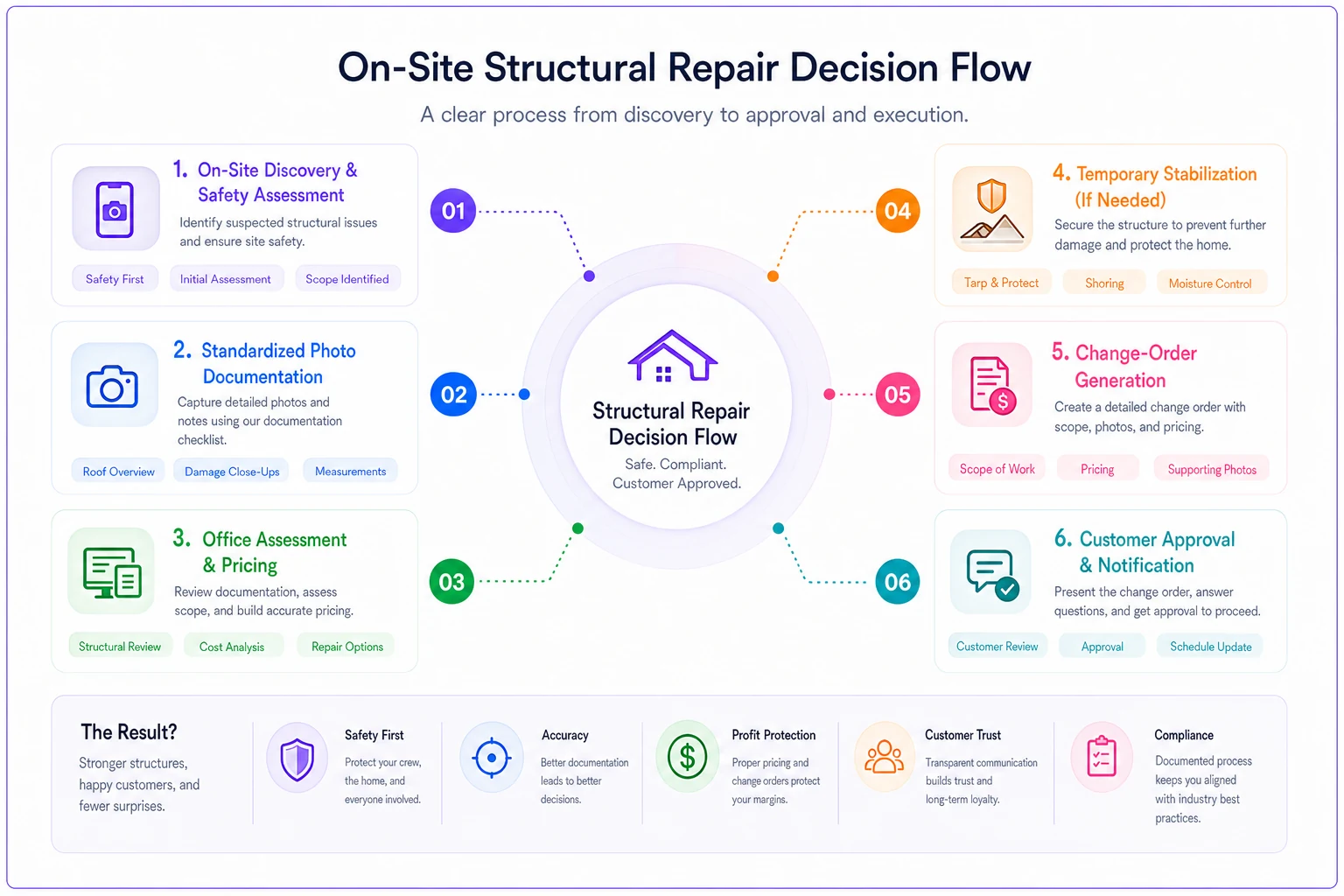
That said, even a laminated decision tree in every crew truck beats the current reality at most roofing companies, which is complete improvisation every time something unexpected turns up.
Your on-site structural repair process determines whether hidden damage becomes a clean change order or a drawn-out dispute. The structure you put in place now saves dozens of field arguments, customer conflicts, and weather damage claims across the season.
Document the process. Train the communication. Set the time limits. Then let your crews solve the problems they run into every week instead of waiting on permission to act.
Ready to elevate your roofing operations?
Join hundreds of roofing contractors using Roofyly to streamline workflows, improve crew coordination, and enhance client satisfaction.