


Most roofing shops adopt field automation the same way they buy a new nail gun — somebody tries it on a job, it saves time, and six months later half the crews are leaning on it without anyone writing down how it works. Photo tagging, damage detection, measurement reconciliation, supplement drafting, scheduling suggestions — all of it quietly becomes part of how estimates get built and claims get documented.
Then a claim gets contested. An adjuster asks why your estimate flagged hail bruising on a slope the carrier's inspector called "wear and tear." Or a homeowner's attorney in a small-claims dispute wants to know who decided the decking needed replacement and what that decision was based on. Suddenly the question isn't "does the tool work" — it's "can you prove what it did, when, and who signed off on it."
That gap is what field AI governance for roofing is actually about. Not banning the tools. Not drowning crews in paperwork. Making sure that when field automation touches a decision that ends up in an estimate, a supplement, or a court exhibit, you can reconstruct what happened and defend it.
This article walks through the audit-log schema, the human review gates, the model-versioning discipline, and the evidence bundles that make that possible — without turning your office into a compliance department.
The real problem: automation creates decisions nobody remembers making
The pattern that keeps showing up across roofing operations that scale past two or three crews: automation doesn't make one big obvious decision. It makes hundreds of small ones that blend into the normal flow of work.
A photo gets auto-tagged as "hail impact, north slope." An estimator glances at it, accepts it, moves on. A measurement tool reconciles a satellite estimate against field photos and nudges the squares up by 4%. Nobody notices because it's close to what they expected. A supplement draft suggests adding drip edge based on jurisdiction code logic. The office approves the batch.
Each step feels minor. But two months later, when a carrier denies the supplement or a homeowner disputes the scope, you're looking at a final document that was shaped by software — and you have no record of which parts were machine-suggested, which parts a human changed, or what the tool was actually working from when it made the call.
The dangerous version of this isn't when the tool is wrong. It's when the tool is right but you can't prove the reasoning. Adjusters and attorneys don't need to show your automation failed. They just need to show you can't account for it. An estimate you can't explain is an estimate you can't defend, no matter how accurate it was.
This is a close cousin of the problem covered in field data governance and photo retention for roofing teams — except instead of asking "can you produce the evidence," you're asking "can you produce the decision trail behind the evidence."
What actually breaks as you scale
With one crew and an owner who handles all the estimating, governance is informal and that's fine. The owner remembers every job. He knows which photos came from which roof, and he knows when he overrode a tool suggestion because he's been doing this for twenty years. That memory is the control system. It just doesn't survive growth.
Keep every roofing job on track and on time.
Roofyly helps you manage, schedule, and communicate every roofing project with precision and ease.
- Centralized project planning
- Real-time crew notifications
- Integrated scheduling & client updates
No credit card required
Here's roughly where things start to crack:
-
At 2–3 crews, estimating splits off from the owner. Now two or three people are accepting or editing automated outputs with no shared rule for when you trust the tool and when you don't. One estimator accepts auto-measurements without question; another re-measures everything. Your estimates become inconsistent in ways you won't notice until a claim exposes them.
-
At 4–8 crews, the office starts batch-processing. Supplements, photo packages, and scope documents move through faster than any one person can genuinely review. "Approval" becomes clicking through. The human-in-the-loop still technically exists but it's not really doing anything.
-
Past that, you've probably switched tools or versions at least once. The model that tagged photos in the spring behaves differently than the one running in the fall. Nobody logged the switch. So when you pull up a nine-month-old claim, you can't even say which version of the software produced the output you're now defending.
The through-line: informal governance runs on one person's memory, and memory doesn't batch. The moment decisions outnumber what a single human can personally track, you need a record that does the remembering.
The audit-log schema: what to capture on every automated decision
The foundation of defensible field automation is a log that answers five questions for any decision a tool influenced: what, when, who, on what basis, and what changed.
You don't need an enterprise logging system. You need these fields captured consistently. Here's a practical schema that holds up for adjusters and courts without burying your crews:
| Field | What it records | Why it matters in a dispute |
|---|---|---|
decision_id | Unique ID for the automated action | Lets you pull one specific decision out of thousands |
job_id | Links to the specific job/claim | Ties the decision to the right roof |
timestamp_utc | When the tool acted | Proves sequence — did the tool suggest before or after the human looked? |
toolname + modelversion | Which system and which version | You can state exactly what produced the output |
input_refs | Which photos/measurements/data fed the decision | Shows the decision wasn't invented from nothing |
output_summary | What the tool suggested (tag, measurement, scope line) | The actual claim being defended |
confidenceorbasis | Confidence score or rule triggered | "The tool flagged this because X," not a black box |
human_action | accepted / edited / rejected / unreviewed | The single most important field |
humanuserid | Who reviewed it | Accountability and chain of custody |
edit_delta | What the human changed, if anything | Separates machine judgment from human judgment |
review_timestamp | When the human acted | Proves a human actually looked, and when |
The humanaction and editdelta fields are where most shops have nothing today. Everyone logs the tool's output. Almost nobody logs whether a human genuinely engaged with it or just let it ride. That distinction is the whole ballgame when an attorney asks "who decided this."
One thing worth flagging: if your logs show human_action as "accepted" on 98% of outputs within two seconds of the tool producing them, you don't have a human-in-the-loop. You have a rubber stamp, and it won't hold up under scrutiny. Real review leaves a realistic time signature and a reasonable rate of edits.
The diagram below shows the workflow for capturing and packaging audit entries.
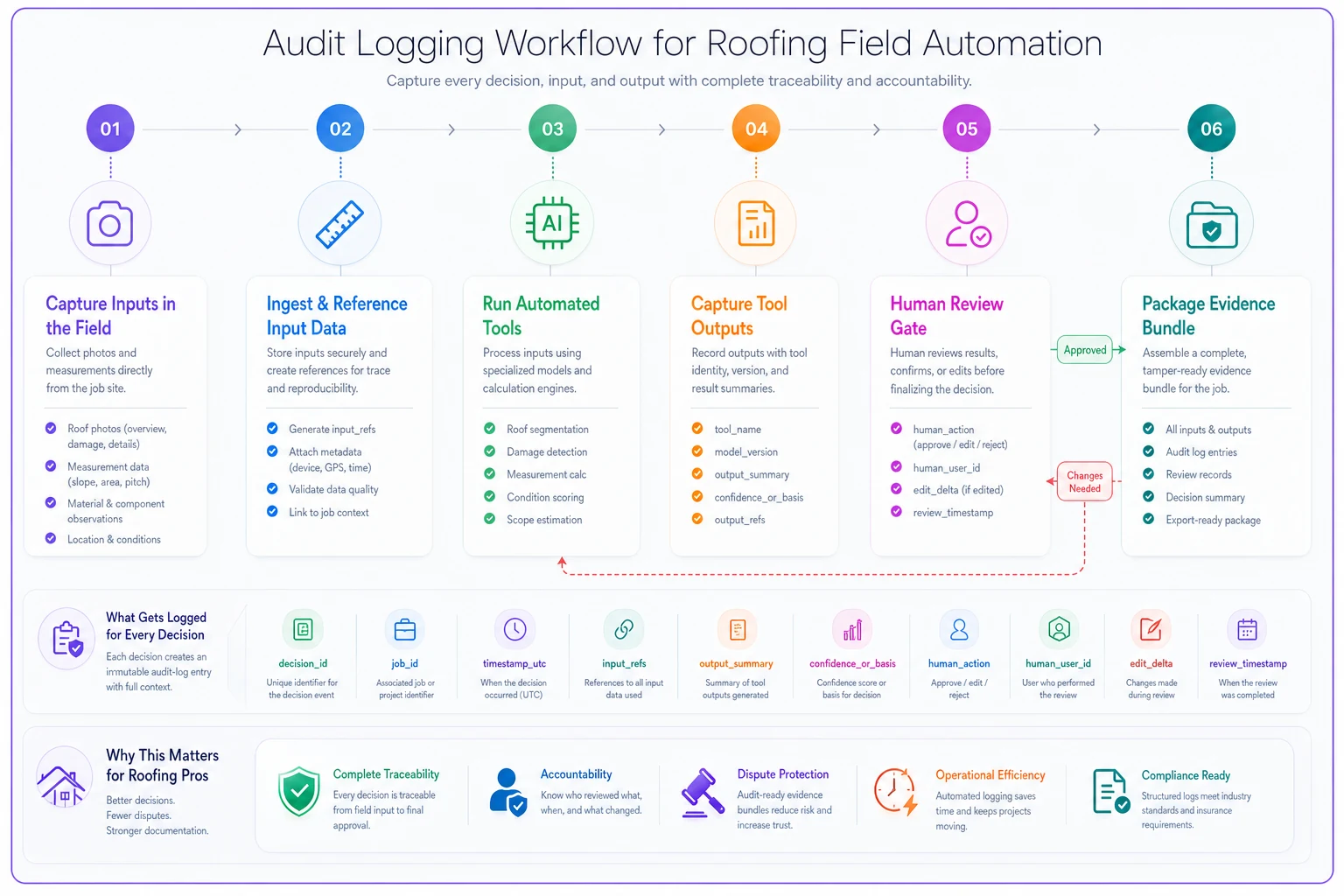
The audit-log schema is purposely minimal but consistent: capture the tool, the inputs, the output, the human interaction, and the timing. That's the record you need to reconstruct a decision.
Human-in-the-loop gates: deciding where a human must sign
Not every automated action needs a human gate. If the tool renames a photo file or sorts images by slope, let it run — logging is enough. Gates are for decisions that carry money or liability.
A useful frame: a gate belongs anywhere an automated output can end up in a document someone outside your company relies on — an estimate, a supplement, a scope of work, a court exhibit, an inspection packet.
-
Auto-run, log only — Organizational actions with no scope impact. Photo tagging, folder sorting, basic measurement capture. No human gate required; the log is the control.
-
Review before use — Anything that changes quantity, scope, or classification. Measurement reconciliation that alters square footage, damage classifications that drive coverage decisions, suggested scope lines. A named human must accept or edit before it moves to an external document.
-
Dual review / senior sign-off — High-dollar or high-dispute-risk items. Full tear-off recommendations, structural decking calls, large supplements, anything over a dollar threshold you decide internally. Two reviewers, or one senior estimator, with both captured in the log.
Map gate tiers to your rules-based thresholds so the same triggers that drive field decisions determine when review is required.
The mistake shops make is applying the same gate to everything. Gate too hard and crews route around it. Gate too soft and the big decisions slip through unexamined. The tiering is what makes governance survivable day-to-day — heavy review lands only where it's actually earned.
This connects directly to how you set decision thresholds in the first place. If you've built out something like a rules-based metrics framework that turns roofing data into clear field decisions, your gate tiers should map onto those same thresholds — so the rules triggering a review are consistent with the rules driving everything else in the field.
Model-versioning rules: knowing which tool produced which output
This is the governance piece roofing shops ignore until it bites them.
-
Record the version on every logged decision. The
model_versionfield isn't optional — it's what lets you say "this output came from version 2.3, which applied these rules." -
Log every version change as its own event with a date and who approved the switch. When a vendor pushes an update, that's a dated entry in your records, not a silent change.
-
Freeze the version reference on closed claims. Once a job's documentation is finalized, the version that produced it is locked in the record even after you've upgraded. You're not defending today's tool — you're defending the one that did the work at the time.
-
Keep a short note on significant behavior shifts. If an update noticeably changes how the tool classifies damage or measures, write one line about it. A year later, that note explains why April estimates and October estimates look slightly different.
A concrete example of why this matters: a contractor defends a contested supplement from eight months back. The adjuster argues the damage classification was unreliable. The contractor pulls the log, states the exact version, shows the confidence basis and the senior estimator who signed off, and references a change note confirming that version's logic was unchanged through the claim period. That's a defensible position. "I think it was whatever version we had back then" is not.
Evidence bundles: packaging decisions for adjusters and courts
An audit log is for you. An evidence bundle is for everyone else — the adjuster, the attorney, the small-claims judge. It translates your internal records into something an outside party can read and trust without needing access to your systems.
The goal of a bundle is to tell a clean story: here's the roof, here's what we found, here's how we documented it, here's who decided what, and here's proof nothing was fabricated after the fact.
-
Cover summary — Job ID, address, dates, scope in plain language, and a short statement of what's being defended.
-
Source evidence — Original photos with capture timestamps and location data intact, plus original measurements. Unedited, in original resolution.
-
Decision trail — The relevant audit-log entries showing what the tools suggested, the version that produced each output, the confidence or rule basis, and what the human did with each one.
-
Human sign-off record — Who reviewed, when, and what they changed. This is what separates "a human exercised judgment" from "software did it automatically."
-
Version statement — A plain-language note stating which tool versions were in use and that they're locked for this claim.
-
Chain-of-custody note — A short statement confirming evidence was captured in-field and stored unaltered, with retention dates.
The difference between a bundle that holds and one that doesn't usually isn't evidence quality — it's whether the human judgment is visible. Adjusters and courts are far more comfortable with "a tool suggested hail damage, and a licensed estimator confirmed it in person on this date" than with "our system detected hail damage." Make the human accountability the spine of the bundle, with automation as supporting detail.
For contested carrier supplements specifically, this structure ties directly into the evidence-first approach in the insurance supplement workflow and adjuster negotiation kit — the audit trail gives the supplement its backbone, and the negotiation kit gives it its argument.
Override and exception checklists: the human judgment layer
Automation will be wrong sometimes. The ability to override it cleanly is itself a governance control — an override that isn't logged looks, in hindsight, identical to tampering. So the override process needs to be as disciplined as the automation it's correcting.
-
[ ] What did the tool suggest? Record the original output before changing it.
-
[ ] What are we changing it to? Record the override value.
-
[ ] Why? One line of reasoning — "field inspection showed no impact, tool misread granule loss as hail."
-
[ ] Who's overriding? Named person, with authority appropriate to the decision tier.
-
[ ] Evidence supporting the override? Reference the photo, measurement, or observation that justifies it.
-
[ ] Does this need a second reviewer? For high-tier decisions, yes — log both.
The exception side matters too. Sometimes a tool can't produce an output at all — a photo's too dark, a measurement won't reconcile, the roof geometry confuses the classifier. Those gaps need to be logged as exceptions, not silently filled by a human guess that later looks like it came from the tool. An exception log entry says: "automation couldn't process this, a human handled it manually, here's who and here's the basis." That honesty is protective. Pretending the tool did something it didn't is how defensible documentation becomes indefensible.
The pattern worth watching is override clustering. If one estimator is overriding the measurement tool on 40% of jobs, either the tool is miscalibrated for your roofs or that estimator is working around a control. Either way, the override log just told you something your P&L hadn't yet.
When heavy governance makes sense — and when it doesn't
Governance has a cost, and pretending otherwise is how you end up with a system crews quietly ignore.
When this level of governance makes sense:
-
You're running multiple crews and estimating has left the owner's direct oversight.
-
A meaningful share of revenue runs through insurance claims and supplements.
-
You operate in markets where documentation gets tested — litigious areas, high-dispute carriers.
-
Automation is touching scope, measurement, or damage classification — decisions with real dollars attached.
When it's overkill:
-
Single crew, owner does all estimating, low claim volume. Your memory is still a valid control. Capture the basics and move on.
-
Automation is purely organizational — sorting and naming photos with no scope impact. Log it and leave it.
Who should not do this yet: A shop that hasn't gotten basic photo and data retention under control. Governance of automated decisions sits on top of clean evidence capture. If field photos are still scattered and inconsistent, fix that foundation first. Layering decision audits over chaotic source data just gives you an organized record of a mess.
The honest middle path for most growing shops: capture the full audit-log schema from day one because it's cheap to log and expensive to reconstruct later, then phase in the human-gate tiering and evidence bundles as claim volume and crew count actually demand them.
A real scenario: the contested tear-off
A mid-size reroofing contractor — around six crews, heavy on insurance work — ran into a dispute that illustrates why this matters.
A carrier contested a full tear-off on a 32-square roof, arguing the decking replacement wasn't justified and that the damage was pre-existing. The amount in dispute landed somewhere in the $9k–$11k range once you factored in the decking, tear-off labor, and supplement lines built on top of it. The damage classification had been partly tool-assisted — photo analysis flagged moisture intrusion patterns, and the estimator confirmed on site.
Before any governance was in place, that's where they'd have lost. They'd have had photos and a final estimate, but no way to show the decision sequence — whether a human actually inspected or just accepted a tool output. The carrier's argument hinged on exactly that ambiguity.
Instead, they pulled the evidence bundle. It showed the original moisture-pattern photos with intact timestamps, the tool's output and the version that produced it, the estimator's in-person confirmation dated the same day with his sign-off, and an override note where he'd actually expanded the decking scope beyond what the tool suggested because he found soft decking the photos hadn't captured. The human judgment was all over the record, with automation clearly in a supporting role.
The supplement held. Not because the tool was impressive, but because the decision trail was complete and the human accountability was obvious. Having that discipline in place turned a handful of borderline contested claims per year from coin-flips into defensible positions — probably low-to-mid five figures annually that had previously evaporated in disputes.
The minimal compliance checklist for crews and offices
You don't need all of this on day one. But this is the floor for a shop running field automation on decisions that matter.
For crews (field):
-
[ ] Capture source evidence (photos, measurements) unaltered, with timestamps intact.
-
[ ] Note when automation couldn't process something — flag the exception, don't fill the gap silently.
-
[ ] Don't edit tool outputs on your own for scope-level decisions; route them to whoever has authority.
For the office (estimating/admin):
-
[ ] Every scope-affecting automated output gets a logged human action
accepted, edited, or rejected.
-
[ ] High-tier decisions (tear-offs, structural, large supplements) get senior or dual sign-off.
-
[ ] Overrides follow the override checklist — original value, new value, reason, evidence, reviewer.
-
[ ] Model version is recorded on every logged decision and frozen on closed claims.
-
[ ] Version changes are logged as dated events with a short behavior note.
For the owner/manager (oversight):
-
[ ] Spot-check logs monthly for rubber-stamping — outputs accepted instantly with zero edits.
-
[ ] Watch override clustering for signs of miscalibrated tools or controls being worked around.
-
[ ] Keep evidence-bundle templates ready so you're not building them under deadline during a live dispute.
Building these habits early is significantly cheaper than reconstructing a defensible record after a claim is already in dispute.
Bringing it together
The shift that matters here is straightforward to describe and harder to maintain: automation in the field is fine, as long as every decision it touches has a human name and a timestamp attached to it. The tools can suggest, measure, classify, and draft all day. What keeps you defensible is that a person with authority looked, decided, and left a record — and that you can reproduce which version of which tool was involved.
Shops that get burned aren't the ones using automation. They're the ones who let automation make decisions that nobody can later account for. The log, the gates, the version discipline, the evidence bundles — none of it is about distrusting the tools. It's about making sure that when someone outside your company asks "who decided this and on what basis," you have a clean, complete answer ready.
In roofing, where the money lives in contested claims and disputes arrive months after the work is done, that answer is worth more than almost any efficiency gain the automation itself delivers.
In roofing, where the money lives in contested claims and disputes arrive months after the work is done, that answer is worth more than almost any efficiency gain the automation itself delivers.
Ready to elevate your roofing operations?
Join hundreds of roofing contractors using Roofyly to streamline workflows, improve crew coordination, and enhance client satisfaction.