



Most roofing companies don't lose money on the roof. They lose it in the gap between "the crew is done" and "the money hit the account." That gap is where invoices get contested, holdbacks stretch to 90 days, and a $22k reroof turns into a $17k collection headache with a couple hundred dollars in legal noise on top.
The fix isn't chasing homeowners harder. It's building your billing so that every dollar you request is already backed by proof the customer agreed to before they saw the number. That's what progressive billing in roofing should actually be — not "bill a third up front, a third at dry-in, a third at completion" as some arbitrary schedule, but a system where each milestone releases money only when a defined evidence packet exists and passes a check.
Here's how the whole thing connects, where it breaks as you scale, and what a defensible version actually looks like.
Why milestone billing quietly falls apart
The typical progressive schedule looks clean on paper. Deposit, dry-in draw, completion draw. Three invoices, three payments, done.
In real operations, this is what actually unfolds. The deposit goes fine. Then the crew tears off, hits some decking rot, swaps a few sheets, and the foreman texts the office a couple blurry photos. Office sends the dry-in invoice. Homeowner looks at it, sees a number higher than expected, and goes: "Wait, what am I paying for right now? The roof isn't even done."
Now you're in a conversation. And every conversation about money that starts after you've sent the invoice is one you're already losing. The homeowner has leverage because you've done the work and need to get paid. You're explaining backwards.
The root problem is that the milestone was a time marker, not an evidence marker. "Dry-in" as a billing trigger means nothing to a homeowner. "Underlayment installed, all penetrations flashed, ice-and-water in the valleys, here are 14 timestamped photos and your signed approval on the two sheets of decking we replaced" — that means something. One is a date. The other is proof.
This is the same failure pattern behind common handoff breakdowns that cause invoice delays. The billing team invoices off a status flag that production set, but the artifacts that justify the status never traveled with it. Sales knows one thing, production knows another, accounting bills on a guess.
The core idea: a milestone is a packet, not a phase
Reframe every billing milestone as a minimum evidence packet. Money doesn't release because a phase is "done." It releases because a specific bundle of artifacts exists, is complete, and has been accepted.
Keep every roofing job on track and on time.
Roofyly helps you manage, schedule, and communicate every roofing project with precision and ease.
- Centralized project planning
- Real-time crew notifications
- Integrated scheduling & client updates
No credit card required
An evidence packet is a defined list of items that must be present for that milestone to be billable. If anything's missing, the milestone isn't billable — full stop. No "we'll get the photo later." The packet is what makes the invoice un-arguable.
| Milestone | Minimum evidence packet | What it kills |
|---|---|---|
| Deposit / mobilization | Signed contract, scope sheet, measurement report, material order confirmation, start-date acknowledgment | "I never agreed to that scope" |
| Tear-off complete | Deck photos (full field), any rot/damage documented with location + signed change approval, disposal confirmation | Surprise decking charges |
| Dry-in | Underlayment photos, valley/penetration flashing photos, timestamped, homeowner or inspector acknowledgment | "The roof isn't done, why am I paying" |
| Shingle/system complete | Full-field finished photos, ridge/hip detail, drip edge, gutter apron, product labels/wrappers documented | Material substitution disputes |
| Final acceptance | Cleanup photos, magnet sweep confirmation, final walkthrough sign-off, warranty packet delivered | Holdback stalling, callback leverage |
Notice the pattern: each packet is designed to shut down the specific dispute that shows up at that stage. You're not collecting photos for the sake of photos. You're pre-answering the objection before the invoice goes out.
Where the change orders sneak in
The single biggest source of milestone billing disputes is the decking swap during tear-off. It's unplanned, it's mid-job, and the homeowner isn't standing on the roof watching it happen. So when it lands on the invoice, it feels invented.
This is why your evidence packet at the tear-off milestone can't just be "photos of the rot." It has to include the approval that happened before the wood went on. Photo of the damaged sheet with a location marker, the count, the per-sheet price, and a signed or texted "yes, proceed" with a timestamp that's earlier than the repair.
If your change approvals aren't governed with real time rules and evidence gates, this falls apart the moment you're running more than one crew. A tight change-order governance system with SLAs and evidence gates is what makes the tear-off milestone billable without an argument. The change order and the milestone packet are the same document flow — the approval captured in the field is the evidence that unlocks the money later.
Worth naming directly: crews that document rot well but capture approval poorly still lose these disputes. Great photos of decking the homeowner never agreed to replace is just great photos of an unauthorized charge. The approval matters more than the picture.
Dispute SLAs — put a clock on the homeowner
Most contractors never do this: define a dispute window in the contract, tied to each milestone.
When you send a milestone invoice with its evidence packet, the homeowner gets a fixed window — 3 business days is a reasonable starting point — to raise a specific, itemized objection. Not "I don't like it." A specific line: "I dispute the two decking sheets." If they don't dispute within the window, the milestone is deemed accepted and payment is due.
Without a dispute SLA, objections show up whenever the homeowner feels like it — usually at the final draw, when they've bundled up every small grievance from the whole job and are using it to negotiate the holdback down. A dispute SLA forces objections to surface at the milestone they belong to, when the evidence is fresh and the fix is cheap.
-
Milestone invoice sent with evidence packet attached (same day the milestone is verified).
-
3 business days for the homeowner to raise a written, itemized dispute.
-
48 hours for your office to respond to a raised dispute with the relevant packet artifact.
-
Undisputed items become due immediately — you never hold the whole invoice hostage over one contested line.
-
Escalation only triggers on the specific disputed amount, not the full milestone.
That last point is the one people miss. Separate the clean money from the contested money. If a homeowner disputes $600 of decking on a $7,800 dry-in draw, you collect the $7,200 now and sort out the $600 separately. Never let one small dispute freeze a large payment.
A realistic dispute SLA structure:
Escrow and holdback rules that don't strangle cashflow
Holdbacks are fine. Uncontrolled holdbacks are how good companies go broke while technically profitable on paper.
The mistake is letting the holdback be vague — "final payment on completion" — because "completion" is exactly the word homeowners weaponize. There's always one more thing. A shingle looks slightly off, a downspout sits wrong, a nail in the driveway. Suddenly your final 30% is being held over $150 of nitpicks.
Fix it by making the holdback specific and releasable in pieces:
-
Cap the holdback at a number tied to remaining risk, not a percentage habit. On a clean install, 10% covers punch-list risk. 30% is you financing the customer's caution.
-
Define exactly what releases it
the final acceptance packet. Cleanup photos, magnet sweep, signed walkthrough, warranty docs delivered. When the packet is complete, the holdback is due — the homeowner doesn't get to invent new conditions.
-
Separate punch-list holdback from the main balance. If there's a genuine open item, hold only the reasonable cost of that item, not the entire remaining balance.
A typical example: a company running 30% final holdbacks on $20k+ jobs was routinely sitting on $18k–$25k of "completed" money across active jobs at any time, most of it stalled over trivial punch items. Restructuring to a 10% holdback with a defined final-acceptance packet, plus itemized punch-list holds, pulled somewhere around $12k–$16k of that back into current cashflow without changing a single thing about actual work quality. The money was always earned. It just wasn't defensibly demandable.
The collections escalation ladder
When a payment goes past due, most offices improvise. Someone remembers to call, then forgets, then three weeks later a partner gets angry and threatens a lien out of nowhere. Homeowners can smell disorganization, and it invites stalling.
A defined ladder removes the emotion and makes late payment feel like a process, not a mood.
Tier 1 — Day 1–3 past due: Automated, friendly reminder. Invoice and evidence packet re-attached. "Just confirming you received the completion documents." No pressure, just presence.
Tier 2 — Day 4–7: Direct call from the office, logged. Reference the dispute window: "The acceptance window closed on the 14th, we want to make sure there's nothing outstanding on your end." This is where you confirm it's a payment issue, not a dispute issue.
Tier 3 — Day 8–14: Written notice referencing the contract terms — the specific clause, the accepted milestone, the dispute SLA that already passed. Calm, factual, on letterhead.
Tier 4 — Day 15–30: Formal pre-lien or notice of intent per your state's timeline. This is not a bluff — it's a deadline-driven legal step, and it has to be tracked because lien rights expire.
Tier 5 — Beyond 30: Lien filing and/or small-claims prep. By this point your evidence packets are your case. Everything you documented at each milestone becomes the exhibit list.
That last tier is where the whole system pays off. If you've been building evidence packets all along, you're not scrambling to reconstruct what happened — you already have a defensible file. Assembling a small-claims evidence packet for homeowner disputes becomes copy-paste instead of a week of digging through texts and camera rolls. The billing system and the legal-defense system are the same system, just used at different moments.
The workflow, start to finish
Here's how it flows when it's actually working:
-
Sales closes and the contract locks the milestone schedule, the dispute SLA, and the holdback rules — all in writing, all acknowledged.
-
Production runs the job and captures each milestone's packet as the work happens, not reconstructed after the fact.
-
The foreman doesn't mark "dry-in complete" and walk away — the milestone status can't flip until the required photos and acknowledgments are there.
-
When the packet is complete, the milestone becomes billable and the invoice goes out with the packet attached the same day.
-
The dispute clock starts. Undisputed amounts collect. Disputed lines split off into a separate, tracked resolution.
-
Past-due invoices climb the escalation ladder on a schedule nobody has to remember manually.
The key structural point: the field crew's documentation and the office's billing are locked together. In the broken version, production does the work and accounting tries to justify a bill after the fact. In the working version, completing a milestone is completing the invoice's justification. There's no gap for a dispute to live in.
A quick visual of the workflow:
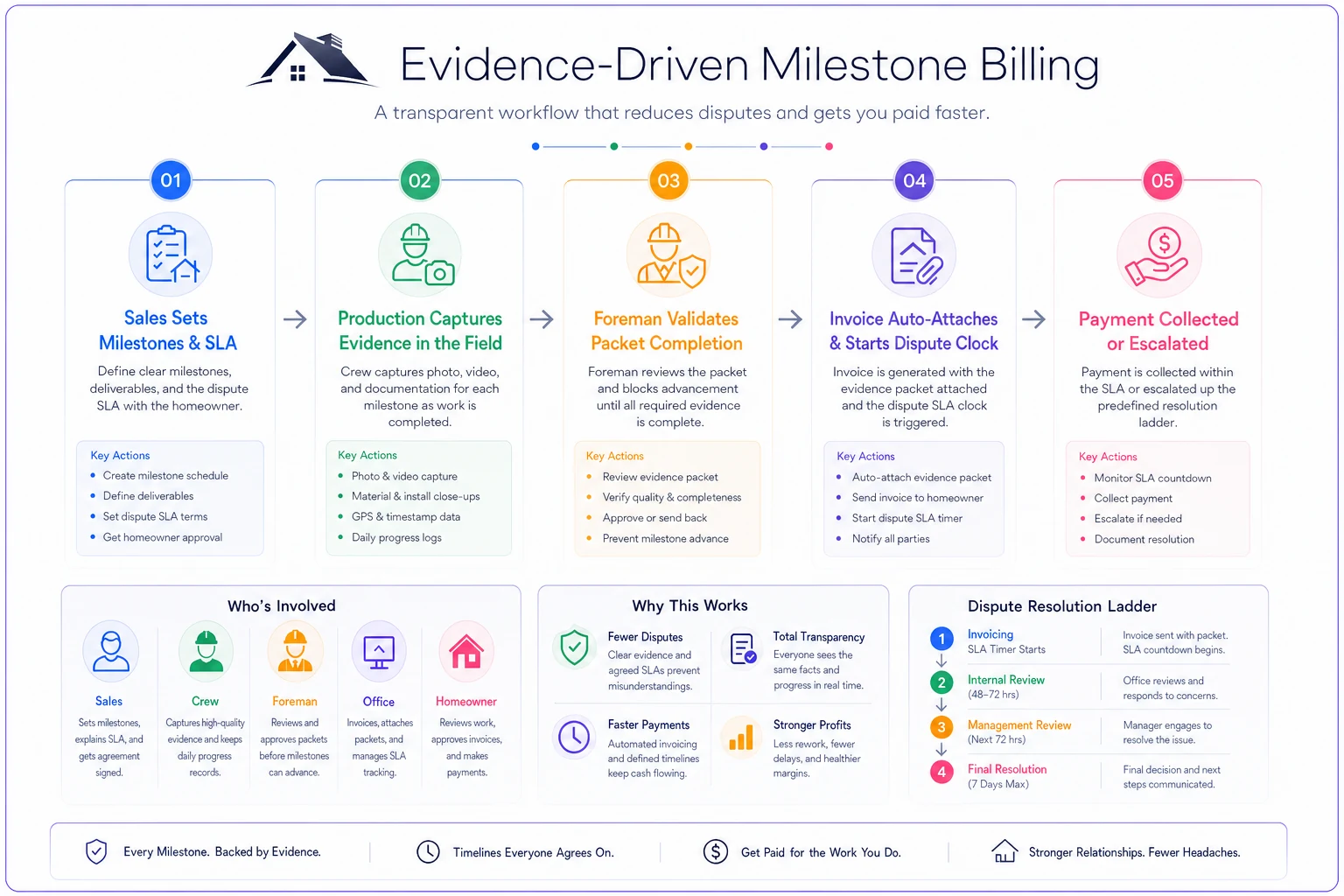
Auto-attaching the packet to the invoice when the milestone completes prevents manual errors and immediately starts the dispute clock.
This is where AI-assisted operational software genuinely earns its place — not by replacing the foreman's judgment, but by refusing to let a milestone advance without its packet, auto-attaching the right artifacts to the right invoice, starting dispute clocks, and moving overdue accounts up the ladder without someone manually babysitting each job. The rules are yours. The software just enforces them consistently across every crew and every project, which is precisely what stops being possible by hand once you're running more than a few concurrent jobs.
What breaks when you scale
At one or two crews, a sharp office manager holds all of this in their head. They know which jobs are billable, which have open disputes, who's overdue. It works because one person has full visibility.
At four, six, eight crews, that visibility shatters. Now you've got:
-
Milestones marked "done" with incomplete packets, so invoices go out and immediately get disputed
-
Dispute windows that quietly expire without anyone collecting on the accepted amount
-
Holdbacks stalling because nobody's tracking which final packets are actually complete
-
Overdue accounts sitting untouched because the one person who tracked them is buried in other things
The failure isn't that people got worse at their jobs. It's that the informal system had a ceiling and you hit it. Every part of the billing chain that used to live in someone's memory needs to become an explicit rule with an owner and a trigger.
When this makes sense — and when it doesn't
This makes sense when you're running jobs large enough that decking surprises and holdbacks are real money, you have more than a couple crews, or you've already eaten a few disputes that dragged past 60 days. The overhead of building packets pays back fast once a single avoided dispute covers the effort.
This is overkill when you're doing small repairs billed in one shot, paid on completion. If the whole job is $1,800 and collected same-day, a five-milestone evidence system is bureaucracy for its own sake. Match the rigor to the risk.
Who should not do this: anyone who won't actually enforce the packets. A milestone rule you override every time "just this once" is worse than no rule, because it trains your crews and your homeowners that the system is theater. If you're going to let people bill without the packet, don't build the packet system — you'll get all the overhead and none of the protection.
A quick real scenario
A mid-sized residential roofer running five crews on $20k–$30k jobs was averaging around 40+ days to collect final draws, with several jobs each month sliding past 90. Most disputes clustered in two places: tear-off decking charges and the final holdback.
They rebuilt billing around evidence packets. Tear-off draws required damaged-deck photos plus timestamped approval before repair. Final draws required a complete acceptance packet, holdbacks cut to 10%, punch items held separately. A 3-day dispute SLA went into every contract, and overdue accounts moved up a defined ladder without anyone manually pushing them.
Within a couple months, average days-to-collect on final draws dropped from the low 40s into the low-to-mid 20s. The past-90 pile mostly cleared out — not because homeowners changed, but because the disputes had nowhere to hide. When someone questioned a decking charge, the office attached the pre-repair approval and the conversation ended in one reply. The money was always earned. Now it was finally easy to demand.
Bottom line
Progressive billing works when each milestone is proof, not just a date on a schedule. Tie every draw to a minimum evidence packet, put a clock on disputes, make holdbacks specific and releasable in pieces, and run overdue accounts up a defined ladder. Do that consistently, and the fights that used to eat your cashflow mostly stop happening — because you answered the objection before you ever sent the invoice.
Ready to elevate your roofing operations?
Join hundreds of roofing contractors using Roofyly to streamline workflows, improve crew coordination, and enhance client satisfaction.