



Most roofing companies don't lose money on change orders because they priced them wrong. They lose money because nobody owns the change order at the moment it matters, the evidence shows up three days too late, and by the time finance tries to bill it, the homeowner has already decided it was "part of the original job."
That's the real problem. A change order isn't a pricing event — it's a coordination event. It crosses three departments, usually in under an hour, and the handoffs are where the whole thing quietly falls apart. Sales promised something. The field discovered something. Finance has to defend something. Nobody wrote down who was responsible for what, or by when.
This is a governance article, not a "how to write a change order" article. The assumption is that you already know what a change order is and already have a form for it. What you probably don't have is a system that forces the right person to act inside a time window, blocks the job from moving forward without evidence, and leaves an audit trail clean enough to survive a homeowner dispute or a slow-paying insurer.
Why change orders break at the seams between departments
The pattern comes up constantly: the crew is mid-tear-off, they find rotted decking, the foreman calls the office, someone says "yeah go ahead," and the extra work gets done. Three weeks later finance is trying to collect an extra $1,900 and the homeowner says nobody told them the price. No signature, no timestamped photo tied to the specific decking sheets, no record of who approved the verbal go-ahead.
The failure isn't the missing form. It's that the change order lived in three people's heads and never became a governed object with an owner and a clock.
In real operations, this usually happens for a few structural reasons:
-
Sales owns the relationship but isn't on the roof. They can't verify the condition that triggered the change, so they either rubber-stamp it or stall it.
-
The field owns the discovery but not the money. Foremen are trained to keep the job moving, so they'll approve verbally to avoid downtime and worry about paperwork "later."
-
Finance owns the billing but sees the change last. By the time an invoice line appears, the evidence window has closed and the homeowner's memory has hardened.
When these three roles aren't linked by explicit triggers and deadlines, every change order becomes an after-the-fact negotiation instead of a documented decision made in the moment. And after-the-fact negotiations are where margin dies.
The related failure mode shows up in common handoff breakdowns that cause invoice delays — a change order is really just a mini-version of the same estimate-to-invoice breakdown, compressed into a single afternoon and made worse by the fact that a crew is standing on a roof waiting.
What actually breaks as you scale
With one crew and an owner who answers every call, informal change orders sort of work. The owner remembers the conversation, knows the homeowner, and can smooth over a billing dispute personally. Fragile, but it holds.
Keep every roofing job on track and on time.
Roofyly helps you manage, schedule, and communicate every roofing project with precision and ease.
- Centralized project planning
- Real-time crew notifications
- Integrated scheduling & client updates
No credit card required
The wheels come off somewhere between three and six crews. Now the owner isn't on every call. Approvals get delegated to a production manager or office admin who wasn't part of the original sale. The homeowner talked to a salesperson who's now working a different neighborhood. And the volume of change orders — even at a modest 15–20% of jobs — means a handful are always sitting in limbo.
At that scale, three specific things break:
-
Approval latency creeps up. A change that needed a 30-minute decision now waits half a day because the approver is in a meeting or on another site. The crew either stalls (labor cost) or proceeds without approval (billing risk).
-
Evidence gets thinner. Under time pressure and with more jobs in flight, photos get skipped, taken wrong, or buried in a phone camera roll with no link to the change. The documentation discipline that comes naturally to an owner-operator doesn't survive delegation without a system.
-
Nobody can reconstruct the timeline later. When a dispute lands, you need to show when the condition was discovered, when the homeowner was notified, when they approved, and what the evidence was. Across dozens of jobs a month, that reconstruction is impossible from memory and messy from texts and voicemails.
The collections impact is direct. Change orders that lack clean approval and evidence are the ones that sit in accounts receivable the longest. In a lot of shops, disputed change-order dollars are a small share of total revenue but a large share of the AR that ages past 60 days. It's the tail that wags the cashflow.
The four control mechanisms that make governance work
A change order that's actually defensible runs through four controls before it becomes billable. These are gates, not suggestions.
1. Role assignment. Every change order has exactly one owner at each stage — discovery, approval, and billing — and the handoff between them is explicit. No "someone will handle it."
2. SLA timers. Each stage has a clock. When the clock runs out, the change order escalates automatically to the next person up. This is what stops changes from sitting in limbo.
3. Evidence gates. The change order cannot advance to the next stage until required evidence is attached. No approval without photos. No billing without signature. The gate is a hard block, not a reminder.
4. Audit artifacts. Every action leaves a timestamped, attributable record — who did what, when, with what evidence. This is what you hand to an insurer or pull up in a small-claims filing.
| Stage | Owner | SLA timer | Evidence gate | Audit artifact |
|---|---|---|---|---|
| Discovery | Foreman | Log within 30 min of finding | Wide + close photos tied to the specific condition | Timestamped photo set, GPS/location, crew ID |
| Notification | Production coordinator | Homeowner contacted within 2 hrs | Written price + scope sent | Sent message record, delivery confirmation |
| Approval | Homeowner (via coordinator) | Decision within 4 hrs on active jobs | Signature or recorded verbal + written confirm | Signed change form, timestamp |
| Billing prep | Finance | Line added within 1 business day of approval | Approval + evidence bundle attached | Invoice line linked to change order ID |
| Escalation | Production manager | Triggered if any SLA breaches | N/A — escalation only | Escalation log entry |
The point of the table isn't the exact numbers — those depend on your job mix and how tight your margins run. The point is that every row has an owner, a clock, a gate, and a record. Miss any one of those and the change order becomes disputable.
The workflow, in plain terms
Here's how a governed change order actually moves in practice.
The foreman finds rotted decking during tear-off. Instead of calling the office and saying "go ahead?" he opens the change order, tags it to the job, and captures the required photos — a wide shot showing location on the roof and close shots showing the extent. The change order is now created but blocked. It can't move until notification happens. That evidence discipline mirrors what you'd already have from a solid on-site decision flow for hidden structural repairs during tear-off — the change order governance layer just makes sure that field decision becomes a billable, defensible record instead of a verbal memory.
The moment it's created, the notification clock starts. The production coordinator gets it, sends the homeowner a written scope and price, and logs the send. Now the approval clock starts. If the homeowner approves — signature or a recorded verbal confirmed in writing — the change order advances and lands in finance's queue with the full evidence bundle already attached.
If any clock runs out, the change order escalates. Notification not sent in two hours? Production manager gets pinged. Homeowner hasn't decided in four hours on an active job? The foreman gets a decision rule: stop, do a temporary protective measure, or proceed at documented risk. The escalation isn't a nag — it's a forced decision so the job never sits in ambiguous limbo eating labor.
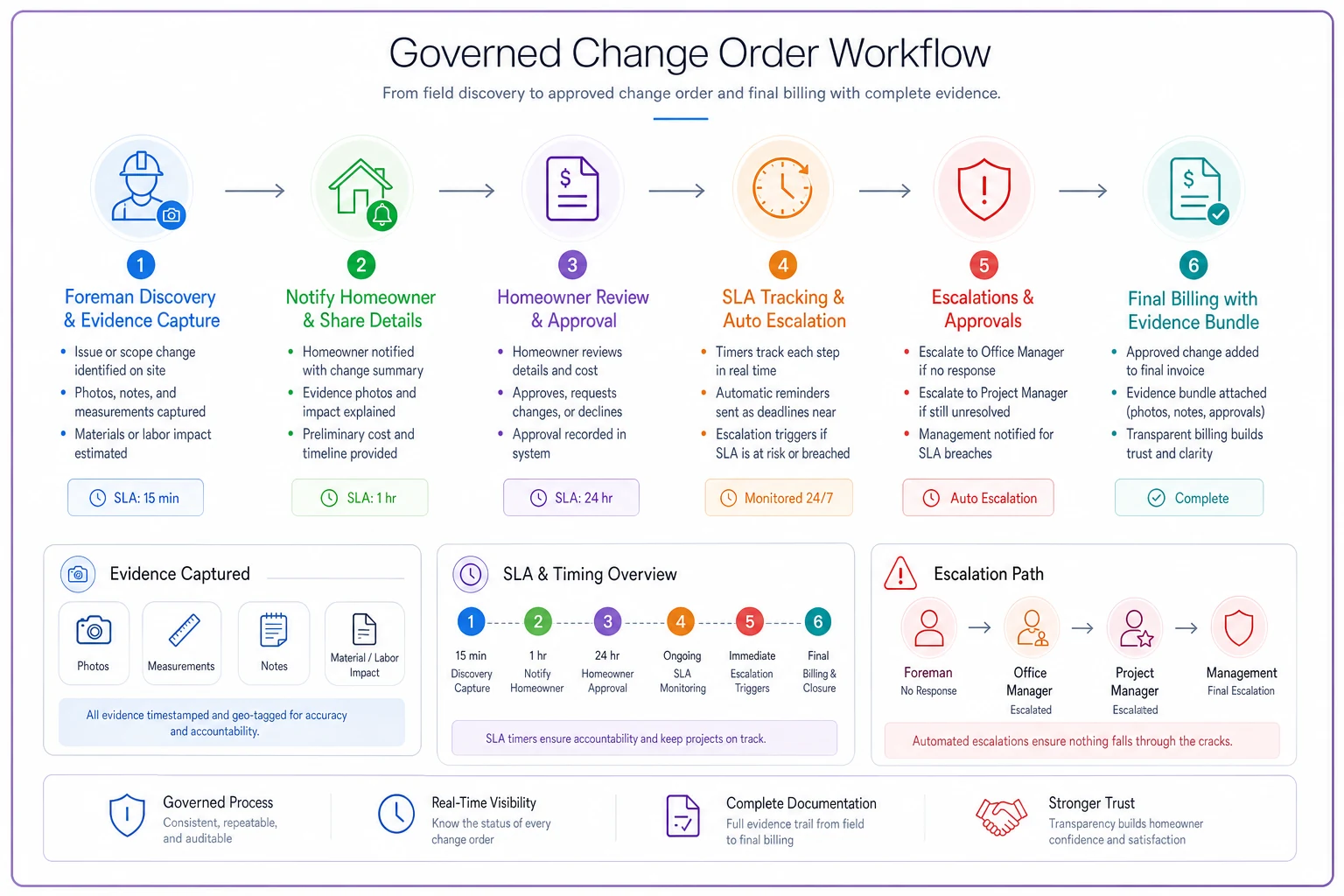
By the time finance touches it, everything they need is already there. No chasing the foreman for photos. No asking sales what was promised. The billing line links back to the change order ID, and the whole timeline is reconstructable from timestamps.
The evidence checklist that survives a dispute
The single biggest reason change orders don't get paid is thin evidence. Here's the minimum bundle that holds up when a homeowner or insurer pushes back:
-
Wide photo establishing location on the roof (so nobody can claim it's from a different job)
-
Close photos showing the specific condition and its extent
-
A measurement or count where the price depends on it (decking sheets, linear feet of flashing, number of penetrations)
-
Written scope describing what will be done and why
-
The price, sent before work proceeds, not after
-
Homeowner approval — signature preferred, recorded verbal acceptable only if confirmed in writing same day
-
Timestamp on every artifact, ideally with location data
The rule that saves you: evidence is captured at discovery, not at billing. Once the decking is replaced and the roof is dried in, you can't re-photograph the rot. The evidence window closes fast on a roofing job, which is exactly why the gate has to sit at the front of the process.
For change orders tied to insurance work, this bundle also feeds directly into your supplement documentation — the same evidence-first discipline that makes the difference in an evidence-first insurance supplement workflow. A change order and a supplement are cousins: both are "the job is bigger than we thought" claims, and both live or die on whether the evidence was captured at the right moment.
Role responsibilities template
Keep this short enough that people actually read it. One line per role, tied to the trigger that activates them.
-
Foreman / crew lead Owns discovery. Trigger: any condition not in the original scope. Action: create the change order and capture evidence before touching the condition. Never approve pricing verbally.
-
Production coordinator Owns notification and homeowner contact. Trigger: change order created. Action: send written scope + price within the SLA, log the send, chase the decision.
-
Production manager Owns escalation. Trigger: any SLA breach. Action: make the stop/proceed/temporary-fix call and document it.
-
Salesperson Owns relationship context, not approval. Trigger: homeowner pushes back citing the original sale. Action: provide the original scope record so notification isn't a he-said-she-said.
-
Finance / billing Owns billing and collections. Trigger: change order approved. Action: add the linked line within one business day, only if the evidence bundle is complete.
The one boundary that matters most: the foreman never sets or confirms price with the homeowner. That's the single most common source of billing disputes — a crew lead says "it'll probably be a few hundred bucks" to keep the homeowner calm, and now finance is stuck defending a number they never quoted.
When this level of governance actually makes sense
This isn't free. Every gate and timer adds a small amount of friction, and for a two-person operation that friction might not be worth it.
It makes sense when:
-
You're running three or more crews and the owner can't be on every approval.
-
Change orders are 15%+ of your jobs and represent real dollars.
-
You do insurance work where documentation defensibility is non-negotiable.
-
Your AR aging shows disputed change orders clustering past 60 days.
It's overkill when:
-
You're a solo or two-crew shop where the owner touches every job personally.
-
Your change-order volume is genuinely rare — a few a month, all small.
One thing worth saying clearly: don't bolt this on wholesale if you haven't fixed your basic estimate-to-production handoff first. If your core jobs are already chaotic, adding change-order SLAs won't fix the upstream mess — it'll just create more escalations you can't service. Get the main workflow stable first, then layer governance on the exceptions.
A real scenario
A residential reroofing company running four crews was doing somewhere around 45–55 jobs a month, with roughly one in six generating a change order — mostly decking, flashing, and ventilation surprises found during tear-off. Their process was verbal: foreman calls office, office says go, paperwork "later."
The problem showed up in AR. Change-order dollars were maybe 6–7% of revenue, but they made up a disproportionate share of everything sitting past 60 days. Roughly a third of change orders got some form of pushback at billing, and a handful each quarter got written off entirely because there was nothing to defend them with — no timestamped photo, no signed approval, just a foreman's memory of a phone call.
They put in three things: a discovery gate that blocked the change order until photos were attached, a four-hour approval clock with auto-escalation to the production manager, and a rule that finance couldn't bill a change without the evidence bundle. Nothing exotic. Just owners, clocks, gates, and records.
Over the following couple of quarters, the disputed rate on change orders dropped from about a third to under 10%. The write-offs mostly stopped, because now there was always something to show. The softer win was collections speed — change orders that used to age 60–90 days were getting paid closer to the main invoice, because the homeowner had already seen and approved the price while the crew was still on the roof. The recovered write-offs came out to a few thousand dollars a quarter, which for a shop that size is real money.
The more interesting part wasn't the recovered dollars, though. It was that the foremen liked it better. They'd been getting blamed for billing fights they didn't cause. Once the process forced the coordinator to handle price and forced the homeowner to approve up front, the crews stopped being the fall guys.
The audit trail is the whole point
Everything above exists to produce one thing: a clean, timestamped, attributable record that shows exactly what happened and when. That record is what you pull up when a homeowner disputes a charge, when an insurer questions a supplement, or when a job ends up in small claims.
A defensible audit trail for a single change order should let you answer, in order and with timestamps:
-
When was the condition discovered, and what did it look like?
-
When was the homeowner notified, and what price were they given?
-
When did they approve, and how — signature or confirmed verbal?
-
When was it billed, and does the invoice line match the approved scope?
-
If anything breached an SLA, when did it escalate and who resolved it?
If you can answer all five from records instead of memory, the change order is defensible. If you can't answer even one, it's a negotiation — and you'll usually lose the negotiation, or at least wait a long time to get paid.
Change-order governance isn't about adding bureaucracy to a roofing crew. It's about recognizing that a change order is the single most dispute-prone moment in the whole job — a place where three departments have to coordinate fast, under pressure, with real money on the line. Give that moment an owner, a clock, a gate, and a record, and it stops being the thing that clogs your AR. Leave it informal, and it'll keep costing you the margin you thought you already earned.
Ready to elevate your roofing operations?
Join hundreds of roofing contractors using Roofyly to streamline workflows, improve crew coordination, and enhance client satisfaction.