


Most roofing disputes that end up in small-claims court aren't lost because the contractor did bad work. They're lost because the contractor showed up with a folder of random phone photos, a couple of texts, and a signed contract they couldn't fully explain — while the homeowner showed up with a tidy timeline and three color printouts of ceiling stains.
The evidence isn't necessarily better. It's just organized around the claim.
That's the whole game in small claims. A judge has maybe 10–15 minutes for your case. They're not going to dig through 200 unlabeled images looking for the flashing detail that proves you're right. If you can't hand them a clean story — this is what they claimed, here's the proof it's false, here's the timeline — you're relying on them to reconstruct it for you. They usually won't.
This piece walks through building a roofing small claims evidence packet you can pull off the shelf and fill in fast, mapped to the specific complaint types homeowners actually file.
Why roofing disputes get messy in court specifically
Roofing has a few characteristics that make disputes harder to defend than, say, a plumbing invoice fight.
The work gets covered up. Once shingles are down, nobody can see the underlayment, the ice-and-water membrane, or how you handled that valley. If you didn't photograph it during tear-off, it functionally never happened as far as a judge is concerned.
The damage is often weather-timed. A homeowner claiming a leak "started right after you installed" has a plausible-sounding story unless you can show what the roof looked like on day one and what the weather did afterward.
And the money is emotional. A $9,000 reroof feels enormous to a homeowner. When something goes wrong — real or imagined — they're primed to believe they got taken. That emotion shows up in court, and clean documentation is the only thing that cuts through it.
The pattern that keeps showing up: contractors have the evidence. It's on three different phones, buried in a texting thread, in the estimator's email, in a filing cabinet somewhere. It exists. It's just not assembled into anything a judge can use. Assembly is the bottleneck, not collection.
The five complaint types (and what actually proves each one)
Almost every homeowner small-claims filing against a roofer falls into one of five buckets. Each bucket needs a different spine of evidence. Guessing wrong — bringing leak evidence to a workmanship complaint — is how prepared contractors still lose.
Keep every roofing job on track and on time.
Roofyly helps you manage, schedule, and communicate every roofing project with precision and ease.
- Centralized project planning
- Real-time crew notifications
- Integrated scheduling & client updates
No credit card required
| Complaint type | What they're really claiming | Core evidence that wins it |
|---|---|---|
| Leak / water intrusion | Your work caused water damage | Pre-existing condition photos, install photos of the leak area, weather logs, moisture readings, timeline of first report |
| Workmanship / poor install | It looks bad or wasn't done "right" | Manufacturer spec sheets, install photos showing spec compliance, code references, comparable-quality photos |
| Incomplete / abandoned work | You didn't finish what you were paid for | Signed scope, progress photos by date, change orders, communication log showing homeowner-caused delays |
| Property damage | You damaged gutters, landscaping, driveway | Pre-job walkthrough photos, dumpster/staging placement photos, crew statements, post-job walkthrough |
| Billing / overcharge | You charged for work not done or overpriced | Signed contract, itemized change orders with signatures, material receipts, measurement documentation |
The mistake that kills contractors here is treating all five the same. A leak claim lives or dies on timeline and pre-existing condition. A property-damage claim lives or dies on the before photos nobody thought to take because the crew was focused on the roof, not the flower beds.
The pre-built packet structure
Every packet, regardless of complaint type, should follow the same skeleton. Judges reward predictability. When your Exhibit A is always the contract and your Exhibit B is always the timeline, the judge learns your format in the first thirty seconds and can follow along.
-
One-page case summary — three sentences. What they claim, why it's wrong, what you're asking the court to find. This goes on top so the judge knows the destination before the journey.
-
The signed contract and scope — highlighted to the clause that matters for this dispute.
-
The timeline — a single dated table from first contact to the dispute. This is the most underused and most powerful document in the whole packet.
-
The evidence exhibits — photos, readings, receipts, labeled and captioned, in the order they appear in your timeline.
-
Communication record — texts and emails, in date order, showing what was said and when.
-
Third-party support — manufacturer specs, code sections, permit sign-offs, inspector notes.
The reason this order works: it front-loads context and back-loads detail. A judge who reads only the first two pages already understands your position. Everything after that is them confirming what you told them, not discovering it fresh.
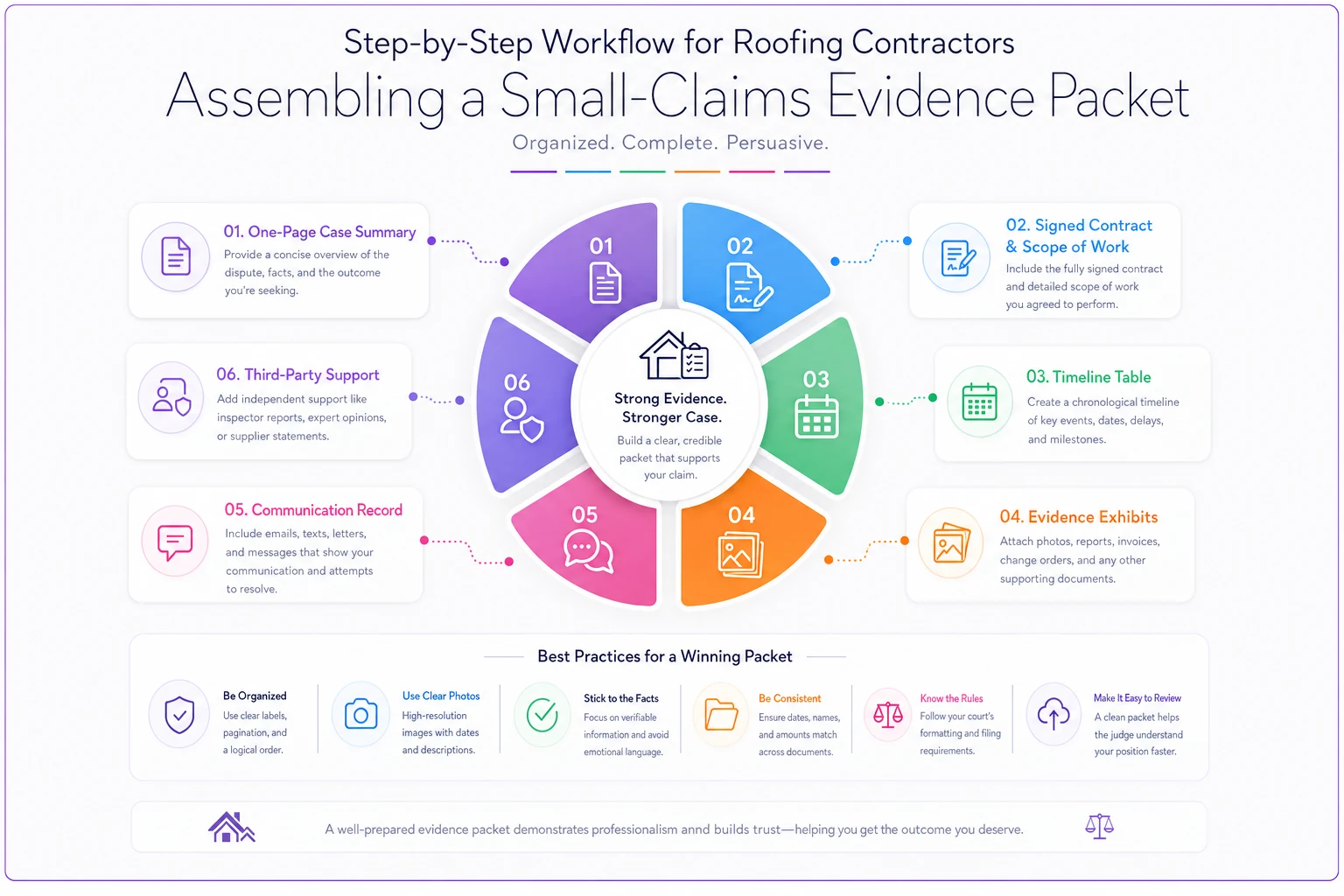
Here's a simple visual workflow you can use as a checklist when assembling the packet.
Building the timeline document (this is where cases are won)
If you only fix one thing, fix the timeline. Most contractors don't have one at all — they have a pile of dated artifacts and expect the judge to sort them.
A timeline is a simple two-column table: date on the left, event on the right. Every event should tie to an exhibit.
-
March 3 — Initial inspection. Pre-existing water staining in attic photographed (Exhibit C1–C3).
-
March 11 — Contract signed, scope defined (Exhibit A).
-
March 18 — Tear-off. Old flashing corrosion documented (Exhibit C4).
-
March 19 — Install complete. Final walkthrough photos (Exhibit C5–C9).
-
April 2 — Heavy rain event, 1.9" recorded (Exhibit D, weather log).
-
April 4 — Homeowner reports interior stain.
-
April 5 — Return visit. Leak traced to failed skylight seal, not roof plane (Exhibit C10).
Read that and the story tells itself. The staining predated you. The rain came before the report. The failure was a skylight you didn't touch. A judge can render that in seconds.
Tie each timeline entry to an exhibit label (e.g., Exhibit C1) so you can point the judge to the exact photo or document instantly.
The timeline also protects you from the single most damaging courtroom moment: the homeowner introducing a date you can't respond to. When your timeline is complete and dated, "you never came back" gets answered with a line and an exhibit instead of a fumble.
Judge-friendly wording that keeps you credible
The language on your captions and summary matters more than most contractors expect. There's a tone that reads as credible and a tone that reads as defensive, and judges pick up on it fast.
A few rules that hold up well:
-
Describe, don't argue. Caption a photo "Attic decking, north side, water staining present at inspection 3/3" — not "Proof the damage was already there before we started." Let the judge draw the conclusion. Stating it for them reads as coaching.
-
Use neutral, specific nouns. "Step flashing at chimney, west side" beats "the flashing area." Specificity signals you know your trade.
-
Reference standards by name. "Installed per manufacturer spec sheet, section 4.2 (Exhibit F)" carries weight because it's checkable.
-
Never editorialize about the homeowner. No "the plaintiff is mistaken" or "as usual the customer." Even when they're wrong, the moment you sound annoyed, some of your credibility transfers to them.
The pattern to avoid: contractors who write captions like they're still arguing with the customer in their head. The judge isn't the customer. The judge is a neutral reader who will trust the calmer, more precise party.
The photo problem underneath all of this
None of this works if the underlying photos are a mess. And they usually are — timestamps missing, no idea which job they're from, half of them blurry shots of a truck bed.
This is worth solving before any dispute exists, because you can't retroactively create a photo you never took. A structured approach to field capture — consistent shot lists, naming conventions, automatic tagging — is what makes packet assembly fast instead of forensic. We went deep on that in the piece on photo chaos and defensible field photos, and the packet is only as strong as the capture discipline behind it.
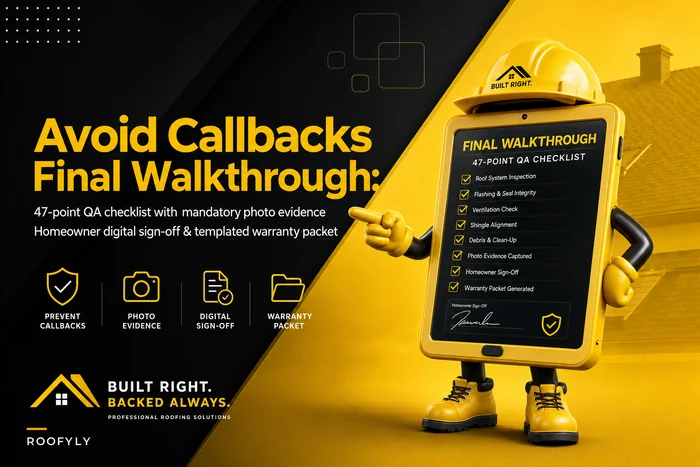
The same goes for closeout. A lot of disputes never form at all when the homeowner signs off on a documented final walkthrough. The final-walkthrough QA checklist and closeout packet approach creates a signed record that quietly kills most "incomplete work" and "damage" claims before they reach a courtroom — because you already have their signature saying the job looked right on completion day.
A real scenario
A mid-sized residential roofer — three crews, mostly reroofs in the $8k–$14k range — got hit with a small-claims filing over a claimed ceiling leak. The homeowner wanted around $4,600 for water damage and "faulty installation."
The first time this company faced a similar claim, assembly took the owner and office manager the better part of two weeks. They pulled photos off two phones, screenshotted texts, dug out the contract, and still walked in with gaps. They settled for roughly $2,800 mostly to make it go away, even though they were fairly confident the work was fine.
Second time around, they had a fixed packet template and a photo library that was actually organized by job. The leak traced back to a skylight the homeowner had installed themselves after the reroof. Because the crew had photographed the roof plane at completion — and the skylight wasn't there yet — the timeline did the whole job. Assembly took an afternoon.
Case dismissed. No settlement. The office manager also pointed out the quieter win: the owner didn't spend two weeks stressed and distracted from running the business.
The difference between those two outcomes wasn't better roofing. It was better assembly.
When a defensible packet actually matters
Not every disagreement needs this. A homeowner grumbling about a minor cosmetic issue you can fix in an hour doesn't call for exhibits and timelines. Bringing courtroom-grade documentation to a small friction point can actually escalate things — it signals you're bracing for a fight the customer wasn't planning.
-
Any dispute involving a dollar figure over a couple thousand
-
Any claim where the homeowner is alleging you caused damage, not just that they're unhappy
-
Anything where a leak or structural issue is involved, because those get technical fast
-
Any situation where communication has already gone cold or hostile and a filing feels likely
If you're seeing early warning signs — the homeowner stops responding, mentions "my lawyer," or starts documenting things themselves — that's the moment to quietly start assembling your packet, whether or not it's ever needed. Doing it early, while memories and files are fresh, is dramatically easier than reconstructing everything three months later under a filing deadline.
Who should not rely on this alone
A packet template organizes truth — it doesn't manufacture it. If the work genuinely wasn't done to spec, no amount of clean formatting fixes that, and trying to dress up a weak position in court usually backfires when the judge spots the gap. In those cases you're better off fixing the problem or negotiating a resolution than litigating it.
It also doesn't replace legal advice on larger disputes. Small claims has dollar limits, and once a claim climbs past those thresholds or involves counterclaims, you're in different territory. The packet structure still helps your attorney, but it's not a substitute for one.
The takeaway
The contractors who win these cases aren't the ones with the most evidence. They're the ones whose evidence is already arranged around the claim — a summary on top, a dated timeline in the middle, labeled exhibits that a busy judge can follow without effort.
Build the template once. Map each complaint type to its evidence spine. Keep your field photos organized as a habit, not a scramble. Then when a filing lands, you're pulling a structure off the shelf and filling it in — not starting from a folder of chaos with a court date two weeks out.
The contractors who win these cases aren't the ones with the most evidence. They're the ones whose evidence is already arranged around the claim — a summary on top, a dated timeline in the middle, labeled exhibits that a busy judge can follow without effort.
Build the template once. Map each complaint type to its evidence spine. Keep your field photos organized as a habit, not a scramble. Then when a filing lands, you're pulling a structure off the shelf and filling it in — not starting from a folder of chaos with a court date two weeks out.
Ready to elevate your roofing operations?
Join hundreds of roofing contractors using Roofyly to streamline workflows, improve crew coordination, and enhance client satisfaction.