



The gap between "estimate approved" and "crew on the roof" is where roofing companies quietly lose margin. Not through big obvious mistakes, but through a hundred small handoff failures nobody owns. An estimator hands off a job. Production looks at it, isn't sure the measurements are right, orders material anyway, and then either sits on a hold or eats a re-measure two days before install.
Most of the time nobody logs it. Nobody knows how often it happens. It just becomes "the way roofing works." But the estimating to production handoff roofing teams run is a system, and like any system it can be tightened until the leaks stop.
The fix isn't more meetings or a longer checklist buried in a shared drive. It's a single acceptance artifact that production either accepts or rejects, a short SLA board that puts a clock on every step, and dispute rules everyone agreed to before the fight started. That's the whole thing. Below is how it actually works when you build it.
Why the handoff breaks in the first place
The core problem is ownership ambiguity. When an estimate leaves the estimator's hands, it enters a no-man's-land. The estimator assumes production will "catch anything wrong." Production assumes the estimator "already verified it." Both assumptions are wrong at the same time, and the job stalls in the middle.
The pattern repeats constantly: an estimator builds a job off a satellite report, sets a price, gets the homeowner to sign, and moves on to the next lead. Production picks it up and immediately has questions. Is that pitch right? Did anyone account for the second layer? Why does the waste factor look low for a hip roof? Nobody documented answers to those questions because the estimate was never accepted — it was just passed along.
The breakdown accelerates the moment you add a second crew or a second estimator. With one estimator and one foreman, they know each other's habits. The estimator knows the foreman always double-checks flashing counts. The foreman knows the estimator always pads valleys. That tribal knowledge doesn't scale. Add a third crew and the informal system collapses, because now you've got mismatched assumptions colliding on every job.
The two most expensive symptoms of a broken handoff are almost always the same:
-
Re-measures — production doesn't trust the estimate, so someone drives back out to the roof
-
Material holds — production won't order until they get answers, so the job sits and the schedule slips
Both cost real money. A re-measure burns half a day of a skilled person's time plus fuel. A material hold pushes install dates, which cascades into every job behind it. Neither shows up cleanly on a P&L, which is exactly why they never get fixed.
The single acceptance artifact
The entire idea rests on collapsing everything production needs into one document that production formally accepts or rejects. Not an email thread. Not a folder of PDFs. One artifact with three parts:
Keep every roofing job on track and on time.
Roofyly helps you manage, schedule, and communicate every roofing project with precision and ease.
- Centralized project planning
- Real-time crew notifications
- Integrated scheduling & client updates
No credit card required
-
A visit report (what the estimator saw and measured)
-
A 7-point acceptance checklist (what production confirms before accepting)
-
A dispute path (what happens when production rejects)
The point of one artifact is accountability. When production clicks accept, they own the job. When they reject, the reason is logged against a specific checklist item. No more "I thought you handled it." The handoff becomes a gate, not a hallway.
The visit-report template
The visit report is the estimator's sworn statement about the roof. Keep it tight — if it's too long, nobody fills it in honestly. Here's the structure that works:
| Field | What goes here |
|---|---|
| Job ID / address | Unique, matches your job numbering |
| Roof measurements source | Satellite report, hand measure, or both |
| Squares (total + waste %) | Split so production sees the raw and adjusted |
| Pitch(es) | Every distinct pitch, not an average |
| Layers | Confirmed number of existing layers |
| Penetrations & flashings | Counted, not estimated — vents, pipes, chimneys |
| Access & staging notes | Where material lands, where the dumpster goes |
| Known unknowns | What the estimator couldn't verify from the ground |
| Photos attached | Yes/No + count, linked to the shot list |
That "known unknowns" field is the most important line on the page and the one most templates skip. An honest estimator writes "couldn't confirm second layer, no attic access" — and now production knows exactly where to look instead of discovering it mid-tear-off. This is also where good measurement discipline pays off. If your team already runs a solid field verification process to reconcile satellite estimates, the visit report becomes a formality instead of a fight. Our breakdown on reconciling satellite estimates and avoiding surprise re-measures pairs directly with this artifact.
The 7-point acceptance checklist
-
Measurements reconcile — satellite and any field measure agree within your tolerance (most teams use ±5%)
-
Pitch is documented per plane — no single "average pitch" hiding a steep section
-
Layer count confirmed — with a note on how it was confirmed
-
Penetrations and flashings counted — matches the material list
-
Waste factor matches roof geometry — hip/valley-heavy roofs flagged for higher waste
-
Access and staging are workable — nothing that turns into a rigging surprise on job day
-
Photos support the numbers — enough documentation to defend the estimate later
If all seven pass, production accepts and material gets ordered. If any fail, the job goes to the dispute path instead of into a limbo pile.
These seven points are exactly where re-measures come from. You're not checking everything — you're checking the specific things that cause the expensive failures. Waste factor and pitch documentation alone probably account for most of the material-order arguments in a typical shop.
The SLA board
A checklist without a clock is a suggestion. The SLA board is what turns acceptance into a moving process instead of a stack that sits until someone remembers it.
Keep it to a handful of timers. Each timer starts when the previous step completes:
| Stage | SLA timer | Starts when | Owner |
|---|---|---|---|
| Estimator submits visit report | Same day of signed contract | Contract signed | Estimator |
| Production reviews & accepts/rejects | 24 hours | Report submitted | Production lead |
| Dispute resolution (if rejected) | 24 hours | Rejection logged | Estimator + Prod |
| Material order placed | Same day as acceptance | Job accepted | Purchasing |
The board should show every active job with its current stage and how much time is left on the clock. When a job goes red — SLA breached — it's visible to everyone, not buried in one person's inbox.
Here's a simple visual of how the SLA timers flow across the stages.
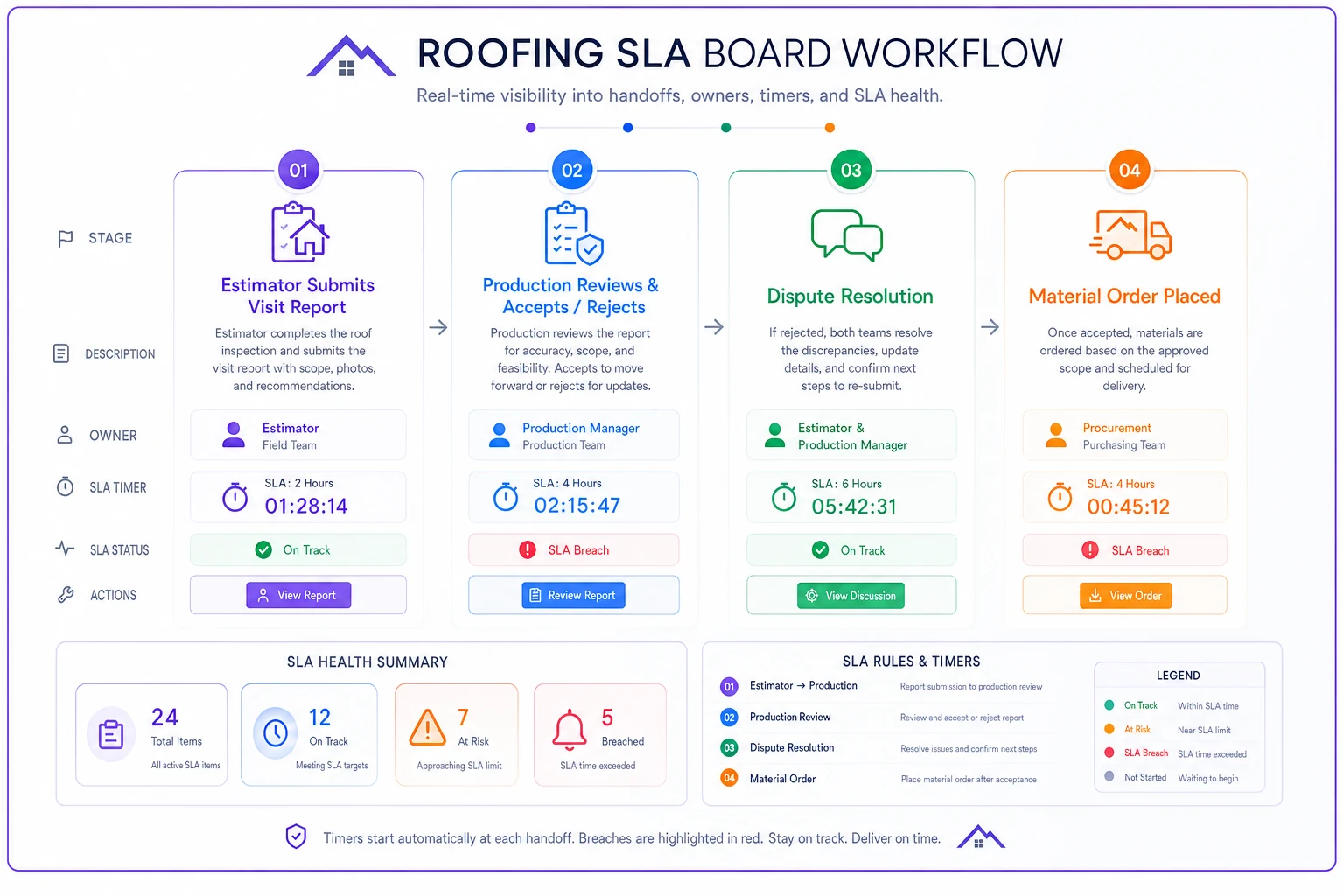
One practical note: don't set SLAs so tight that everyone ignores them.
Without timers, rejected jobs vanish. The estimator's busy, production moves to the next accept, and the disputed job sits for a week until the homeowner calls asking when work starts. The SLA on dispute resolution is arguably more important than the SLA on acceptance, because rejected jobs are the ones that fall through the cracks.
One practical note: don't set SLAs so tight that everyone ignores them. A 24-hour acceptance window respects that production has crews on roofs during the day and reviews handoffs in the evening or morning. Set it to "2 hours" and you've built a board everyone games.
Dispute-resolution rules for field and office
The dispute path is what most teams never write down, and it's where the whole system either holds or falls apart. When production rejects a job, you need pre-agreed rules for who does what — so the rejection doesn't turn into a standoff.
Rule set that keeps disputes from becoming personal:
-
Every rejection cites a specific checklist item. "This is wrong" isn't a rejection. "Item 4 fails — visit report shows 8 pipe boots, satellite shows 11" is a rejection.
-
The estimator owns the first response. They either correct the report from existing info or trigger a field verification.
-
Field verification has an owner and a deadline. If it needs a truck roll to confirm, that's assigned and clocked — not "whenever someone's out that way."
-
Material doesn't get ordered on disputed items. Only the disputed line holds. The rest of the order can proceed if it's clean.
-
Two rejections on the same item escalates to a manager. If the estimator and production can't reconcile it in two rounds, someone with authority calls it. This prevents infinite back-and-forth.
The mistake teams make is treating every dispute as a re-measure trigger. Most disputes are documentation gaps, not measurement errors — the estimator counted the flashings but forgot to log them. If your rule is "any dispute = truck roll," you'll drown in re-measures that a two-minute phone call would have solved. Sort disputes into "answerable from the office" and "genuinely needs eyes on the roof" before anyone drives anywhere.
This is also where your handoff connects to the money side of the business. Broken handoffs don't just delay installs — they delay invoicing, because a job built on a shaky estimate creates change orders and disputes at closeout. If you want to see how this same handoff discipline protects your cash cycle, our piece on handoff breakdowns that cause invoice delays walks the estimate-to-invoice side of the same problem.
A real scenario
A residential reroof company running three crews out of one office. Volume was fine — roughly 18 to 22 jobs a month — but production was constantly frustrated. About a third of jobs triggered either a re-measure or a material hold. Two estimators, and production trusted one more than the other, which created its own quiet chaos.
The specific problem: no acceptance step. Estimates got dropped into a shared folder, production ordered material when they got to it, and disagreements got hashed out over text and voicemail. When a job stalled, nobody could say whose it was.
They built the single artifact and a basic SLA board — nothing fancy, mostly a shared board and a template. The first month was rough because people had to actually fill in the visit report and known-unknowns field. By the second month, re-measures on new jobs dropped to a handful, and material holds went from a regular occurrence to rare. The bigger win was quieter: the two estimators' visit reports started converging, because the checklist made the standard visible. The "good" estimator's habits basically got written into the template.
Cutting even four or five re-measures a month, at half a day of labor plus fuel each, adds up to several thousand dollars a season — and that's before counting schedule slippage from material holds, which is harder to measure but probably costs more.
Where the software layer actually helps
You can run this on a whiteboard and a paper template, and for a small shop that's a fine place to start. Where it gets painful is scale. Once you're past a few crews, keeping the SLA board current by hand becomes its own full-time annoyance, and disputes buried in text threads defeat the entire point.
This is where AI-assisted operational software earns its place — not as a gimmick, but by handling the parts humans forget. A good platform can auto-start SLA timers when a contract is signed, flag jobs going red before they blow the clock, and route a rejection to the right person automatically instead of waiting for someone to notice. AI automation can also pre-check the visit report against satellite data — catching a pitch mismatch or a flashing-count discrepancy before production ever opens it, so half your disputes never happen.
The measurement side of this connects to the labor and estimating discipline you're hopefully already building. When your estimates are grounded in real labor-hour data instead of gut feel, the acceptance checklist has far fewer things to argue about — our method for building defendable labor-hour tables from timesheets feeds directly into more accurate visit reports and fewer disputes down the line.
When this makes sense — and when it doesn't
When to build this now: You're running two or more crews, you've got more than one estimator, or you've noticed re-measures and material holds creeping up without knowing exactly how often. The moment your handoff relies on tribal knowledge between specific people, you're one hire away from it breaking.
When it's overkill: A single owner-operator who estimates and installs their own jobs doesn't need an acceptance gate against themselves. If you're doing under a handful of jobs a month with one crew, a lightweight version — just the visit report and known-unknowns field — is enough. Don't build SLA boards for a problem you don't have yet.
Who should skip the heavy version: Teams with genuinely low volume and stable, experienced people. If your re-measure rate is already near zero, the acceptance artifact adds friction without much payoff. Build the piece that fixes your actual leak, not the whole system because an article told you to.
The real value here isn't the template or the timers. It's making the handoff a decision someone owns instead of a gap everyone assumes someone else is covering. Once acceptance is a clear yes-or-no with a clock on it and a rule for what happens when it's a no, the re-measures and material holds stop being mysterious — and you finally know exactly where your margin was leaking.
Ready to elevate your roofing operations?
Join hundreds of roofing contractors using Roofyly to streamline workflows, improve crew coordination, and enhance client satisfaction.