



Most roofing companies think they have job costing because their accounting software spits out a "job profitability" report. Then a homeowner disputes a supplement, a partner asks why margins dropped last quarter, or a lender wants backup — and the whole thing falls apart. The report shows a number. Nobody can explain where it came from.
That gap between having a number and being able to defend the number is where real job costing roofing work lives. It's not a report. It's a reconciliation cadence — a repeatable rhythm that ties field labor, material spend, and scope changes back to the estimate, catches variances early, and produces a P&L per job that survives scrutiny.
This is the system-level view. Not "track your costs better" but how the pieces connect, where they break as you grow, and what the reconciliation loop actually looks like when it works.
Why "job costing" quietly falls apart
The core problem isn't that roofers don't track costs. It's that costs get captured in three different places, on three different timelines, by three different people who never talk to each other.
-
Labor shows up in timesheets, usually days after the work happens.
-
Materials show up on supplier invoices, often lumped across multiple jobs.
-
Scope changes show up as change orders — or don't show up at all until the crew already did the extra work.
Each stream is fine on its own. The failure happens at the seams. A foreman logs 62 labor hours. The estimate assumed 48. The supplier invoice includes shingles for two jobs on one PO. A homeowner approved extra decking verbally but nobody wrote it up. By the time bookkeeping closes the month, the "cost" side of the job is a guess dressed up as a spreadsheet.
What shows up repeatedly across a lot of operations is that the estimate and the actuals live in separate universes. The estimator builds a clean, defensible number. Then the job runs, reality happens, and no one ever forces the two to meet. The P&L becomes whatever's left after the noise settles.
The reconciliation cadence, not the reconciliation event
The single biggest shift is going from month-end reconciliation to a rolling cadence tied to job stages. If you only reconcile when the books close, you're reconstructing evidence from memory. Nobody remembers why the tear-off crew stayed an extra half-day three weeks ago.
Keep every roofing job on track and on time.
Roofyly helps you manage, schedule, and communicate every roofing project with precision and ease.
- Centralized project planning
- Real-time crew notifications
- Integrated scheduling & client updates
No credit card required
A workable cadence looks like this:
-
Estimate lock (day 0) The estimate becomes the baseline budget. Labor hours, material quantities, and expected subs are frozen as the "plan" line. Nothing else compares against anything until this exists.
-
Daily field capture Timesheets and photo-tagged material receipts get logged the day they happen, tied to the job number. Not batched. Not "end of week."
-
Stage checkpoints (tear-off complete, dry-in, install complete) At each milestone, actuals-to-date get compared against the plan for that stage. Small variances get flagged while the crew is still on site and can explain them.
-
Change-order sync Any approved change updates the baseline. This is the step everyone skips, and it's why margins "mysteriously" collapse.
-
Closeout reconciliation Final labor, final material, all change orders, and the original estimate get merged into the job P&L before the final invoice goes out.
The daily and stage-level pieces are what make the closeout defendable. You're not reconstructing — you're confirming. This connects directly to how you turn raw field time into usable numbers, which we broke down in defendable labor-hour tables. Without clean labor-hour tables, the labor side of every reconciliation is just an argument.
Below is a workflow visualization of that cadence.
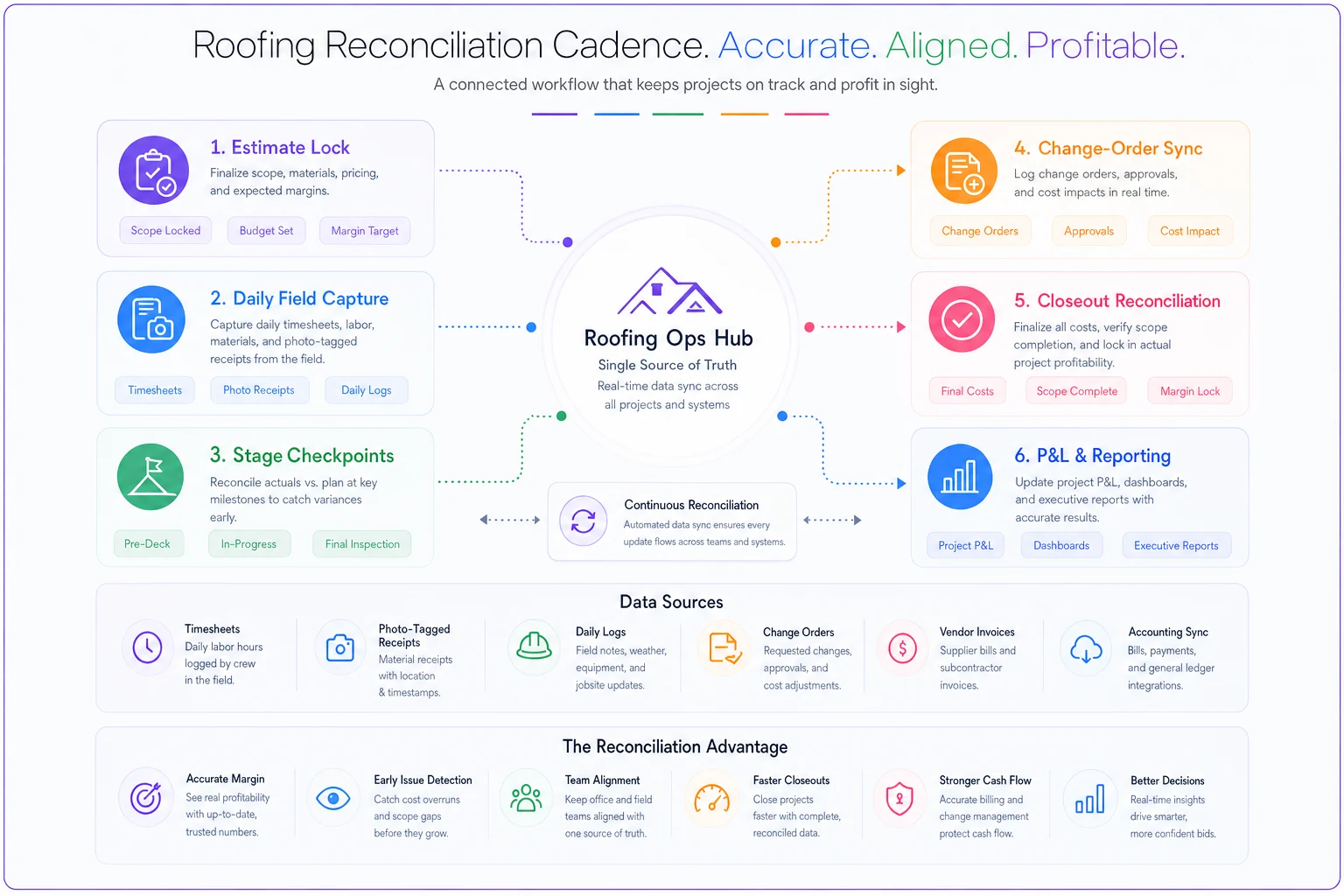
It shows how the stages and evidence streams connect.
What the evidence chain actually looks like
Defendable means every cost line traces back to something you can show. Here's the chain for the three cost streams:
| Cost stream | Evidence artifact | Ties back to | Common failure |
|---|---|---|---|
| Labor | Timesheet entry (clock-in/out, task-tagged) | Estimate labor-hour allowance | Hours logged to wrong job, or batched at week's end |
| Material | Photo-tagged delivery receipt + supplier invoice | Estimate material quantities | One PO split across jobs, no delivery photo |
| Scope change | Signed change order + before/after photos | Updated baseline budget | Verbal approvals, work done before write-up |
| Subs | Sub invoice + scope-of-work reference | Estimate sub allowance | Sub billed for out-of-scope work with no CO |
The photo-tagged receipt matters more than people think. When a material line gets questioned — by a homeowner, an adjuster, or your own partner — a receipt photo tagged to the job number and dated at delivery ends the conversation. Without it, you're relying on a supplier invoice that may have grouped three jobs together.
The change-order column is where most margin leaks live. A crew hits rotten decking during tear-off, does the right thing, replaces it, and moves on. Nobody writes the CO. That decking cost lands in the job's actuals with no corresponding revenue and no baseline adjustment. The job "lost margin" when it actually did unbilled work. This is exactly why change-order governance with SLAs and evidence gates has to be wired into the costing system, not treated as a separate paperwork chore.
Margin-normalization rules: making jobs comparable
Here's a subtle problem. Raw job P&Ls lie to you if you don't normalize them. A steep, cut-up roof and a simple gable both show "labor cost," but comparing them straight tells you nothing. One foreman looks like a hero, another looks lazy, and it's entirely the roof.
Margin normalization is a set of rules that adjust expected cost based on job characteristics before you judge the variance. A few that matter:
-
Pitch factor Steeper roofs get a labor multiplier baked into the plan line, so higher hours aren't automatically a red flag.
-
Complexity/penetration count More penetrations, more flashing, more expected hours.
-
Crew size normalization A three-man crew and a five-man crew produce different timesheet totals for the same work; normalize to crew-hours, not just hours.
-
Waste allowance by geometry Expected material waste differs by roof type, so material variance gets measured against a geometry-adjusted quantity, not the raw square count.
The point of normalization is that variances actually mean something. When a normalized job shows a 15% labor overrun, that's a signal worth chasing. Without it, half your "overruns" are just the roof being harder than average, and your team learns to ignore the flags — which defeats the whole cadence.
Variance thresholds and who acts on them
A reconciliation system without thresholds becomes noise. Every job varies from estimate by something. The question is which variances trigger action and who owns the response.
| Variance level | Range (normalized) | Trigger | Owner |
|---|---|---|---|
| Green | Within ±5% | Log only, no action | Automatic |
| Yellow | ±5% to ±12% | Flag at next stage checkpoint, note reason | Foreman / PM |
| Orange | ±12% to ±20% | Same-day review, corrective action required | PM → Ops lead |
| Red | Over ±20% | Stop-and-review before continuing/invoicing | Ops lead → Finance |
Thresholds should generally be tighter on labor than material for most reroofs, because labor is where controllable overruns hide. Material variance usually traces to a measurement or ordering issue, which is a different corrective path than a crew running slow.
The mistake people make is setting thresholds and then never staffing the response. A red flag that sits in a report for two weeks isn't governance — it's documentation of failure. The threshold only works if it's attached to a named owner and a timeframe.
Corrective-action pathways: ops into finance
This is the part that separates a costing system from a costing report. When a variance fires, something has to happen, and that something usually starts in operations and ends in finance.
Labor overrun (orange/red):
-
PM reviews timesheets against the daily log and photos for the flagged stage.
-
Identify cause — underestimate, crew issue, rework, or unlogged scope change.
-
If it's unlogged scope, a change order gets created retroactively with photo evidence, moving cost from "loss" to "billable."
-
If it's an estimate miss, the labor-hour table gets updated so the next estimate is more accurate.
-
Finance is notified only if the variance affects the invoice or requires a supplement.
Material overrun (orange/red):
-
PM checks photo-tagged receipts against the estimate quantities.
-
Confirm whether the overrun is waste, theft/loss, a split-PO allocation error, or a genuine measurement miss.
-
Correct the PO allocation if it's an accounting artifact — this is common and often "fixes" the variance instantly.
-
If it's real, decide whether it's supplementable or absorbed.
Change-order gap (any level):
-
Any actual cost without a matching baseline adjustment gets frozen for review before invoicing.
-
Retro-CO created with evidence, or cost formally written off with sign-off.
-
Never invoice until the CO gap is resolved either way.
Notice how much of this is ops fixing things before finance ever touches the number. That's the design. Finance shouldn't be discovering variances at month-end — they should be receiving clean, already-reconciled jobs. When the handoff between field and finance is sloppy, you get the invoice-delay spiral we covered in common handoff breakdowns that cause invoice delays.
A real scenario
A mid-sized residential reroofer running four crews, somewhere around 20–25 jobs a month, kept posting "good" quarters that felt worse than they looked. Cash was tight, jobs "made money" on paper, but the owner couldn't explain why the bank account never matched the P&L.
Once they started reconciling at stage checkpoints instead of month-end, the pattern showed up fast. Across a sample of jobs, roughly one in four had unbilled decking, ventilation, or flashing work — replacement the crews did correctly during tear-off but never wrote up. The average leak was somewhere around $600–$900 per affected job. On maybe six jobs a month, that's a few thousand dollars walking out the door, plus the margin distortion that made estimating harder.
The fix wasn't complicated. Stage checkpoints forced the "did we do anything not in the estimate?" question while crews were still on the roof. Retro change orders with photos recovered most of the billable work. Within a couple of months, the gap between paper profit and actual cash narrowed noticeably — and maybe more valuable — the estimates got sharper because the labor-hour tables were finally getting fed real, normalized data.
The reconciliation checklist per job
Before any job closes and the final invoice goes out, the reconciliation should confirm:
-
[ ] Estimate baseline exists and was locked at day 0
-
[ ] All timesheets logged and task-tagged to the correct job
-
[ ] Labor actuals compared against normalized plan (pitch, crew size, complexity)
-
[ ] Every material receipt photo-tagged and matched to a PO line for this job
-
[ ] Split-PO allocations resolved (no shared invoices left unsplit)
-
[ ] Every approved change order reflected in the baseline
-
[ ] Any actual cost without a baseline match resolved (retro-CO or written off with sign-off)
-
[ ] All variances above threshold have a documented cause and owner
-
[ ] Sub invoices matched to scope-of-work references
-
[ ] Final job P&L reviewed and signed before invoicing
If any box is unchecked, the job isn't reconciled — it's just closed. Those are different things, and the difference is exactly what "defendable" means.
Where software fits (and where it doesn't)
You can run this cadence on spreadsheets at low volume. Plenty of two-crew operations do. The problem is that spreadsheets don't enforce the cadence — they just store the results of it. Somebody still has to remember to reconcile at each checkpoint, chase missing receipts, and update the baseline when a CO comes in.
Where an AI-assisted operational platform earns its place is in removing the remembering. When timesheets, photo-tagged receipts, and change orders all flow into one system tied to the job number, the reconciliation stops being a manual assembly job. Automated tagging matches receipts to jobs. Variance thresholds fire flags without someone building a pivot table. The baseline updates when a change order is approved. Ops sees the orange flag the same day, not three weeks later in a finance meeting.
Automated tagging that ties receipts and timesheets to job numbers drastically reduces reconciliation time.
The real value isn't "AI does your accounting." It's the system enforcing the cadence so a busy PM running four crews doesn't have to hold it all in their head. The costing discipline is yours. The software just makes sure nothing falls through the seams.
When this level of rigor makes sense — and when it doesn't
When it makes sense: You're running multiple crews, doing enough volume that estimating errors compound, dealing with insurance work where documentation gets challenged, or trying to answer to a lender or partner who wants defensible numbers. The reconciliation cadence pays for itself in recovered change orders alone.
When it's overkill: A solo operator doing a handful of jobs a month, all cash, all simple gables, who personally touches every cost. The overhead of stage checkpoints might not be worth it yet — though the habit is worth building before you scale into the mess.
Who should not skip it: Anyone growing from one crew to several. The exact moment you stop personally seeing every cost is the moment paper profit and real cash start to diverge, and by the time you notice, you've been bleeding for months.
The bottom line on defendable costing
A job P&L is only worth what you can defend. The number itself is easy — any software produces one. What makes it defendable is the chain behind it: locked estimates, daily field capture, normalized variances caught at stage checkpoints, change orders wired into the baseline, and corrective actions that run from ops into finance before anyone invoices.
Do that consistently and two things happen. Your P&Ls become something you can stand behind in front of a homeowner, an adjuster, or a bank. And your estimates get better every single job, because reconciled actuals are the only honest feedback an estimator ever gets. That loop — estimate feeds job, job feeds P&L, P&L feeds the next estimate — is the whole point. Everything else is just paperwork.
A job P&L is only worth what you can defend. The number itself is easy — any software produces one. What makes it defendable is the chain behind it: locked estimates, daily field capture, normalized variances caught at stage checkpoints, change orders wired into the baseline, and corrective actions that run from ops into finance before anyone invoices.
Ready to elevate your roofing operations?
Join hundreds of roofing contractors using Roofyly to streamline workflows, improve crew coordination, and enhance client satisfaction.