


Most roofing companies plan their busy season backwards. They wait until the phone starts ringing in April, scramble to hire whoever will show up, over-order shingles "just in case," and then spend August apologizing to homeowners about delays. By September they're carrying leftover material, laid-off crew are gone for good, and the marketing spend that drove all those leads got spent whether the pipeline could absorb the work or not.
The frustrating part is that none of these decisions are wrong on their own. Hiring, procurement, and marketing all make sense in isolation. The failure is that they're made in separate rooms, by different people, on different timelines, using different assumptions about how big the season will actually be. That disconnection is the real problem with roofing seasonal capacity planning, and it's why adding more forecasting spreadsheets rarely fixes anything. This article is about wiring those decisions together into a single seasonal playbook — one built on labor-hour history, forecast confidence scoring, and crew-flex rules that tell you when to pull each lever, not just whether to.
The core problem: three teams planning against three different futures
Walk into most contractors during pre-season and you'll find three separate forecasts running simultaneously.
The sales and marketing side is optimistic by design. They set a lead-gen budget assuming a strong spring because their job is to fill the funnel. Operations is conservative, because they're the ones who eat the consequences of overpromising. Procurement sits somewhere in the middle, ordering off last year's totals plus a fudge factor because the supplier rep mentioned prices are going up.
Three futures, three plans. When the season arrives, reality only matches one of them — if any. So one department is always wrong, and the cost lands somewhere else in the business.
A typical example: marketing books a strong March campaign, leads spike 30% over last year, sales closes them, and now operations is staring at a June install calendar it physically cannot staff. The company either delays jobs — killing reviews and referrals — or throws bodies at the problem. Green hires, borrowed subs, overtime. Gross margin quietly bleeds out 4–6 points per job.
The mistake isn't optimism or caution. It's that no single number connects the marketing spend to the crew hours available to the material on the shelf.
Why this breaks in nearly every growing roofing company
The reason is structural, not personal. Small roofing operations start with one person holding all three plans in their head — usually the owner. He knows roughly how many jobs the crews can handle, roughly how much material that takes, and he throttles marketing by feel. That works fine at two crews.
Keep every roofing job on track and on time.
Roofyly helps you manage, schedule, and communicate every roofing project with precision and ease.
- Centralized project planning
- Real-time crew notifications
- Integrated scheduling & client updates
No credit card required
Then the business grows, roles split apart, and the shared mental model disappears. What used to be one brain balancing three variables becomes three inboxes optimizing three separate KPIs. Nobody is responsible for the connection between them, so the connection stops existing.
-
Marketing gets measured on lead volume, not on leads the business can actually deliver. So they'll happily flood April even if crews are already booked through July.
-
Procurement gets measured on not running out, which pushes toward over-ordering. Excess material never shows up as a loss — it just sits in the yard as tied-up cash nobody flags.
-
Operations gets measured on completion, so they absorb the chaos quietly with overtime and shortcuts rather than pushing back on the front end.
Each team is doing its job well. The system is failing because no rule links their decisions to a shared forecast.
What actually breaks at scale
At one or two crews, a bad seasonal plan costs you a rough summer. At five or six crews, it starts costing you the business's margin structure. The failure points multiply and feed each other.
-
Forecast is a single number. "We think we'll do about $4.2M this year." No confidence range, no monthly shape, no sense of how likely that number is. Everyone plans against it as if it's certain.
-
Hiring is timed off gut feel. Crews get added when the backlog already feels painful — which means they're onboarding during peak, exactly when there's no senior labor free to train them.
-
Procurement over-commits early. To hedge against the busy season, someone locks in large material orders in Q1. If the season comes in soft, that's cash frozen in a yard full of shingles.
-
Marketing keeps its foot down. Because lead-gen has a long ramp, they don't dial back until the funnel is already overflowing. Now you're paying for leads you'll disappoint.
Every one of these is defensible alone. Together they produce the classic roofing summer: too much material, not enough trained labor, more leads than you can serve, and margins that look nothing like the estimate.
The tell that you've hit this wall is simple — revenue grows year over year but net margin doesn't. That gap is the cost of uncoordinated seasonal planning, and it widens with every crew you add.
The foundation: honest labor-hour history
You can't flex crews against a forecast if you don't know how many hours a job actually takes. Not the estimate — the real, measured number.
This is where most seasonal plans are built on sand. Labor assumptions come from what the estimate said, not from what the crew did. And the gap between those two is where your capacity math quietly falls apart. If you're pricing a 30-square walkable gable at 22 hours but crews are really burning 28, your entire season is over-scheduled by roughly 27% before you've booked a single job.
Require crew leads to tag hours to job IDs for one month to build defensible labor-hour averages before you set seasonal rules.
Fixing this starts with turning your own timesheet data into defensible numbers. If you haven't done this yet, the process of turning timesheets into defendable labor-hour tables is the single most important input to everything that follows. Your capacity ceiling is nothing more than available crew-hours ÷ real labor-hours per job. Get the denominator wrong and every downstream decision inherits the error.
The pattern to watch for: companies that plan off estimated hours consistently believe they have more capacity than they do. That's exactly why they over-invest in marketing and end up delayed.
Forecast confidence scoring — because a number isn't a plan
A single forecast number is a coin flip dressed up as a plan. The fix is scoring how confident you actually are, then attaching different decisions to different confidence levels.
Think of your seasonal forecast in three bands rather than one figure:
| Confidence band | What it means | Which levers you're allowed to pull |
|---|---|---|
| High (locked) | Signed contracts + deposits in hand | Order material, schedule installs, commit to hire |
| Medium (probable) | Strong pipeline, historical close rates, weather-normal | Pre-stage material orders, line up flex crews, plan marketing |
| Low (speculative) | Optimistic guesses, unsigned leads, "storms might come" | Nothing that costs cash yet — hold and watch |
The whole point is that the size of the commitment should match the confidence behind it. You don't lock a large shingle order against a low-confidence storm season. You don't hire three full crews against a pipeline that's mostly unsigned estimates.
Weather is the wildcard that constantly wrecks the medium band, which is why your confidence scoring has to bake in schedule risk from the start. The same forecast-confidence rules that cut install delays apply at the seasonal level — a season that depends on dry weather in a wet region should carry a lower confidence score and a bigger buffer than the raw pipeline number suggests.
Contractors who plan against a range rather than a point make far fewer catastrophic over-commitments, because they've given themselves permission to wait.
Crew-flex rules that link hiring, procurement, and marketing
This is the part that actually ties the playbook together. Once you have real labor-hours and a confidence-scored forecast, you write rules that trigger the three big levers in sequence, not simultaneously.
The order matters enormously. Most companies pull all three at once when panic hits. The better approach staggers them so each decision confirms the next.
-
Backlog crosses ~3 weeks of scheduled work → freeze speculative marketing. Stop pouring leads into a funnel you can't serve. This is the cheapest lever and the first one to pull.
-
High-confidence backlog holds above 4 weeks for two straight weeks → activate flex labor. Bring in pre-vetted subs or part-time hands before hiring full-time. Flex first, permanent later.
-
Flex labor stays fully utilized for 3–4 weeks → commit to a permanent hire. Now you have evidence the demand is structural, not a spike, and you're hiring into a moment where senior labor is still available to train.
-
Confirmed install schedule extends past your material lead time → release the next procurement tranche. Order against scheduled jobs, not forecasted ones. This is what keeps cash from freezing in the yard.
-
Backlog drops below ~2 weeks → re-open marketing spend and pause flex crews. The valve opens back up in the other direction.
Notice what this does: marketing throttles based on operational capacity, hiring escalates from cheap-and-reversible to expensive-and-permanent, and procurement follows confirmed work instead of hope. Three departments, one connected set of triggers.
The single biggest mistake is hiring permanent crew before testing demand with flex labor. Permanent headcount is the hardest lever to reverse — if the season comes in short, you're carrying payroll you can't bill. Flex labor lets you find out whether the demand is real before you commit.
A real scenario: how the sequencing changes the outcome
Take a residential reroofer running four crews, doing somewhere around $3.8M a year, in a market with a strong but weather-dependent spring.
Before the playbook: In February they locked a large early material order to beat a price increase and hired two new crew members off gut feel. Marketing ran hard through March and April. Leads came in strong — but a wet April pushed the season's real start to mid-May. By the time crews were productive, they had a backlog they couldn't clear, over-ordered material sitting since February tying up roughly $40k–$50k in cash, and two green hires who'd been onboarding during the crunch with nobody free to train them properly. Callback rate ticked up. Net margin came in about 3–4 points under plan despite revenue being up.
After the playbook: The next year they scored the spring forecast as medium-confidence because of the weather risk, held the big material order, and pre-vetted two flex sub-crews instead of hiring. When the backlog crossed four weeks in May, they activated the subs. Marketing had already been throttled back in April when the backlog first tightened, so the funnel matched capacity instead of overflowing it. They released material in tranches against scheduled jobs. When flex labor stayed maxed into June, then they made one permanent hire — with senior guys available to actually train him.
Revenue landed within a whisker of the year before. Cash wasn't frozen in the yard, the callback rate stayed flat, and net margin recovered the points they'd lost the prior year. Same business, same weather variability — the difference was entirely in the sequence of decisions.
When this level of planning actually makes sense
This playbook isn't free to run. It takes clean labor data, someone owning the forecast, and the discipline to not pull levers early. Worth being honest about who actually needs it.
It makes sense when:
-
You're running three or more crews and the owner can no longer hold all three plans in his head.
-
Revenue is growing but net margin isn't following — the classic sign of uncoordinated planning.
-
Your market has real seasonal or weather swing that makes a single forecast number dangerous.
It's overkill when:
-
You're a one or two crew operation where the owner still touches every job. At that scale, the shared mental model still works, and formal confidence scoring is more overhead than it's worth.
-
Your work is steady year-round with little seasonal variation.
If your labor-hour tables are still guesses, don't build a seasonal playbook on top of them. Fix the foundation first. A confidence-scored forecast built on fantasy labor numbers just gives you more confident wrong answers.
Making the three plans talk to each other
The mechanical challenge is keeping labor history, live backlog, and lever-triggers visible in one place — because the moment they live in three separate spreadsheets owned by three separate people, the coordination breaks down again.
This is where a shared operational system earns its keep. The value isn't the software itself; it's that everyone is looking at the same backlog number, the same confidence band, and the same flex rules. When job data, scheduled hours, and pipeline feed into one view, the triggers fire off real conditions instead of somebody's gut. Marketing sees the backlog tightening and knows to ease off. Procurement sees confirmed installs and releases the next tranche. Operations sees flex labor maxing out and knows a permanent hire is justified.
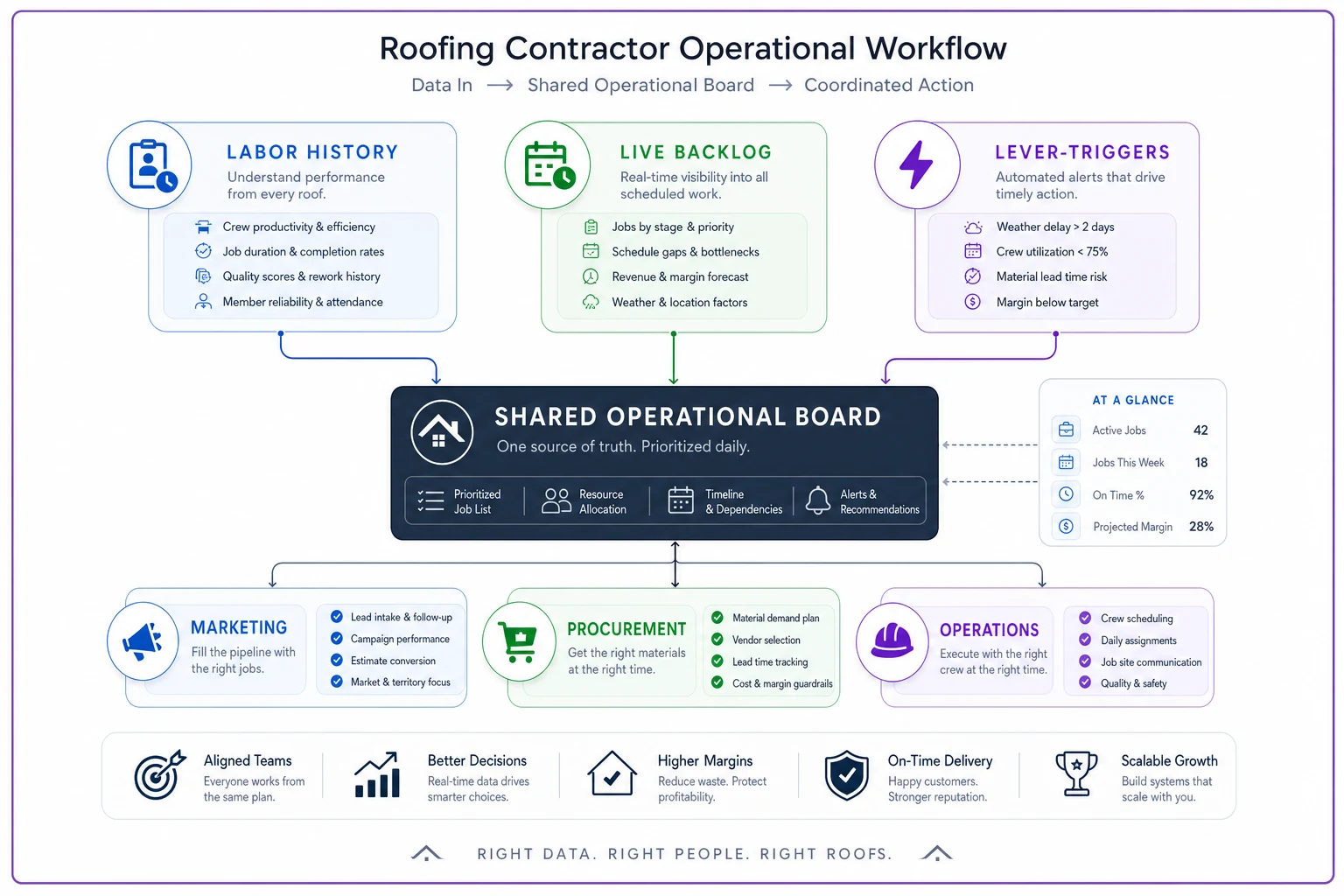
You don't need anything exotic to start. A single shared board with your real labor-hours, current confirmed backlog in weeks, and the five flex-rule thresholds written down where all three teams can see them will catch most of the failures described above. The tooling matters far less than the fact that the three plans finally reference the same reality.
Bringing it together
Seasonal planning doesn't fail because contractors are bad at forecasting. It fails because hiring, procurement, and marketing get planned separately against three different guesses about the same season — and nobody owns the connection between them.
The fix is a single playbook: real labor-hours to set your true capacity ceiling, confidence scoring so commitments match certainty, and staggered crew-flex rules so the cheap, reversible levers fire before the expensive, permanent ones. Get those working together and the season stops being something you survive. It becomes something you can actually plan against — with margin left over at the end of it.
Seasonal planning doesn't fail because contractors are bad at forecasting. It fails because hiring, procurement, and marketing get planned separately against three different guesses about the same season — and nobody owns the connection between them.
The fix is a single playbook: real labor-hours to set your true capacity ceiling, confidence scoring so commitments match certainty, and staggered crew-flex rules so the cheap, reversible levers fire before the expensive, permanent ones. Get those working together and the season stops being something you survive. It becomes something you can actually plan against — with margin left over at the end of it.
Ready to elevate your roofing operations?
Join hundreds of roofing contractors using Roofyly to streamline workflows, improve crew coordination, and enhance client satisfaction.