
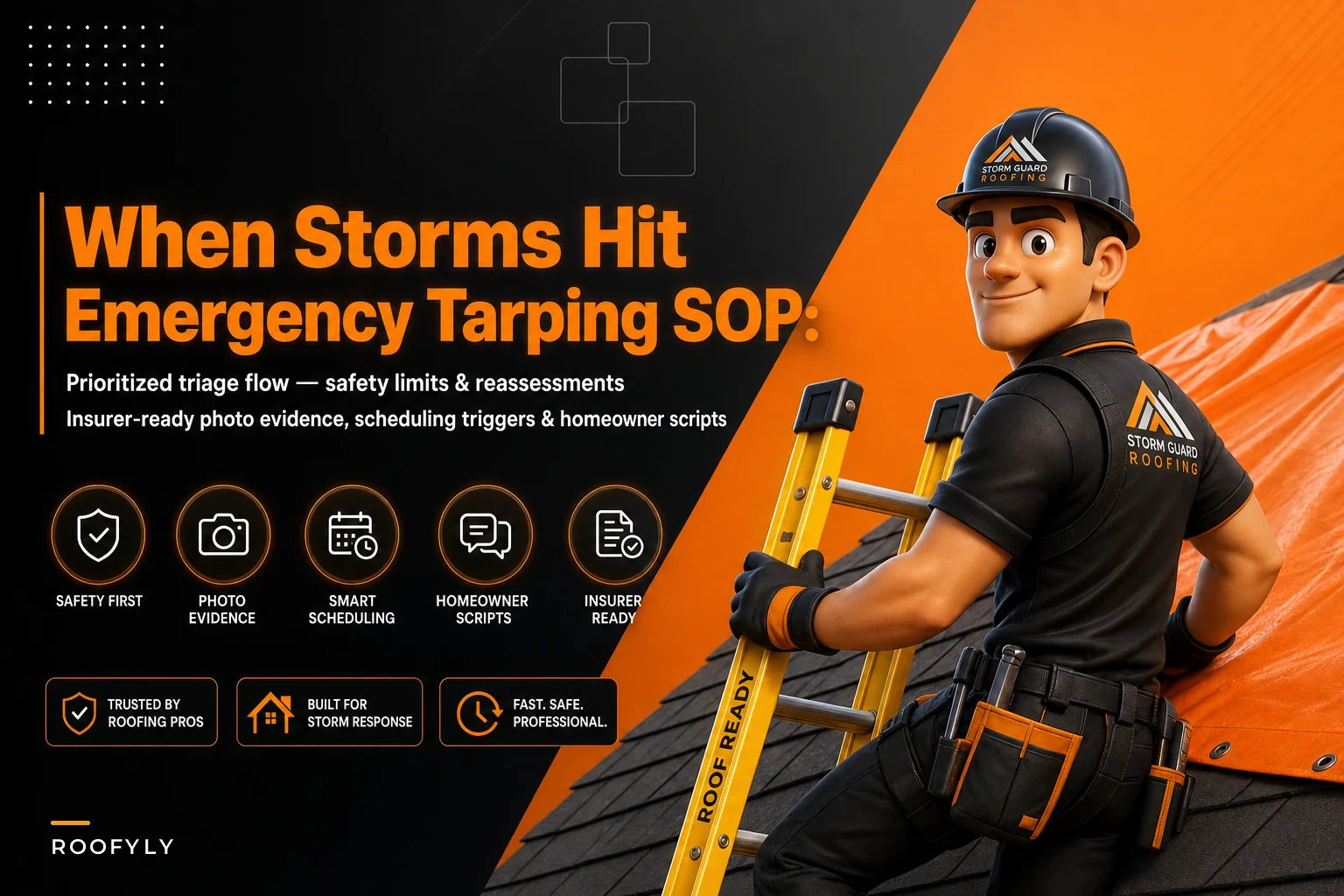

Storm damage calls create a fundamentally different operational challenge than standard roofing work. Your regular scheduling system breaks down. Crews get pulled between emergency tarps and scheduled jobs. Homeowners panic. Insurance adjusters need specific documentation. Safety protocols get pushed aside when everyone's roof is leaking at the same time.
Most roofing contractors handle emergency tarping reactively — whoever calls first gets served first, documentation happens if someone remembers, and safety limits get decided on the spot based on gut feeling. That approach leads to crews spending 40 minutes on a property that needs 10 minutes of work while actual emergencies wait, adjusters rejecting claims because of missing photos, and workers climbing onto structures that shouldn't be accessed at all.
The difference between contractors who thrive during storm season and those who barely survive comes down to having a clear emergency roof tarp SOP that everyone follows under pressure. Not a vague disaster response plan — specific operational protocols for triage, documentation, and communication that your office staff and field crews can actually execute when things get hectic.
The triage categories that actually match storm damage reality
Traditional emergency response uses simple priority levels — high, medium, low. Roof damage doesn't fit those boxes cleanly. A small leak over a bedroom might be more urgent than a large tarp over a garage. Structural damage changes everything about approach and pricing.
Here's a triage system that maps to real storm damage patterns:
Category A: Active interior water damage Properties with water actively entering living spaces. These need response within 2-4 hours regardless of damage size. Includes situations where water is pooling on ceilings, running down walls, or damaging finished spaces. Even a 10-square-foot tarp job becomes Category A if water is hitting hardwood floors or soaking drywall.
Category B: Structural exposure without active interior damage Large areas of missing shingles, exposed decking, or damaged flashing where water will enter during the next rain. Response window is 6-12 hours. No current interior damage, but high probability of major damage if not addressed before next precipitation.
Category C: Exterior damage with intact water barrier Missing shingles with intact underlayment, damaged gutters, loose flashing that isn't currently channeling water inside. These can wait 24-48 hours. Often these properties need tarping for insurance documentation more than actual water protection.
Category D: Cosmetic or minor damage requiring documentation only Small areas of lifted shingles, minor granule loss, aesthetic damage that won't cause leaks. These properties need photos for insurance but no emergency response. Schedule them for batch documentation runs during normal hours.
The triage category determines everything — which crew responds, what materials they carry, how much time gets allocated, and what documentation is required.
Safety limits that protect crews and your liability
Storm-damaged structures present hazards that don't exist during normal roofing work. Clear no-go criteria prevent accidents and protect you from liability when you have to refuse unsafe jobs.
Keep every roofing job on track and on time.
Roofyly helps you manage, schedule, and communicate every roofing project with precision and ease.
- Centralized project planning
- Real-time crew notifications
- Integrated scheduling & client updates
No credit card required
Wind speed is your first hard limit. Above 25 mph sustained winds or 35 mph gusts, no one goes on a roof. Full stop, regardless of customer pressure or damage severity. Between 15-25 mph, only experienced crews work, and only on single-story structures with proper fall protection.
Structural integrity creates the second set of limits. Any visible sagging, cracked rafters, or shifted load-bearing elements means no roof access until an engineer evaluates. Crews can tarp from the ground using poles and weighted systems, but they don't climb compromised structures.
Electrical hazards are the third category. Damaged service drops, exposed wiring, or any electrical components in contact with water or metal roofing means calling the utility company before work begins. Roughly 15% of storm-damaged properties have some electrical hazard that homeowners don't even recognize.
Standing water on roofs creates its own risk profile. More than 2 inches of pooled water indicates potential structural issues and load problems. These situations require pump-out before tarping, or in severe cases, interior water management instead of exterior tarping.
A simple "STOP WORK" checklist that crews review before accessing any storm-damaged roof:
-
Wind speed checked and under limits
-
Structure visually stable (no sagging or shifting)
-
No electrical hazards identified
-
Standing water depth verified if present
-
Adjacent trees and structures evaluated for fall risk
When crews hit stop-work conditions, they document everything, explain the safety issue to the homeowner using a prepared script, and offer ground-based alternatives or referrals to specialized emergency contractors.
Photo documentation requirements by triage level
Insurance companies reject or reduce claims for missing documentation, but taking 200 photos of every property wastes time during emergency response. Your SOP needs specific photo requirements for each triage category.
Category A photo protocol (minimum 12 photos):
-
Wide shot of entire structure from street
-
Four corner elevation shots showing all sides
-
Close-up of primary damage area before tarp
-
Interior damage photos from at least 3 angles
-
Tarp installation in progress
-
Completed tarp with visible anchor points
-
Moisture meter readings if taken
-
Any structural concerns noted
These photos get uploaded immediately, even from the truck, because Category A jobs often lead to large claims that need fast processing.
Category B photo protocol (minimum 8 photos):
-
Overall structure shot
-
Damaged area from multiple angles (minimum 3)
-
Surrounding undamaged areas for comparison
-
Tarp installation showing size and coverage
-
Close-up of anchor methods used
-
Any secondary damage discovered
Category B documentation can upload within 4 hours since these properties have more time before claim deadlines.
Category C photo protocol (minimum 6 photos):
-
Overall damage in context of roof
-
Close-up showing specific failure points
-
Intact underlayment or water barrier visible
-
Tarp if installed
-
Any contributing factors like tree damage or debris impact
-
Property identification shot with address visible
Category D photo protocol (minimum 4 photos):
-
Wide shot showing minor damage location
-
Close-up of specific damage
-
Comparison shot of undamaged similar area
-
Property identification
Categories A and B require photos that prove urgency and prevent further damage. Categories C and D need photos that document existing damage for claim purposes without implying emergency conditions that didn't exist.
Every photo set must include a property identification shot. This sounds basic, but when you're processing dozens of storm claims, mixing up photos between properties can delay or void claims. A simple shot of the house number or a crew member holding a board with the address written on it prevents confusion.
The scheduling trigger system for temporary versus permanent repairs
Storm response creates two distinct scheduling challenges: managing the immediate tarp installation and planning follow-up permanent repairs. Most contractors handle these separately, which leads to tarped houses sitting for weeks while customers quietly shop around.
Your trigger system needs clear handoff points between temporary and permanent work:
Immediate to 48-hour window: All Category A and B properties get scheduled for permanent repair assessment within 48 hours of tarp installation. Not the actual repair — a detailed assessment with a formal estimate. The crew that installs the tarp schedules this automatically, without waiting for office coordination.
48-hour to 1-week window: Category C properties get assessment scheduled within one week. These homeowners aren't in crisis mode, so they're more likely to shop around. Quick follow-up keeps them in your pipeline.
The 30-day re-contact trigger: Any tarped property without a signed repair contract gets recontacted at 30 days. Around a third of homeowners wait for insurance approval or multiple estimates. The 30-day mark often coincides with insurance deadlines, which tends to move people toward a decision.
Weather-based acceleration triggers: When forecasts show significant rain 72+ hours out, all tarped properties get contacted about permanent repair scheduling. Tarps are temporary — UV degradation, wind lifting, and seal failures mean they're really 30-60 day solutions at best.
Build these triggers into your operational workflow, not just a CRM. The crew completing work should trigger the next action, not rely on office staff to remember follow-up timing.
Homeowner communication scripts that prevent problems
Stressed homeowners dealing with roof damage need clear, consistent information. Crews don't have time for lengthy explanations during emergency response. Pre-written scripts for common situations keep communication professional without requiring improvisation.
Initial contact script for Category A response: "We've classified your property as Category A priority due to active interior water damage. Our crew will arrive within 2-4 hours. They'll install a temporary tarp to stop water entry immediately. This is temporary weatherproofing — we'll schedule a full assessment within 48 hours for permanent repairs. The tarp installation typically takes 45-90 minutes. Please move any valuables away from the leak area before we arrive."
Safety refusal script: "We've identified [specific hazard] that prevents safe roof access at this time. For your protection and our crew's safety, we can't perform standard tarping. We can offer [ground-based tarping/interior water management/referral to structural specialist]. Your insurance should cover this documented safety issue. We're providing photos of the hazard for your claim."
Insurance documentation script: "We're documenting everything for your insurance claim — photos of damage, tarp installation, and measurements. You'll receive all documentation within 24 hours via email. Most insurance companies require claim filing within 10-14 days of damage. We recommend contacting them today if you haven't already. Our documentation meets all standard adjuster requirements."
Permanent repair scheduling script: "Your temporary tarp is properly secured and should protect your home for 30-60 days. However, UV exposure and weather will degrade it over time. We'll contact you within [24/48/72] hours to schedule a detailed assessment for permanent repairs. This assessment is free and includes a formal estimate you can provide to insurance."
Expectation-setting script for Category C/D properties: "Your damage has been classified as Category [C/D], meaning there's no immediate water intrusion threat. We'll complete documentation for your insurance claim, but emergency tarping may not be necessary. If conditions change or rain is forecast, we can escalate your priority. Documentation will be complete within [timeframe]."
These scripts prevent the common problems of homeowners expecting permanent fixes from temporary tarps, getting upset about safety-based refusals, or jumping to another contractor because nobody explained the follow-up process.
Insurance adjuster coordination and documentation handoff
The relationship between emergency tarping and insurance approval determines whether you get paid promptly or spend months chasing payment. Adjusters want specific information in specific formats. Miss their requirements and claims get delayed or denied.
Your SOP should include a standard adjuster package for each triage category:
The Category A adjuster package:
-
Time-stamped photos showing active water damage
-
Tarp size and material specifications
-
Labor time with crew size noted
-
Interior damage documentation with moisture readings
-
Explanation of why immediate response was required
-
Temporary repair invoice separate from permanent repair estimate
Adjusters processing Category A claims understand urgency. They're looking for evidence that immediate action prevented greater damage. Your documentation needs to tell that story clearly — water was entering, immediate response stopped it, here's what it cost.
The Category B adjuster package:
-
Photos showing exposure risk
-
Weather forecast data for next 72 hours
-
Prevention-based justification
-
Cost comparison between emergency response and potential damage
-
Materials and labor breakdown
Category B claims require more justification since damage wasn't actively occurring. Including weather forecasts and potential damage estimates helps adjusters approve preventive tarping costs.
Create a standard PDF template for each category that your office team fills out. Include contractor license, insurance information, and contact details on every document. Adjusters handle dozens of claims daily — making their job easier gets your claims processed faster.
Managing crew allocation during storm surge periods
Storm damage doesn't arrive evenly distributed. You might get 40 calls in three hours, then nothing for a day. Traditional crew scheduling collapses under that variability.
Start with crew designation before storms hit. Identify your "storm response" crews — typically your most experienced teams who can work independently and make good field decisions. These crews get pulled from regular jobs when storm calls spike. Also identify your "documentation only" crews — often newer employees or office staff who can safely photograph Category C and D properties without performing actual repairs.
The allocation formula depends on your triage mix. Generally, one experienced crew can handle:
-
4-6 Category A properties per day
-
6-8 Category B properties per day
-
10-12 Category C documentation visits per day
-
15-20 Category D documentation visits per day
What actually happens in practice: categories bunch up geographically. You'll get eight Category A calls from one neighborhood where a microburst hit, while across town you have scattered Category C calls. Fixed crew territories waste drive time during emergency response.
Instead, use dynamic routing based on triage priority and geographic clustering. Every 2-3 hours during surge periods, re-evaluate crew assignments. Pull all unassigned calls, map them, and route crews for minimum total response time while respecting triage priorities. A crew finishing a Category A job might drive past three Category C properties to reach another Category A — that's correct prioritization, not a routing mistake.
The surge allocation system needs clear triggers for scaling up. When Category A and B calls exceed 4 hours of backlog, pull additional crews from scheduled work. When backlog exceeds 8 hours, call in off-duty crews for overtime. When it exceeds 12 hours, activate reciprocal agreements with other contractors for overflow.
A quick visual of dynamic routing and surge triggers helps dispatchers coordinate crews during surge periods.
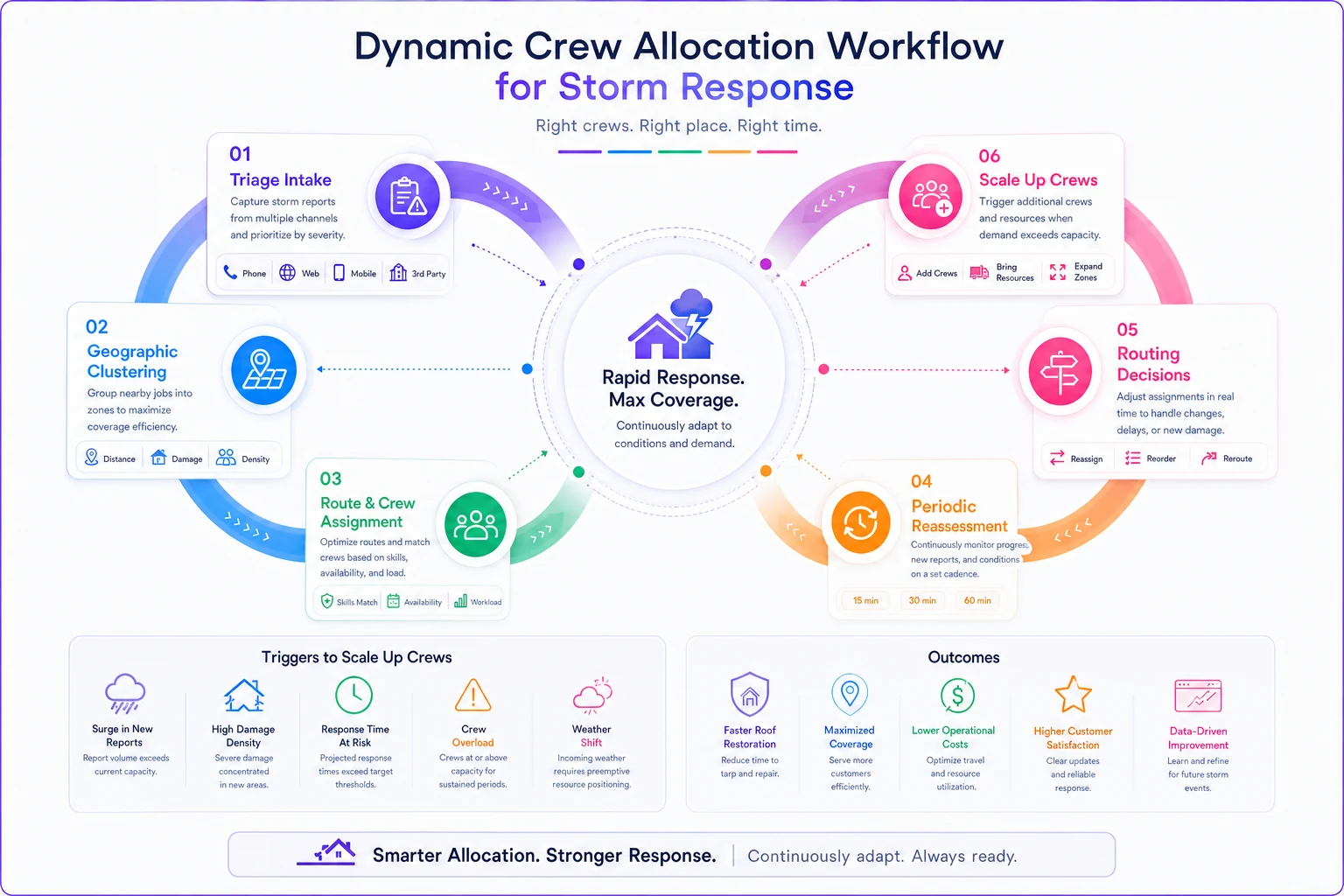
The visual highlights intake, clustering, routing, and escalation triggers so dispatchers can follow a repeatable process during surge periods.
Materials management for emergency response
Emergency tarping uses different materials than permanent roofing. You can't send crews out with standard supplies and expect good results. But you also can't stock every possible tarp size and anchor type.
The 80/20 rule applies strongly here. About 80% of emergency tarps fall into three size categories:
-
10x12 feet for small penetrations and localized damage
-
20x30 feet for moderate section coverage
-
40x60 feet for large areas or full slope coverage
Stock these three sizes in quantity before storm season. Everything else can be field-fabricated from these bases. A crew with tin snips and a heat gun can modify standard tarps faster than driving back for special sizes.
| Tarp size | Typical use |
|---|---|
| 10x12 feet | for small penetrations and localized damage |
| 20x30 feet | for moderate section coverage |
| 40x60 feet | for large areas or full slope coverage |
Anchor systems matter more than tarp quality for temporary installations. Wood battens with screws work on intact decking but fail on compromised structures. Sandbags seem like a good solution until wind gets under the tarp. The most reliable system combines multiple methods:
-
Perimeter battens screwed into solid framing, not just sheathing
-
Intermediate battens every 8-10 feet on large tarps
-
Sandbags on top of battens, not as primary anchors
-
Adhesive strips for sealing edges on smooth surfaces
Keep pre-assembled anchor kits in each truck during storm season. A basic kit contains:
-
20 two-foot battens
-
100 appropriate screws
-
10 sandbags (empty, filled on-site)
-
One roll of tarp tape
-
Bungee cords for temporary securing during installation
Stock the three common tarp sizes before storms and teach crews how to field-fabricate others — it's faster than driving back for special sizes.
This standardization means any crew can grab any truck and complete emergency tarping without hunting for materials mid-job.
The handoff from emergency response to normal operations
Emergency tarping is just the first step. The transition from emergency operations to normal scheduling is where contractors lose customers and revenue. Properties sit tarped for weeks while homeowners assume you'll call. Meanwhile, other contractors approach tarped homes and sell the permanent work.
Your SOP needs structured handoff protocols:
The immediate handoff (at tarp completion): The crew completing emergency tarping creates the permanent repair lead right then. Not later, not when they get back to the office — in the truck before they leave. Basic information: property address, damage assessment, triage category, customer contact preference, insurance claim status if known.
The 24-hour handoff (office processing): Office team reviews all previous day's emergency jobs each morning. They match tarp installations to existing customer records, create new records as needed, and assign permanent repair assessments based on geographic efficiency and crew availability. Every tarped property should have a scheduled follow-up within this 24-hour window.
The assessment handoff (estimate creation): The assessment crew needs emergency response information to create accurate estimates. Photos from emergency response, triage categorization, and any structural concerns noted during tarping all inform the permanent repair scope. This isn't starting from scratch — it's building on existing documentation.
A spreadsheet isn't enough for tracking these handoffs when you're managing 30+ emergency jobs simultaneously. The operational complexity requires proper workflow management that ensures nothing falls through the cracks. AI-powered operational software helps here — automatically creating permanent repair workflows from emergency job completions, tracking follow-up timing, and flagging when handoffs haven't occurred within the expected window.
Pricing structures for emergency versus scheduled work
Emergency tarping pricing operates differently than standard roofing. You can't spend 30 minutes building detailed estimates when water is pouring through someone's ceiling. But you also can't absorb costs when emergency response requires overtime, special materials, or multiple truck rolls.
Establish tiered pricing before storm season:
Category A pricing: Flat mobilization fee ($200-$350) plus standardized tarp installation rates based on size. A 10x12 tarp might be $400 total, 20x30 runs $800, 40x60 hits $1,500. These prices include basic materials and standard anchoring. Additional charges apply for overtime (after 6 PM or weekends), extreme height (over 2 stories), or structural complications.
Category B pricing: Lower mobilization fee ($150-$250) since timing is less critical, but same installation rates. The reduced urgency doesn't significantly change labor time, just scheduling flexibility.
Category C/D pricing: Documentation-only visits run flat rate ($75-$150) regardless of damage extent. If tarping is requested despite low priority, use Category B pricing.
Present pricing at first contact, not after completion. Your dispatch script should include: "Emergency response includes a mobilization fee of $X plus installation based on tarp size. Most residential jobs run $X to $X total. We can provide exact pricing after assessment, but work proceeds immediately to prevent further damage."
That transparency prevents pricing disputes when homeowners are already stressed and fielding calls from multiple contractors.
Conversion optimization from emergency to permanent repairs
Roughly 45% of emergency tarp customers should convert to permanent repairs with your company. If conversion runs below 30%, your follow-up process has gaps. Above 60% might mean you're only tarping easy-to-close customers and missing broader emergency response opportunities.
Conversion hinges on three moments:
Moment 1: During emergency response Your crew's professionalism during crisis creates lasting impressions. Showing up on time, working efficiently, explaining what they're doing, and cleaning up debris all influence whether customers trust you with permanent repairs. But pushing sales during emergency response backfires — solve the immediate problem first.
Moment 2: The 48-hour follow-up This contact can't be generic. Reference specific damage observed, use the customer's name, and give concrete next steps. "Hi Sarah, this is Mike from the crew that tarped your home Tuesday afternoon. That damaged section over your kitchen is properly protected now. I'm calling to schedule your detailed assessment for permanent repairs. Insurance typically needs our formal estimate within 10 days — can we come Thursday morning or Friday afternoon?"
Moment 3: The assessment presentation Don't make customers chase you for estimates. Complete the assessment within 48 hours and deliver the estimate within 24 hours after that. Include photos from both emergency response and assessment, clear pricing breakdown, and insurance claim assistance. The faster you deliver a professional estimate, the less likely customers look elsewhere.
Track conversion by triage category. Category A customers convert highest — around 65% — because you solved their crisis. Category B runs about 45%, Category C/D closer to 25%. If Category A conversion drops below 50%, examine your emergency response quality. If Category B/C falls below 20%, the follow-up process needs work.
Common failure points in emergency response operations
There are predictable failure patterns that repeat across different companies and storm events. They're not random problems — they're systematic breakdowns.
Failure Point 1: Mixed triage priorities Office staff take calls and assign their own urgency levels. A crying homeowner with minor damage gets Category A response while major structural exposure gets classified as "schedule when available." Without clear triage criteria, emotional response overrides operational logic.
Failure Point 2: Documentation gaps during busy periods First few jobs get thoroughly photographed. By job eight, crews skip photos to save time. Two months later, insurance wants documentation for that eighth job — which doesn't exist. Documentation can't be optional regardless of volume.
Failure Point 3: Crew safety creep Early in storm response, crews follow safety protocols carefully. As pressure builds and customers complain about wait times, crews start pushing limits. They'll work in 30 mph winds "just this once" or access questionable structures because "it looks stable enough." Safety protocols need enforcement precisely when pressure peaks.
Failure Point 4: Lost follow-up revenue Emergency response feels successful — crews worked hard, customers got helped, immediate crisis passed. Then three weeks later you realize none of those tarped properties converted to permanent repairs. Other contractors approached your tarped homes and sold the work while you assumed customers would call back.
Failure Point 5: Material shortages mid-response Storm hits Sunday. Monday response is going well. Tuesday afternoon you run out of 20x30 tarps and sandbags. Suppliers are also slammed and can't deliver until Thursday. Crews sit idle or use wrong-sized materials. Pre-storm stocking and supplier agreements prevent this entirely.
Each failure point needs specific countermeasures built into your SOP, not just general awareness that problems might occur.
Building your complete emergency response playbook
A comprehensive emergency roof tarp SOP spans around 20-25 pages when fully documented. Crews won't read 25 pages during an emergency response. You need layered documentation:
Layer 1: Field cards Laminated cards for each truck with:
-
Triage definitions and photo requirements
-
Safety stop-work triggers
-
Basic pricing tiers
-
Emergency contact numbers
Layer 2: Dispatch protocols Office procedures for:
-
Call intake and triage assignment
-
Crew allocation rules
-
Customer communication scripts
-
Insurance documentation requirements
Layer 3: Management playbook Complete procedures including:
-
Surge scaling triggers
-
Materials management
-
Follow-up conversion tracking
-
Quality control processes
-
Training requirements
Start with field cards and dispatch protocols. These create immediate operational improvement. Add management playbook elements as you refine processes through actual storm response.
Your emergency response capability becomes a real competitive advantage when executed properly. While competitors scramble to figure out processes mid-storm, you execute proven protocols. Customers remember who helped during a crisis. Insurance adjusters prefer contractors who provide proper documentation. These advantages compound over multiple storm seasons.
A decent storm response might generate $150k-$300k in emergency tarping revenue over a few days. More importantly, it creates a pipeline of permanent repair work worth significantly more. But only if your operational system can handle the surge professionally while maintaining safety and documentation standards.
That's the difference between contractors who see storms as chaos and those who see them as opportunity — preparation and systematic execution. Your emergency roof tarp SOP transforms unpredictable events into manageable operations that serve customers, protect crews, and generate sustainable revenue through both emergency response and permanent repair conversion.
Your emergency response capability becomes a real competitive advantage when executed properly. While competitors scramble to figure out processes mid-storm, you execute proven protocols. Customers remember who helped during a crisis. Insurance adjusters prefer contractors who provide proper documentation. These advantages compound over multiple storm seasons.
Ready to elevate your roofing operations?
Join hundreds of roofing contractors using Roofyly to streamline workflows, improve crew coordination, and enhance client satisfaction.