


Municipal permit delays aren't really about filing forms wrong anymore. The actual breakdown happens in the gray zones between jurisdictions, the unspoken inspector preferences, and the communication gaps that turn 3-day permits into 3-week nightmares.
One pattern keeps showing up across dozens of municipalities: contractors who treat permit tracking as a jurisdictional strategy rather than a filing process cut their delays by roughly 40%. Most teams are still operating like it's 2015—submitting forms and hoping for the best.
Why permit delays actually happen (hint: it's not what you filed)
Your permit application sits untouched for 8 days. Not because you forgot a form or got the square footage wrong. The real culprit? You submitted to the wrong intake desk at the county level when the job technically falls under township jurisdiction because of a historical annexation from 1987 that nobody bothered to mention.
This kind of jurisdictional confusion creates a very specific type of chaos. Your crew has materials scheduled for Tuesday. The homeowner took time off Wednesday. Your next job starts Thursday. But the permit is stuck in limbo because the county clerk forwarded it to the township, who forwarded it back with a note about needing county approval for properties on that particular street.
Meanwhile, another contractor who knows this quirk walks their permit directly to the township office, mentions the annexation issue upfront, and gets approved same day. Not because they're better at paperwork—they've just mapped the maze.
The three-tier jurisdiction breakdown most contractors miss
Municipal permit systems operate on overlapping authority that nobody explains clearly. You've got city limits, county zones, and special districts all claiming different pieces of your roofing job.
Keep every roofing job on track and on time.
Roofyly helps you manage, schedule, and communicate every roofing project with precision and ease.
- Centralized project planning
- Real-time crew notifications
- Integrated scheduling & client updates
No credit card required
City jurisdiction typically covers:
-
Residential zones within official city boundaries
-
Commercial properties on main streets
-
Historic districts with preservation rules
-
Properties with existing city utility connections
County jurisdiction usually includes:
-
Unincorporated areas outside city limits
-
Rural properties with well/septic systems
-
Agricultural zones with barn structures
-
Subdivisions built before city expansion
Special district overlays add complexity:
-
Watershed protection zones
-
Fire districts with specific access requirements
-
HOA territories with architectural committees
-
Conservation areas with environmental reviews
The expensive mistake happens when contractors assume jurisdiction follows zip codes or mailing addresses. A house might have a city mailing address but fall under county building codes. Or it sits in a special overlay district that requires additional approvals nobody told you about.
Building your jurisdiction intake checklist
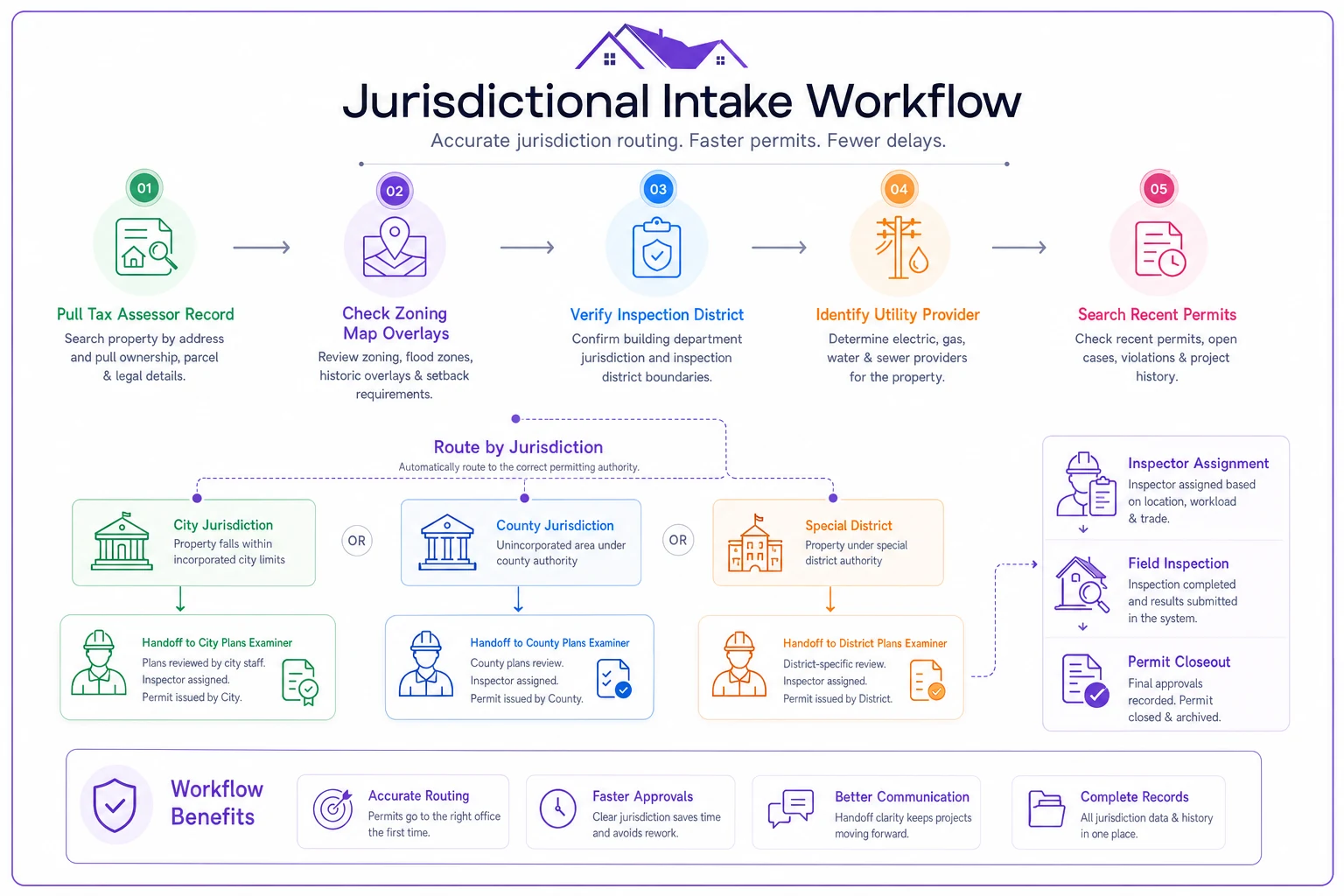
Successful permit tracking starts before you even pull the application. Here's the intake process that actually prevents delays:
Property verification sequence:
-
Pull the tax assessor record (shows actual jurisdiction)
-
Check the zoning map overlay (reveals special districts)
-
Verify the inspection district (might differ from permit office)
-
Identify the utility provider (indicates permit routing)
-
Search recent permits for that address (shows which office approved them)
Red flag properties that need special handling:
-
Corner lots touching two jurisdictions
-
Properties near city/county boundaries
-
Anything built before 1990 (often grandfathered rules)
-
Subdivisions with active HOAs
-
Properties with previous code violations
Here's a quick visual of that intake workflow.
The difference between a smooth permit and a nightmare often comes down to one question asked upfront: "Has this property been annexed or redistricted in the last 20 years?" If yes, you're dealing with overlapping authority that requires specific routing.
Inspector communication cadence that actually works
Nobody tells you this about inspector relationships: they remember contractors who make their jobs easier. Not through gifts or schmoozing—through predictable communication patterns that respect their workflow.
Most inspectors handle somewhere between 12 and 20 stops per day. They plan routes geographically. They hate surprises. And they absolutely remember contractors who waste their time with unprepared sites or missing documentation.
The 3-touch inspector cadence:
Touch 1 – Initial permit submission:
-
Include a cover sheet with
-
- Clear job timeline
-
- Preferred inspection windows
-
- Cell number for day-of contact
-
- Brief note about any access issues
Touch 2 – 48-hour advance notice:
-
Send a text or email confirming
-
- Site will be ready
-
- What stage needs inspection
-
- Any special site conditions
-
- Confirmation you'll have someone on-site
Touch 3 – Morning-of confirmation:
-
Quick text by 7 AM
-
- "Ready for inspection at [address]"
-
- "Gate code is [XXXX]"
-
- "Foreman Jake on-site
[phone]"
Keep a standardized one-page cover sheet saved as a PDF to reduce prep time and ensure inspectors always have the same info.
This cadence cuts failed inspections by a significant margin because inspectors know exactly what to expect. More importantly, when you need a favor—a late Friday inspection or a same-day reinspection—inspectors who know you're reliable are far more likely to work with you.
The permit tracking template that prevents rework
Generic permit trackers fail because they track dates, not dependencies. Roofing jobs don't just need permits approved—they need specific sequences completed in order, with different authorities controlling different stages.
Essential tracking fields most templates miss:
| Tracking Element | Why It Matters | Common Failure Point |
|---|---|---|
| Jurisdiction type | Routes to correct office | Assuming city = permit authority |
| Intake method | Some require in-person | Online submission to wrong portal |
| Inspector name | Build relationships | Treating all inspectors identically |
| Prerequisite permits | Some permits need others first | Starting electrical before structural |
| Revision triggers | What forces resubmission | Minor changes requiring new application |
| Approval dependencies | What else needs this permit | HOA approval after municipal permit |
The template should also track communication timestamps—not just "permit submitted 3/15" but "emailed planning dept 3/15 9:30 AM, called 3/17 2 PM no response, visited office 3/19 got verbal approval pending documentation."
That level of granularity is where patterns start to surface. Maybe permits submitted Tuesday mornings get processed faster. Maybe inspector Johnson always wants additional documentation that inspector Williams never asks for. These patterns become real operational advantage over time.
Reading the unwritten rules of local permit offices
Every permit office has unofficial protocols that can accelerate or destroy your timeline. These aren't posted anywhere—you learn them through expensive mistakes or by paying close attention.
Common unwritten rules worth documenting:
The "Thursday problem": Many offices do batch processing. Submit Monday, get reviewed Thursday. Submit Tuesday, still reviewed Thursday. But submit Thursday after batch processing? You're waiting until next Thursday.
The "completeness trap": Some offices review applications for completeness before entering the queue. Others enter everything immediately then reject for missing items. Knowing which approach your office uses changes your entire submission strategy.
The "revision reset": Minor permit revisions might seem harmless. But in many jurisdictions, any revision sends you back to day one of the review process. That small square footage adjustment just added two weeks.
The "inspector personality matrix": Inspector Davis measures everything twice and checks every nail. Inspector Rodriguez focuses on structural elements and ignores cosmetic issues. Knowing who's coming changes your prep completely.
Why traditional permit tracking fails roofing contractors
Roofing contractors face permit challenges that generic construction software just doesn't account for. Jobs are weather-dependent and require flexible scheduling. Permits often trigger multiple inspections—structural, electrical, final. Materials have short return windows that don't care about permit delays.
Standard permit tracking assumes linear progression: submit, wait, approve, build. Roofing operations need parallel tracking across multiple authorities, contingency planning for weather delays, and coordination between permit status and material delivery schedules.
The operational reality is messier than that. You're submitting the primary permit while checking HOA requirements, scheduling tentative material delivery assuming standard approval time, maintaining backup windows for two weather delays, coordinating inspector availability with crew scheduling, and adjusting everything when one jurisdiction moves faster or slower than expected.
Turning permit delays into competitive advantage
Contractors winning in competitive markets aren't avoiding permit delays—they're navigating around them better than everyone else. When the same municipal bottlenecks hit everybody, your response strategy becomes your differentiation.
Start tracking permit velocity by jurisdiction and inspector. If County permits average 12 days but City permits take 6, price County jobs differently or schedule them accordingly. If Inspector Thompson approves 90% on first inspection but Inspector Lee requires two visits half the time, that belongs in your scheduling assumptions.
Build a permit delay communication template for customers. Instead of vague "waiting on permits" updates, send something specific: "Permit entered final review today, typically 3-4 business days from here. Inspector Johnson is scheduled for Tuesday pending no weather delays." That transparency builds trust even when things are slow.
Use permit tracking intelligence as a sales tool too. When competitors quote 4-week completion times without knowing about the special overlay district requiring environmental review, you can set realistic expectations upfront. Honesty about timelines isn't a weakness—it's how you win repeat business.
Where AI-powered permit tracking changes the game
Modern permit tracking for roofing contractors isn't about digitizing paper forms. It's about pattern recognition across jurisdictions, intelligent scheduling around approval timelines, and communication sequences that maintain inspector relationships without someone manually chasing every follow-up.
AI-powered operational software handles tracking multiple jurisdiction requirements simultaneously, flags when permit sequences are out of order, and predicts approval timelines based on historical data. Instead of someone manually checking three different municipality websites every day, automated systems monitor status changes and surface alerts only when action is actually needed.
The real value is connecting permit status to the rest of your operations. When permits delay, these platforms can automatically adjust material orders, reschedule crews, update customer communications, and suggest alternative job sequencing to protect cash flow. It's not replacing your permit expertise—it's extending your capacity to apply that expertise across more jobs at once.
Permit delays don't happen because municipalities are slow. They happen because contractors treat complex jurisdictional requirements like simple administrative tasks.
The teams succeeding here aren't just filing paperwork—they're mapping jurisdiction patterns, building inspector relationships, and running operational systems that turn permit complexity into competitive advantage. Your permit tracking system should reveal patterns, not just record dates. Your jurisdiction checklist should prevent delays, not just document them. Your inspector communication should build relationships, not just request inspections.
The roofing contractors thriving despite permit complexity aren't lucky. They've turned the municipal maze into mapped territory where they know the shortcuts, the dead ends, and the fast lanes. In a business where one permit delay can cascade into weeks of scheduling chaos, that knowledge is worth real money. Stop treating permits like paperwork—they're an operational chess game, and the municipalities aren't changing their processes anytime soon, but you can absolutely change how you navigate them.
Ready to elevate your roofing operations?
Join hundreds of roofing contractors using Roofyly to streamline workflows, improve crew coordination, and enhance client satisfaction.