
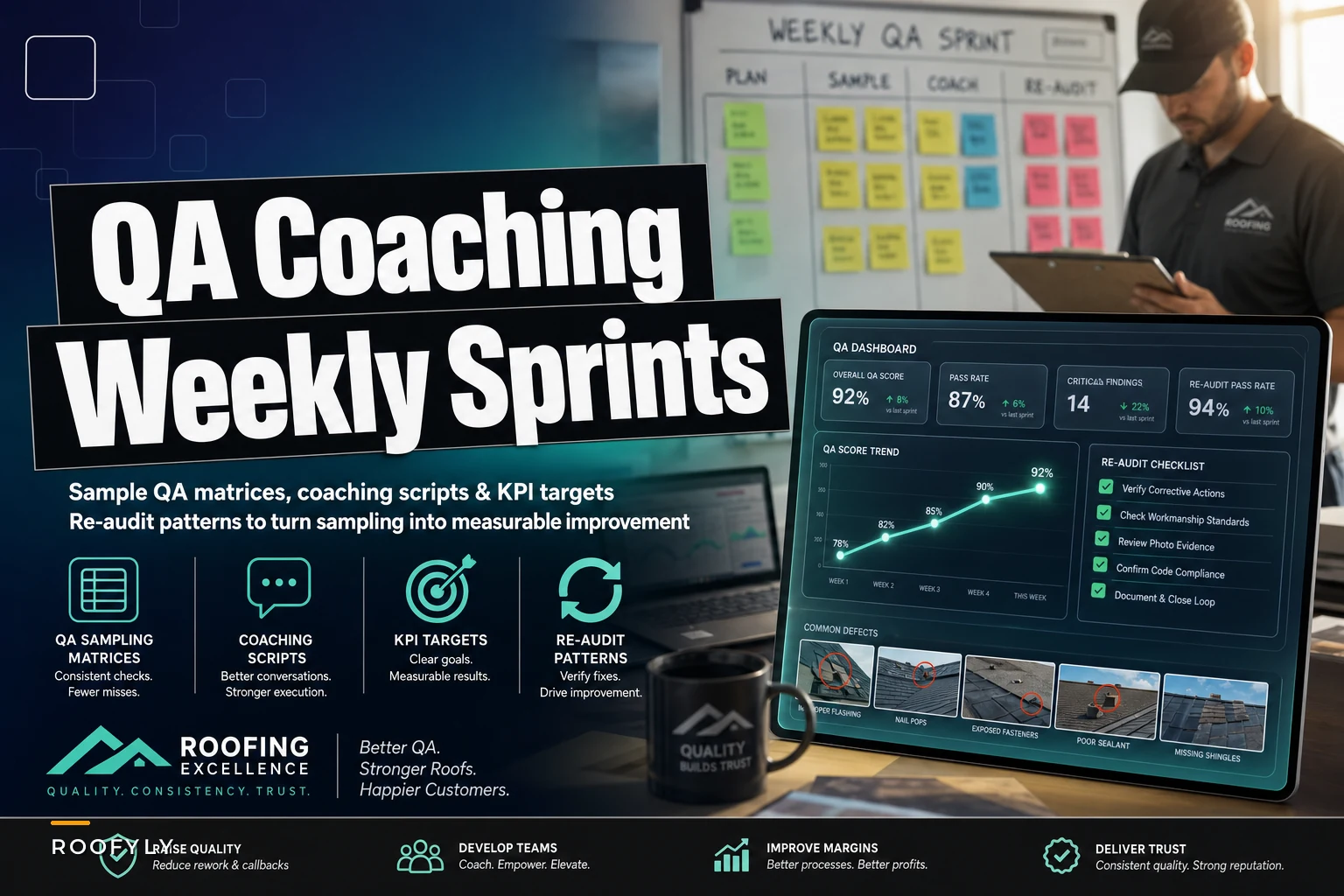

Most roofing QA programs die the same way. You run a sampling plan, catch defects, write them up in a shared doc nobody opens, and six weeks later the exact same crew is nailing high on the same pitch or skipping the starter course offset on the same eave detail. The inspection worked. The correction didn't. The problem was never detection — it was the gap between finding a defect and actually changing the behavior that caused it.
That gap is where a weekly sprint cadence earns its keep. Not a quarterly review. Not an annual "quality push." A short, repeating loop that samples, scores, coaches, sets a target, and re-audits — fast enough that the lesson lands while the crew still remembers the roof.
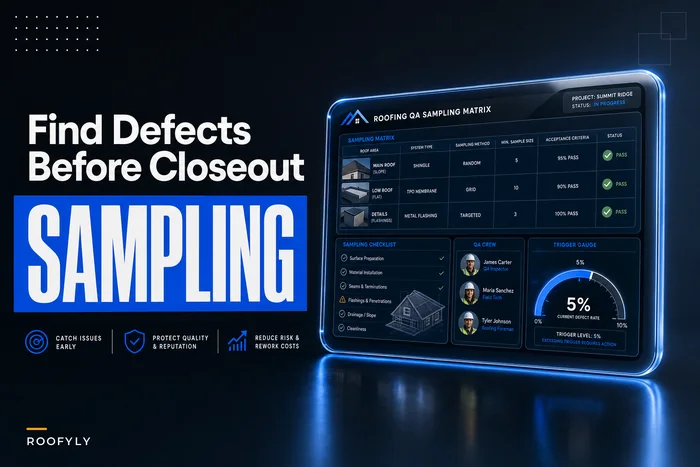
This is specifically about operationalizing QA coaching sprints roofing teams can actually sustain, built on top of whatever sampling you're already doing. If you don't have a defensible sampling foundation yet, start with the statistically defensible roofing QA sampling plan for spot-checks first — this article assumes you can already surface defects reliably and focuses entirely on turning those findings into measurable behavior change.
Why detection alone never fixes workmanship
Defects aren't random. A single crew will throw the same two or three errors over and over because those errors come from a habit, a shortcut, or a training gap. Nail placement drift. Inconsistent exposure on the last few courses before a valley. Pipe boots seated but not sealed on the uphill side. Ice-and-water underlap where two pieces meet mid-valley.
When you inspect and log these but don't close the loop in days, three things happen:
-
The foreman forgets the specific roof by the time feedback arrives
-
The correction becomes an abstract rule ("be more careful on valleys") instead of a concrete motion
-
The same defect reappears on the next job because nothing in the crew's actual workflow changed
A typical example: a mid-size residential company running four crews logs 140-some defects across a quarter. When they finally sort them, about 60% trace back to just seven recurring issue types, and nearly half of those belong to two crews. The data was always there. Nobody turned it into a weekly conversation with a number attached.
The sprint shape: what a week actually looks like
A QA coaching sprint is one week long on purpose. Long enough to pull a real sample across active jobs, short enough that corrective feedback hits before the crew's muscle memory resets. The cadence repeats indefinitely, and each week has a fixed rhythm so nobody has to reinvent it.
Keep every roofing job on track and on time.
Roofyly helps you manage, schedule, and communicate every roofing project with precision and ease.
- Centralized project planning
- Real-time crew notifications
- Integrated scheduling & client updates
No credit card required
Here's the weekly flow in order:
-
Monday — pull the sample. Lock the jobs that closed or hit a QA stage in the past 7 days. Pull your sample using your existing plan. Score each sampled roof against the defect matrix (below).
-
Tuesday — build the crew-level tally. Roll defects up by crew and by issue type. You're not looking at individual roofs anymore — you're looking for the repeating defect per crew.
-
Wednesday — coaching conversations. Each foreman gets a 15–20 minute session tied to their top recurring defect. Script-driven, specific, photo-backed.
-
Thursday — set the one target. Each crew leaves with exactly one measurable target for next week. Not five. One.
-
Following week — re-audit that specific target. When that crew's jobs come up in next week's sample, you flag whether the targeted defect reappeared.
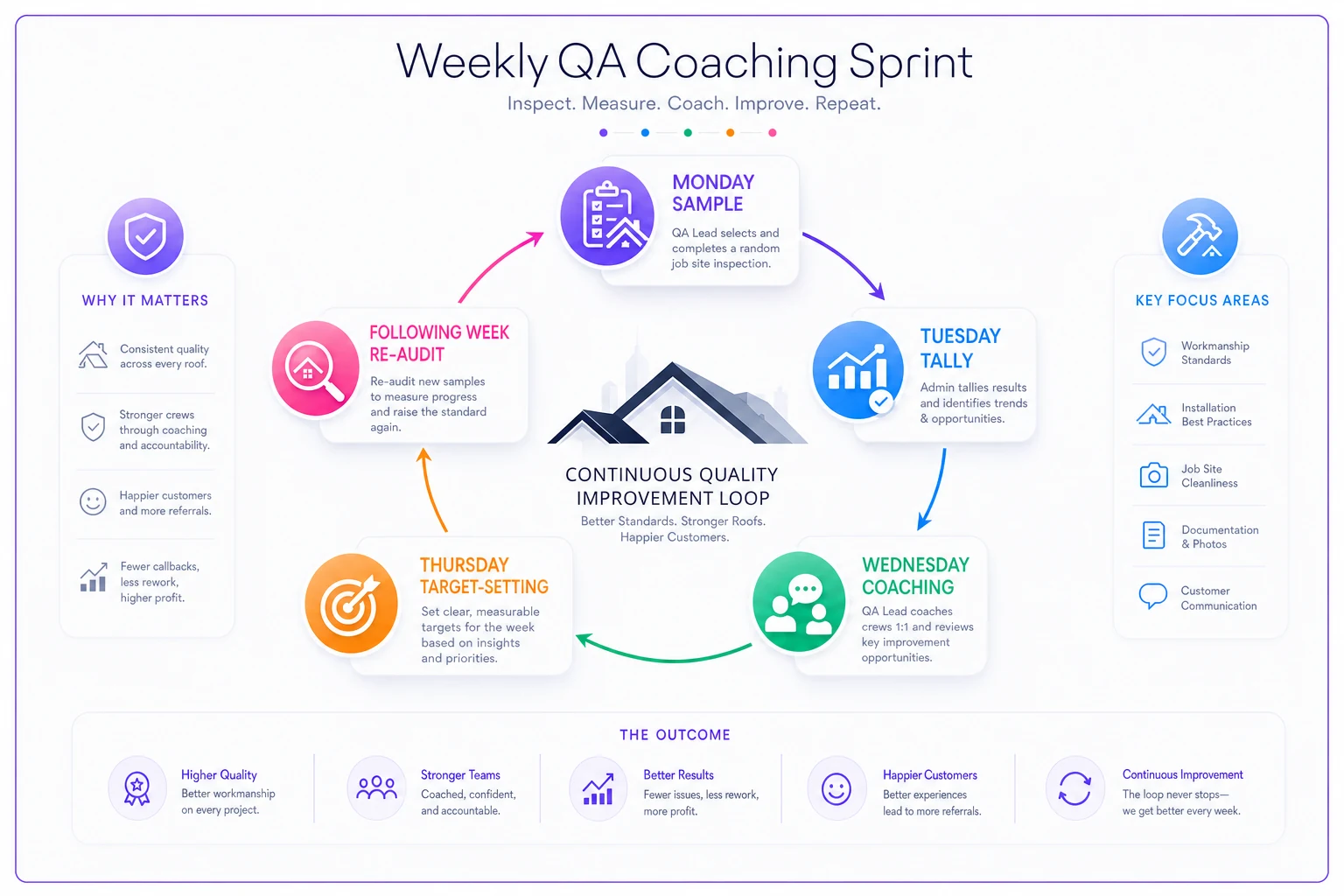
Visualize the cadence as a tight weekly loop so the team sees the flow.
The discipline is in the narrowness. One defect, one crew, one target, one re-audit. A sprint that tries to fix everything fixes nothing — the foreman walks away with a vague sense that "quality was bad" and no single thing to change on Monday morning.
The sample matrix: scoring that forces a decision
You need a scoring sheet that produces a crew-level signal, not just a pile of notes. The matrix below is the backbone. Each sampled roof gets scored on the defect categories that actually drive callbacks, and each category gets a severity weight so a critical miss doesn't get buried under cosmetic nitpicks.
| Defect category | What you're checking | Severity weight | Re-audit trigger threshold |
|---|---|---|---|
| Fastener placement/pattern | Nail height, count, overdriven/underdriven | 3 | 2+ hits in a sample |
| Valley treatment | Underlayment lap, cut alignment, exposure | 3 | 1 hit |
| Penetration flashing/sealing | Boot seating, uphill seal, collar condition | 3 | 1 hit |
| Starter/eave detail | Offset, overhang, adhesive strip orientation | 2 | 2+ hits |
| Course exposure consistency | Reveal drift across the field | 2 | 3+ hits |
| Ridge/hip detail | Cap spacing, exposure, end treatment | 2 | 2+ hits |
| Debris/magnet/site cleanup | Nails left, gutter debris | 1 | 3+ hits |
The weights matter because they decide what you coach first. A crew with one valley miss and six cleanup flags does not get coached on cleanup — the valley is a potential leak and a warranty callback; the cleanup is a one-minute fix. Rank the coaching target by weighted severity, not raw count. The most common mistake teams make here is coaching the loudest defect (cleanup, because it's visible) instead of the most expensive one (water-path details, because those are what actually come back).
Coaching scripts that change a motion, not a mood
A coaching session fails when it turns into "you need to do better." It works when it names the exact defect, shows the photo, demonstrates the correct motion, and ends with a target the foreman repeats back. The structure should stay the same every week so it becomes routine instead of a confrontation.
A working script for a recurring valley defect looks roughly like this:
-
Name it with evidence "On the Henderson job, the sampled valley had the underlayment lapped downhill over uphill on the right side. Here's the photo. This shows up on two of your last three valleys."
-
Explain the consequence in their terms "That's the exact path water takes in a heavy rain. This is the detail that becomes a callback in February, and callbacks come out of the bonus pool."
-
Demonstrate the correct motion walk the actual sequence — which piece goes down first, which direction the lap runs, where the cut lands.
-
Set one target "Next week, every valley on your jobs gets the uphill-over-downhill lap, and you snap a photo of it before you cover it. I'll check it in the sample."
-
Confirm back have the foreman restate the target in their own words. If they can't, the coaching didn't land.
No general lecture, no laundry list, no tone of discipline. The whole session is one defect, one cause, one motion, one target. The same framing that makes estimator coaching work during live visits applies on the roof — specific, evidence-backed, tied to a measurable follow-up, and detached from personal criticism.
KPI targets: what you actually track across sprints
Individual coaching sessions are the mechanism. KPIs are how you prove the loop is working and know when a crew needs escalation instead of another conversation. Keep the KPI set small — tracking fifteen numbers means tracking none.
-
Weighted defect rate per crew — total severity points divided by roofs sampled. This is your headline trend line per crew.
-
Repeat-defect rate — percentage of coached defects that reappear in the next sprint's sample for that crew. This is the single most important number in the whole program.
-
Target hit rate — did the crew clear its one assigned target? Binary, per crew, per week.
-
Time-to-close — days from defect logged to coaching delivered. Keep this under 4 or the loop loses its teeth.
-
Sample coverage — are you actually sampling each crew often enough to catch repeats? A crew that only appears in the sample once a month can't be coached on a weekly cadence.
Set targets that are realistic for your starting point. If a crew is running a weighted defect rate of 4.5, the target isn't zero — it's a steady drop of roughly 15–20% per sprint until it plateaus around your acceptable floor. The repeat-defect rate is where you'll see the real story: when a coached defect keeps coming back after two or three sprints, you've moved past a coaching problem into a competency or willingness problem, and that gets handled differently.
The re-audit pattern: closing the loop
The re-audit is what separates a sprint program from a suggestion box. Every target set in a coaching session must get explicitly checked in a later sample — and the result gets recorded as cleared, recurred, or not sampled.
When crew B gets a target to fix penetration sealing, that target carries a flag. The next time crew B's jobs land in the weekly sample, the scorer specifically inspects penetration sealing and marks the flag. Three outcomes drive three different responses:
-
Cleared — target closes, crew moves to coaching on their next-highest weighted defect.
-
Recurred once — re-coach, but tighten the demonstration and consider whether the issue is a tool, a material, or an understanding gap.
-
Recurred twice — escalate. This is no longer a weekly-sprint problem; it goes to the ops manager for a hands-on jobsite session or a competency review.
The recurred-twice rule protects the whole program. Without it, a crew can absorb endless gentle coaching on the same defect while callbacks pile up, and the sprint cadence becomes theater. The escalation is the backstop that keeps the loop honest.
A real scenario
A residential reroof company running three crews had a callback rate hovering around 9% of completed jobs, with roughly two-thirds of those callbacks traceable to water-path details — valleys, penetrations, and flashing. They were already sampling roofs at closeout but logging everything into a spreadsheet that got reviewed "when there was time," usually monthly, usually too late to matter.
They switched to a weekly sprint. Monday sample, Tuesday tally, Wednesday coaching, one target per crew, re-audit the following week. No new inspection volume — same number of roofs sampled, just a faster loop and a narrower focus.
The first few weeks were ugly. The weighted defect rates were higher than anyone wanted to admit, and two crews repeated their coached defect in the first re-audit. But by the end of about two months, the repeat-defect rate had dropped from roughly half of coached items down to under one in five. Water-path callbacks fell by a bit more than a third over the following quarter. The number that moved the owner most wasn't even on the KPI sheet: foremen started photographing valley laps and boot seals before covering them, without being told, because they knew it was getting checked.
Nothing magic happened. The defects were always findable. The change was speed plus narrowness — one defect, one crew, one target, checked next week.
When this works, and when it doesn't
This makes sense when you're already sampling consistently, you have enough job volume that each crew lands in the sample at least every week or two, and you have someone who can run the tally and deliver coaching without it becoming a political event. Three to eight crews is the sweet spot.
This is a bad idea when your sampling is inconsistent or undefined — you'll be coaching noise. Fix the sampling foundation first. It also struggles if a single crew only appears in your sample monthly; the cadence can't catch repeats fast enough to coach them, and you'll need to either sample more heavily or run their sprint on a slower clock.
Who should probably not run this yet: one or two-crew operations where the owner is on every roof anyway. At that scale the loop is already happening informally, and the overhead of a formal sprint adds structure without adding signal. The program earns its keep when you've grown past the point where one person can personally feel every defect.
Keeping the loop alive past week six
The real threat to any QA program isn't that it doesn't work — it's that it quietly stops happening. The sample doesn't get pulled one busy week, then two, and the cadence is dead. The things that keep it running are boring and non-negotiable: the Monday sample is somebody's named job, the coaching sessions are on the calendar like any other meeting, and the re-audit flags actually get checked instead of forgotten.
Centralize the tally and re-audit flags in your ops platform so the sprint runs off the same job records the field already uses.
A lot of teams centralize the tally, defect photos, targets, and re-audit flags inside whatever operational platform already holds their job data — so the sprint runs off the same records the field is already capturing rather than a separate spreadsheet somebody has to remember to update. The tool matters far less than the discipline, but reducing the manual overhead of rolling up defects and tracking which targets are still open is often the difference between a program that survives a busy season and one that quietly dies by October.
You probably don't have a detection problem. You have a loop-speed problem. Tighten the gap between finding a defect and changing the motion that caused it, keep the focus narrow enough that every foreman walks away with exactly one thing to fix, and re-audit that one thing until it's genuinely gone. That's the entire program.
Ready to elevate your roofing operations?
Join hundreds of roofing contractors using Roofyly to streamline workflows, improve crew coordination, and enhance client satisfaction.