



Most roofing shops don't lose margin at the material desk or on the roof. They lose it in the forty-five minutes an estimator spends standing in a driveway, talking, measuring, and quoting. That window is almost never audited. Foremen get time-motion studies, crews get safety gates, but the person who sets the price for the entire job usually operates on trust and gut feel.
That's fine until a $14k proposal gets challenged, or two estimators quote the same roof $4k apart, or a homeowner pulls out a competitor's line-item sheet and asks why yours has none. Then you find out fast whether your estimator's behavior and pricing logic can actually be defended.
This is a live-visit audit — you ride along, watch the real appointment, and score what actually happens versus what your estimator says happens. It's not a training class. It's a field observation with a scorecard, coaching scripts you use in the truck afterward, and sample estimate language that closes the defensibility gaps you'll find.
Why estimator behavior is the blind spot
Estimating drift is quiet. Nobody notices it in week one. What happens across a season is that each estimator slowly develops their own habits — one always rounds squares up "to be safe," another discounts on the spot to avoid awkward silences, a third never writes down why they added a layer of ice-and-water. Individually these feel harmless. Collectively they create a pricing book with no consistent logic behind it.
The pattern that shows up repeatedly: a company grows to three or four estimators, gross margin starts sliding two or three points, and leadership blames material costs. They dig into POs for weeks. The real leak was that two estimators were quoting steep-and-cut jobs like walkable ranch roofs, and one was giving verbal "we'll take care of that" promises that turned into unbudgeted change orders.
The reason it stays hidden is simple. Nobody watches the appointment. The estimate arrives in the CRM as a number and a signed contract. By the time production sees the mismatch, the estimator has already moved on to the next twelve leads.
The 7-point live-visit audit checklist
Ride to a real appointment. Sit in the truck or stand back far enough that you're observing, not participating. Score each point 0–2: 0 = didn't happen, 1 = partial, 2 = done cleanly.
Keep every roofing job on track and on time.
Roofyly helps you manage, schedule, and communicate every roofing project with precision and ease.
- Centralized project planning
- Real-time crew notifications
- Integrated scheduling & client updates
No credit card required
1. Measurement verification behavior Did they actually confirm the roof rather than trust the satellite report? You're watching whether they spot-check pitch, count penetrations, and note anything the aerial missed — valleys, a second layer, a dormer that reads flat from above. If your estimator quotes straight off the report without a ground or ladder check, that's a 0 no matter how confident they sound. This is exactly the gap covered in the roof measurement QA field verification checklist, and it's the single most common source of surprise re-measures.
2. Scope articulation to the homeowner Did they clearly state what's included and — this is the part people skip — what's not? "We're replacing the field shingles and all flashings, we're not touching the chimney masonry" is defensible. Silence on exclusions is how disputes start.
3. Pricing consistency and rounding logic Watch for on-the-fly math. A defensible estimator pulls from set allowances, not mental estimates. If you hear "let's call it fifteen grand," you've found a problem. Pricing should trace back to measured quantities times known rates, especially for the labor-heavy details. If your penetration and flashing numbers aren't standardized, the defensible labor allowances tables for penetrations and flashings fix half of this line item on their own.
4. Documentation during the visit Photos, notes, and measurements captured while standing there — not reconstructed in the parking lot. Reconstructed notes are where "I think there were three pipe boots" becomes a change order.
5. Discount and concession discipline Did they hold price, or did they cave the moment the homeowner paused? Note whether any discount was tied to something (cash pay, off-season, referral) or just given to fill silence. Unanchored discounts are pure margin loss and they train homeowners to negotiate every time.
6. Change-order and unknown-condition language Did they set expectations for what happens if the deck is rotted or there's a hidden second layer? The phrase you want to hear is some version of "if we find X, here's what happens and here's roughly what it costs." No pre-framing means every surprise becomes a fight.
7. Close behavior and verbal promises This is the one that burns production. Listen for verbal add-ons that never make it onto paper — "yeah we'll haul that old shed debris too," "sure, we'll paint the fascia." Every unwritten promise is a callback waiting to happen and a margin hit nobody budgeted.
Use this workflow when running the ride-along audit.
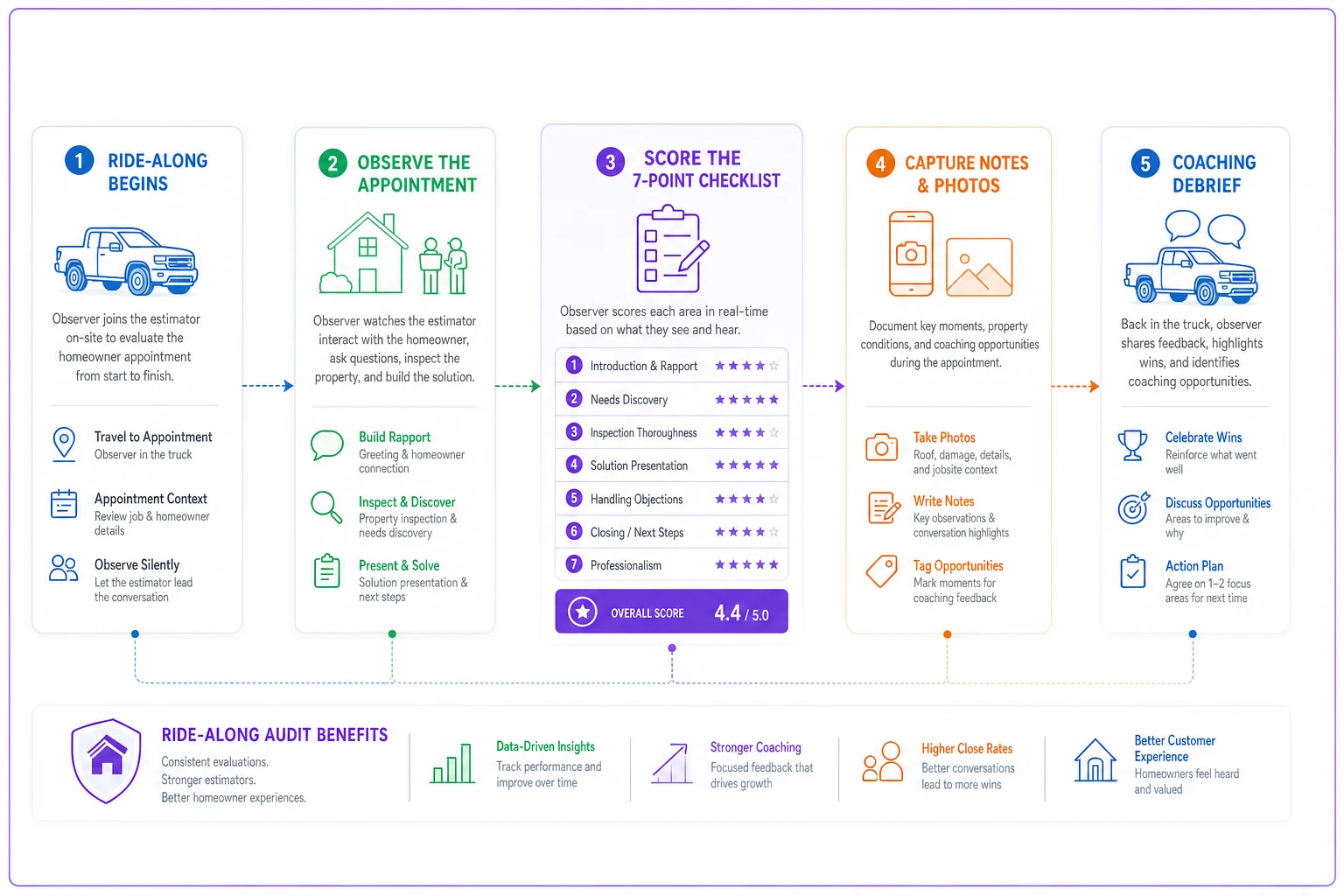
A clean visit scores 14. Anything under 10 needs coaching before that estimator quotes solo again.
What a real audit turns up
A mid-size shop running four estimators ran ride-alongs across two weeks — roughly eighteen appointments total. The scores told a clearer story than six months of margin reports had.
| Point audited | Avg score (0–2) | Biggest issue found |
|---|---|---|
| Measurement verification | 1.6 | One estimator never laddered up |
| Scope articulation | 1.1 | Exclusions almost never stated |
| Pricing consistency | 0.9 | Two quoted the same roof type differently |
| In-visit documentation | 1.4 | Notes reconstructed in truck |
| Discount discipline | 0.7 | Concessions given to break silence |
| Change-order framing | 0.8 | Unknowns rarely pre-framed |
| Close/verbal promises | 1.0 | Three unwritten add-ons in one visit |
The lowest scores clustered around discounts, change-order framing, and pricing consistency — all three of which hit margin directly. Measurement and documentation actually scored strongest, which is common in shops that already run a photo protocol but never trained the pricing side of the visit.
The concession finding was the eye-opener. One estimator was averaging somewhere around $600–$900 in unprompted discounts per closed job. Across his volume, that was north of $20k a year in margin handed away to avoid five seconds of quiet.
Coaching scripts for the drive back
Coaching works best in the truck, right after the visit, while it's fresh. Don't lecture. Ask, then reframe. Here are the three that actually move the needle.
On unanchored discounts: > "I noticed you dropped the price by about eight hundred right after she went quiet. Walk me through what you were reading there. Silence isn't a no. Next time, let it sit. If you're going to move on price, tie it to something — cash pay, signing today, off-season scheduling. A discount with a reason protects you. A discount to fill silence just trains them to push."
On missing exclusions: > "Great job on the scope walkthrough — but you never said what we're not doing. When the chimney flashing leaks in two years, this becomes our problem unless we said out loud today that it wasn't in scope. Say the exclusions. It feels awkward the first few times. It saves callbacks."
On verbal promises: > "You told him we'd haul the shed debris. That's fine — if it's on the estimate. If it's not written, production doesn't know, it doesn't get budgeted, and you just created a callback. Every promise goes on paper before we leave, or it doesn't get made."
The goal isn't to make estimators robotic. It's to make the pricing logic consistent while leaving the personality intact.
Sample estimate language that closes the gaps
Half the defensibility problem is fixed by the words on the estimate itself. Vague estimates invite disputes. These lines exist specifically to hold up when challenged.
Scope with explicit exclusions: > "Scope includes: tear-off of existing roofing to deck, installation of [system], replacement of all pipe boots, step flashing, and drip edge. Excluded unless separately quoted: chimney masonry repair, gutter replacement, fascia/soffit work, structural deck repair beyond allowance below."
Unknown-condition allowance (pre-framed change order): > "This estimate assumes sound decking. If deteriorated sheathing is found at tear-off, replacement is billed at $[X] per sheet with homeowner notification and photo documentation before installation. First [N] sheets included."
Discount anchoring: > "Price reflects [cash payment / off-season scheduling / signed by DATE]. Standard pricing applies if these conditions are not met."
That decking language does two jobs. It sets the price before anyone's emotional, and it forces the photo-before-install habit that keeps the change order defensible.
The dispute and escalation path
When a homeowner or adjuster challenges an estimate, most shops improvise. That's how you end up eating costs you didn't need to. A short, fixed path keeps things calm and keeps the margin.
-
Estimator responds first, within 24 hours. They pull the visit documentation — photos, measurements, signed scope — and walk the homeowner through the line item being questioned. Most disputes die here because the answer is already on paper.
-
If unresolved, escalate to a sales lead or ops manager. They review whether the estimate followed standard pricing. If the estimator freelanced (unanchored discount, missing exclusion), that's an internal coaching issue, not a homeowner concession.
-
Written position within 48 hours. A short document restating scope, exclusions, and the measured basis for the disputed number. This is what you'd hand an adjuster or, worst case, attach to a small-claims packet.
-
Only then discuss concession. If you're going to give ground, decide it deliberately at the manager level — not reflexively in the moment.
The reason to write down step 3 every time isn't the current dispute. It's the pattern. After a season of these, you can see which estimators generate the most challenges and on which line items. That's your next coaching target.
Keeping the audit from dying after month one
The hard part isn't running one round of ride-alongs. It's making the scorecard live somewhere everyone can see, tying it back to actual job outcomes, and running it again next quarter. Shops that print the checklist, run it once, and file it in a drawer get a two-week improvement and then full drift-back.
Tie audit scores to the estimate and job results so you can trace a low "change-order framing" score to the actual change orders that follow.
What actually holds is when audit scores sit in the same system as the estimates and the job results — so you can connect a low "change-order framing" score to the actual change orders that estimator generated three months later. This is where an operational platform earns its place: not as a magic fix, but as the shared record that keeps the estimate, the visit documentation, the audit score, and the eventual job margin connected instead of scattered across a CRM, someone's phone, and a truck notebook. When those live together, coaching stops being opinion and starts being traceable.
When this makes sense — and when it doesn't
Run this if: you have two or more estimators, you've noticed margin variance you can't explain, or you're about to promote a crew member into estimating. Multiple estimators is the trigger. One person's habits are a personality; three people's habits are a pricing problem.
Skip it if: you're an owner-estimator quoting everything yourself. You already know your own logic. Your time is better spent standardizing the estimate language so it survives when you eventually hand estimating off.
Who should be careful: shops that run the audit as a gotcha. If estimators think ride-alongs are about writing them up, they'll perform for the audit and revert the next day. Frame it as calibration, not surveillance. The point is a defensible, consistent price — not catching people.
Bottom line
The estimator visit is the most expensive unaudited process in most roofing operations. A number gets set, a contract gets signed, and nobody ever watched how the price was built or defended. A repeatable ride-along scorecard, honest truck-cab coaching, and estimate language written to survive a challenge don't just tighten margin — they make your pricing something you can actually stand behind when someone pushes. And in a market where homeowners and adjusters push harder every year, defensibility is the difference between holding your number and eating it.
Ready to elevate your roofing operations?
Join hundreds of roofing contractors using Roofyly to streamline workflows, improve crew coordination, and enhance client satisfaction.