
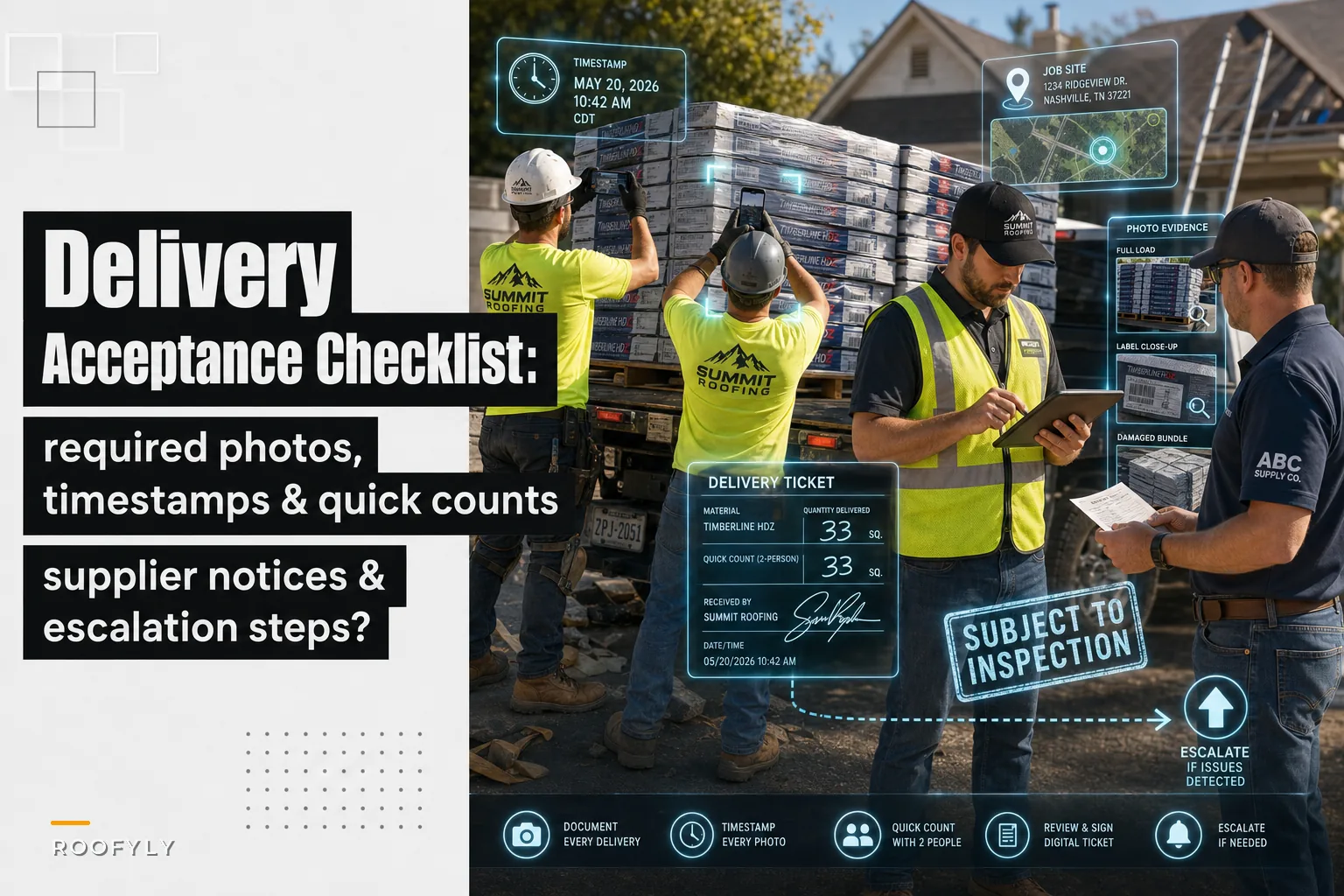

The delivery driver drops 34 squares of architectural shingle at 7:40 a.m., hands the foreman a tablet to sign, and rolls out. Crew starts staging. Around 9:15 someone notices two bundles are cracked at the corners, one pallet is the wrong color line, and the count feels light. The foreman calls the supplier. The supplier pulls up the signed delivery ticket — signed clean, no exceptions noted — and asks for photos with timestamps. There are none, or there are three blurry shots taken at 9:20 that prove nothing about condition when the truck arrived.
That's the whole game. The window to protect a delivery claim is measured in minutes, and it closes the moment the driver leaves with a clean signature. Everything after that is you arguing about what you think happened versus what the supplier can prove happened.
This post covers the exact protocol that closes that gap: what photos to take, what metadata has to survive, how to run a quick-count that actually holds up, and what to send the supplier the same day so your claim doesn't die on the vine.
Why clean-signed tickets quietly cost roofers thousands
The signature line on a delivery ticket is a legal event. In most supply agreements, signing without noted exceptions is treated as acceptance of the goods "as delivered, in good condition, in the quantity shown." That single signature shifts the burden of proof onto you.
-
Deliveries land during the worst possible window. Crews are staging, homeowners are asking questions, and the tear-off clock is running. Nobody wants to hold a driver hostage while counting bundles.
-
Rooftop loading hides problems. When a boom truck loads directly to the roof, the crew never touches the ground stack. Damaged bottoms of pallets, mixed lots, and short counts get discovered after the material is spread across three roof planes.
-
The person signing isn't the person who ordered. The foreman signs based on trust, not against the PO. He has no idea you ordered 36 squares, not 34, or that the color was supposed to be Weathered Wood, not Weatherwood — yes, those are different, and yes, that mix-up happens.
The supplier isn't necessarily being shady. Warehouse pull errors, lot mixing, and forklift damage are normal in high-volume distribution. The problem is that their normal error rate becomes your loss the second you can't prove condition at delivery.
What a defensible delivery claim actually requires
Suppliers and manufacturers reject delivery claims for predictable reasons. If you understand what they need to accept one, you can build your protocol backward from that.
Keep every roofing job on track and on time.
Roofyly helps you manage, schedule, and communicate every roofing project with precision and ease.
- Centralized project planning
- Real-time crew notifications
- Integrated scheduling & client updates
No credit card required
| Claim element | What kills it | What preserves it |
|---|---|---|
| Damage | Photos taken hours later, no context of when/where | Timestamped photos at truck-side, before staging |
| Short count | "It felt light" with no documented count | Two-person quick-count against the PO, noted on ticket |
| Wrong product/color | Discovered after installation started | Color/lot check before signing, photo of product label + bundle |
| Concealed damage | No note that packaging was intact on arrival | "Subject to inspection" notation + intact-packaging photo |
| Timing | Report filed days later, outside supplier window | Same-day notice with photo package attached |
The pattern across every row is the same: the supplier will honor what you documented at the moment of delivery and dispute everything you documented later. The protocol is about compressing all your evidence-gathering into the delivery window itself.
The four things to photograph before you sign anything
This isn't about taking a hundred pictures. It's about taking the right five or six that establish condition, quantity indicators, and identity — all with metadata intact.
-
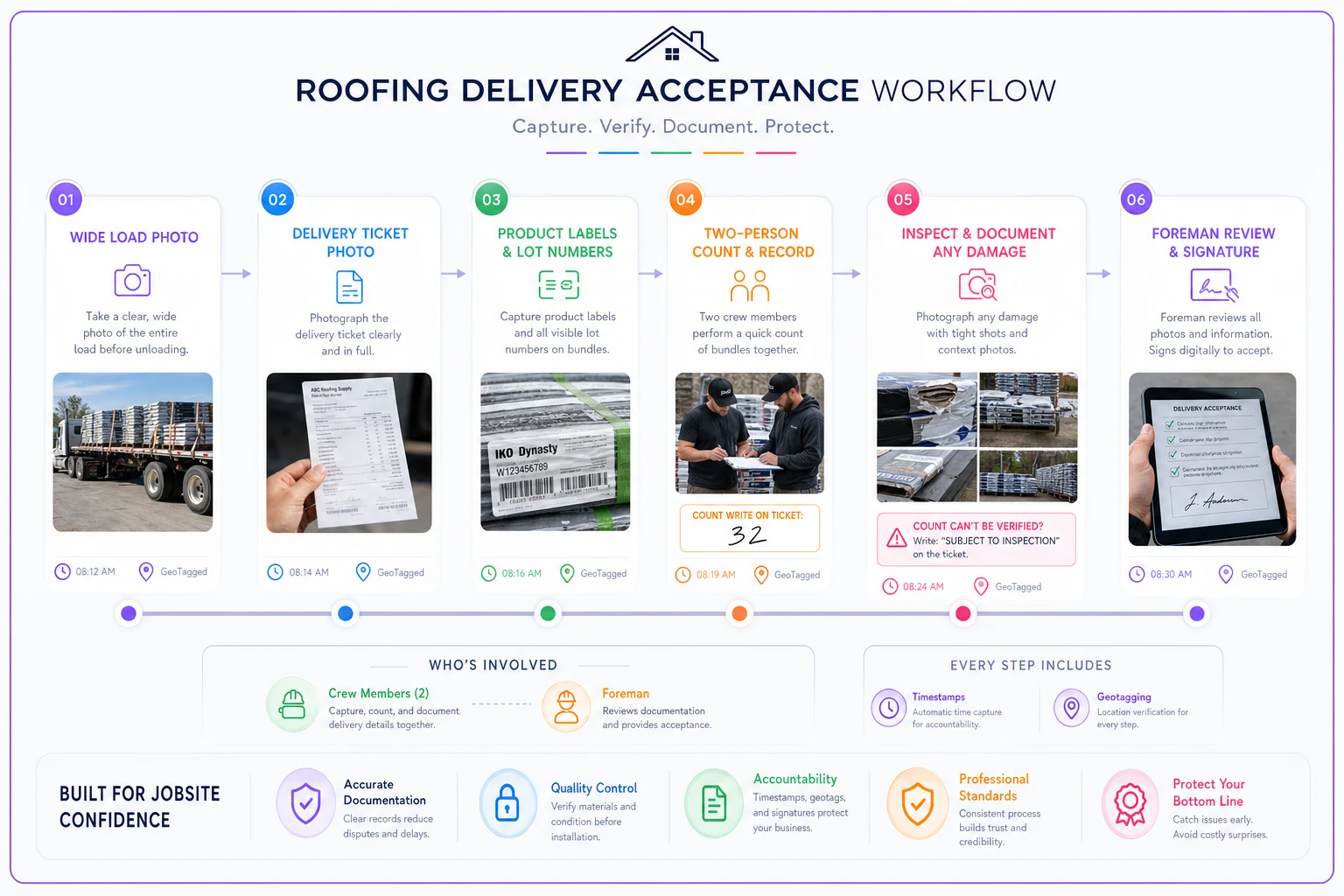
The full load on the truck (or staged pile) before unloading. Wide shot showing the whole delivery. This establishes the scene and the arrival state.
-
The delivery ticket itself, laid flat. Photograph it so the PO number, product lines, quantities, and any pre-printed notes are legible. This ties your evidence to the paperwork.
-
Product labels and lot numbers on at least one bundle per pallet. Color line, product name, and lot/batch codes. Concealed color and lot-mix problems live here.
-
Any damage, up close AND in context. One tight shot of the crack or crush, one pulled-back shot showing where it sits in the stack so location is undeniable.
Visualize the quick truck-side acceptance workflow with this simple diagram.
The non-negotiable part: the metadata has to survive. A photo is only as good as the timestamp and geotag baked into it. If your crew screenshots photos, sends them through compression-heavy messaging apps, or the phone's location and date settings are off, you've stripped exactly the data an adjuster or supplier rep needs.
A few practical rules that trip people up:
-
Native camera app only for delivery shots — screenshots discard EXIF data.
-
Confirm the phone's clock and location services are on. A photo timestamped from a wrong device clock is worse than no photo.
-
Don't crop or mark up the original. Keep the untouched file and annotate a copy.
We've written more about keeping field media intact when connectivity and device settings work against you in this breakdown of mobile offline capture and sync rules — worth reading if your crews shoot in dead zones, because a delivery photo that never syncs is the same as one that never existed.
The quick-count rule that doesn't hold the driver hostage
The most common objection to counting at delivery is time. Nobody wants a 20-minute count while a driver drums his fingers and the crew stands idle. So the rule has to be fast — two to three minutes — and structured so it's defensible even when it's quick.
-
Count pallets and bundles, not shingles. You're verifying gross quantity against the PO, not auditing every unit. A reroof order is usually squares → bundles (3 bundles per square for most architectural lines). If the PO says 34 squares, you should see roughly 102 bundles. Off by six? Flag it.
-
Two sets of eyes, one number. Foreman counts, one crew member confirms. Two people agreeing on a number is dramatically harder to dispute than one person's memory.
-
Write the count on the ticket before signing. Not "received" — the actual number you counted, next to the number printed. If they match, great. If they don't, that discrepancy is now on the document the supplier keeps too.
-
When you can't count (rooftop load, time crunch), write "SUBJECT TO INSPECTION — COUNT NOT VERIFIED" before signing. This preserves the right to dispute count later instead of waiving it with a clean signature.
That last line is the single highest-leverage phrase on a delivery ticket. It converts a full acceptance into a conditional one. Most suppliers accept it because it's standard commercial practice; the ones who push back are telling you something about how they'll handle a future claim.
Supplier-notice templates: send the same day or lose the claim
Documentation at the truck is half the job. The other half is notice — formally telling the supplier there's a problem while the evidence is fresh and inside their claim window. Many supply agreements require notice of shortage or damage within 24 to 72 hours. Miss that window and even perfect photos won't save you.
Keep two short templates ready so the foreman or coordinator isn't drafting prose under pressure.
Short/damage notice (same day):
> Subject: Delivery exception — PO [#], [Job address], [Date] > > Delivery received today at [time]. Exceptions noted at delivery: > - [Short count: PO shows squares / bundles; counted _ bundles] > - [Damage: _ bundles cracked/crushed, photos attached] > - [Wrong product/color: received , ordered ] > > Ticket signed "subject to inspection." Timestamped photos attached. Please advise on replacement/credit and expected timeline. We need resolution to keep this install on schedule.
Concealed-damage notice (within 24–48 hrs of discovery):
> Subject: Concealed damage — PO [#], [Job address] > > Packaging was intact and photographed at delivery on [date]. On opening/staging today we found [describe damage] in __ bundles. Photos of intact packaging at delivery and damage on discovery attached. Requesting replacement under [supplier/manufacturer] policy.
Two details make these work. First, they reference the timestamped photos and the ticket notation — you're not asking the supplier to trust you, you're pointing at proof. Second, they name the schedule impact, which quietly moves your claim up the priority list because now it's not just a credit, it's a job they're holding up.
A quick delivery-acceptance checklist your foreman can actually run
Print it, laminate it, tape it inside the truck.
-
- [ ] Photo
full load before unloading (wide)
-
- [ ] Photo
delivery ticket laid flat, PO + quantities legible
-
- [ ] Photo
product label + lot number, one per pallet
-
- [ ] Check color line and product name against the PO — not just "shingles"
-
- [ ] Two-person bundle count vs PO; write the counted number on the ticket
-
- [ ] Photo any damage
tight shot + context shot
-
- [ ] If count can't be verified
write "SUBJECT TO INSPECTION" before signing
-
- [ ] Confirm phone clock + location on; use native camera (no screenshots)
-
- [ ] Any exception → same-day supplier notice with photos attached
-
- [ ] Save originals unedited; annotate copies only
The point is that it runs in under five minutes and doesn't depend on anyone remembering it.
A realistic before/after
A mid-size residential outfit running four crews was absorbing delivery losses without ever actually tracking them. Wrong-color pallets discovered after a plane was half-loaded, short counts nobody could prove, forklift-crushed bundles written off as just part of the job. When they finally added it up over a season, it landed somewhere in the range of $4k–$6k in absorbed material cost — and, worse, two schedule slips that pushed jobs into a rain week.
The fix wasn't complicated. They standardized the truck-side photo set, added the two-person count with the number written on every ticket, and built the "subject to inspection" habit for rooftop loads. The same-day notice template went to every foreman's phone.
Over the next couple months, most delivery discrepancies got caught before the driver left or within the same day, which meant the supplier credited or replaced instead of shrugging. Absorbed losses dropped to almost nothing, and the two-person count surfaced a recurring short-count pattern from one branch that turned into a standing credit conversation. That count discipline also fed cleaner data back into their reorder triggers — which connects to the procurement and forecasting approach we covered here, since knowing what actually arrived versus what was ordered is the foundation for any reliable reorder logic.
When this level of protocol is overkill — and when it isn't
Not every delivery needs the full treatment, and pretending otherwise gets the protocol ignored entirely.
When to run the full protocol:
-
High-value deliveries (full reroof material drops, specialty or premium lines)
-
Rooftop/boom loads where the crew never inspects the ground stack
-
New or problem suppliers, or a branch with a history of pull errors
-
Custom-color or special-order product where a wrong lot is unrecoverable
When a lighter version is fine:
-
Small resupply drops (a few bundles, accessories, a couple rolls of underlayment)
-
Trusted supplier, will-call pickups you loaded and inspected yourself
-
Same-day top-offs where you're standing right there
One thing worth saying plainly: if your foremen won't consistently run even the five-minute version, the laminated card doesn't fix it. That's a training and accountability problem, not a checklist problem. A protocol nobody follows is worse than none, because it creates false confidence that claims are protected when they aren't.
The one habit worth building first
Stop signing clean. That's it. The "subject to inspection" notation on rooftop and time-pressured deliveries preserves more claims than any photo, because it keeps the burden of proof from silently transferring to you the moment the pen touches the tablet.
Add the two-person count and the same-day notice on top of that, and the delivery window stops being the place your money quietly leaks out. The photo set, the metadata discipline, the templates — all of that is there to make the claim win once you've kept the right to make it.
Build the acceptance habit at the truck, and the disputes that used to drag on for weeks start resolving on the day of delivery, which is exactly where they should.
Build the acceptance habit at the truck, and the disputes that used to drag on for weeks start resolving on the day of delivery, which is exactly where they should.
Ready to elevate your roofing operations?
Join hundreds of roofing contractors using Roofyly to streamline workflows, improve crew coordination, and enhance client satisfaction.