



Most waste conversations stop at "add 10% and call it a day." That flat 10% works fine on a plain gable and quietly bleeds money on everything else. Waste isn't a number you pick—it's something the roof's geometry hands you before you ever cut a shingle. Hips, valleys, dead valleys, cricket saddles, and starter/ridge coverage each pull material at a different rate, and they don't add up linearly.
If you've ever finished a job with three untouched bundles sitting in the driveway—or worse, sent a crew back to the yard mid-install because you ran short on a cut-up roof—the problem wasn't the crew. It was the multiplier you assumed at estimate time.
This post is about turning that guess into numbers you can actually defend. Concrete waste multipliers by roof complexity, what cut patterns look like on the deck, and rules for when a contingency bundle is worth carrying versus when it's just cash sitting in a truck.
The real reason waste isn't a flat percentage
Waste comes from two very different sources, and mixing them up is where estimates go wrong.
The first is cut waste—the offcuts you throw away because a shingle doesn't fit neatly against a valley, hip, rake, or penetration. This scales with linear feet of cut edges, not with roof area. A 30-square roof that's one clean rectangle has almost no cut edges. A 30-square roof chopped into six planes with two valleys and a dormer has hundreds of linear feet of cutting.
The second is coverage waste—starter course, hip and ridge cap consumption, and the extra course you burn matching exposure lines across offset planes. This one hides in plain sight because it looks like normal material use, but on a heavily-hipped roof, cap shingles alone can blow past your allowance.
The mistake that shows up constantly: estimators apply one blanket percentage across both, so simple roofs get over-ordered and complex roofs get under-ordered. The blanket number is calibrated to some "average" roof that basically doesn't exist in a real neighborhood.
The pattern worth internalizing—valleys and dead valleys are the expensive geometry. A single open or closed-cut valley can generate more offcut than four hips of the same length, because valley cuts are diagonal across the shingle and both sides need trimming. Hips waste caps and some field, but the field cuts are cleaner and more of the offcut is reusable on the opposite slope.
Waste multipliers by roof complexity
These are working multipliers for architectural (dimensional) asphalt shingles on a full field order. They assume competent cutters who reuse offcuts where the geometry allows. Three-tab runs slightly lower on cut waste because the shingles are more forgiving to piece in; premium designer shingles run higher because color and pattern matching restricts offcut reuse.
Keep every roofing job on track and on time.
Roofyly helps you manage, schedule, and communicate every roofing project with precision and ease.
- Centralized project planning
- Real-time crew notifications
- Integrated scheduling & client updates
No credit card required
| Roof type | Description | Field waste factor | Notes on cap/starter |
|---|---|---|---|
| Simple gable | 1–2 planes, no valleys, straight rakes | 5–7% | Starter + ridge only; predictable |
| Gable w/ 1 dormer | Minor plane breaks, short valleys | 8–10% | Add ~1 bundle cap for dormer ridge |
| Hip roof (basic) | 4 planes meeting at ridge | 10–12% | Cap consumption is the story—budget 2–3× a gable |
| Hip + valley combo | Hips plus 2–3 valleys | 13–16% | Valley cut waste stacks on cap waste |
| Cut-up / complex | 6+ planes, multiple valleys, dead valleys | 17–22% | Offcut reuse drops sharply; verify by plane |
| Steep + complex (12/12+) | Complex geometry on steep pitch | 20–25% | Handling breakage and safety trimming add waste |
| Turret / conical | Radial cuts, tapered courses | 25–35% | Nearly every course requires custom cutting |
A few things worth flagging here. The jump from basic hip to hip-plus-valley isn't gradual—it's a step. The moment you add valleys to a hip roof, you're paying cut waste and cap waste simultaneously, and they don't offset each other. That turret line isn't a typo either; conical and radial sections are the single worst waste geometry in residential roofing, and they should be ordered as their own line item, never folded into the field number.
What the cut patterns actually look like on the deck
Numbers help, but crews cut based on what's in front of them. A few visual heuristics that explain where the waste physically comes from:
Straight valley (closed-cut): Shingles from the primary slope run through the valley and get trimmed on a diagonal. The trimmed triangle is offcut. On the secondary slope, shingles butt into the valley and get cut back. A valley eats roughly half a bundle of pure waste per 16–18 linear feet once you account for both sides and pieces too small to reuse.
Hip: Field shingles run into the hip and get angle-cut. The offcut from one slope often flips to start the adjacent slope, so cut waste is moderate. The real cost is cap—hip caps run the full length of every hip line, and a four-hip roof can burn 3–4 bundles of cap alone.
Dead valley (behind a chimney or where two low slopes meet): Short courses, lots of small trimmed pieces, extra membrane, and almost no reusable offcut. Treat every dead valley as a fixed add of about 1 bundle regardless of size, because the waste is in the fiddly cutting, not the area.
Offset planes with different eave heights: When adjacent planes don't share a starter line, you lose a partial course matching exposure across the transition. Small per instance, but on a roof with five or six plane transitions it quietly adds up to a bundle or more.
The thing most estimators miss: waste isn't proportional to how big the complex feature is—it's proportional to how many separate cutting decisions the crew has to make. Ten short valleys waste more than two long ones of equal total length, because setup, small-piece loss, and non-reusable scrap happen per feature, not per foot.
A real ordering example with numbers
Take a two-story home in a mixed suburban tract. Satellite report comes back at 32 squares. It's a hip roof with two valleys where a rear addition ties in, plus a small dead valley behind the chimney.
Old habit: flat 10%—32 squares × 1.10 = ~35.2 squares → 106 bundles ordered.
Reworked by geometry: base 32 squares, apply a hip-plus-valley factor of ~14% for field = ~36.5 squares → 110 bundles field. Then the features a flat percentage never captures:
-
Two valleys
~1 bundle of pure cut waste combined
-
Dead valley behind chimney
~1 bundle fixed
-
Hip cap across four hip lines plus ridge
about 3.5 bundles of cap/starter beyond the gable baseline the 10% assumed
The honest order lands around 112–113 field bundles plus a properly separated cap count. Under the old flat-10% method, this crew ran short on cap on almost every hip job and made a mid-day yard run roughly one in three complex roofs. A yard run isn't just the drive—it's two guys idle, an hour of daylight gone, and sometimes a dye-lot mismatch when the yard restocks between deliveries. That's easily $150–$250 in soft cost every time it happens.
None of this works if the underlying measurement is shaky. Waste multipliers applied to a wrong square count just scale the error, which is why reconciling satellite numbers against field reality matters before you touch a multiplier. The process in our roof measurement QA checklist pairs directly with everything covered here.
When to buy a contingency bundle (and when not to)
Contingency bundles are cheap insurance—until you're carrying returns you can't make because the dye lot moved or the return window closed.
Buy contingency when:
-
The roof has any dead valley or a turret/conical section (always—these are unpredictable)
-
Total order exceeds ~40 squares (probability of a bad course or damaged bundle rises with volume)
-
Dye lot consistency matters and the yard can't guarantee same-lot restock within your install window
-
The crew doing the job is new to you or the shingle line—less offcut reuse until they know the product
-
Access is bad enough that a mid-day run costs real daylight
Skip contingency when:
-
Simple gable, tight measurement, experienced crew—your 5–7% already covers you
-
The yard is 10 minutes away with reliable same-lot stock (the run is cheaper than the return hassle)
-
You're on a premium designer shingle with a strict return policy and low reorder likelihood—tighten the estimate instead of padding it
The rule that keeps this clean: contingency is for uncertainty, not for sloppy estimating. If you're adding two extra bundles "just in case" on a plain gable, you don't have a waste problem—you have a measurement confidence problem, and that's a different fix.
A repeatable ordering process
Below is the sequence that keeps complex-roof orders honest without adding an hour to every estimate.
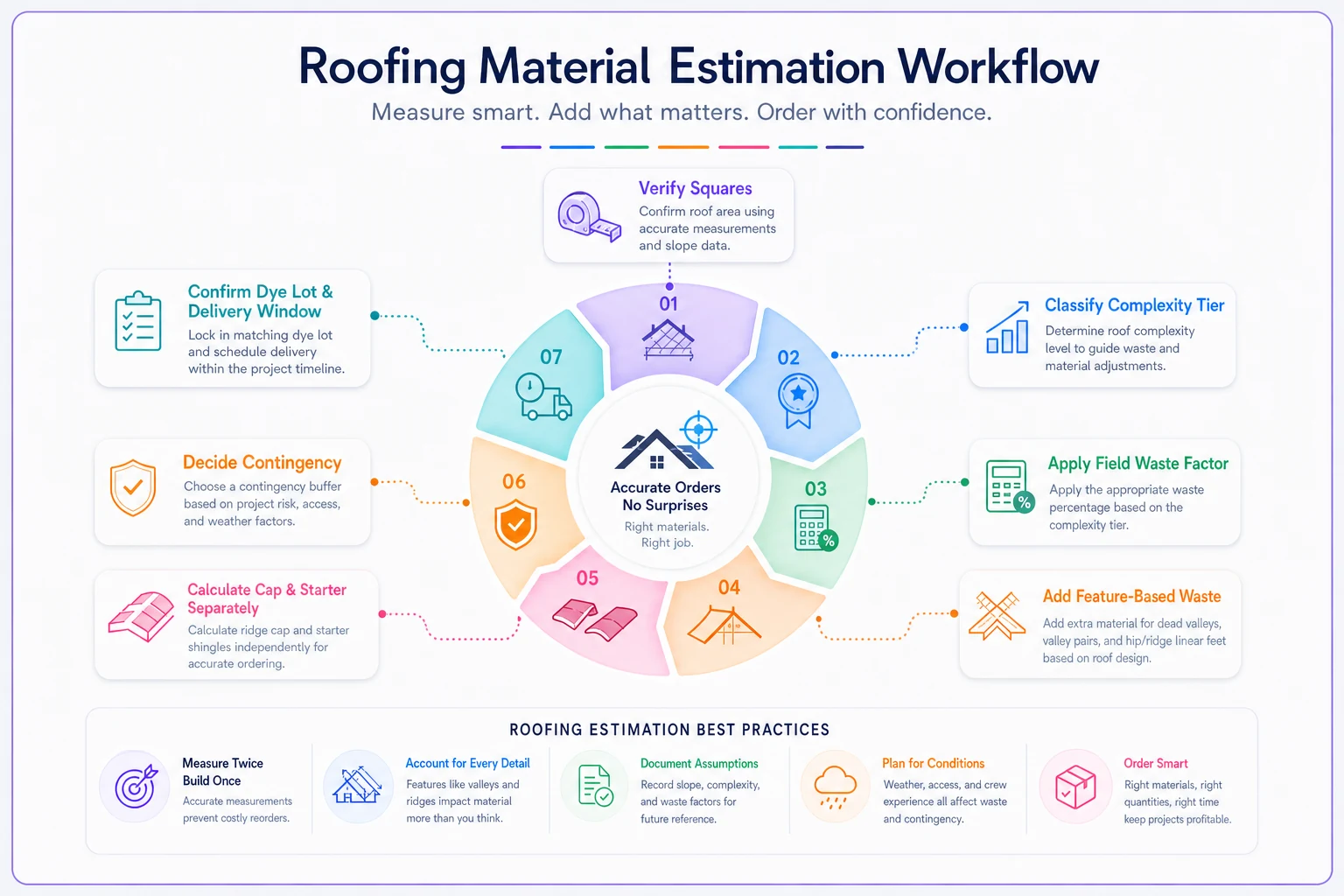
This diagram lays out the ordering steps so you can follow them in sequence.
-
Lock the measured squares from a verified report—reconcile against field spot-checks before applying anything.
-
Classify the roof into one of the complexity tiers in the table above. Don't overthink it; pick the closest match.
-
Apply the field waste factor for that tier to get field bundles.
-
Add feature-based waste separately
~1 bundle per dead valley, ~0.5 bundle per standard valley pair, count hip/ridge linear feet for cap.
-
Calculate cap and starter as their own line, never as part of the field percentage.
-
Decide contingency using the framework above—write down why you added it so you can audit whether the padding was justified.
-
Note the dye lot and delivery window on the order so a mid-job shortage doesn't turn into a mismatch.
The step people skip is #4. Folding features into a percentage feels faster, but it's exactly why cut-up roofs come up short—percentages scale with area, and features don't.
A pre-order checklist for complex roofs
Run this before submitting the order on anything above a basic hip:
-
[ ] Squares verified against field, not just satellite
-
[ ] Roof complexity tier assigned and written on the estimate
-
[ ] Valleys counted and priced as separate waste
-
[ ] Dead valleys flagged with fixed bundle adds
-
[ ] Hip + ridge linear feet measured for cap count
-
[ ] Starter course figured on full eave + rake length
-
[ ] Cap/starter ordered as separate SKUs, not field bundles
-
[ ] Turret/conical sections quoted as their own line item
-
[ ] Dye lot confirmed available for full order + contingency
-
[ ] Contingency decision logged with reason
-
[ ] Delivery timed so restock can't split your dye lot
Running through this on a complex roof takes maybe five minutes. Skipping it can cost a yard run, a dye-lot mismatch, or both.
Where this connects to the rest of your operation
Getting waste multipliers right isn't a standalone win—it feeds ordering discipline across the whole pipeline. When reorder triggers and vendor relationships are tuned to accurate per-job consumption instead of padded guesses, your yard stops carrying dead inventory and job costs get tighter. That linkage between estimating accuracy and procurement is worth building deliberately; the procurement and seasonal forecasting approach covers how reorder logic ties back to what you're actually installing.
Where software genuinely helps is the unglamorous part: keeping a per-tier waste table consistent across every estimator, and logging actual leftover bundles against estimated waste so your multipliers self-correct over time. Most crews already have this data—it's just scattered across delivery tickets and nobody's comparing ordered-versus-used. A platform that captures actual consumption per job and flags when a tier's real waste drifts from your assumed number turns a static table into one that sharpens every season.
But the table itself, and the discipline of separating cut waste from cap waste, is what actually moves the needle. Start there. The estimators who consistently order right aren't guessing better—they're just refusing to let one flat percentage stand in for six different geometries. Count the features, price the valleys and caps on their own, and reserve contingency for genuine uncertainty. Do that and the driveway stops filling up with returns you can't make, and the crew stops making that mid-day run to the yard.
Ready to elevate your roofing operations?
Join hundreds of roofing contractors using Roofyly to streamline workflows, improve crew coordination, and enhance client satisfaction.