

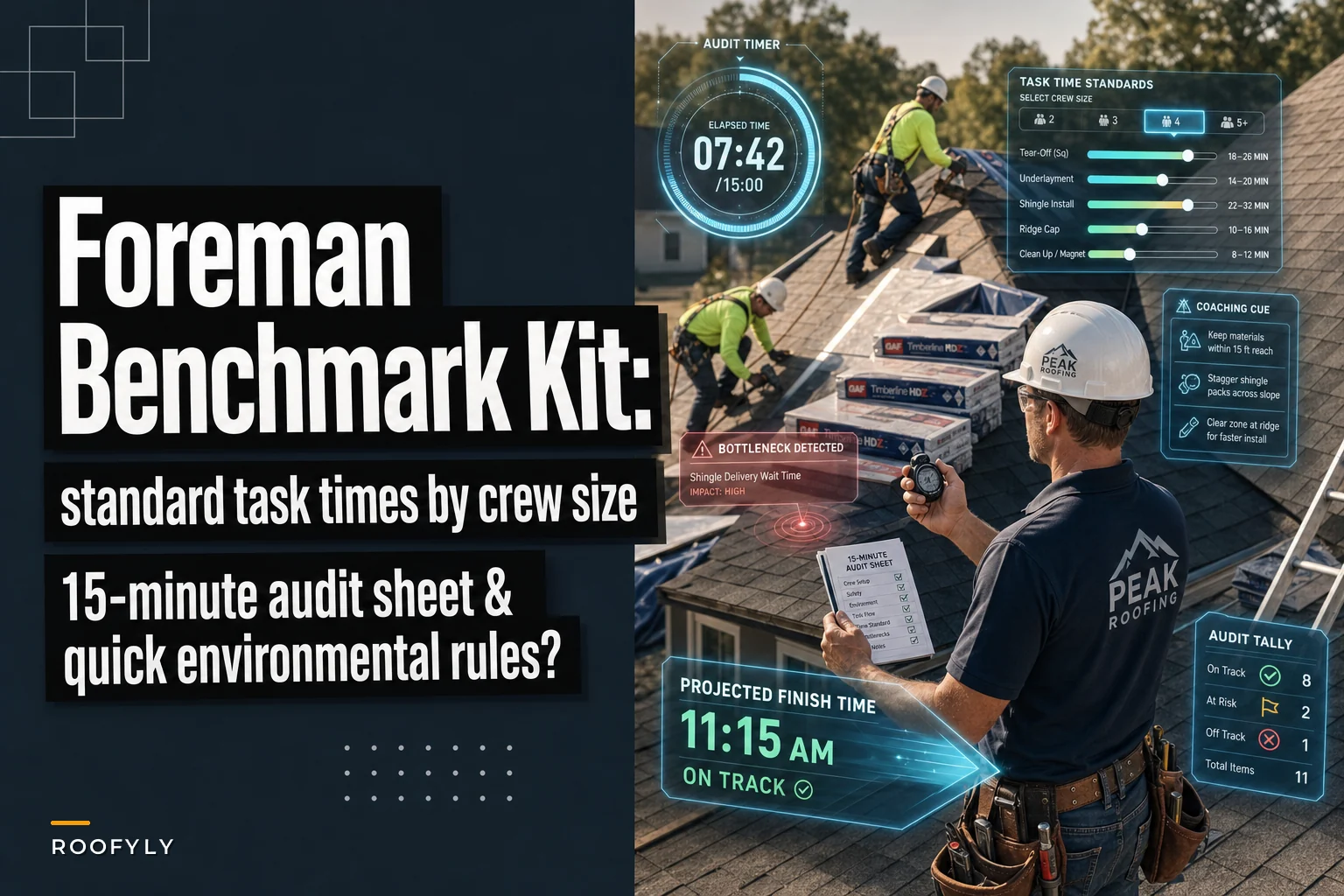

Most reroof crews don't lose their day to one big disaster. They lose it to forty minutes here, twenty-five there — a tear-off that ran long, a dry-in that stretched because two guys were waiting on a third, a felt run that took twice as long because nobody staged the rolls before break. By 3 p.m. the foreman knows they're behind, but he can't tell you where the day went. That's the real gap. Not effort. Visibility.
Roofing time and motion benchmarks fix that, but only if they're built for the way crews actually work — with real ranges instead of single "ideal" numbers, adjustments for pitch and weather baked in, and a way to check pace mid-day instead of finding out at closeout. This is the kit for that. Task ranges by crew size, a 15-minute audit sheet a foreman can run without stopping work, environmental adjustment rules, and coaching scripts that actually change behavior instead of making guys feel watched.
Why single "standard times" fail the second they hit a real roof
The most common mistake is building a benchmark table with one number per task. "Tear-off: 2.5 hours." That number is useless in the field because it silently assumes a crew size, a pitch, dry weather, and a clean deck. Change any of those and the estimate is wrong, but the foreman still gets judged against it.
Crews game single-number benchmarks almost immediately. If the tear-off standard is 2.5 hours and they finish in 2, they slow-walk the next task to look consistent. If they blow past it, they stop logging honestly. Neither helps you. A benchmark only works when it's a range tied to conditions, so the foreman can look at the actual roof and know which end of the range is realistic today.
The second issue: single numbers hide crew-size math. Two guys tearing off a 24-square roof is not "half the speed" of four guys. There's a coordination tax — staging, dumping, ladder traffic — that doesn't scale linearly. A four-man crew on a simple gable often clears more than double a two-man crew per hour because they can split roles cleanly. On a cut-up hip roof with three valleys, adding bodies barely helps because everyone's tripping over the same tricky area. Your benchmark has to reflect that, or foremen will make bad staffing calls off it.
The standard task-time ranges (by crew size)
These are working ranges for asphalt shingle reroofs on residential jobs, expressed per square where it makes sense and per task where it doesn't. They assume a competent crew, decent staging, and a walkable pitch (4/12 to 6/12). Everything above that gets adjusted later.
Keep every roofing job on track and on time.
Roofyly helps you manage, schedule, and communicate every roofing project with precision and ease.
- Centralized project planning
- Real-time crew notifications
- Integrated scheduling & client updates
No credit card required
Treat these as your starting baseline. The whole point is that you'll tune them against your own timesheet data — and if you haven't built that data yet, the method in turning timesheets into defendable labor-hour tables is where I'd start before trusting any table, including this one.
| Task | 2-man crew | 3-man crew | 4-man crew | Notes |
|---|---|---|---|---|
| Setup / staging / ladder & dump placement | 30–50 min | 25–40 min | 20–35 min | Fixed cost, barely scales |
| Tear-off (per square, single layer) | 8–12 min | 6–9 min | 4–7 min | Add ~40% for second layer |
| Deck inspection & spot repair | 15–35 min | 15–30 min | 15–30 min | Doesn't scale — one person's eyes |
| Dry-in / underlayment (per square) | 5–8 min | 4–6 min | 3–5 min | Wind kills this fast |
| Drip edge & starter (per 100 lf) | 18–28 min | 14–22 min | 12–18 min | Detail-dependent |
| Shingle install, field (per square) | 22–32 min | 16–24 min | 12–20 min | Biggest variance driver |
| Valleys / penetrations / flashing | 25–45 min each | 20–40 min each | 20–40 min each | Craft work, doesn't scale |
| Cleanup & magnet sweep | 30–45 min | 25–35 min | 20–30 min | Fixed-ish cost |
Two things worth calling out. Deck inspection and flashing detail work barely move with crew size — they're skill-bound, not labor-bound, so throwing bodies at them wastes money. And the field install range is wide on purpose. That's where pitch, complexity, and pacing discipline show up most, which is exactly where your audit sheet earns its keep.
For flashing and penetration numbers specifically, the ranges here are kept loose because the real driver is detail count and pitch, not crew size. The adjustment tables for penetrations and flashings by pitch and crew size break that down far more precisely than a single row in this table can.
The 15-minute foreman audit sheet
Nobody tells you this about time-motion work on a roof: if the audit pulls the foreman off the roof for an hour, it never happens. It has to be fast, done from the ground or the ridge, and it has to answer one question — are we on pace, and if not, where's the drag?
This is a walk-and-note check, not a stopwatch study. Run it once mid-morning and once early afternoon.
The 15-minute run
-
Log the clock (30 sec). Write the current time and the task the crew is on. Nothing else.
-
Count what's done (2 min). Squares torn off, squares dried-in, squares of field laid. Rough is fine. Eyeball it against the roof.
-
Compare to range (2 min). Take elapsed time on the current task, divide by squares done, and see where you land in the table above for this crew size. Are you at the fast end, slow end, or off the chart?
-
Spot the bottleneck (3 min). Watch for 90 seconds. Who's waiting? Is anyone walking material they shouldn't be? Is one guy doing a job two should share, or two guys crowding a job for one? Note it.
-
Check staging (2 min). Is the next task's material already up and positioned, or will there be a gap when this task ends? Staging gaps are the single most common hidden time-sink.
-
Note conditions (1 min). Pitch, wind, heat, deck surprises. These become your adjustment justification later.
-
One coaching action (1 min). Pick exactly one thing to fix right now. Not five. One.
-
Write the projected finish (1 min). Based on current pace, when does this task actually end? Say it out loud to the crew lead.
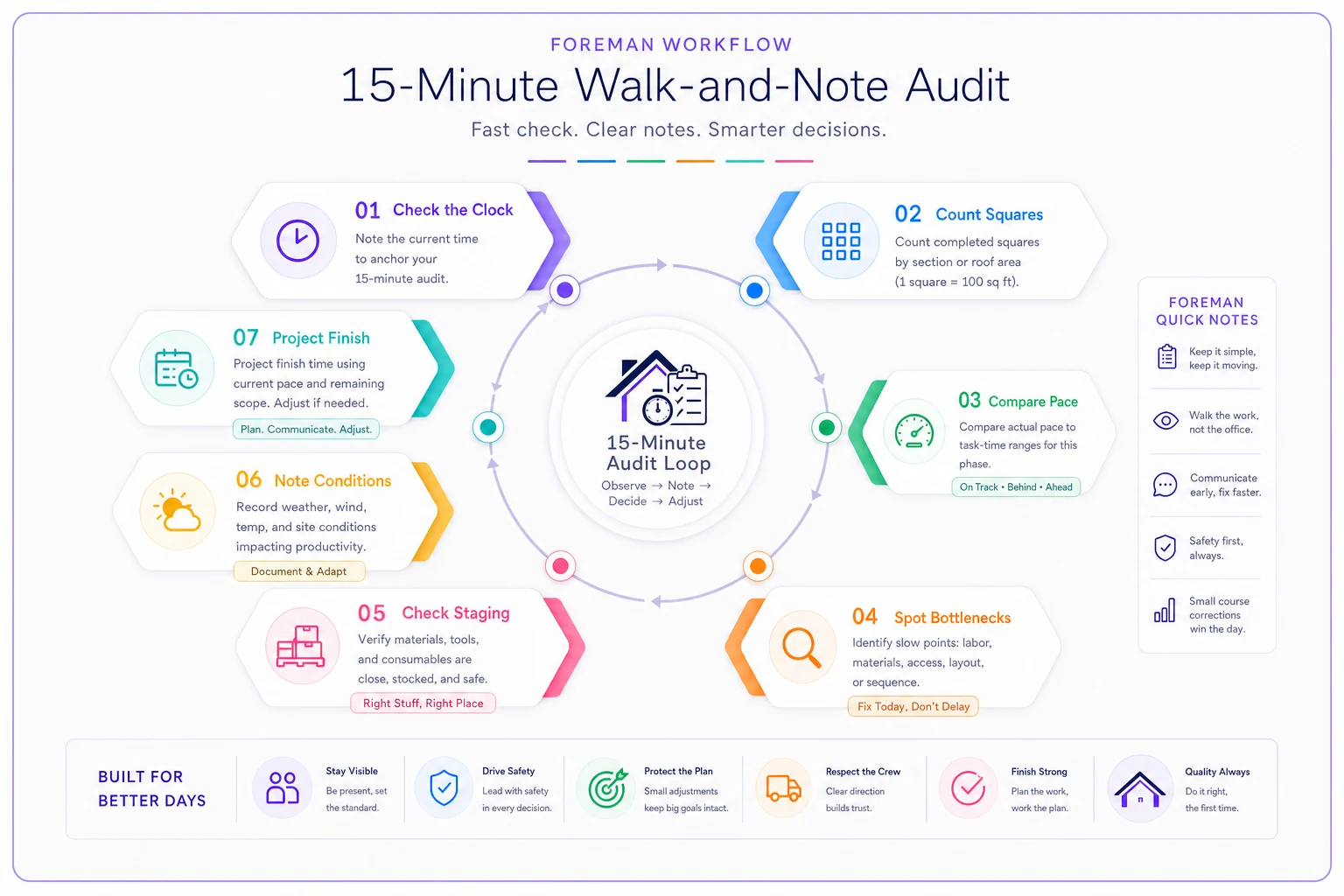
This visual outlines the quick walk-and-note audit workflow and the key checks to run in 15 minutes.
The projected-finish step is the one that changes behavior. When a crew hears "at this pace, tear-off wraps at 11:40, not 11:00," they self-correct without you having to push. It turns an abstract benchmark into a concrete "we're 40 minutes light" fact everyone can see.
What to actually write down
-
Time + current task
-
Squares complete vs. elapsed time
-
Pace position
fast end / mid / slow end / off-range
-
Bottleneck observed (waiting, walking, crowding, staging gap)
-
Conditions
pitch, wind, heat, deck condition
-
One coaching action taken
-
Projected task finish time
Run the audit from the ground or the ridge so it doesn't pull the foreman off the roof.
Keep it to one index card or one screen. If it needs two pages, it's already too much and it won't get run consistently.
Environmental adjustments: pitch and weather rules
A benchmark that ignores pitch and weather isn't defensible, and everyone on the crew knows it. The fastest way to lose credibility with a foreman is to hold him to a 6/12 dry-day number on an 8/12 roof in 20-mph wind. The adjustments have to be explicit, simple, and applied before you judge the pace — not pulled out as an excuse afterward.
Pitch multipliers
| Pitch | Multiplier | Practical effect |
|---|---|---|
| Up to 6/12 | 1.0x | Baseline, walkable |
| 7/12–8/12 | 1.15–1.25x | Slower footing, more staging trips |
| 9/12–10/12 | 1.3–1.5x | Roof jacks needed, real slowdown |
| 11/12+ | 1.6x+ | Fall protection setup dominates; treat as its own line |
One mistake that comes up constantly: crews apply the pitch multiplier to everything. It doesn't touch cleanup much, and it barely touches deck inspection. It hits movement-heavy tasks — tear-off, dry-in, field install. Be surgical about where you apply it.
Weather rules
-
Wind over 15 mph Add 20–35% to dry-in and underlayment. Loose felt and synthetic in wind is a genuine time-sink, and rushing it causes callbacks. Above roughly 25 mph, dry-in pace stops being the problem and safety becomes the call.
-
Heat over 90°F Build in more breaks and expect field-install pace to sag 10–15% after noon. This isn't crews being lazy — shingle handling and footing on hot asphalt genuinely slows. Judge the afternoon against a softer target.
-
Cold under 45°F Shingles get brittle and sealing slows. Add around 10% and don't push crews to force seals that need warmth.
-
Damp deck / morning dew Delay dry-in start, don't penalize the pace once it begins. Rushing onto a wet deck is how you get slips and a torn-up underlayment redo.
The rule that keeps this honest: conditions get logged at the start of the audit, not invented at the end. If the foreman writes "8/12, 18-mph wind" at 9 a.m., the adjusted target is set fairly and nobody's arguing about it at 2 p.m.
Coaching scripts to tune pacing (without becoming the timing cop)
This is where most time-motion efforts die. The foreman starts running numbers, the crew feels watched, morale drops, and honest logging stops. The fix is scripting the coaching so it lands as help, not surveillance.
Coach the system, not the person. "You're slow" gets defensiveness. "We've got a staging gap coming — let's get the next bundles up now" gets action. Every script below points at the workflow, not the worker.
> "We're running about 40 minutes behind where this pitch should put us. I'm not worried about effort — looks like the material's coming up one bundle at a time. Let's stage the next section all at once and see if that closes the gap."
> "Three guys on that valley is one too many — you're stacking up. [Name], jump on drip edge on the north side so we're running two fronts instead of one."
> "Every time we finish a task we lose ten minutes waiting on material. Going forward, whoever finishes first stages the next task's material before break, not after. Let's try it this afternoon."
> "You're ahead of pace and the work looks clean — nice. Don't slow down to fill the day. If we wrap early we'll pull the next job's setup forward."
> "8/12 and that wind killed the dry-in — that's on the roof, not us. I'm logging it. We adjust the target and move on."
Saying that out loud, and actually logging it, is what makes crews trust the system. If the foreman only mentions the numbers when the crew is behind, they'll treat benchmarks as a punishment tool. If he also names the conditions that fairly slowed them, they'll treat it as accurate. Accurate is what you're after.
A real scenario: where the day was actually going
A three-man residential reroof crew at a mid-size contractor was consistently finishing 24–28 square jobs a half-day later than estimated. The owner assumed the crew was just slow and started thinking about replacing the lead. The timesheets said "tear-off, install, cleanup" with start and end times and nothing in between — no way to see inside the day.
They started running the 15-minute audit twice a day for two weeks. The pattern showed up almost immediately, and it wasn't the install pace at all — field install was actually at the fast end of the range. The drag was staging gaps. Between every major task there was a 12–20 minute dead zone while someone went down to load material that should've already been up. Across a full reroof that was adding up to roughly 90 minutes of pure waiting, which is exactly the half-day slip when you compound it over setup, dry-in, and field transitions.
The fix was one coaching rule: last man on a finishing task stages the next task's material before stopping. No new hires, no speed pressure. Within about three weeks the crew was landing jobs inside the estimated window, and the lead — who the owner nearly cut — turned out to be one of the fastest installers on the payroll. The problem was never pace. It was the gaps between tasks that nobody could see until someone started counting.
When this kit makes sense — and when to skip it
Run this when: you've got recurring schedule slips you can't explain, you're scaling past a single crew and need consistency, or your estimates keep missing and you don't know if it's the bid or the crew. Time-motion benchmarks turn "we're always behind" into "we lose 90 minutes to staging," which is a fixable sentence.
Skip or go light when: you're a one-crew shop doing straightforward gable reroofs where the foreman already has a tight read on the day. The overhead of formal auditing may cost more attention than it returns. In that case, keep the pitch and weather adjustment rules — they're cheap and always useful — and drop the twice-daily audit.
One more thing on who should not do this: anyone planning to use the numbers to bludgeon crews. The second a benchmark becomes a discipline weapon, the logging goes dishonest and every downstream estimate is built on garbage. If you can't commit to coaching the system instead of blaming the person, don't start.
Keeping the data honest over time
Benchmarks drift. Crews change, material changes, your job mix shifts toward steeper or cut-up roofs. The ranges in this article are a starting point, not gospel — the real value comes when you feed the audit observations back into your actual labor-hour data every quarter and re-tune. That's the difference between a benchmark that reflects your business and one you copied off a blog.
The operational win here is small and boring, which is exactly why it works. You're not chasing a productivity miracle. You're making the invisible middle of the day visible — the forty minutes of staging gaps, the crowded valley, the pace that sagged after lunch in the heat. Count it twice a day, adjust for the roof you're actually on, and coach the workflow instead of the man. Do that consistently and the schedule slips you couldn't explain start explaining themselves.
The operational win here is small and boring, which is exactly why it works. You're not chasing a productivity miracle. You're making the invisible middle of the day visible — the forty minutes of staging gaps, the crowded valley, the pace that sagged after lunch in the heat. Count it twice a day, adjust for the roof you're actually on, and coach the workflow instead of the man. Do that consistently and the schedule slips you couldn't explain start explaining themselves.
Ready to elevate your roofing operations?
Join hundreds of roofing contractors using Roofyly to streamline workflows, improve crew coordination, and enhance client satisfaction.