



Your dispatch board probably looks like controlled chaos every morning. Crews scattered across the metro area, jobs grouped by completion type instead of geography, and that one emergency repair that blows up the entire day's routing. The dispatcher burns an hour moving pins on a map trying to cut drive time while juggling crew specialties, job durations, and customer time windows.
Most roofing companies handle this with pure intuition ("Dave knows the west side best") or they drop thousands on routing software that collects dust because it takes 45 minutes to input all the variables correctly. There's a middle ground that actually works for residential roofing.
Why traditional routing fails for roofing crews
Routing rules for roofing dispatch need to account for variables that standard delivery routing ignores completely. A shingle delivery truck hits 12 stops in predictable 15-minute windows. Your tear-off crew might spend anywhere from 3 to 8 hours at a single property depending on what they find under the old materials.
-
Material staging requirements (some jobs need delivery the day before)
-
Crew size variations (2-man repair crew vs. 6-man installation team)
-
Equipment constraints (only one crew has the conveyor belt today)
-
Weather sensitivity windows (can't start tear-off if rain's hitting at noon)
-
Inspector availability for specific neighborhoods
Standard TSP (traveling salesman problem) software treats every stop equally. It'll route your crew past three repair jobs to reach an all-day installation first because the algorithm optimizes pure distance, not operational reality.
Building radius-based routing templates
The most effective roofing dispatch routing rules start with geography, not job types. Draw rough circles on a map — typically 4-6 mile radius from major intersections or highway exits. These become your routing templates.
Keep every roofing job on track and on time.
Roofyly helps you manage, schedule, and communicate every roofing project with precision and ease.
- Centralized project planning
- Real-time crew notifications
- Integrated scheduling & client updates
No credit card required
A zone-based morning dispatch might look like:
Northwest Zone (I-35 & Loop 410)
-
Primary crew
Installation Team A
-
Backup crew
Repair Team 2
-
Standard job sequence
Major installs → Minor repairs → Estimates
-
Drive time buffer
25 minutes between stops
-
Zone capacity
1 full install OR 3-4 repairs daily
The value of standardizing these zones builds over time. Crews learn the traffic patterns, figure out where to grab lunch, know which neighborhoods have parking restrictions. They develop familiarity with local lumber yards and suppliers that you genuinely can't replicate from the office.
When that emergency leak call comes in at 11am, you already know which crew can handle it based on zone position and remaining capacity — not scrambling to figure out who's closest.
Duration buckets simplify complex scheduling
Instead of trying to predict exact job durations, group work into time buckets that match your actual operational reality:
-
Quick Hit (Under 2 hours) - Ridge cap repairs - Isolated leak patches - Gutter reattachment - Single skylight flashing
-
Half Day (2-5 hours) - Partial tear-off sections - Multiple penetration repairs - Full garage reroof - Storm damage patches
-
Full Day (5-10 hours) - Complete residential tear-off and install - Multi-layer removal jobs - Steep pitch installations - Homes over 3,000 sq ft
-
Multi-Day - Complex architectural shingles - Full decking replacement - Historic property work - Commercial flat roof conversions
Your dispatch routing rules then follow simple math: one full day job per crew, or two half-day jobs, or one half-day plus two quick hits. No complex calculations needed.
The 20% buffer rule
Every experienced dispatcher learns this through pain: always build in 20% dead time to your routing. For an 8-hour crew day, that's roughly 90 minutes of buffer.
-
Unexpected structural damage requiring immediate approval protocols
-
Material delivery delays
-
Customer not home for the final walkthrough
-
Previous job running long
-
Traffic accidents on major routes
Spread this buffer throughout the day rather than banking it all at the end. A typical allocation:
-
Morning startup buffer
20 minutes (7:00–7:20am)
-
Mid-morning transition
25 minutes (10:00–10:25am)
-
Lunch flexibility
15 minutes (12:30–12:45pm)
-
Afternoon transition
20 minutes (2:30–2:50pm)
-
End of day cushion
10 minutes (4:50–5:00pm)
Allocate part of your buffer to morning and mid-morning transitions—small delays there compound through the day.
Crews stop feeling rushed, customers get more reliable arrival windows, and your dispatcher isn't constantly fielding "running late" calls.
Last-minute pivot tactics that actually work
The real test of roofing dispatch routing rules comes at 10am when everything changes. A crew finds extensive rot requiring full deck replacement. Another job site has no material delivery. A customer cancels. The inspector showed up early and needs access now.
Smart pivoting requires pre-built decision trees, not seat-of-the-pants reactions:
Scenario: Crew finds major damage, job extends 3+ hours
-
Can remaining jobs slide to tomorrow? → Notify customers of 24-hour delay
-
Is backup crew in same zone? → Handoff remaining quick hits
-
Can jobs swap zones? → Trade with nearest crew's afternoon schedule
-
Must complete today? → Authorize overtime, adjust tomorrow's start
Scenario: Material no-show, crew standing idle
-
Any quick hits within 10 minutes? → Pivot immediately
-
Can crew prep another job site? → Send for tear-off only
-
Material ETA under 2 hours? → Have crew complete paperwork, handle equipment maintenance
-
No resolution? → Send crew to tomorrow's job for prep work
The key is making these decisions fast — within 5-10 minutes. Every minute of indecision costs money and leaves customers waiting for updates that aren't coming.
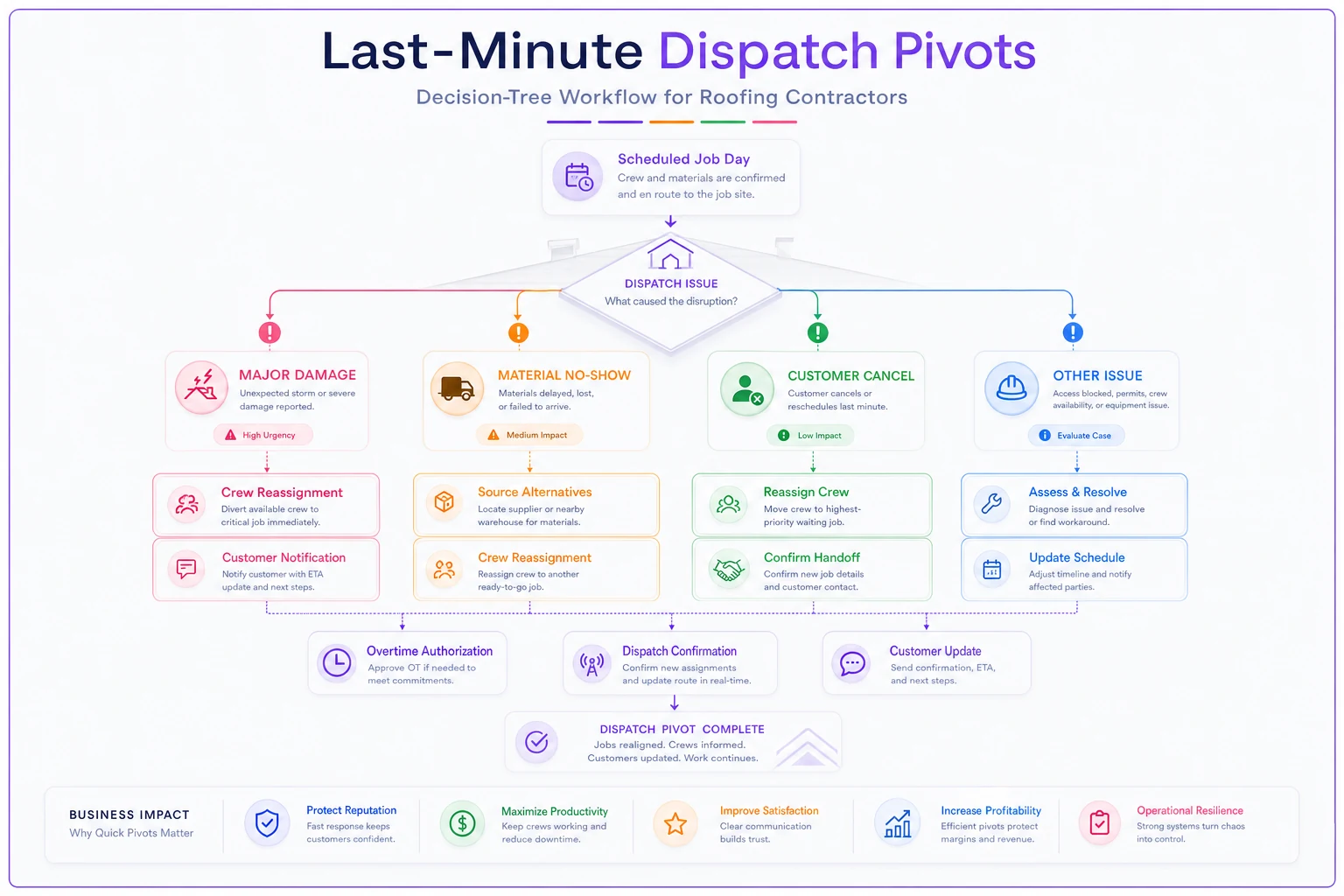
A quick visual of these decision trees helps dispatchers act fast and consistently.
Route optimization without the complexity
You don't need sophisticated routing algorithms to improve dispatch efficiency. A simple scoring system works for most residential roofing operations:
Daily Route Scorecard
| Factor | Good (1 pt) | Okay (2 pts) | Poor (3 pts) |
|---|---|---|---|
| Total windshield time | < 60 min | 60–90 min | > 90 min |
| Jobs per zone | All same zone | Adjacent zones | 3+ zones |
| Backtracking | None | Once | Multiple |
| Rush hour overlap | None | One crossing | Multiple |
| Crew specialty match | Perfect | Mostly matched | Mismatched |
Score under 8 points? Good routing day. Over 12? Your dispatch needs adjustment.
Track these scores weekly and patterns emerge quickly. Maybe Tuesday routes consistently score poorly because you're squeezing in too many estimates. Or Friday afternoons suffer because crews are spread thin finishing weekly commitments.
Communication rhythms that prevent routing chaos
The best roofing dispatch routing rules mean nothing if crews don't follow them. Establish rigid communication checkpoints:
-
7
00am – Morning Confirmation
- Crew confirms first job arrival - Reviews full day schedule - Flags any concerns -
10
30am – Mid-Morning Check
- First job status update - Confirm or adjust afternoon timing - Report any material issues -
1
00pm – Afternoon Pivot Point
- Morning jobs complete? - Afternoon schedule still valid? - Last chance for major changes -
3
30pm – End of Day Planning
- Expected completion time - Tomorrow's first job confirmed - Equipment and material needs
Missing any checkpoint triggers immediate dispatcher follow-up. No assumptions, no "they're probably fine" — active confirmation keeps routes on track.
When to break your own rules
Sometimes optimal routing conflicts with business priorities. Recognizing when to override your standard routing rules separates good dispatchers from great ones.
-
A high-value customer who needs a specific crew
-
Inspector availability windows that don't align with zones
-
Weather windows that favor certain neighborhoods
-
End-of-month pushes requiring all hands on specific jobs
-
Training opportunities for newer crews
But document why you broke the rule. Track whether the override actually achieved its goal. Too many overrides usually means the base rules need adjustment, not more exceptions.
The operational software angle for dispatch
Modern operational platforms handle the repetitive parts of dispatch routing while leaving strategic decisions to humans. Software built with AI automation can track crew locations, calculate realistic drive times using actual traffic data, and adjust schedules automatically when delays hit.
The real value comes from pattern recognition over time. The system learns that Northwest Zone jobs typically run 15% longer than estimated, or that one crew consistently finishes repairs faster than scheduled. It adjusts future routing without requiring someone to manually recalculate everything.
This isn't about replacing human judgment — it's about eliminating the mechanical work of moving schedule blocks around and recalculating drive times every time something shifts. Your dispatcher focuses on customer communication and strategic calls while the software handles the math in the background.
Start with one zone
Don't try to overhaul your entire dispatch system at once. Pick your most problematic zone — usually the one furthest from your shop or with the worst traffic congestion. Implement these routing rules for just that area:
-
Define the geographic boundary clearly
-
Assign a primary crew for two weeks
-
Track actual vs. planned times consistently
-
Build the zone's duration buckets from real data
-
Test different buffer allocations
-
Document which pivot tactics work
After two weeks, you'll have a template built from your actual operational reality, not theoretical optimization. Roll it out to the next zone, then the next. Within a couple months, your entire service area runs on routing rules that crews actually follow.
The goal isn't perfection — it's predictability. When customers know you'll arrive within a two-hour window and you actually show up, when crews aren't racing across town during rush hour, when dispatchers can handle surprises without everything falling apart — that's when routing rules stop being administrative overhead and start being a genuine competitive advantage.
Fuel costs drop, crew morale improves, and customers stop calling angry about missed windows. All without spending thousands on complex software nobody wants to learn. Just simple, repeatable rules that match how roofing work actually happens in the field.
Ready to elevate your roofing operations?
Join hundreds of roofing contractors using Roofyly to streamline workflows, improve crew coordination, and enhance client satisfaction.