



Most roofing claims aren't rejected because the damage isn't real. They get stalled, underpaid, or kicked back because the submission is a mess to read. An adjuster opens a 60-photo dump, three unlabeled PDFs, a measurement report, and a cover email that says "see attached" — and now your scope decision depends on whether a stranger feels like doing homework that afternoon.
That's the whole game with multi-issue claims. When a single job involves wind damage to the field shingles, hail bruising on the ridge, a flashing failure around a chimney, and interior water staining, you're not really submitting one claim. You're submitting four arguments that happen to share a roof. And if those four arguments are tangled together in one undifferentiated pile, the adjuster will approve the obvious one and quietly move on from the other three.
Good evidence bundling for roofing claims is about making each issue stand on its own, in an order that matches how the person reading it actually makes decisions. This post covers the mechanics of that — bundling heuristics, standard exhibit ordering, a one-page summary that does the thinking for the reader, and redaction and timeline rules that keep you out of trouble.
Why multi-issue claims fall apart in the reader's hands
The core problem is a mismatch between how field crews collect evidence and how adjusters process it.
Your crew works spatially. They move across the roof photographing whatever they hit in the order they hit it. So the photo set reads like a walking tour: north slope, then the chimney, then back to the north slope because they forgot the drip edge, then the attic, then the chimney again from a different angle.
Adjusters read by issue. They need to settle the field shingle question, write a line, settle the flashing question, write a line. When your evidence forces them to reconstruct which photos belong to which issue, you've handed them a sorting task before they can even start evaluating. That's exactly when things get "pended for additional information" — not because the info is missing, but because it's unsorted.
Worth noticing: the more legitimate issues a claim has, the worse it tends to perform when bundled poorly. A clean single-issue hail claim survives sloppy organization. A four-issue claim with the same sloppiness gets reduced to its most obvious component. You lose money precisely on the jobs where you did the most work documenting.
The bundling heuristic: one issue, one self-contained packet
The rule that fixes most of this is simple to state and annoying to enforce: every distinct issue gets its own self-contained exhibit, and each exhibit should make sense if the adjuster read nothing else.
Keep every roofing job on track and on time.
Roofyly helps you manage, schedule, and communicate every roofing project with precision and ease.
- Centralized project planning
- Real-time crew notifications
- Integrated scheduling & client updates
No credit card required
-
Location identifier (slope, elevation, or a marked spot on the roof diagram)
-
Overview photo showing where this is on the roof
-
Close-up photos showing what the damage is
-
A measurement or quantity tied directly to that issue
-
The scope line item it supports
Think of it this way. If you pulled Exhibit C out and handed it to someone who'd never seen the rest of the file, could they understand what's damaged, where it is, and what you're asking for? If yes, you've bundled correctly. If they'd need Exhibit A to make sense of it, you've got dependency — and dependency is where claims leak.
How to decide what counts as a separate issue
-
Different peril or cause? Hail and wind are separate exhibits even on the same slope.
-
Different trade or scope line? Shingle replacement and interior drywall repair are separate, because they'll be priced and possibly approved independently.
-
Different location an adjuster might dispute? If the chimney flashing and the pipe boot could each be argued on their own, split them.
When two things always rise and fall together — say, the drip edge and the starter course on the same eave — keep them in one exhibit. Splitting things that can't be argued separately just pads the file and makes you look like you're inflating.
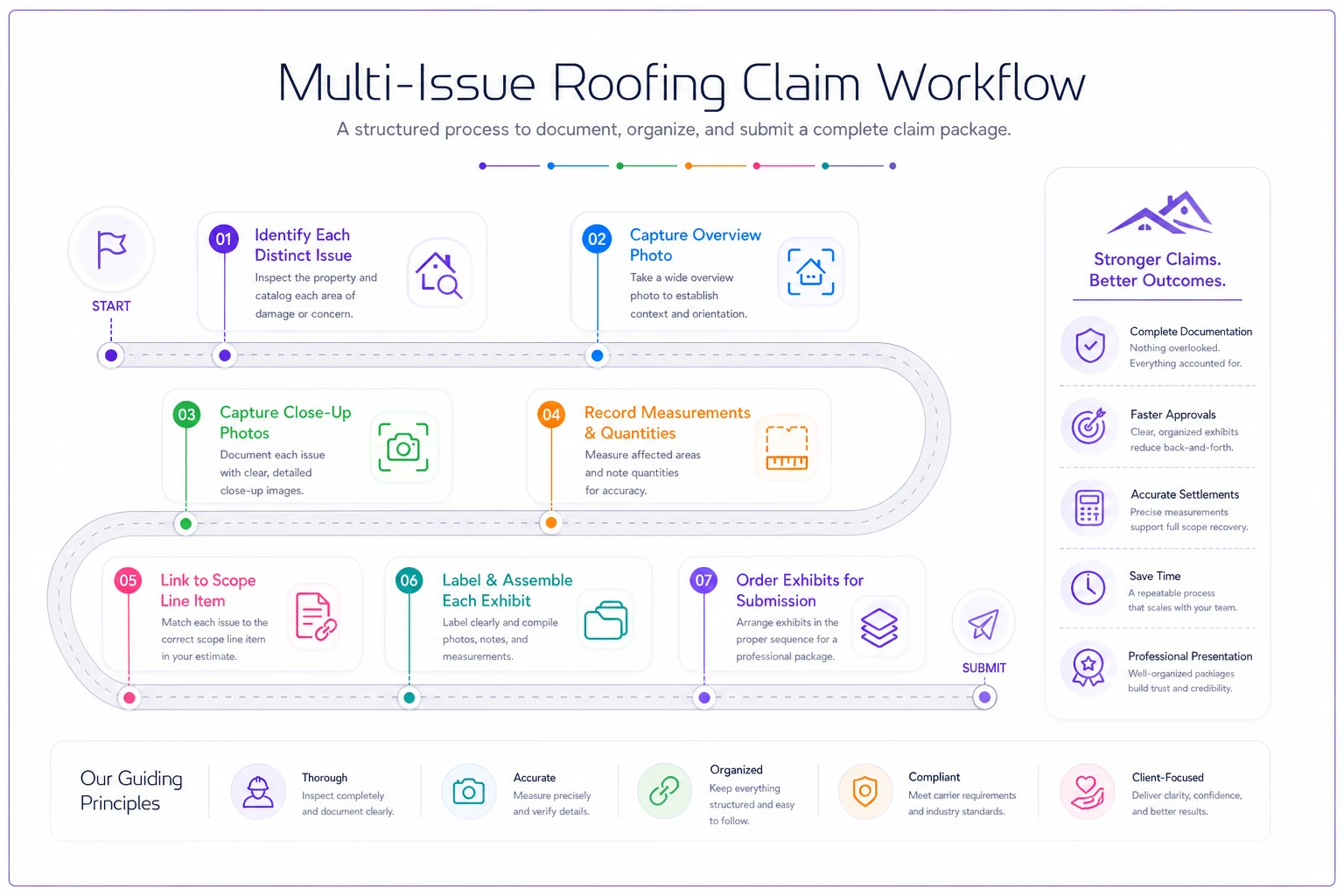
A simple visual of the bundling steps makes it easier for your team to follow the packet rules in the field.
Standard exhibit ordering that matches how claims get decided
Order matters more than people think. The first exhibit sets the frame for everything after it. Lead with your weakest or most ambiguous issue and the adjuster's skepticism carries forward. Lead strong and you buy goodwill for the harder stuff.
Here's an ordering that holds up well across complex residential claims:
| Position | Exhibit | Why it goes here |
|---|---|---|
| 1 | Roof diagram / overview | Orients the reader before any detail. Everything else references back to this. |
| 2 | Strongest, most obvious damage | Establishes the loss is real and gets an early mental "yes." |
| 3–N | Remaining issues, grouped by trade | Keeps related scope together so pricing flows logically. |
| Second to last | Interior / consequential damage | Only makes sense after the roof cause is established. |
| Last | Supporting docs (weather report, prior inspection, invoices) | Reference material, not the argument itself. |
The common mistake is burying the roof diagram at the end as an afterthought, or skipping it entirely. The diagram is the map the adjuster uses to place every other photo. Without it, each close-up is a floating image with no anchor — and floating close-ups are easy to dismiss.
Lead with the roof diagram; it orients the reader and reduces the chance of pends.
Grouping by trade in the middle section is what keeps a four-issue claim from feeling like chaos. All the shingle-related exhibits together, all the flashing exhibits together, all the interior together. The adjuster can settle a whole trade in one pass instead of bouncing around the roof.
The one-page executive summary that does the reading for them
If you add nothing else from this post, add this. A single page at the front that summarizes the entire claim turns a 40-minute review into a 5-minute confirmation.
The point isn't to impress anyone. It's to let a busy adjuster agree with you quickly. You're pre-chewing the decision.
A workable one-page template includes:
-
Header line Insured name, claim number, loss date, property address, inspection date.
-
Loss summary One or two sentences on what happened. "Hail event on [date] caused impact damage to field shingles and ridge, with wind-driven displacement on the south slope and consequential interior staining in the master bedroom."
-
Issue index table Each issue, its exhibit letter, location, and the scope line it supports.
-
Total requested The number, clearly stated.
-
What's attached A plain list of exhibits in order.
The issue index table is the workhorse. Something like:
| Exhibit | Issue | Location | Scope line |
|---|---|---|---|
| A | Roof overview & diagram | Whole structure | — |
| B | Hail impact, field shingles | North & west slopes | Full slope replacement |
| C | Ridge cap damage | Main ridge | Ridge replacement |
| D | Chimney flashing failure | SE elevation | Reflash chimney |
| E | Interior water staining | Master bedroom ceiling | Drywall & paint |
An adjuster can read that table and understand your entire argument before opening a single photo. When they then open the photos, they're confirming, not discovering. That shift — from discovery to confirmation — is where approval speed actually comes from.
One detail people miss: keep the summary's exhibit letters identical to the actual file names and labels on the photos. If your summary says Exhibit D but the file is named "chimneysouth3.jpg," you've reintroduced the exact sorting problem you were trying to kill.
Redaction and timeline rules that protect the claim
Two things quietly sink otherwise solid submissions: leaking information you shouldn't, and timeline gaps that make the loss look suspicious.
Redaction
-
Strip unrelated personal info from any homeowner documents you're including — account numbers, unrelated medical or financial details that sometimes ride along on insurance correspondence.
-
Remove internal pricing notes, your margins, or crew comments from screenshots. More than one contractor has accidentally sent an adjuster a screenshot with internal cost notes still visible in the corner.
-
Keep metadata intact on the photos (timestamps and geotags help you), but scrub it from any document exports where it might reveal edits or unrelated file paths.
The principle: the adjuster should see everything that supports the claim and nothing that complicates it or exposes your client.
Timeline rules
A multi-issue claim is also a chronology, and adjusters are trained to look for gaps. The loss date, the discovery date, the inspection date, and the submission date should form a clean, explainable line.
The danger zone is when interior damage is dated well after the roof event with no bridge between them. If the hail hit in May and the ceiling stain shows up in your August inspection, an adjuster's first instinct is "was this maintenance neglect, not storm?"
A simple timeline rule set:
-
Every exhibit's photos should be timestamped, with dates consistent with your stated loss and inspection dates.
-
If there's a gap, explain it in one sentence rather than hoping no one notices.
-
Never include a photo whose timestamp contradicts your narrative — one out-of-sequence image can cast doubt on the whole bundle.
You close that gap by including the sequence explicitly in the summary and ordering the interior exhibit after the roof cause — so the reader understands the staining as a downstream effect, not a separate unexplained problem.
When heavy bundling is worth it — and when it's overkill
Full exhibit bundling takes real time to assemble. It's not always the right move.
When it's worth it:
-
Three or more distinct issues on one claim
-
Any claim where interior or consequential damage depends on proving the roof cause
-
High-dollar claims where even a partial denial costs thousands
-
Any claim you suspect will be disputed or supplemented later
When it's overkill:
-
Clean single-issue claims with obvious damage — a well-labeled photo set and a short cover note does fine
-
Small-dollar repairs where the assembly time outweighs the risk
If you're a one-truck operation doing straightforward repair claims, building full exhibit packets for every job will eat hours you don't have. Reserve the full treatment for the complex, high-value, or contested claims where organization actually changes the outcome. The skill is knowing which claims deserve the effort.
A real scenario
A mid-size residential contractor kept running into the same problem on storm claims: multi-issue submissions were getting approved for the field shingles and pended on everything else. Across roughly a dozen complex claims in one season, the flashing and interior line items were getting approved maybe half the time — usually after a second round of back-and-forth that added a week or two each.
The fix wasn't more photos. They already had plenty. It was reorganization. They started leading with the roof diagram, splitting each issue into its own labeled exhibit, grouping by trade, and putting a one-page summary with an issue index up front. Same evidence, restructured.
The change showed up fastest in the back-and-forth. Requests for clarification dropped off noticeably, because the clarifying information was already sitting in the summary table. Approval on secondary line items improved, and the ones that still got questioned were questioned on their actual merits — not because the adjuster couldn't tell what was being claimed. The owner's own read on it: they weren't winning new arguments, they'd just stopped losing claims to disorganization.
Where this connects to the rest of your claims process
Bundling is the assembly step, but it only works if the upstream pieces are solid. If your supplement process is weak, better bundling just organizes a weak argument — the evidence-first approach in stopping supplement rejections pairs directly with clean exhibit ordering. And when a claim can't be resolved with the insurer and ends up as a homeowner dispute, the same self-contained-exhibit discipline carries straight into a small-claims evidence packet, where a judge reads under the same constraint an adjuster does: limited time, zero patience for sorting.
Keep consistent file names, exhibit letters, and timeline conventions across all of this, because you never know which claim becomes contested. The ones that go sideways are rarely the ones you expected. Building every complex submission as if a skeptical stranger will read it under time pressure is just cheaper than rebuilding the file later when someone actually does.
The short version
Multi-issue claims don't fail on evidence. They fail on organization. Give each issue its own self-contained exhibit, lead with a diagram and your strongest damage, group by trade, and put a one-page summary up front that lets the adjuster confirm instead of investigate. Keep your redaction tight and your timeline clean. Do that consistently, and you stop losing the secondary line items that quietly disappear every storm season — not because you argued better, but because you made it easy to say yes.
Ready to elevate your roofing operations?
Join hundreds of roofing contractors using Roofyly to streamline workflows, improve crew coordination, and enhance client satisfaction.