

Running three crews in-house feels manageable. You know every installer's strengths, track their work personally, catch problems before callbacks happen. Then growth hits—suddenly you need eight crews for storm season, commercial projects require specialized teams, and your best foreman suggests bringing in subs for the overflow work.
The math looks compelling. Subcontractors handle their own workers comp, bring their own tools, scale up and down with demand. No more carrying payroll through slow January. Except six months later you're dealing with a collapsed deck nobody photographed, insurance certificates that expired mid-job, and a homeowner threatening litigation because the sub's crew damaged their landscaping and disappeared.
Most roofing contractors learn subcontractor management through expensive mistakes. A single uncaught liability issue wipes out three months of margin. Quality problems from one bad sub tank your reputation across an entire neighborhood. Insurance gaps discovered after an accident trigger personal asset exposure you never saw coming.
Why Traditional Subcontractor Approaches Break Down
The standard approach treats subs like temporary employees—hand them specs, check the finished work, cut a check. This works until it spectacularly doesn't. The breakdowns follow predictable patterns that operational software now helps contractors prevent through systematic vetting and oversight.
Small residential shops often start with handshake agreements and verbal quality standards. The owner knows a few good crews, maintains relationships through consistent work, relies on reputation and repeat business to keep standards up. This relationship-based model caps out around $2M annual revenue when personal oversight becomes impossible.
The first scaling attempt usually involves basic paperwork—generic subcontractor agreements downloaded online, insurance certificate collection, maybe a checklist for completed work. But generic contracts miss roofing-specific liabilities. Insurance certificates sit in filing cabinets unchecked for expiration. Quality issues get caught after the damage is done, not at critical handoff points.
Even sophisticated contractors struggle with the oversight burden. Tracking 15 subs across 40 active jobs requires dedicated staff just for compliance monitoring. Daily quality checks across dispersed sites become logistically impossible. The administrative overhead starts approaching the savings from using subs in the first place.
Building Your Vetting Matrix
Effective roofing subcontractor management starts before anyone touches a shingle. The vetting process determines 80% of your downstream problems or success. Yet most contractors evaluate subs based on price and availability, discovering critical gaps only after something goes wrong.
Keep every roofing job on track and on time.
Roofyly helps you manage, schedule, and communicate every roofing project with precision and ease.
- Centralized project planning
- Real-time crew notifications
- Integrated scheduling & client updates
No credit card required
A functional vetting matrix evaluates four interconnected areas: financial stability, operational capability, compliance readiness, and quality history. Each area requires specific documentation and verification steps that operational platforms now automate but that manual systems often skip.
Financial stability goes beyond checking references. Pull business credit reports showing payment patterns to suppliers—a sub who's 90 days behind at ABC Supply won't finish your job when materials get cut off. Verify their banking relationships; established subs maintain commercial accounts and credit lines, not just personal checking. Request and actually review their last three months of payroll records to confirm crew stability.
Operational capability means matching sub specializations to job types. A crew that excels at production shingling might botch commercial TPO work. Document their equipment inventory—do they own brake machines for custom flashing or rent everything job by job? Check their typical crew size and structure; a "company" that's really one guy hiring day laborers creates very different risks than an established team with consistent foremen.
The compliance documentation creates your legal firewall. Current general liability with roofing classification codes, not just generic contractor coverage. Workers compensation with no gaps—verify the policy covers owners if they're working on roofs. Auto insurance including non-owned vehicle coverage for crew members driving personal trucks. Most critically, additional insured status for your company on all policies, not just certificate holder notification.
Quality history requires digging beyond references. Ask for photo portfolios of similar complexity work—if you're subbing slate repairs, see their actual slate projects, not just shingle galleries. Contact material suppliers about warranty claim rates. Check permit records in your jurisdictions for inspection failure patterns. Run contractor license board complaints even if not legally required in your area.
The Three-Stage Operational Framework
Successful subcontractor programs operate in three distinct stages: intake/vetting, active job management, and closeout/payment. Each stage requires specific processes, documentation, and handoff protocols that prevent common failure points.
Stage 1: Intake and Assignment
The intake stage begins when you identify subcontractor need and ends when crews mobilize to site. This window determines whether the job runs smoothly or devolves into finger-pointing over scope gaps.
Start with a detailed scope document that goes beyond basic specifications. Include explicit exclusions—what the sub is NOT responsible for. Define material handling responsibilities: who unloads, who stages, who removes debris. Specify acceptable working hours, noise restrictions, adjacent property protection requirements. Document site access procedures, parking limitations, storage areas.
The legal framework needs teeth without requiring attorney review for every job. Create modular contract addendums for common scenarios: occupied homes requiring interior protection, commercial sites with operational constraints, storm damage work with potential hidden conditions. Include hold harmless provisions for your company's equipment and materials. Add specific liquidated damages for critical failures like permit violations or safety incidents.
Photo requirements at this stage prevent later disputes. Before subs start, they document existing conditions including adjacent properties, landscaping, visible interior ceilings. This protects both parties—you can't blame them for pre-existing damage, they can't claim you didn't disclose known issues. Time-stamped photos with job addresses visible eliminate the "wrong house" confusion that happens more often than contractors like to admit.
Stage 2: Active Job Management
The active management phase separates professional programs from chaos. Daily oversight rhythms don't mean babysitting; they mean structured check-ins at critical progression points.
Morning verification confirms the right crew arrived with proper equipment. A two-minute video walk-around showing crew members, truck markings, and staged materials prevents the "different guys showed up" problem. Require subs to text photos of permits posted and safety equipment deployed before starting work.
Critical handoff points need documented sign-offs, not casual inspection. After tear-off, photograph and measure any deck repairs needed with the sub's foreman in frame acknowledging the condition. Before underlayment installation, verify and document slope measurements if approaching minimum requirements. After flashing installation but before shingle courses, conduct and photograph step flashing counts, cricket construction, and penetration boots.
Quality gates work best when tied to payment milestones. Release 30% after verified tear-off and deck prep. Another 30% after dried-in status with all underlayment and flashings complete. 30% at substantial completion pending punch list. Final 10% after homeowner sign-off and final photos delivered. This structure incentivizes proper handoffs without creating cash flow problems for subs.
| Milestone | Payment |
|---|---|
| After verified tear-off and deck prep | 30% |
| After dried-in status with underlayment and flashings complete | 30% |
| At substantial completion pending punch list | 30% |
| After homeowner sign-off and final photos delivered | 10% |
The oversight rhythm should follow natural break points. End-of-day photos showing progress and secured site. Next-morning confirmation of return time and crew size. Weather-delay protocols that specify who makes go/no-go calls. Hot work permits and monitoring for any torch-down or modified bitumen sections.
Stage 3: Closeout and Documentation
The closeout stage captures everything needed for warranties, compliance, and future reference while memories are still fresh. Most contractors rush this phase, creating problems months or years later when issues surface.
The final walkthrough requires systematic documentation, not just visual approval. Use standardized forms listing every component: ridge venting linear footage, step flashing counts, penetration boot inventory. Photograph each roof plane from multiple angles showing shingle alignment, pattern consistency, and edge details. Capture close-ups of all flashings, valleys, and transitions. Document gutter conditions and downspout connections.
Payment processing needs protective mechanisms. Require preliminary lien waivers before releasing progress payments. Obtain final lien waivers from both the subcontractor and their material suppliers—many contractors skip supplier waivers until a lien shows up. Verify all permit inspections passed before final payment. Confirm warranty registration if subs are handling manufacturer paperwork.
The administrative closeout feeds future decisions. Score subs on specific metrics: schedule adherence, quality issues found, documentation completeness, communication responsiveness. Track actual versus estimated hours to refine future pricing. Note any specific strengths or weaknesses for job-matching purposes. This data becomes invaluable when choosing subs for similar future projects.
Here is a simple workflow diagram of the three stages.
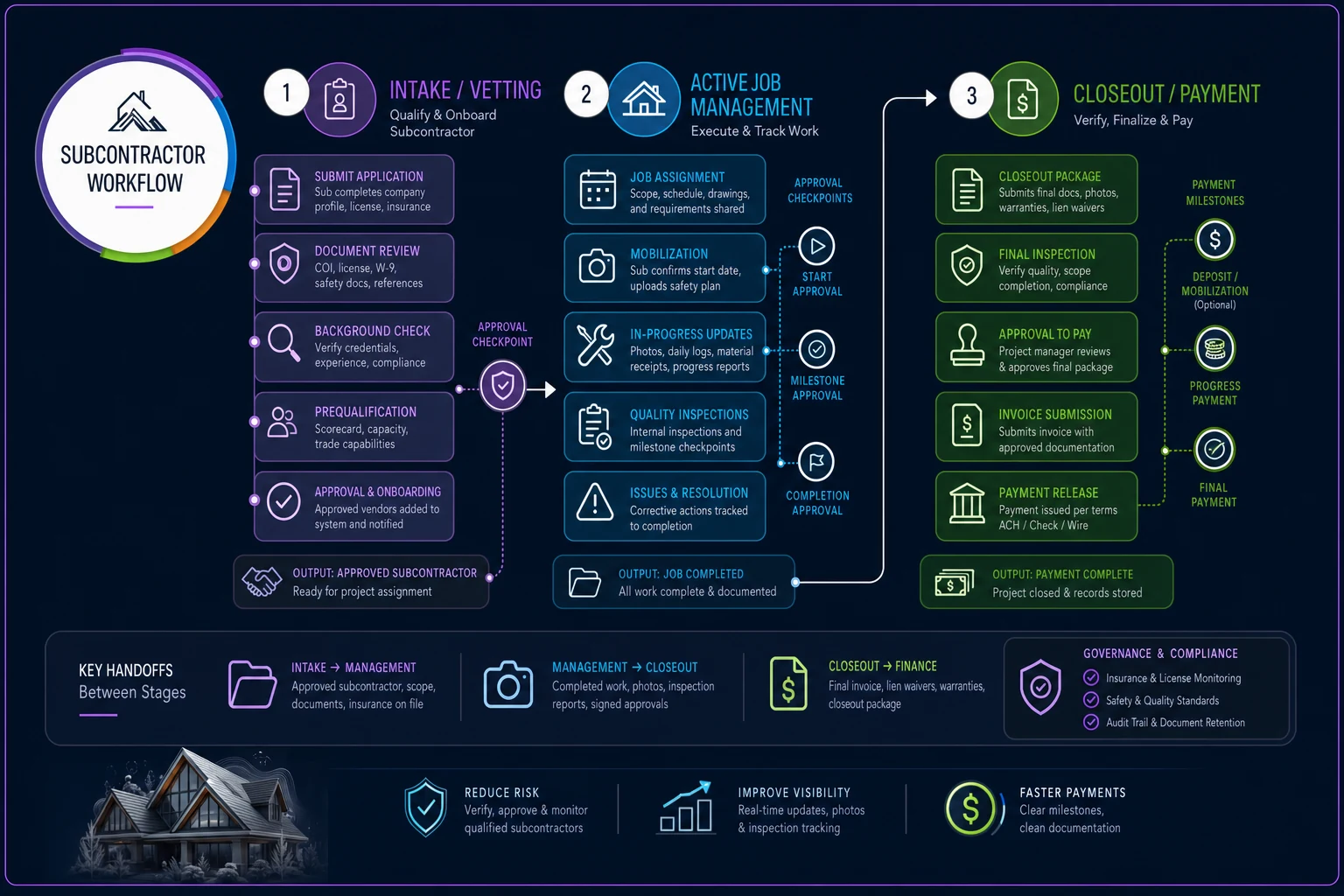
Use this workflow to align responsibilities and technical handoffs before the first mobilization.
Insurance and Liability Protection Layers
Insurance certificates alone don't protect you. The gaps between what certificates show and what coverage actually exists create massive exposure that only emerges during claims. Building proper protection requires multiple overlapping safeguards.
Start with automated certificate tracking that alerts you 30 days before expiration. But go beyond expiration dates—verify coverage types match work performed. A sub doing torch-down work needs specific hot work endorsements. Steep-slope projects may require special height provisions. Commercial projects often mandate higher liability limits than residential work.
Additional insured status requires specific endorsement forms, not just certificate notations. ISO forms CG 20 10 and CG 20 37 provide different coverage levels—know which you're getting. Require primary and non-contributory language so their insurance responds first. Include waiver of subrogation to prevent their carrier from coming after you for partial fault.
Indemnification agreements need enforcement mechanisms. Include right-to-offset provisions allowing you to deduct costs from payments if subs fail to defend claims. Require notice within 24 hours of any incidents or potential claims. Specify that indemnification covers attorney fees, not just settlements.
Common handoff breakdowns that cause invoice delays often stem from insurance documentation gaps. When certificates don't match work performed or additional insured endorsements arrive late, payment processing stalls while administrators chase paperwork.
The nuclear protection option—subcontractor default insurance—makes sense for larger contractors. Unlike bonds that require lengthy default declarations, SDI lets you immediately supplement or replace non-performing subs. The 2-3% premium pays for itself after one avoided disaster.
Creating Your Audit and Quality Framework
Random quality checks catch problems too late. Systematic audits at defined intervals prevent issues from compounding into callbacks or warranty claims. The framework needs enough structure to ensure consistency but enough flexibility to address job-specific risks.
Build audit checklists for each project phase, not just final inspection. Tear-off audits verify deck condition documentation, proper debris containment, and temporary weather protection. Dry-in audits confirm underlayment overlaps, ice barrier coverage zones, and temporary tie-offs for overnight security. In-progress audits check shingle coursing, pattern alignment, and exposure consistency before large areas get covered.
The audit process itself needs documentation standards. Who performed the check, when, weather conditions, specific items reviewed. Note both compliant and non-compliant items—positive reinforcement improves sub relationships. Include photos of any issues requiring correction with measurements or references for clarity. Time-stamp everything to establish sequence if disputes arise.
Correction protocols prevent audit findings from creating job site conflicts. Define severity levels: safety violations require immediate stop-work, quality issues allow completion of current section, minor items go on punch lists. Specify who can authorize rework and who bears material costs for corrections. Create appeals processes for disputed findings—sometimes the sub is right and specs were unclear.
Statistical tracking reveals patterns individual audits miss. Track defect rates by sub, project type, and season. Monitor correction response times and first-time quality rates. Compare warranty callback rates between different subs doing similar work. This data drives both sub selection and training focus areas.
Daily Oversight Rhythms That Scale
Managing one sub crew requires occasional check-ins. Managing twelve crews across eight active jobs demands systematic daily rhythms that capture critical information without overwhelming your operations team. The solution isn't more oversight hours—it's smarter oversight structure.
Morning briefings set daily expectations. Require subs to submit simple daily plans by 7 AM: crew size arriving, estimated progress goals, any material or access needs. This 5-minute requirement prevents the 10 AM surprise when half the crew doesn't show or they're missing critical materials.
Milestone photography replaces constant supervision. Define specific photo requirements for job progression: completed tear-off sections, installed underlayment areas, finished roof planes. Require consistent angles and include reference objects for scale. Modern phones automatically embed GPS and timestamp data, eliminating disputes about when and where work occurred.
End-of-day reporting closes loops. Subs submit actual progress versus planned, any issues encountered, next-day requirements. Include safety observations—near misses today prevent accidents tomorrow. Note any homeowner interactions or concerns raised. This rhythm creates accountability without micromanagement.
Require subs to submit simple daily plans by 7 AM to avoid morning surprises and missing materials.
The escalation matrix keeps small issues from becoming big problems. Define who gets notified for different scenarios: safety issues go immediately to owners, quality concerns to production managers, scheduling changes to project coordinators. Set response time expectations—safety within 1 hour, quality within 4 hours, administrative within 24 hours.
Technology amplifies oversight efficiency. Simple shared spreadsheets beat complex systems that subs won't use. Mobile apps that work offline handle rural job sites. Automated reminders ensure reporting happens without constant nagging. The goal isn't perfect documentation but consistent adequate documentation that scales.
Lightweight Contract Clauses That Actually Protect You
Fifty-page subcontractor agreements don't get read, signed properly, or followed. The protective value comes from specific, enforceable clauses addressing real roofing risks, not boilerplate legalese. Focus on provisions that actually matter when problems arise.
Scope creep kills profitability and relationships. Include explicit change order requirements: written authorization before additional work, detailed pricing for common additions, time limits for claiming hidden conditions. Define what constitutes normal wear versus damage requiring remediation. Specify that visible conditions at bid time are included in base scope.
Payment protection prevents you from financing their business. Include right to joint checks for material suppliers showing past-due accounts. Require sworn statements listing all suppliers and amounts owed before final payment. Allow direct payment to suppliers and deduction from sub payments if needed. Specify that mobilization without proper insurance voids payment obligations.
Performance standards need measurable definitions. Instead of "workmanlike quality," reference specific standards: manufacturer specifications, local code requirements, NRCA guidelines. Define acceptable callback rates and warranty claim thresholds. Include liquidated damages for specific failures: $500 per day for permit violations, $1,000 for safety incidents requiring stop work.
Termination provisions protect against non-performance. Define clear termination triggers: two failed inspections, three safety violations, five days schedule slippage. Include right to complete work with others and charge excess costs to original sub. Require return of materials and site access upon termination. Specify that termination for cause eliminates payment for work not accepted.
Dispute resolution keeps problems manageable. Require mediation before litigation with costs split equally—this encourages reasonable settlement. Include prevailing party attorney fee provisions to discourage frivolous claims. Specify your local jurisdiction for any proceedings. Set short limitation periods for claims—one year maximum versus standard statute of limitations.
Required Handoff Artifacts
Every transition point between sub crews or from sub to your team needs defined deliverables. Missing artifacts create knowledge gaps that turn into callbacks, warranty issues, and payment disputes months later.
Tear-off documentation captures hidden conditions and decisions. Photograph all deck repairs with measurements and material specifications. Document any structural issues discovered and remediation approach. Include disposal weight tickets confirming proper debris handling. Note any deviations from original scope with cause and authorization.
Dry-in packages prove temporary weather protection. Wide shots showing complete coverage with proper overlaps. Close-ups of temporary seals around penetrations and edges. Documentation of tie-down methods for overnight or weather delays. Written confirmation of dry status before crews leave site.
Installation progression records enable warranty support. Photos every 500 square feet showing pattern alignment and exposure consistency. Valley and flashing details before being covered by shingles. Ridge vent installation showing proper baffles and slot cuts. Penetration boots and pipe collars with sealant application visible.
From stockouts to scheduled installs, your material tracking depends on accurate handoff documentation. When subs don't report actual versus estimated material usage, your procurement forecasting breaks down.
Completion packages support both payment and future service. Final photos from all angles in good lighting showing finished work. Punch list sign-offs from both sub foreman and your quality inspector. Warranty registration confirmations from manufacturers. Cleaned-up site photos proving proper restoration.
Scaling Without Quality Loss
Growing from three crews to ten doesn't mean accepting lower quality. But maintaining standards requires different systems than personal oversight provided. The transition challenges are predictable and manageable with proper structure.
Documentation standards replace institutional knowledge. When your experienced foreman who "just knows" good work from bad isn't checking every job, explicit standards become critical. Photo guides showing acceptable versus unacceptable work. Measurement tolerances for exposure, overlap, and offset. Reference installations demonstrating expected quality levels.
Training investment pays compound returns. Don't assume subs know your standards—invest two hours explaining expectations versus spending days fixing problems. Create installation videos for complex details. Host monthly breakfast meetings reviewing common issues. Share callback data so subs understand real quality costs.
Tiered sub relationships reward performance. A-tier subs get first choice on profitable jobs and faster payment terms. B-tier subs handle standard work with normal oversight. C-tier subs require intensive monitoring and get only simple projects. New subs start probationary periods with limited scope until proven.
Quality metrics drive improvement when shared properly. Post monthly scorecards showing callback rates, inspection pass rates, and documentation scores by sub. Celebrate improvements, not just problems. Create competition for quality awards or preferred status. Make performance visible without creating antagonism.
The technology multiplier effect kicks in around eight crews. Basic operational software that felt unnecessary with three crews becomes essential at scale. Automated certificate tracking, digital quality checklists, and photo organization systems pay for themselves through prevented problems. The overhead reduction funds quality inspection staff who maintain standards across expanded operations.
Sample Audit Checklists and Tools
Generic audit forms miss roofing-specific checkpoints that prevent real problems. These battle-tested checklists catch issues that matter for callbacks, warranties, and liability protection.
Pre-Start Audit Checklist:
-
Current insurance certificates on file with additional insured endorsements
-
Signed contract with scope exhibit attached
-
Safety equipment present
fall protection, fire extinguishers, first aid
-
Permit posted and visible from street
-
Adjacent property protection deployed
-
Material delivery matches specifications
-
Crew lead identified and contact confirmed
-
Weather forecast reviewed and acceptable
-
Homeowner notification completed
-
Photo documentation of existing conditions
In-Progress Quality Audit:
-
Deck repairs properly documented with photos and measurements
-
Underlayment overlaps meet manufacturer minimums
-
Ice barrier extends proper distance from eaves
-
Step flashing count matches penetration inventory
-
Valley construction follows specified method (woven/cut/metal)
-
Shingle exposure consistent within 1/4 inch tolerance
-
Pattern alignment maintained across roof planes
-
Penetration boots sealed and properly shingled
-
Ridge vent cut-out width appropriate for vent type
-
Debris management ongoing, not accumulated
Final Inspection Checklist:
-
All roof planes photographed from multiple angles
-
Flashing details documented with close-ups
-
No exposed nails or excessive sealant visible
-
Gutters clear and properly connected
-
Site restored to original or better condition
-
All debris removed including nails from magnetic sweep
-
Warranty documents completed and submitted
-
Homeowner walkthrough completed with sign-off
-
Final invoice matches contract plus approved changes
-
Lien waivers collected from sub and suppliers
These checklists work best when customized for specific job types. Commercial projects need additional safety documentation. Insurance work requires claim-specific photos. Storm damage repairs mandate before-and-after comparison shots. The key is consistency—every job gets audited against the same standards.
Real Operations Example: Colorado Contractor's Sub Program Evolution
Mountain Peak Roofing in Denver grew from $1.8M to $5.2M revenue over three years by systematically building their subcontractor program. The journey included expensive lessons that shaped their current approach.
Initially, they relied on three trusted crews they'd known for years. Handshake agreements, cash payments, occasional quality checks when problems arose. This worked until a 2019 hailstorm brought 300+ jobs in 60 days. Scrambling to add capacity, they brought on seven new subs with minimal vetting.
The results were predictable. Two subs disappeared mid-job after getting progress payments. One crew's expired insurance was discovered after a worker fell. Quality callbacks jumped from 3% to 18%. A single botched commercial job resulted in $45,000 in repairs and legal fees.
The transformation started with basic documentation. Simple one-page agreements requiring insurance. Photo requirements at three checkpoints. Payment held until inspection passed. Just these changes dropped callbacks to 8% while handling 40% more volume.
The real improvement came from systematic vetting and oversight. They now maintain a roster of 12 approved subs categorized by specialization. Each goes through a 10-point vetting process including reference checks, insurance verification, and test projects. Daily photo submissions get reviewed each morning. Quality scores determine future job assignments.
The investment required one full-time administrator and basic operational software costing around $400 monthly. Callbacks dropped to 2.5%, insurance claims fell 80%, and margins improved 3% through reduced rework. More importantly, they can now confidently take large commercial projects knowing quality won't suffer.
Their advice to other contractors: start with documentation standards, add systematic vetting, then layer in daily oversight rhythms. Don't wait for problems to force changes. The upfront effort prevents exponentially larger downstream costs.
Making This System Work for Your Operation
Building an effective subcontractor program doesn't require perfection from day one. Start with the highest-risk areas and expand systematically as you prove the value and refine processes.
Begin with insurance verification and basic agreements. These legal protections prevent catastrophic losses that kill businesses. Even simple forms beat nothing when problems arise. Focus on getting signatures and certificates before mobilization—enforcement becomes nearly impossible after work starts.
Add quality checkpoints at natural breaks. Don't try monitoring everything immediately. Pick three critical points: post-tear-off, post-dry-in, and final. Require photos at just these stages initially. As comfort grows, add intermediate checkpoints for complex work.
Build measurement systems before you need them. Track callback rates by sub before problems emerge. Monitor insurance expiration patterns. Document typical quality issues. This baseline data drives improvements and justifies program investments.
The systematic approach transforms subcontractors from necessary evils into competitive advantages. When you can confidently scale up for storm season or take commercial projects knowing quality won't suffer, growth becomes sustainable rather than chaotic. The documentation and oversight feel like overhead initially but prevent multiples of their cost in problems.
Modern operational software makes these systems manageable even for small contractors. Automated insurance tracking, digital checklists, and organized photo storage eliminate the administrative burden that previously made proper oversight impossible. But the principles work even with basic spreadsheets and consistent processes.
The Path Forward
Your subcontractor program determines whether growth strengthens or breaks your roofing business. The companies that scale successfully treat sub management as a core operational competency, not an afterthought. They invest in vetting, documentation, and oversight systems before problems force their hand.
The difference between contractors stuck at $2M revenue and those reaching $10M isn't just sales volume. It's the ability to deliver consistent quality through others' hands. When you can trust your sub program to maintain standards without personally checking every detail, sustainable growth becomes achievable.
Start with one piece—usually insurance verification or basic quality checklists. Prove the value through reduced problems. Use those wins to justify expanding the program. Within six months, you'll wonder how you ever operated without proper structure.
The roofing subcontractor management systems that actually work aren't complex. They're consistent, documented, and enforced. They protect both parties through clear expectations and verified compliance. Most importantly, they let you sleep soundly knowing that tomorrow's callbacks aren't being created on today's job sites.
The roofing subcontractor management systems that actually work aren't complex. They're consistent, documented, and enforced. They protect both parties through clear expectations and verified compliance. Most importantly, they let you sleep soundly knowing that tomorrow's callbacks aren't being created on today's job sites.
Ready to elevate your roofing operations?
Join hundreds of roofing contractors using Roofyly to streamline workflows, improve crew coordination, and enhance client satisfaction.