

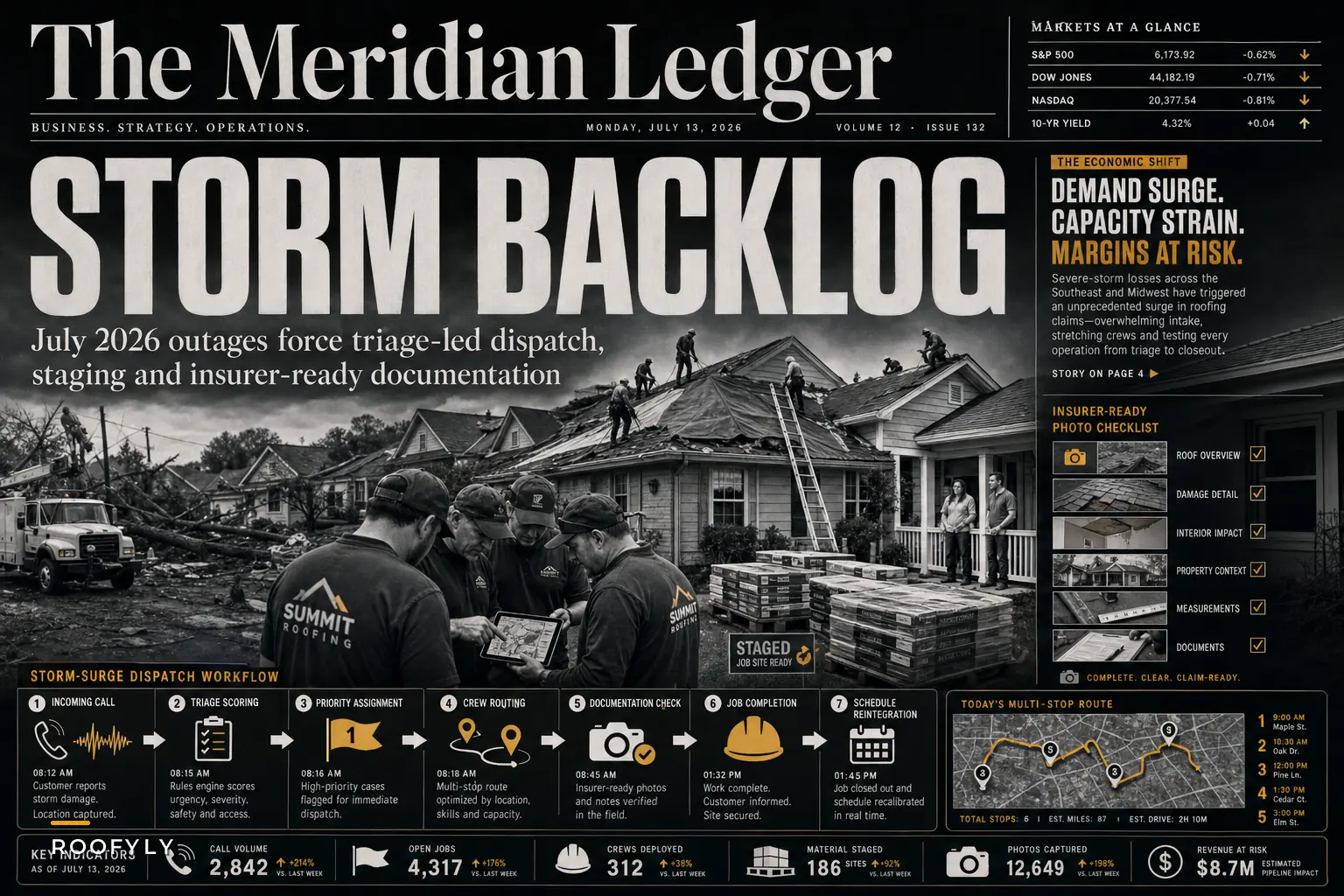

The July 4th weekend storms that swept through the Midwest and Northeast left a mess that's still playing out weeks later. CBS reported nearly 800,000 customers without power at the peak, with widespread wind damage from Chicago to Philadelphia. For roofing contractors in these regions, the aftermath has been a masterclass in operational chaos—crews scattered across emergency tarping jobs, install schedules blown apart, and a mountain of insurance paperwork that keeps growing.
Storm Surge Operations: What Actually Breaks and How to Fix It
What makes storm response surges genuinely different from a normal busy stretch isn't just volume. It's compression. When three months of emergency calls hit in four days, your standard dispatch system breaks. Crews get pulled off profitable installs to handle $400 tarp jobs. Your office manager drowns in adjuster callbacks. Somewhere between the tenth "we need someone TODAY" call and your lead installer texting about running out of tarps, you realize your surge workflow was built for a 30% spike, not 300%.
The contractors who got through this latest surge without completely unraveling weren't necessarily the biggest operations. They had clear triage rules that didn't require someone making a judgment call on every situation. While other teams debated which emergency to handle first, these guys already had scoring systems running—damage severity, customer status, insurer type, crew proximity. Their dispatch leads weren't making 50 micro-decisions an hour. They were executing a playbook.
The Triage Scoring System Most Teams Skip
Most roofing operations treat storm response as pure firefighting. First call gets first response, maybe with some loose adjustment for "good customers." When you're fielding 40+ emergency calls before 9am, that approach falls apart fast.
Keep every roofing job on track and on time.
Roofyly helps you manage, schedule, and communicate every roofing project with precision and ease.
- Centralized project planning
- Real-time crew notifications
- Integrated scheduling & client updates
No credit card required
The scoring approach that actually holds up combines four weighted factors into a single dispatch priority number. Structural damage severity gets the highest weight—active water intrusion beats cosmetic damage every time. Customer relationship status matters, but less than you'd think. A 10-year customer with minor damage shouldn't jump ahead of a new caller with water pouring through their ceiling. Insurance carrier type affects scoring because some adjusters move faster than others. State Farm and Allstate typically process emergency authorizations within hours; smaller regional carriers can take days. Geographic clustering rounds it out—two medium-priority jobs on the same street score higher than one high-priority job 45 minutes away.
| Factor | Weight | 1 Point | 2 Points | 3 Points |
|---|---|---|---|---|
| Damage Severity | x4 | Cosmetic only | Partial exposure | Active water entry |
| Customer Status | x1 | New/unknown | Past customer | Current maintenance |
| Carrier Type | x2 | Small regional | Mid-tier | Major national |
| Location Cluster | x3 | Isolated | Near other job | Multiple nearby |
Teams using this system during the July storms processed roughly triple their normal emergency volume without adding dispatch staff. Not because the scoring is perfect—it isn't. But because it eliminates the decision paralysis that kills response time. When your dispatcher can score a call in 30 seconds instead of debating for three minutes, those saved minutes compound fast across dozens of calls.
Documentation Requirements That Adjusters Actually Accept
The gap between what roofing crews photograph and what insurance adjusters need has always been wide. Storm surge work makes it worse. Crews racing between emergency jobs don't have time for elaborate documentation, but inadequate photos mean claim delays, payment disputes, and cash flow problems weeks down the road.
A documentation system that survives real storm conditions has to be dead simple. Not "simple after training"—simple enough that a helper who's been on the crew two days can execute it correctly. That means photo sequences, not photo artistry.
Every emergency response needs exactly five photo groups, taken in this order:
-
Wide establishing shot showing the full roof
-
Damaged area from multiple angles
-
Close-up of the specific failure point
-
Interior damage if accessible
-
Completed temporary repair
That's it. No measuring tapes in frame, no artistic angles, no trying to capture the full story. Five groups, same sequence, every job.
The establishing shot prevents the "which property was this?" confusion when you're reviewing 50+ emergency jobs two weeks later. Damaged area photos from multiple angles protect against pre-existing damage disputes. The close-up proves severity—adjusters need to see split decking, not just missing shingles. Interior damage photos justify emergency response fees. The completed temporary repair photo starts your liability clock and proves scope of work.
Some contractors tried detailed photo apps during the recent storms. Most abandoned them by day two. The crews that maintained documentation quality did it simpler: one person per crew designated as the photo person, using a basic checklist card, uploading everything to a shared folder organized by address. Not sophisticated, but it worked when the more complicated systems didn't.
The 72-Hour Crew Rotation Nobody Wants to Implement
Extended storm response destroys crews. Not immediately—adrenaline and overtime carry teams through the first few days. But by day four or five, mistakes spike, injuries increase, and your best installers start calling in sick. Physical exhaustion combines with the mental drain of constant crisis mode. Quality drops, callbacks increase, and suddenly your storm response is creating new problems.
The rotation system that actually preserves crew performance requires acknowledging something most contractors resist: no crew can sustain emergency pace beyond 72 hours. After three straight days of storm response, that crew needs to rotate back to normal installation work or get a full day off. This isn't weakness—it's just how people work.
Where it gets complicated is the transition. You can't shuffle crews randomly. Emergency tarping and standard installation require different mindsets, tools, and materials. A crew that's been doing careful detailed work on a high-end residential install can't instantly flip to rapid tarp deployment. The mental shift takes time, the truck needs restocking, and someone needs to brief them on emergency protocols.
The contractors who managed the July surge without burning out their people pre-designated emergency response crews and installation protection crews before the surge hit. Emergency crews handled nothing but storm work for their 72-hour window. Installation crews stayed on their scheduled jobs, protecting revenue and customer commitments. After 72 hours, they switched—with a half-day buffer for restocking, debriefing, and resetting.
This approach felt like a luxury until about day five, when other contractors started losing their best people to exhaustion while the rotation kept delivering consistent output.
Material Staging When Everyone's Out of Everything
Storm surge material management isn't really about having enough supplies—it's about having them in the right places at the right time. The July storms created instant shortages of tarps, fasteners, and sealants across entire regions. ABC News reported the combination of extreme heat and severe storms stressed infrastructure and supply chains simultaneously. But even within those shortages, some contractors kept operating while others sent crews home empty-handed.
The difference was distributed staging. Instead of relying on morning warehouse pickups, the operations that kept moving had pre-positioned emergency supplies at multiple points. Not full warehouses—just strategic caches. A storage unit on the north side with 50 tarps and fasteners. A covered trailer at a crew leader's house on the south side with another 50. Basic supplies, positioned where crews could reach them without driving across town during peak chaos.
The math on this seems wasteful during normal operations. Why tie up $3,000 in emergency supplies sitting in storage units? During surge events, those distributed caches eliminate the central dispatch bottleneck entirely. A crew finishing a job in the north suburbs can restock and hit another emergency without returning to base. That's not just efficiency—it's actual capacity multiplication.
Staging small caches near crew clusters cuts deadhead time and keeps crews moving.
It also protects against supplier stockouts. When your primary supplier runs out of tarps at 10am, you're not dead. You've got three other smaller caches to work through while sourcing alternatives. The contractors who kept operating through day four and five of the July surge were pulling from their third and fourth backup locations while others were calling suppliers three states away.
The Handoff Protocol That Keeps Your Install Schedule from Collapsing
The real damage from storm surges often shows up after the emergency phase ends. Your installation schedule, carefully built for crew efficiency and weather windows, gets shredded. Customers scheduled for new roofs watch emergency trucks in their neighborhood and wonder why their job got pushed. Crews bouncing between emergency and scheduled work make more mistakes. And somewhere in the chaos, that commercial job with liquidated damages clauses is suddenly three days behind.
The handoff from emergency response back to normal operations determines whether you recover in two weeks or two months. The original schedule is gone—this is about building a new one that acknowledges reality while protecting critical commitments.
Start with installation triage. Which scheduled jobs absolutely cannot slip? Commercial contracts with penalties, customers with events, jobs where special-order materials arrive Tuesday—those get protected first. Everything else gets honestly reassessed. That means difficult phone calls, but vague communication during storm recovery damages customer relationships worse than honest delays do.
The production managers who navigated post-storm recovery most successfully built what some called "commitment pools." Instead of pretending specific dates still made sense, they moved customers into weekly windows. "Your installation will happen the week of August 12th, weather permitting. We'll confirm the exact day by Thursday." That honest uncertainty actually reduced customer anxiety more than repeatedly pushing specific dates that kept slipping.
Where AI-Powered Dispatch Actually Helps During Surge
Manual dispatch during storm surge is like solving a puzzle where the pieces keep multiplying. You're tracking 30+ emergency jobs, coordinating crews, managing material logistics, and every few minutes another call scrambles the plan. At some point, the human brain just can't process it fast enough.
The contractors who maintained smooth operations during the July surge weren't necessarily better at dispatch—they'd built AI-powered operational software into their workflows that handled computational complexity while humans handled judgment calls. The software doesn't replace your dispatcher. It processes scoring algorithms instantly, identifies routing patterns across a dozen active jobs, and flags resource conflicts before they turn into actual problems.
This workflow diagram captures the dispatch steps described above.
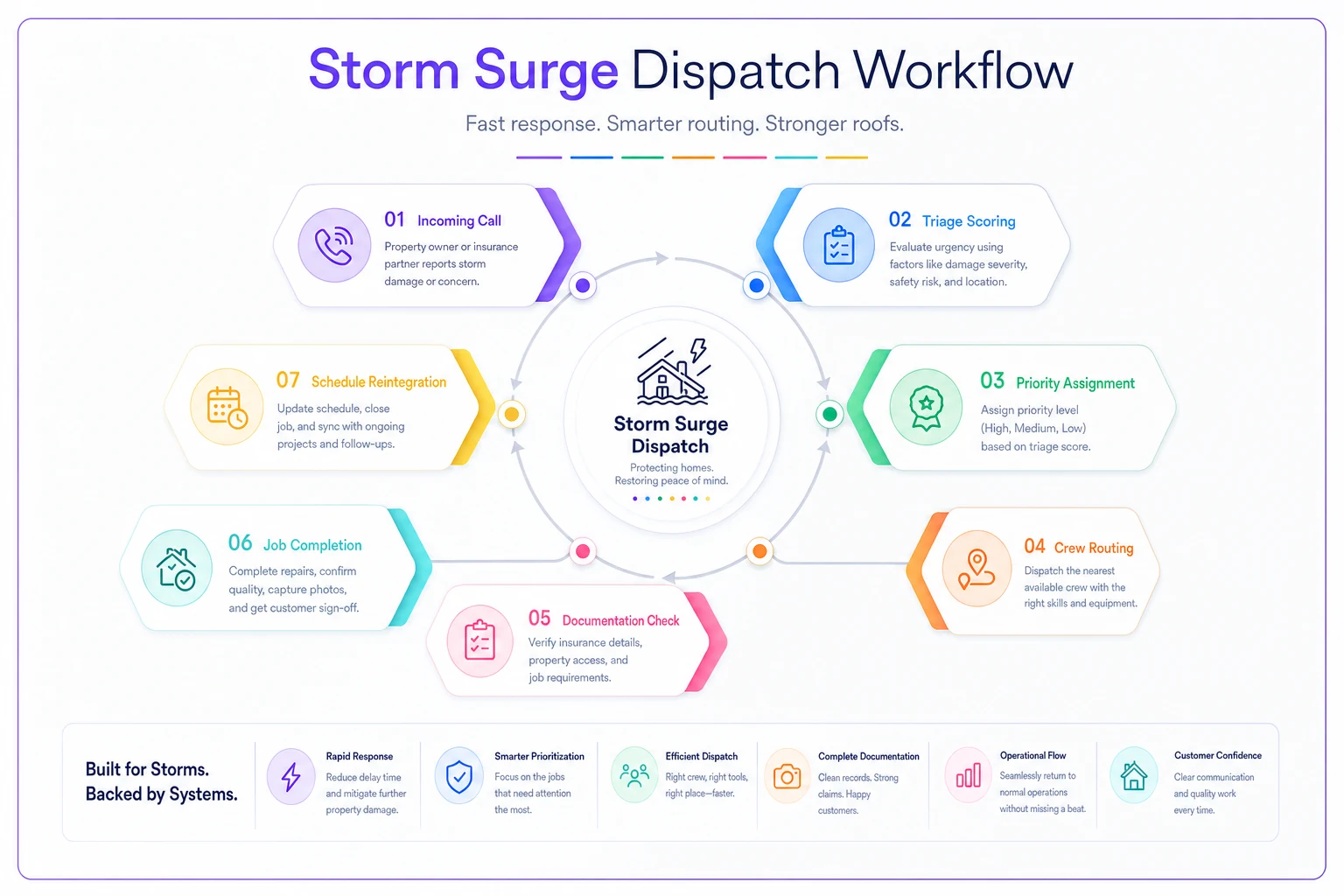
When crew 3 calls saying they need an extra hour at their current job, your dispatcher normally has to manually recalculate remaining capacity, figure out which jobs need reassignment, identify who has room, and communicate changes to everyone affected. That's 15 to 20 minutes of scrambling. With AI-enhanced dispatch, those calculations happen in seconds. The system surfaces a few reallocation options ranked by efficiency, and the dispatcher picks one.
Documentation is another area where automation earns its place. Instead of crews trying to remember photo sequences or office staff manually sorting hundreds of images, the platform automatically categorizes uploads, identifies missing documentation, and can alert crews before they leave the site. During a multi-day surge when everyone's exhausted, those automated checks prevent the documentation gaps that cause payment delays weeks later. The AI handles computation and pattern recognition. Humans handle relationships and judgment calls. Your dispatcher still decides whether to accommodate a longtime customer's special request. Your crew lead still assesses whether conditions are safe to work. The software just makes sure they have complete information when making those calls.
The Recovery Audit Most Teams Skip
Most contractors treat storm surge like a sprint—maximum effort until the emergency calls stop, then collapse back to normal. The teams that actually come out ahead do something different in the two weeks after. They look hard at what broke, adapt their systems, and write down what they learned. Not a formal "lessons learned" session that produces a dusty binder. A practical audit that produces actual workflow changes.
The audit covers five specific areas:
-
Communication breakdowns — where did information get lost between field and office?
-
Resource bottlenecks — which materials, tools, or vehicles ran out first?
-
Crew performance variance — which teams handled the pressure well and which didn't?
-
Customer escalations — which client types created disproportionate demands?
-
Documentation gaps — which required photos or forms were consistently missed?
One contractor found their top installation crew performed worst during emergency response, while their newest crew excelled. The experienced installers overthought simple tarp jobs; the newer crew just ran the basic protocol. That insight changed how they select surge response teams going forward.
The audit also surfaces profit leaks that hide in the chaos. Emergency supply runs that should have been billable. Travel time that wasn't tracked. Change orders verbally approved but never documented. During normal operations, those leaks might cost a few hundred dollars weekly. During surge response, they can reach thousands per day. Most contractors never go back and calculate what they actually lost—which is exactly why it happens again next storm.
Building Surge Capacity Before the Next Storm
The July 2026 storms won't be the last surge event hitting roofing contractors. Whether it's hurricanes, derechos, hail, or winter damage, surge events are part of the business. The question isn't whether another one is coming—it's whether your operation handles it better than this one.
Real surge readiness starts with accepting that emergency response needs different operational frameworks than daily installation work. You wouldn't use the same tools for metal roofing and shingle work. Why run the same dispatch system for steady-state and surge operations? The contractors who came through July in decent shape had built parallel systems—one optimized for efficiency, one for surge capacity.
For teams looking to systematize storm response before the next event, the previous guide covers the complete emergency tarping SOP with safety protocols and documentation standards. Combined with the dispatch and triage frameworks here, it gives you the operational foundation for managing surge events without destroying your core business.
The roofing contractors who turned the July 2026 storms from crisis into something manageable didn't have more resources. They had better systems. Scoring protocols that cut through the debate. Documentation procedures crews could actually execute while exhausted. Rotation schedules that kept their workforce intact. And increasingly, AI-powered platforms that handled the computational load while humans handled the relationships.
Late summer moving into peak hurricane season is not the time to be figuring out your surge playbook on the fly. The contractors who built those systems before the last storm are already ahead. The ones still trying to manual-dispatch through surge events are learning that lesson right now, the hard way.
Ready to elevate your roofing operations?
Join hundreds of roofing contractors using Roofyly to streamline workflows, improve crew coordination, and enhance client satisfaction.