

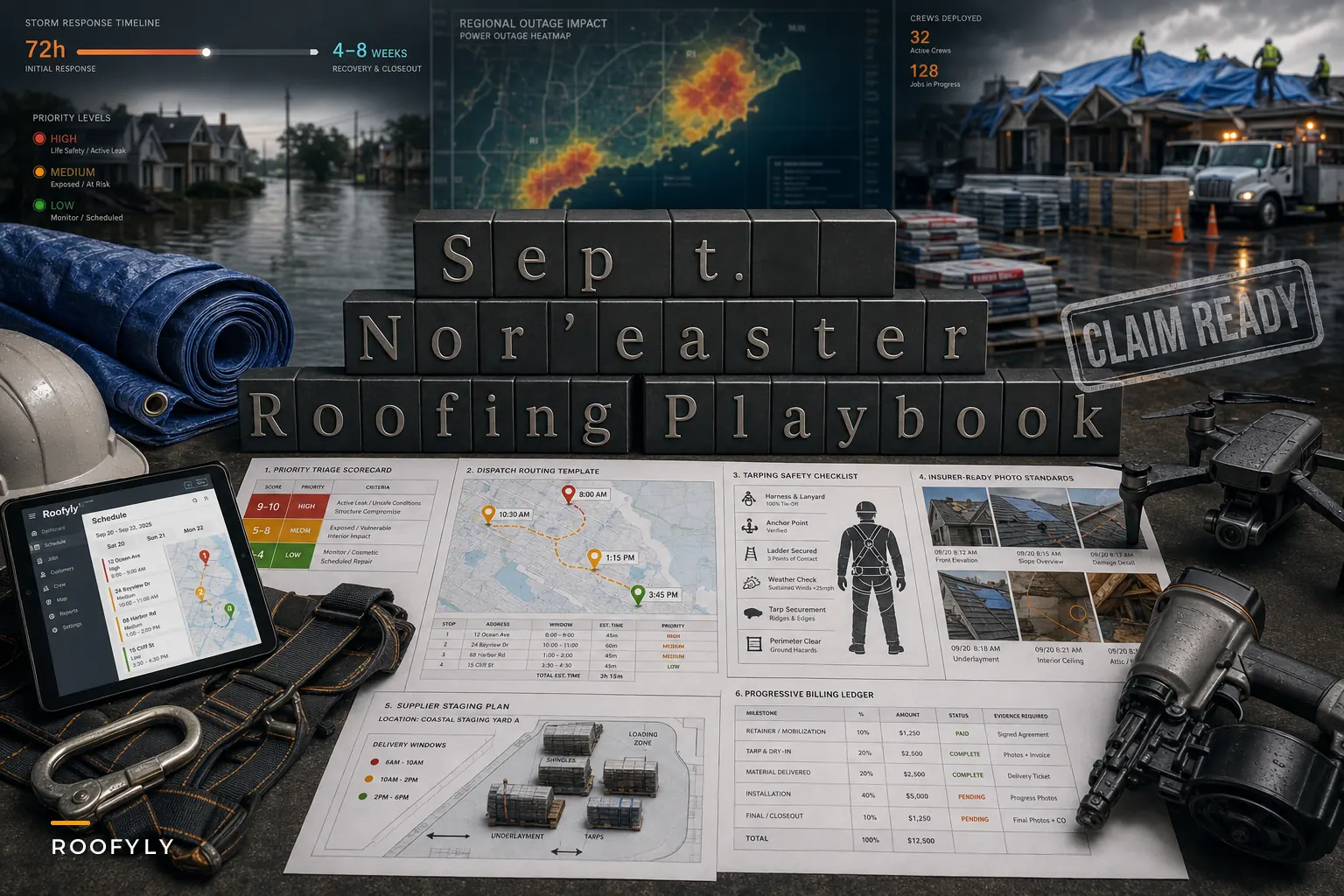

The late-September nor'easter that hit the Northeast on the 25th and 26th didn't do anything subtle. Heavy coastal rain, flooding in the usual low spots, downed trees taking lines with them, and over 100,000 customers losing power according to Reuters. Hundreds of flights scrubbed. The kind of storm that fills your voicemail by 6 a.m. and keeps your phone warm for two weeks.
If you run a roofing operation anywhere from New Jersey up through coastal New England, you already know what comes next. The calls aren't the problem — the calls are easy. What breaks teams is everything behind the calls. Supply runs that take twice as long because half the roads are closed. Adjusters who stop answering. Crews running on four hours of sleep. And the quiet cashflow bleed that starts when you tarp fifty roofs and bill none of them properly.
This isn't about whether to respond to storm work. You're responding. This is about how to run the backlog so it doesn't run you.
The real bottleneck isn't the sequence
Most teams get this wrong in the first 72 hours. They treat every emergency call as roughly equal and work them in the order they came in. First call, first truck. It feels fair, it feels fast, and it quietly costs thousands.
Post-storm demand isn't a queue. It's a triage situation, and the jobs are wildly different in urgency, complexity, and payout. A punctured flat roof over a finished basement that's actively taking water is a completely different animal than a few lifted shingles on a detached garage. If your dispatch logic can't tell them apart, you'll send your best crew to the garage at 7 a.m. and reach the flooding basement at 4 p.m. — after the drywall's already gone.
A quick triage scoring approach
You don't need software to start this. You need a shared definition so your phone intake person and your foreman mean the same thing when they say "urgent."
| Factor | Low (1) | Medium (2) | High (3) |
|---|---|---|---|
| Active water intrusion | None visible | Damp/staining | Actively dripping into living space |
| Interior exposure | Garage/exterior only | Attic/unfinished | Finished living area |
| Structural concern | None | Possible decking soft spot | Visible sag or compromised framing |
| Safety access | Easy, dry | Moderate | Standing water / downed lines nearby |
| Insurance in play | Cash job | Claim likely | Claim filed, adjuster assigned |
Total the score. Anything 11+ goes to the front of the line regardless of call order. Anything flagged for downed lines nearby gets a utility confirmation before a single boot hits the ladder — power restoration crews were stretched thin after this storm, and an energized line near a wet roof isn't a risk you negotiate with.
The triage table is straightforward, but actually committing to it under surge conditions is harder than it looks. When your phone is ringing and a homeowner is panicking, skipping the scoring and just dispatching feels like the faster move. It usually isn't.
Why your supply chain breaks before your crews do
The outage map matters for a reason that isn't immediately obvious. When Reuters reports six-figure outage counts, that's not just homeowners in the dark — that's your lumber yard running on a generator, your supplier's inventory system offline, and delivery trucks rerouting around flooded roads. CNN's storm coverage showed how widespread the road and power disruption got across the major metros.
Keep every roofing job on track and on time.
Roofyly helps you manage, schedule, and communicate every roofing project with precision and ease.
- Centralized project planning
- Real-time crew notifications
- Integrated scheduling & client updates
No credit card required
In practice, this plays out as a material gap you don't see coming. You've got the crews, you've got the signed authorizations, and you can't get synthetic underlayment or enough tarps because your three closest suppliers are either closed or picked clean by the other dozen roofing companies in your area who all woke up to the same storm.
Practical move: split your response into two parallel tracks from hour one.
-
One person owns materials — calling suppliers, confirming stock, placing holds, arranging pickup if delivery windows blow out.
-
Everyone else owns field triage and tarping.
Assign a single materials owner in hour one to prevent sourcing bottlenecks.
If you fold material sourcing into your foreman's job during a storm surge, it won't get done well. He's on a roof. He can't be on hold with a supplier at the same time.
Tarping is a cashflow decision, not just a stopgap
This is where a lot of money quietly disappears. Emergency tarping during a storm backlog is some of the least profitable work you'll do — if you treat it as disconnected from the permanent repair. You send a crew out, they spend 90 minutes securing a roof, and that cost sits on your books with no clear path to recovery.
The teams that handle this well treat every tarp as the opening document of a claim, not as a favor. The photos, measurements, and damage notes captured while tarping become the foundation for the permanent-repair estimate and the insurance supplement. Skip that step and you're sending a second crew back to re-document everything a week later — paying twice for one set of information.
If you want the full breakdown of how to run the tarping itself — safety limits, what documentation actually holds up with an adjuster, and the homeowner conversations that prevent the "I thought this was included" argument — we broke that whole workflow out in our triage SOP for emergency roof tarping. Worth reading before you send crews out this week.
The core point is simple: the tarp crew and the estimate are not two separate events. When they're disconnected, you lose the documentation, you lose the billing trail, and you lose the homeowner's memory of how bad it looked before you showed up.
The scheduling problem nobody budgets for: crew fatigue
Storm weeks produce a specific kind of mistake. Around day four or five, when calls are still coming and crews have been running 11- and 12-hour days, quality starts slipping. Nails get missed. A tarp gets secured a little sloppy. Someone takes a shortcut on fall protection because they're exhausted and three more roofs are waiting.
What follows is predictable: callbacks on the emergency work itself, which eats the crews you need for new jobs. The storm backlog essentially re-infects you.
A simple response sequence for the first week
-
Hours 0–12 Stand up two tracks (materials + field). Score every incoming call. Confirm utility status on anything flagged for downed lines.
-
Hours 12–48 Clear all 11+ severity jobs. Every tarp gets full photo and measurement documentation tied to the address and homeowner.
-
Days 2–4 Work the medium-severity backlog. Begin filing supplements on documented emergency work so the paperwork isn't sitting cold.
-
Days 5–6 Quality audit on completed emergency work before moving deeper into the queue. Catch your own callbacks before the homeowner does.
-
Day 6+ Mandatory crew rest rotation. Transition from pure emergency mode into scheduled permanent-repair production.
The sequence above isn't complicated, but holding to it when demand is still climbing takes real discipline. Most of the teams that blow it aren't making bad decisions — they're just making no decision, letting the volume dictate the pace instead of the other way around.
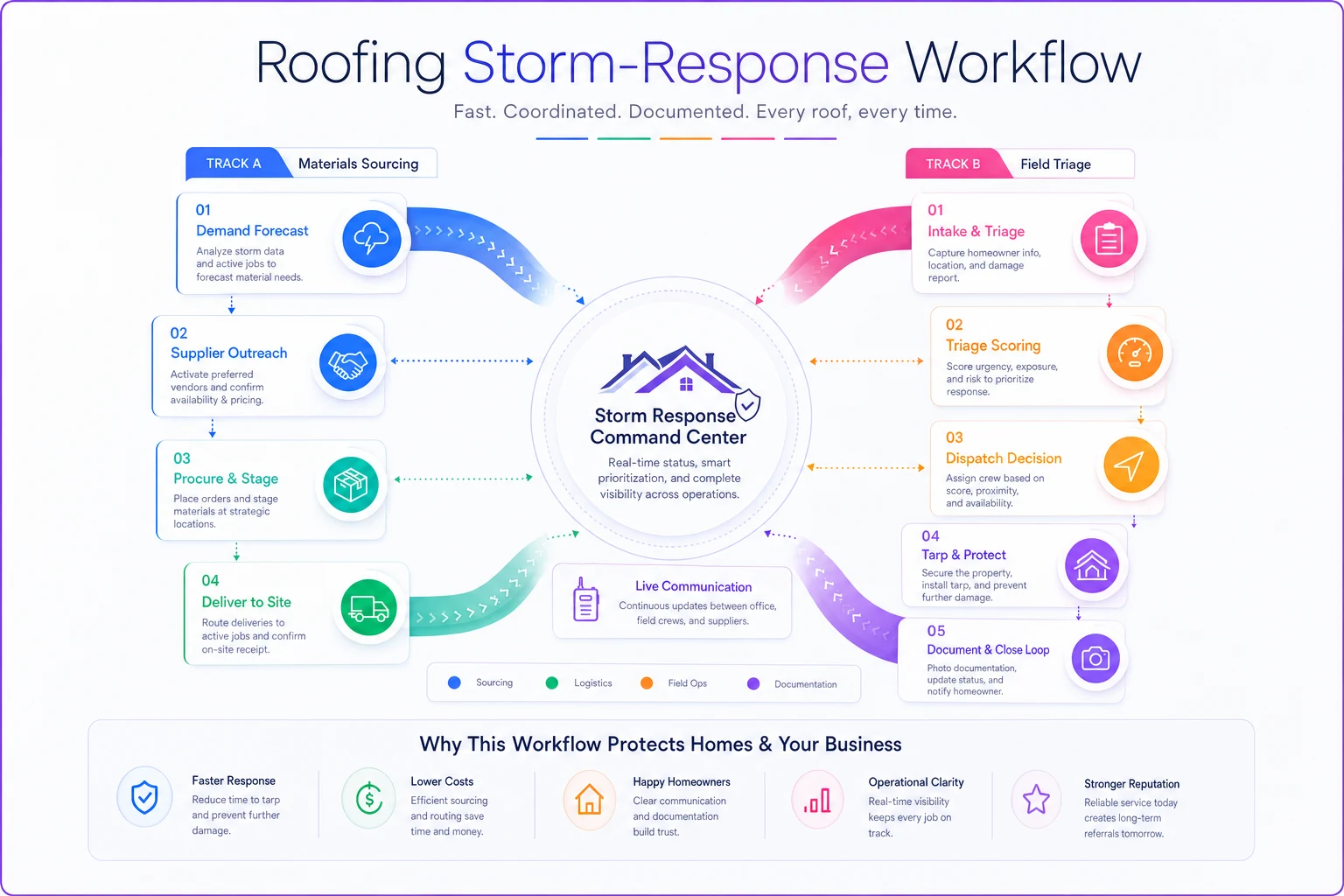
Use the flow to align intake, materials, field documentation, and scheduled rest so the backlog moves through a system rather than adrenaline.
Protecting cashflow when insurers are backlogged
This part tends to bite three to six weeks out. After a major regional storm, adjusters are buried. Approvals that normally take a week stretch to three. If your billing depends on waiting for insurer sign-off before you see money, a storm surge can leave you asset-rich and cash-poor — plenty of authorized work on the books, nothing coming in to pay the crews who did it.
The teams that stay liquid through a storm backlog tend to do a few things differently:
-
They collect deductibles and emergency-service fees at the point of tarping, not after permanent repair. That emergency call is real work; bill it as its own line item.
-
They stage billing so documented, completed phases get invoiced as they close, rather than holding everything for one final invoice pending insurer approval.
-
They maintain a clean, dated evidence trail per address so when the adjuster finally calls, the supplement is already assembled and ready — no scrambling, no delay added on their end.
When aggressive storm response is a bad idea
Not every shop should chase a full storm surge, and it's worth being straight about that.
-
If you're a two-crew operation already booked solid on scheduled reroofs, taking on fifty emergency calls means blowing up commitments to existing customers who will remember it long after the storm news cycle ends.
-
If your documentation habits are loose, a storm surge multiplies every weakness — you'll end up with dozens of poorly documented jobs and a stack of denied supplements.
-
If your cash reserves are thin and you can't float payroll through an insurance backlog, volume alone can push you into a cash crunch even while you're technically "busy."
Busy and profitable are not the same thing during a storm. Plenty of contractors finish a big storm season with strong revenue and a worse cash position than when they started.
A real scenario worth learning from
A mid-size residential roofing operation in coastal Connecticut — four crews, somewhere around $4M in annual volume — got hit by a comparable fall storm a couple seasons back. First surge, they ran it the old way: first-call-first-served, foreman handling his own material runs, tarps documented with a few quick phone photos.
The damage showed up later. Roughly 15% of their emergency tarps needed a return trip because documentation was too thin to support the supplement, and several finished-basement jobs reached them too late to prevent interior damage they ended up getting blamed for. Their effective recovery rate on emergency work sat somewhere in the low 60s after all the disputes and re-dos.
The following storm season, they scored every call at intake, put one dedicated person on materials, and treated every tarp as a documented claim opener. Emergency callbacks dropped to the low single digits. Recovery on emergency work climbed into the high 80s. Same storm intensity, roughly the same call volume — the difference was entirely in the sequence and documentation discipline, not in working harder or longer.
That's the whole point. The storm is the same for everyone in your market. What separates the operations that profit from the ones that just survive is whether the backlog moves through a system or through adrenaline.
Closing thought
A nor'easter like this one will keep your phone ringing for weeks, and there's real money in that work — but only if the backlog is scored, sequenced, documented, and billed as it moves. The contractors who struggle aren't lacking demand. They're treating a triage event like a normal week with more calls.
Build the scoring habit before the next system rolls up the coast. Lock your material tracks early. Treat every tarp as the first page of a claim. And protect your crews — because the backlog you're staring at today is only worth something if your team is still standing and sharp when the permanent-repair work finally comes due.
Ready to elevate your roofing operations?
Join hundreds of roofing contractors using Roofyly to streamline workflows, improve crew coordination, and enhance client satisfaction.