



Last week's mortgage rate climb caught a lot of contractors off guard. The 30-year fixed hit 6.7%, pushing borrowing costs to near one-year highs according to Freddie Mac's weekly survey. For roofing crews mid-summer, the timing is genuinely brutal.
Your sales team is probably already feeling it. Homeowners who were ready to sign last month are suddenly asking for "time to think about it." A $35,000 full replacement that made sense at 5.8% now costs an extra $180 per month if they're pulling equity. That's enough to kill deals you thought were done.
What most roofing operations miss: mortgage rate spikes don't just slow sales—they create a cascade of operational problems that compound fast. When conversion rates drop even 20%, your August schedule starts developing gaps. Gaps mean idle crews. Idle crews mean labor costs eating into margins that were already thin. And if you're carrying inventory based on July's pipeline projections, you're about to get squeezed from both ends.
The hidden operational damage when deals slow down
Mortgage rates affecting roofing demand isn't new. What catches teams off guard is how quickly the operational math falls apart.
Take a typical residential roofing operation running 3-4 crews. You're probably scheduling jobs 2-3 weeks out, maybe 4 weeks for larger replacements. Sales team closing at a normal rate—say 35% on first visits, another 20% on follow-ups. Materials ordered weekly based on upcoming installs. Everything flows when demand is predictable.
Then rates jump. That 35% first-visit close rate falls to 25%. Follow-ups stretch from one week to three. Some homeowners ghost completely. Your August schedule that looked full two weeks ago now has Monday and Tuesday gaps you're scrambling to fill with maintenance work that barely covers crew costs.
Materials get worse. You've got maybe $45,000 in shingles sitting in the warehouse, ordered for jobs that just pushed to "maybe September" or "next spring." Your supplier's 30-day terms don't care that homeowners are spooked. And those early-pay discounts you were taking advantage of? Gone, because cashflow just got tight.
This is when good roofing companies start making bad decisions. They chase revenue with aggressive discounts. They take insurance work they'd normally pass on. They cut newer crew members, destroying team cohesion they spent months building. They delay paying suppliers and burn relationships they'll need when demand returns.
Why traditional sales tactics fail when borrowing costs spike
Most roofing sales training focuses on urgency and value. Show the damage, explain the consequences, present the solution. Works great when homeowners have access to capital. Falls apart when their borrowing power drops 15-20% overnight.
Keep every roofing job on track and on time.
Roofyly helps you manage, schedule, and communicate every roofing project with precision and ease.
- Centralized project planning
- Real-time crew notifications
- Integrated scheduling & client updates
No credit card required
The typical response? Sales teams push harder. More follow-up calls. Bigger discounts. Payment plans that destroy margins. "Limited time offers" that smell desperate. None of it works because you're solving the wrong problem.
Homeowners aren't saying no to your roof. They're saying no to the monthly payment—or more accurately, they're saying no to adding another payment when groceries, gas, and utilities keep climbing. That architectural shingle upgrade you usually sell? Suddenly impossible when the base replacement already stretches their budget.
Your team starts hearing the same objections on repeat: "We need to wait until rates drop." "Let me see what my bank says." "Can you just patch it for now?" By the time you realize these aren't real objections—they're polite ways of saying "I can't afford this right now"—you've burned weeks of pipeline development time.
The scheduling impact compounds everything. Sales slows, so you tell crews to stretch jobs an extra half-day for "quality." You start accepting smaller repairs to keep everyone busy. You move your best installers to warranty work that should've been handled by newer teams. Efficiency drops while overhead stays flat.
Building a mortgage-resistant sales process (without destroying margins)
The companies that survive mortgage rate spikes don't discount their way through them. They restructure how they sell, what they sell, and who they sell to.
A simple sales workflow for phased projects and timing flexibility:
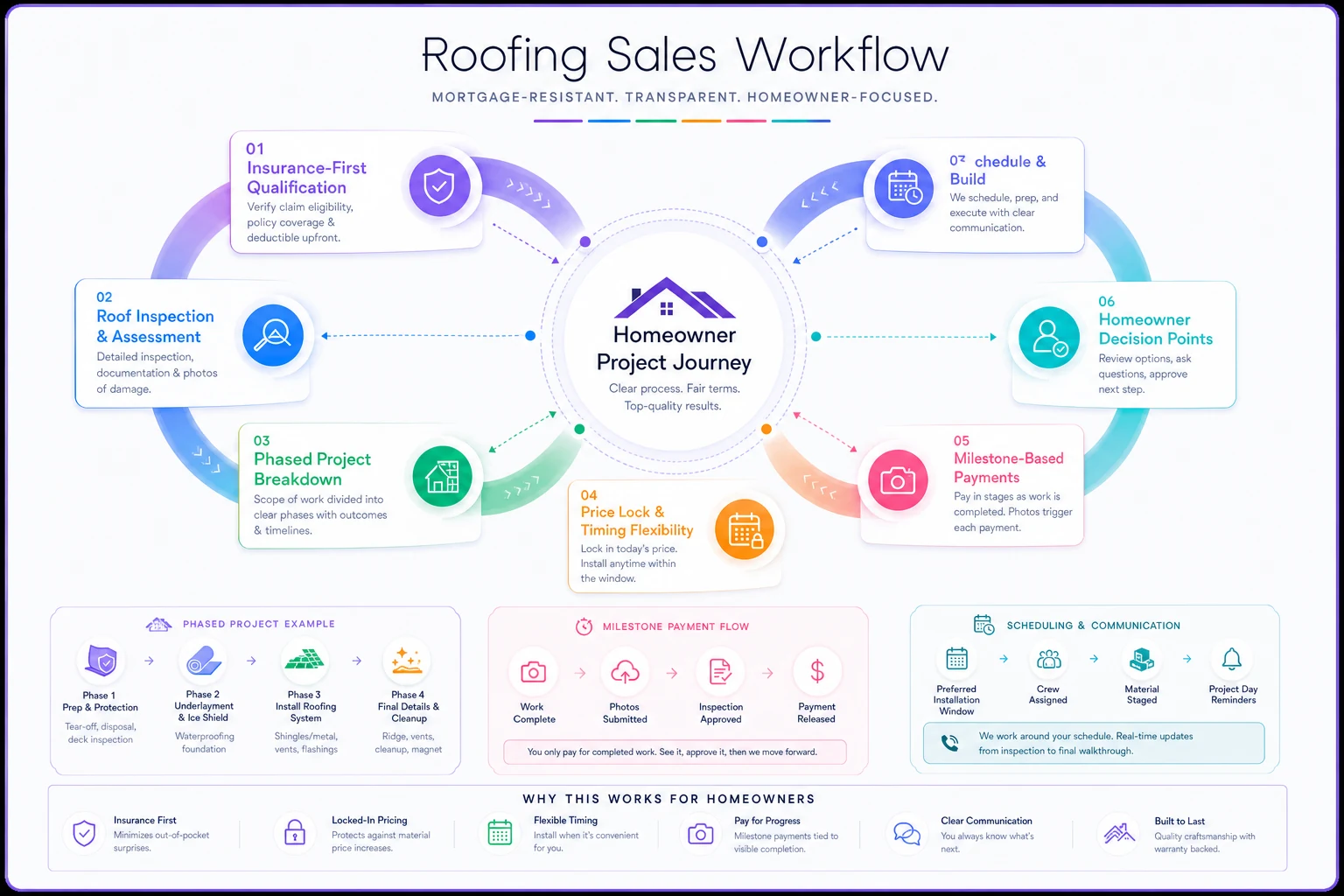
Start with deal structure. When rates were low, a full replacement made sense as one project. Now you need to think in phases. Can the back section wait until spring? Can you replace the main roof now and handle the garage next year? Breaking a $35,000 project into a $22,000 job and a $13,000 future project keeps you in the game.
Payment timing matters more than payment options. Instead of pushing financing, push timing flexibility. "Lock in today's price, install within 6 months." This gives homeowners room to wait—maybe for a bonus, a tax refund, or a rate drop—while you secure future work. Yes, it complicates scheduling, but predictable future revenue beats empty weeks.
Sales scripts need a full overhaul. Stop selling against leaks and start selling against cost escalation. "Every month you wait, the repair gets more expensive." Show them the $3,000 repair that becomes an $8,000 section replacement if they wait through winter. Take photos of three similar houses on their street—one that waited too long, one that acted early, one in between. Make procrastination scarier than the payment.
Insurance work becomes your stability anchor, but not the way most companies approach it. Instead of chasing storm damage, focus on age-related claims. Help homeowners understand their coverage before they need it. A 15-year-old roof might qualify for replacement under certain policies. Teaching homeowners to work their insurance properly creates demand that doesn't depend on their borrowing capacity.
Cashflow protection when revenue gets unpredictable
The brutal reality of mortgage-driven slowdowns: they expose every cashflow weakness in your operation. That 45-day collection cycle you've been tolerating? It'll hurt badly when revenue drops 30%. The supplier credit you've been floating? They'll cut you off right when you need it most.
Accelerate collections on everything already in progress—not next week, today. Every completed job that isn't fully collected is money you're effectively lending at zero percent while you pay suppliers at net-30. Set up a daily collection scorecard: jobs completed, amounts outstanding, days overdue. Make it someone's actual job to chase everything over 15 days.
Set up a daily collection scorecard and assign someone to chase everything over 15 days.
Cut your inventory position immediately. That procurement system tracking your material flow? Time to run it lean. Cancel orders for jobs that pushed out. Return what you can. Negotiate extended terms on what you can't. Better to pay a restocking fee than sit on dead inventory. Your warehouse isn't a savings account.
Payment terms need to flip in your favor. Larger deposits—move from 25% to 40%. Progress payments for anything over $15,000. Final payment before the crew leaves the site, not "upon satisfaction." Will you lose some deals? Yes. But the deals you keep will have cleaner cashflow.
What actually works well: milestone-based payment with clear triggers. Deposit on signing. Second payment when materials hit the job site. Third when tear-off is complete. Final when installation passes inspection. Each trigger is objective, documented with photos, and non-negotiable. Homeowners often prefer this anyway—no surprise at the end.
Crew utilization tactics that preserve capability
When demand drops, the knee-jerk reaction is to cut crews. This destroys capability right when you need flexibility. The smarter move is to restructure rather than reduce.
Transform your crews into flexible units. That 6-person crew? Split them into two 3-person teams for smaller jobs. Cross-train your best installers on repairs and maintenance. Take repair specialists and teach them basic installation. When big jobs come in, combine teams. When things are slow, run multiple small jobs simultaneously.
Maintenance contracts become your utilization buffer. Go back to every customer from the last two years: "Annual inspection and minor repair package, $400." You're not making much on these—you're keeping crews moving and staying in front of customers. When rates drop and demand returns, they'll call you first.
Schedule density beats schedule optimization. Instead of perfect routing, cluster jobs geographically. All northside jobs Monday-Tuesday, southside Wednesday-Thursday. Yes, you'll occasionally drive past potential jobs. But tight geographic clusters let you respond to same-day opportunities and cut windshield time when every hour counts.
The counterintuitive move: use slow periods for training. That newer guy who's been doing tear-off for six months? Teach him installation. Installers who only know one shingle type? Cross-train on metal and tile. When demand returns—and it will—you'll have more capability than competitors who cut to the bone.
Material and supplier strategies during demand uncertainty
Inventory during a mortgage spike turns toxic fast. Every bundle in your warehouse is cash you can't use for payroll. But stockouts when a job appears will kill your reputation. The balance requires a real strategy shift.
Move to just-in-time ordering for everything except your top two shingle colors. Those you keep maybe one week of inventory, no more. Special orders? Customer pays 100% upfront for materials before you order anything. Non-refundable. Some customers will push back. But carrying special-order inventory during uncertain demand is a bad gamble.
Supplier relationships need attention now. Schedule a face-to-face with your top three suppliers. Be direct: "Demand dropped, cashflow is tight, but I want to protect our relationship." Most will work with you—extended terms, smaller minimums, quicker delivery windows. The ones that won't? You just learned who not to depend on when things recover.
A material swap network with nearby contractors is underrated. That stack of weathered wood shingles sitting in your yard? Someone needs them. Their excess architectural gray might work on your next job. A simple group text with 3-4 non-competing contractors, sharing excess inventory weekly. Even at cost, moving dead material beats watching it age.
Converting mortgage resistance into different revenue streams
When homeowners can't afford replacements, they still need roofing services. The companies that do well during rate spikes find these alternatives fast.
Repair-and-monitor programs generate immediate revenue while building future pipeline. Instead of pushing a $25,000 replacement, offer a $3,000 repair with quarterly inspections for $200 per year. You're not giving up on the replacement—you're getting paid to stay in front of the customer until they're ready.
Gutter services need minimal capital and appeal to cashflow-conscious homeowners. Clean, repair, and guard installation keeps crews productive without heavy material investment. A two-person team can realistically pull $2,000-3,000 daily in gutter work. Not enough to replace roofing revenue, but enough to cover costs and contribute to overhead.
Commercial property managers get interesting when residential slows. They budget annually, don't need mortgages, and value reliable contractors. Those strip mall repairs you'd normally pass on? They look different when residential is quiet. Start with smaller property management companies—they're easier to reach and decisions happen faster.
The competitive advantages of operational discipline
Rate spikes create real opportunity for operationally disciplined companies. While competitors panic and make desperate moves, you can position for the recovery.
Keep your quality standards consistent. When others cut corners to protect margins, your work becomes a differentiator. Document everything—photos, warranties, customer communications. When homeowners eventually move forward, they remember who stayed professional when things got tough.
Keep pricing stable through structural changes, not discounts. Smaller scope? Fine. Phased payment? If structured right. But your per-square pricing shouldn't move. Customers talk, and nothing erodes trust faster than finding out the neighbor paid less for identical work.
Stay in front of customers consistently. Weekly update emails. Calls after storms. Annual inspection reminders. When competitors go quiet, your presence builds trust. That trust converts when borrowing capacity returns.
Protect your core team. The temptation to cut your experienced foreman or veteran salespeople will be real. Resist it. These people are your operational backbone. Find creative ways to hold onto them—reduced hours, temporary adjustments, cross-training into other roles. Losing them saves money short-term and destroys capability you'll desperately need in recovery.
Building resilience for the next rate cycle
This won't be the last time mortgage rates affect roofing demand. The companies that survive multiple cycles build systematic resilience rather than reacting each time.
Target no more than 60% of revenue from mortgage-dependent replacements. The rest should come from insurance work, repairs, maintenance contracts, and commercial projects. Building that mix requires different sales and operational capabilities, but the stability is worth it.
Build a cashflow reserve during good periods. Target 90 days of operating expenses. Seems impossible? Start with 30 days and add to it every strong month. That buffer lets you make strategic decisions instead of desperate ones when things soften.
Develop scenario-based operational plans. What happens if demand drops 20%? 40%? 60%? Not vague ideas—specific actions with defined triggers. At 20%, implement geographic scheduling. At 40%, restructure crews. At 60%, pivot hard to alternative services. Having the playbook ready prevents panic.
-
At 20%, implement geographic scheduling.
-
At 40%, restructure crews.
-
At 60%, pivot hard to alternative services.
Track leading indicators that predict demand shifts. Mortgage rate trends from sources like Reuters matter, but local building permits, real estate inventory, and insurance claim frequency tell you more about where roofing demand is actually heading. A simple monthly dashboard tracking these indicators means you can adjust before you feel the impact—not after.
The next 90 days determine the next 9 months
Mortgage rates at 6.7% aren't killing your roofing business—but how you respond might. Companies that treat this as an operational challenge rather than just a sales problem will come out of it stronger when rates stabilize.
Immediate priorities: restructure your sales process for payment-sensitive buyers, break projects into phases, create timing flexibility, and focus on insurance opportunities. Protect cashflow through faster collections, lean inventory, and tighter payment terms. Maintain crew capability through restructuring and cross-training. Build alternative revenue streams before you need them.
| Immediate priority |
|---|
| restructure your sales process for payment-sensitive buyers |
| break projects into phases |
| create timing flexibility |
| focus on insurance opportunities |
| Protect cashflow through faster collections, lean inventory, and tighter payment terms |
| Maintain crew capability through restructuring and cross-training |
| Build alternative revenue streams before you need them. |
The temptation when demand drops is to hunker down and wait. That's exactly the wrong move. Use this period to fix operational weaknesses, build new capabilities, and strengthen supplier relationships. When rates eventually ease—and history says they will—you want more capacity and better positioning than competitors who just waited it out.
The roofing companies still growing through this rate spike aren't lucky. They're operationally disciplined, financially flexible, and focused on what they can actually control. Mortgage rates are just another variable to manage, not an excuse for poor performance.
React desperately to every deal that doesn't close, or systematically build an operation that holds up regardless of borrowing conditions. The next 90 days will show which path you're actually on.
Ready to elevate your roofing operations?
Join hundreds of roofing contractors using Roofyly to streamline workflows, improve crew coordination, and enhance client satisfaction.