



Mid-August brought a signal worth paying attention to. Lowe's posted softer-than-expected Q2 numbers and trimmed its full-year guidance, pointing to weaker DIY and home-improvement demand and a more cautious consumer. You can read the specifics in Lowe's own Q2 release, and CNBC's breakdown of the quarter covers how the market read it.
Retail earnings aren't a perfect proxy for roofing demand. A homeowner buying less paint and fewer deck boards isn't the same as a homeowner skipping a roof that's actively leaking. But the two move together more than most contractors want to admit. When big-box retailers see discretionary home spending soften, that same hesitation tends to show up in your pipeline 4 to 8 weeks later. The estimate that used to close in three days now sits for two weeks. The full tear-off becomes "let's just do the worst slope for now." The financing questions get more pointed.
This post isn't about the earnings report itself. It's about what to actually do — with your crews, your material orders, and your cash — when discretionary reroof demand starts thinning out.
The demand that disappears first isn't the demand you think
The pattern that catches most roofing ops off guard: when spending softens, you don't lose jobs proportionally across the board. You lose a specific slice first, and it's usually your highest-margin work.
The jobs that vanish early:
-
Proactive replacements — the 18-to-22-year-old roof that's technically fine but the homeowner "wanted to get ahead of it." These evaporate fast.
-
Upgrade-driven reroofs — someone replacing a functional roof for better shingles, a color change, or because they're remodeling.
-
Whole-remodel roofing — tied to a kitchen or addition project that just got shelved.
The jobs that hold steady:
-
Active leaks and storm damage — water in the house doesn't wait for consumer confidence.
-
Insurance-backed claims — the homeowner isn't spending discretionary cash, the carrier is.
-
Real-estate-triggered work — inspections and closings force a timeline.
The proactive-replacement segment can easily be 30–40% of a residential book in a good year. When it thins, revenue doesn't drop evenly across everything — one whole category quietly dries up while the rest looks normal for a few more weeks. That lag is dangerous, because your scheduling and material ordering are still tuned for the old mix.
Why the crew utilization problem is worse than the revenue problem
A revenue dip you can see coming. A utilization gap sneaks up on you.
Keep every roofing job on track and on time.
Roofyly helps you manage, schedule, and communicate every roofing project with precision and ease.
- Centralized project planning
- Real-time crew notifications
- Integrated scheduling & client updates
No credit card required
Say you run three crews and your booked backlog was sitting at around 5–6 weeks. That feels like a buffer, so nobody panics when a few estimates stall. But backlog is a lagging comfort. The jobs already on the calendar keep the crews busy for a month, which means the slowdown doesn't hit the field until the backlog burns down — and by then you've lost a month of adjustment time you can't get back.
The math that hurts: a crew that drops from full weeks to roughly 3.5 productive days doesn't cost you 30% of that crew's output. Fixed labor, truck payments, insurance, and your foreman's salary don't shrink with the schedule. The margin impact ends up closer to 50–60% for that crew. Underutilized crews are the fastest way to turn a soft quarter into an actual cash problem.
The mistake most ops managers make is waiting for the backlog to empty before reacting. By then you're either laying off crew you'll want back in spring, or eating idle payroll for weeks. Neither option is good.
The real underlying problem: your capacity was planned for a demand pattern that just changed
A slowdown tends to expose something that was already broken — most roofing teams plan capacity off last year's calendar plus gut feel, not off a live read of their pipeline.
When demand is steady, that approach works fine. Gut feel and last year's numbers roughly match reality. But the moment the mix shifts — more insurance work, fewer discretionary reroofs, longer sales cycles — the old plan produces the wrong crew count, the wrong material orders, and the wrong financing posture.
There's a deeper breakdown worth reading on why seasonal capacity planning fails and the forecast-driven rules that fix it, and a demand slowdown is exactly the stress test that separates teams running off rules from teams running off habit. The core idea holds here: you want capacity tied to leading indicators — quote volume, estimate age, conversion rate by job type — not to the trailing comfort of a full backlog.
What to watch weekly (the leading indicators that actually move first)
Stop looking at booked revenue as your early warning. It's the last thing to move. Track these instead, week over week:
| Indicator | What it tells you | Reacts before revenue by |
|---|---|---|
| Inbound estimate requests | Top-of-funnel demand | 4–8 weeks |
| Estimate-to-sold conversion rate | Buyer hesitation / price sensitivity | 2–4 weeks |
| Average estimate age (days open) | Sales cycle lengthening | 2–3 weeks |
| % of pipeline that's insurance/storm | Mix shift toward non-discretionary | 3–6 weeks |
| Financing inquiry rate | Cash-constrained buyers | 1–3 weeks |
| Downsell rate (full job → partial) | Margin erosion in the funnel | 2–4 weeks |
The single most useful one during a slowdown is the downsell rate. When homeowners start choosing partial repairs over full replacements, it shows up before your revenue drops — your job count might even hold while your average ticket quietly falls 15–20%. If you're only watching job count, you'll miss it entirely.
Tracking all of this manually is where most smaller operations fall short. Teams that use AI-powered operational software can pull these indicators into a single weekly dashboard automatically — flagging when estimate age creeps up or conversion rate drops below threshold — without someone manually digging through a spreadsheet every Friday afternoon. That kind of early-warning visibility is what actually gives you time to react.
Here's a simple workflow to monitor these indicators weekly.
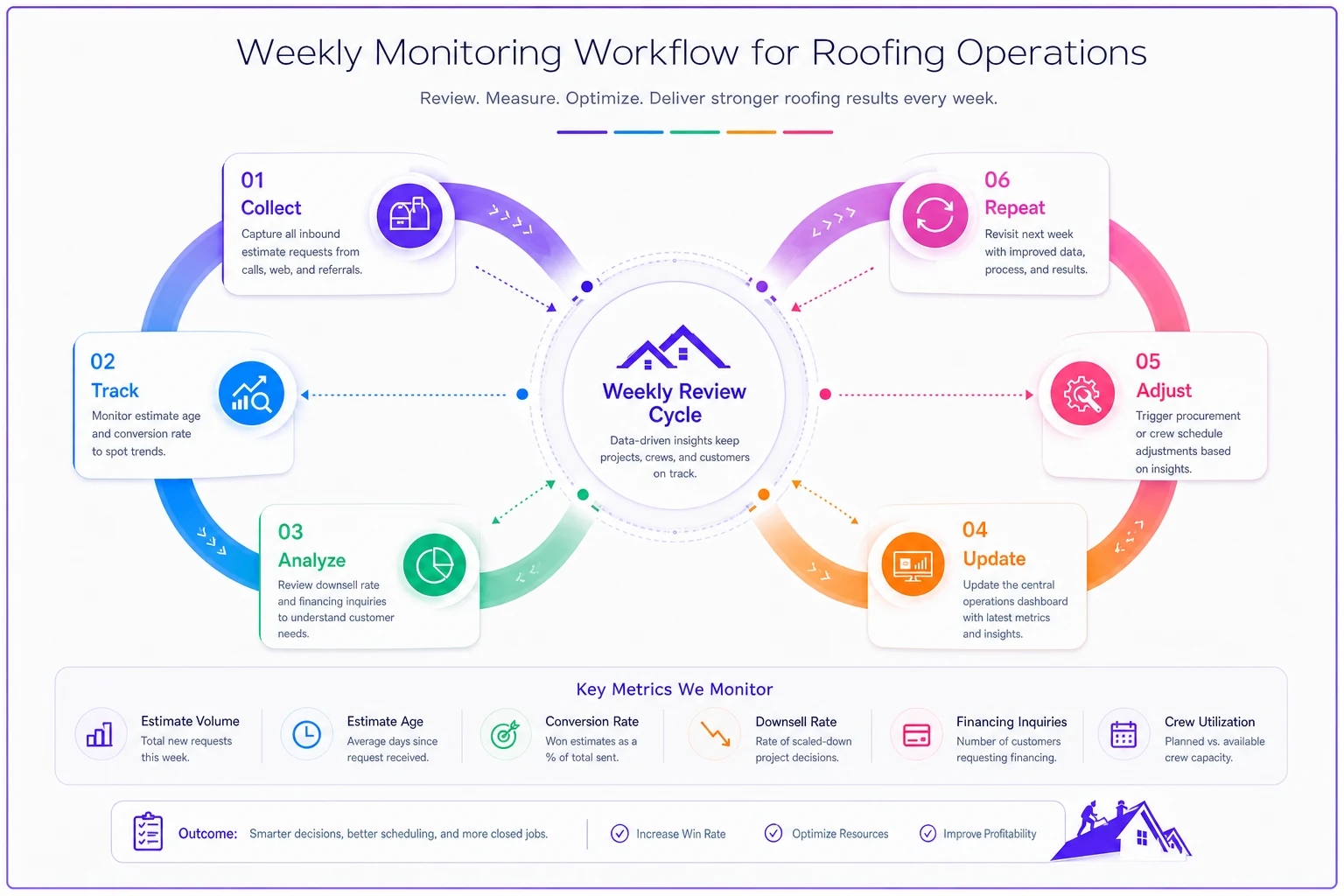
Use this weekly loop to spot lead indicators and act early.
Recalibrating procurement so cash doesn't get trapped in a driveway
Material is where a slowdown quietly bleeds you if you keep ordering to your old rhythm.
In a busy stretch, buying ahead makes sense — you protect against price bumps and stockouts, and the material turns over fast. In a softening market, the same behavior locks cash into inventory that now sits for weeks. Shingles on the ground aren't an asset when your booking rate just dropped; they're cash you can't use to make payroll.
The adjustment isn't complicated, but it requires actual discipline to hold the line on. Here's how to structure it:
-
Shorten your reorder horizon. If you normally stage material 2–3 weeks out, pull it to job-confirmed plus a few days for the discretionary segment. Keep normal staging only for signed insurance and storm work you're confident will close.
-
Separate committed from speculative orders. Material for signed jobs is committed. Material bought "because we'll probably need it" is speculative — and speculative buying is the first thing to cut.
-
Renegotiate return windows. Ask suppliers about restocking terms before you need them. A 15% restock fee beats holding dead inventory for two months.
-
Watch color and profile spread. Slowdowns are when odd-lot and special-order material becomes a trap. A pallet of a discontinued color that the customer canceled on is real money gone.
-
Tie every reorder trigger to a confirmed job stage, not to a calendar or a par level that was set during a busy season.
A quick example of how this goes wrong: a mid-size residential contractor kept their standard practice of staging roughly a week of material ahead across all crews. When two large discretionary reroofs pushed and one canceled outright, they had somewhere in the range of $18k–$22k in shingles and underlayment sitting in the yard with no home for it.
Shorten reorder horizons first for discretionary installs — that's where trapped cash shows up fastest.
Not a catastrophe by itself — but it landed the same week payroll was due, and that timing collision turned a manageable slow month into a scramble for a credit line.
Financing requests will climb — decide your posture before they arrive
When discretionary buyers hesitate, more of the ones who do move forward will ask about payment plans, financing, or staged billing. That's not inherently a bad thing — financing can rescue a job that would otherwise stall. But it changes your cashflow profile, and you want a clear stance before estimates start going out the door.
When offering financing or staged terms actually makes sense:
-
The job is non-discretionary (leak, storm, insurance supplement) and the only barrier is timing of cash.
-
You have a financing partner who funds you promptly, so your cash isn't the one stretched.
-
The homeowner's hesitation is genuinely a liquidity issue, not a commitment issue.
When it's a bad idea:
-
You're self-financing the receivable and your own cash is already tight — you'd be converting a margin problem into a collections problem.
-
The customer is shopping on price and financing is just a lever to squeeze your number down.
-
The job is speculative and financing is being used to talk someone into a purchase they're lukewarm on. Those become the callbacks and the collection headaches.
The teams that handle this well set their financing rules before the slowdown and give estimators a clear script. The ones that struggle improvise per deal, and end up carrying receivables they can't afford.
A short real scenario
A three-crew residential roofer in a mixed suburban/exurban market went into late summer with a healthy-looking backlog and no alarm bells going off. Their inbound estimate requests had dropped about 20% over three weeks, but nobody flagged it because the calendar was still full.
By the time the backlog burned down, one crew was running around three days a week. They'd also kept ordering material on the old schedule, so cash was tied up in staged product for jobs that had either downsized or stalled.
The fix wasn't some dramatic pivot. Once they started watching inbound requests and downsell rate weekly instead of staring at booked revenue, they caught the next dip about five weeks ahead. That lead time let them shift one crew toward insurance and repair work, pause speculative material buys, and hold off on a hire they'd been about to make. Revenue still softened for the quarter, but they avoided idle payroll and trapped inventory — and kept all three crews intact going into the spring rebound.
The lesson wasn't a new tactic. It was moving attention from the lagging number everyone stares at to the leading numbers that actually move first.
A practical checklist for the next 60–90 days
This is where most contractors either catch themselves in time or don't. Run through this list before the backlog gives you false confidence for another month:
-
- [ ] Rebuild your crew schedule off confirmed work, not backlog comfort
-
- [ ] Set a weekly review of inbound estimates, conversion rate, estimate age, and downsell rate
-
- [ ] Reweight your pipeline target toward insurance, storm, and repair work
-
- [ ] Split material orders into committed vs. speculative — freeze speculative
-
- [ ] Shorten reorder horizons for the discretionary segment
-
- [ ] Confirm supplier return and restock terms in writing now
-
- [ ] Write clear financing rules and hand estimators a script
-
- [ ] Model your cash position for a 20–30% discretionary drop before it happens
-
- [ ] Identify which crew flexes to repair/insurance work if utilization slips
-
- [ ] Decide your layoff-vs.-retain line before you're forced to choose in a panic
Operational software with built-in workflow automation can make several of these items easier to hold consistently — automated pipeline reports, material order flags tied to job stage, crew utilization tracking that updates without manual entry. The value isn't glamorous, it's just that the numbers you need are actually there when you want to check them, instead of scattered across a CRM, a spreadsheet, and someone's memory.
A retailer trimming guidance isn't a prediction about your business — it's a weather report. It tells you the consumer is getting cautious, and that caution reaches roofing on a delay. The contractors who get hurt are the ones who treat a full backlog as safety and keep planning off last year's rhythm. The ones who come through fine are watching the front of the funnel, protecting crew utilization, keeping cash out of the driveway, and steering their pipeline toward work that doesn't depend on discretionary spending.
A soft stretch in DIY spending is survivable. Disciplined operators often quietly take share from the ones who froze and waited for the calendar to fix itself. The difference comes down to how early you read the shift and how quickly your scheduling, procurement, and financing move with it instead of against it.
Ready to elevate your roofing operations?
Join hundreds of roofing contractors using Roofyly to streamline workflows, improve crew coordination, and enhance client satisfaction.