

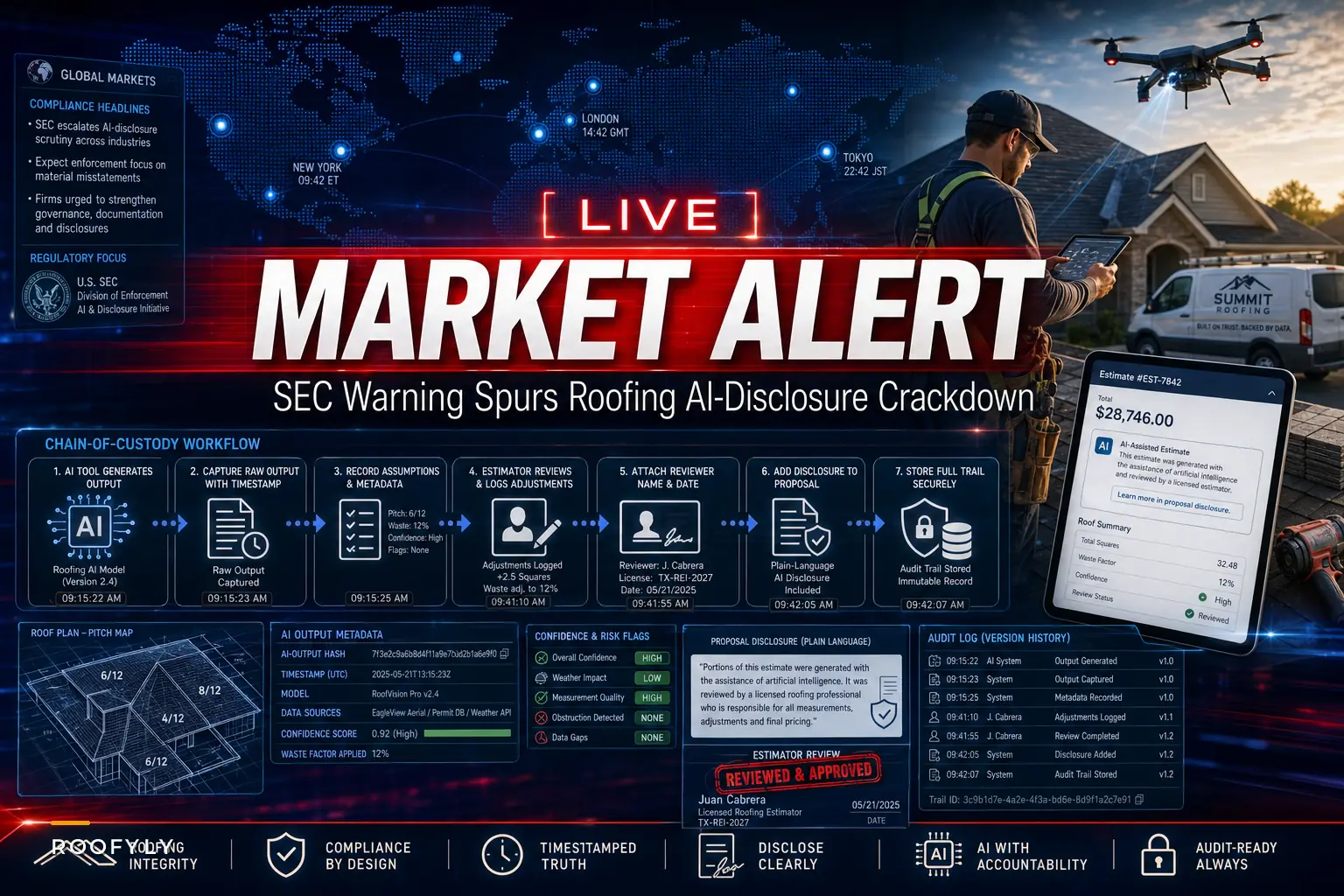

The SEC recently said it's keeping a closer eye on how companies talk about artificial intelligence. According to a Reuters report, the agency's top enforcement official flagged that regulators are scrutinizing AI-related statements and the controls behind them — essentially warning companies not to overstate what their AI does or hand-wave the governance underneath it.
Most roofing contractors read something like that and think: not my problem, I'm not a public company. And technically, you're right. The SEC isn't coming for your three-truck reroof operation.
But that's the wrong way to read this signal. When regulators start policing AI claims at the top of the food chain, the pressure rolls downhill — through your software vendors, your insurance partners, and eventually into the paperwork you hand homeowners and adjusters. The question stops being "is this enforceable against me" and starts being "can I prove how my AI-driven numbers were produced when someone disputes them." That's a very roofing problem.
The real exposure isn't the SEC — it's your estimate getting challenged
Nobody in roofing is connecting this yet. You already lean on AI-powered tools more than you probably admit. Satellite measurement platforms, automated photo tagging, risk-scored scheduling, predictive material ordering, estimate engines that spit out a square count and a price before a human touches it. That's AI-driven output flowing straight into contracts, supplements, and insurance claims.
Now picture when it goes sideways. An adjuster rejects a supplement. A homeowner files in small claims saying your estimate was inflated. An attorney in a storm-chaser lawsuit asks, under oath, how did you arrive at this measurement and this price?
If your honest answer is "the software did it," you've got a problem. Not a regulatory one — an evidentiary one. You can't defend a number you can't explain. The broader shift the SEC is signaling is that "the AI did it" is no longer an acceptable answer anywhere in the chain. Whoever presents an AI-assisted output is expected to show the inputs, the logic, and the human who reviewed it.
What shows up across operations that lean hard on automated estimating is a quiet gap: the tool produces a defensible-looking number, everyone trusts it, and nobody retains the reasoning. The screenshot gets deleted. The measurement overlay gets overwritten on the next job. Six weeks later when the dispute lands, the evidence is gone.
Where AI actually touches your paperwork (and where the risk hides)
Most contractors underestimate how many customer-facing documents already carry AI-generated content. Mapping it out tends to surprise people.
Keep every roofing job on track and on time.
Roofyly helps you manage, schedule, and communicate every roofing project with precision and ease.
- Centralized project planning
- Real-time crew notifications
- Integrated scheduling & client updates
No credit card required
| Workflow | AI-driven element | What's exposed if challenged |
|---|---|---|
| Estimating | Satellite/aerial square counts, auto-pricing | Measurement source, pitch assumptions, waste factor logic |
| Supplements | Auto-flagged damage, scope suggestions | Why line items were added; adjuster-facing defensibility |
| Scheduling | Risk-scored sequencing, weather confidence calls | Why a job was delayed/prioritized; delay-claim disputes |
| Photo documentation | Auto-tagging, damage detection | Whether tags reflect actual conditions or model guesses |
| Procurement | Predictive reorder, yield forecasting | Over/under-ordering disputes, billed material variance |
| Analytics / bids | Margin scoring, job-cost predictions | Pricing consistency claims, discrimination-risk in bids |
The pattern worth noticing: the riskiest spots aren't the flashy ones. It's the quiet assumptions baked into outputs — the waste factor your estimating tool silently applied, the pitch it inferred from a satellite image, the "high risk" score that pushed a customer into a different price tier. Those are the ones that look arbitrary under questioning because nobody wrote down the rule.
The underlying problem: you're disclosing AI by accident, or not at all
Two failure modes show up constantly.
The first is silent AI. The homeowner has no idea a chunk of their estimate came from an algorithm reading a satellite photo. That's fine until the measurement's off by 12% because tree cover fooled the imagery, and now it looks like you either hid something or didn't check your own numbers.
The second is sloppy disclosure. Someone, trying to sound modern, drops "powered by AI" into the proposal or the website, promising accuracy the tool can't actually guarantee. That's precisely the kind of overstated claim the regulatory attention is targeting — and in a dispute, your own marketing language gets used against you.
This usually happens when a contractor adopts a new estimating or measurement platform, loves the speed, and never updates a single template to reflect that a machine is now in the loop. The tech changed. The paperwork didn't. The gap between what your tools do and what your documents say is where liability lives.
A roofing AI disclosure & governance checklist
This isn't about compliance theater. It's about being able to stand behind every AI-assisted number you put in front of a customer, an adjuster, or a judge.
-
Inventory every AI-touched output. List each tool, what it generates, and which customer-facing document that output lands in. If you can't name the tool behind a number, that's finding #1.
-
Audit your vendor contracts and data flows. Know where your photos, measurements, and job data actually go, who can access them, and what the vendor claims their AI does versus what it actually does.
-
Add plain-language disclosure to proposals. One honest sentence: "Measurements and portions of this estimate were generated using automated/aerial measurement tools and reviewed by our estimator." No hype, no accuracy guarantees.
-
Require a human-review stamp. Every AI-generated estimate or supplement gets a name and a date attached before it leaves the building. "Reviewed by" is your single strongest defense.
-
Log and retain the reasoning, not just the result. Save the measurement overlay, the waste-factor setting, the pitch assumption, the timestamp. Retain it on the same schedule as your photos.
-
Document the override rule. Write down when and why an estimator is expected to override the AI. An undocumented override looks like a mistake; a documented one looks like judgment.
-
Update SLA and change-order templates. If a re-measure or re-estimate happens because the automated number was wrong, your change-order language should already anticipate it.
-
Train the crew and office on "AI-output review." Everyone who forwards an automated number should know they're accountable for sanity-checking it, not just relaying it.
Save the original overlay file alongside the final estimate and make it searchable by job number.
Work through it tool by tool.
A workflow for making AI estimates defensible
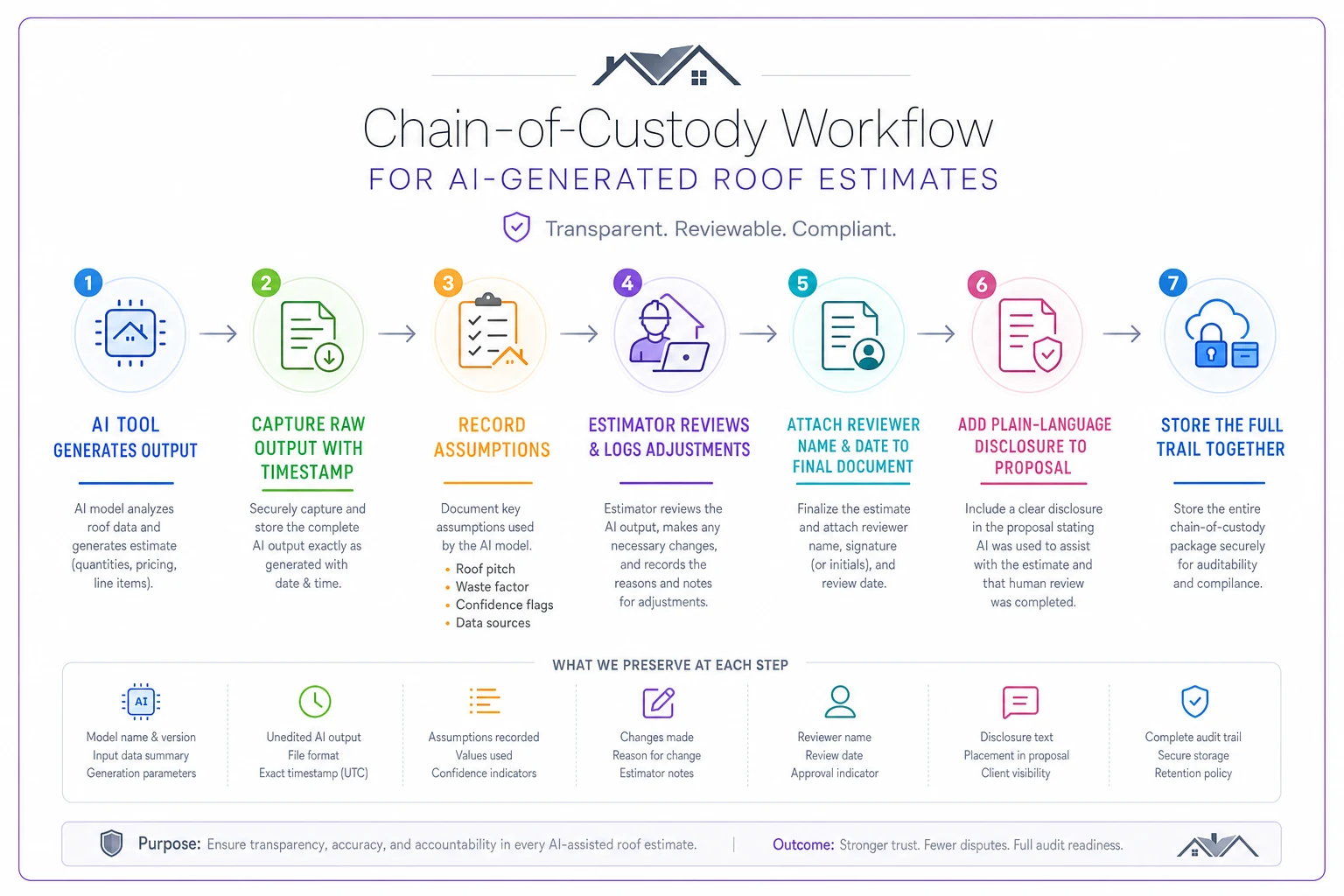
Think of it as a chain of custody for numbers — the same discipline you'd apply to photo evidence, extended to the math.
[AI Tool Generates Output] ↓ [Capture Raw Output + Timestamp] ↓ [Record Assumptions: Pitch / Waste Factor / Confidence Flags] ↓ [Estimator Reviews, Adjusts, Logs Changes] ↓ [Attach Reviewer Name + Date to Final Document] ↓ [Add Plain-Language Disclosure to Customer Proposal] ↓ [Store Full Trail: Source + Assumptions + Review Notes + Final Estimate]
Here's a simple visual workflow for the steps below.
-
Capture the source. When the aerial measurement or auto-estimate is generated, screenshot or export the raw output with its timestamp before anyone edits it.
-
Record assumptions. Note the pitch, waste factor, and any model confidence flags the tool surfaced. These are the first things challenged later.
-
Human review and adjustment. The estimator checks it against field reality, adjusts, and logs what changed and why in one or two lines.
-
Attach reviewer identity. Name and date on the final document. This converts "the software said" into "our estimator verified."
-
Disclose on the customer document. The plain-language line goes on the proposal. No surprises later.
-
Retain the full trail. Source output + assumptions + review notes + final estimate, stored together, retrievable in minutes.
The whole point is that if a supplement gets rejected or a homeowner disputes a square count eight weeks out, you pull one record and the entire reasoning is sitting there. You're not reconstructing anything from memory.
When this level of rigor actually makes sense — and when it's overkill
When it's worth the effort: You run insurance-heavy work, you're scaling past one or two crews, you operate in litigious or heavily-regulated states, or you've already had a supplement or small-claims dispute where your numbers got picked apart. In those situations, a clean AI evidence trail pays for itself the first time you avoid one bad outcome.
When it's probably overkill: You're a small cash-retail operation doing simple repairs, measuring most roofs yourself, and barely using automated tools. Don't build a governance program for AI you don't really rely on. Add disclosure language, keep it light, move on.
Who should not half-do this: Anyone marketing "AI-powered" accuracy in their sales material while keeping no evidence trail behind it. That's the worst combination — loud claims, zero backup. If you can't support the claim, drop the claim.
A realistic scenario
A mid-sized residential contractor — four crews, heavy on insurance restoration — leaned almost entirely on an aerial measurement platform for estimates. Fast, clean, and nobody retained the underlying overlays once the estimate was finalized.
A storm season later, an insurer started systematically kicking back supplements, arguing several measurements were overstated. The contractor couldn't produce the original automated outputs or any record of estimator review for jobs already closed. Over a stretch of a few months, they ate somewhere in the range of $20k–$30k in disputed scope they couldn't defend — not because the numbers were wrong, but because they couldn't prove they were right.
The fix wasn't a new tool. It was a two-line review log and a retention rule: every automated estimate saved with its source overlay and a reviewer stamp. The next time an adjuster pushed back, they pulled the full trail on the spot. Rejections on measurement-based line items dropped noticeably, and the back-and-forth on supplements got shorter because the evidence was simply there.
This is a governance problem, and you've solved versions of it before
If this feels familiar, it should. It's the same discipline roofing teams already apply to field photos and vendor integrations — knowing where data comes from, who touches it, and whether you can reproduce it on demand. AI-generated estimates and scores are just another data stream that needs owners, retention rules, and a defensible trail. The regulatory noise is simply forcing the issue earlier than most contractors planned for.
The teams that handle this well won't treat it as a separate "AI compliance" project. They'll fold it into the data-governance practices they should already have — the same approach laid out in operational tech governance for roofing integrations and data contracts. Clear ownership, documented data flows, retention you can actually enforce. AI outputs slot right in.
The contractors who get burned over the next couple of years won't be the ones using AI. They'll be the ones who used it everywhere, said nothing, saved nothing, and had no answer when someone finally asked how the number was made. You don't need to fear the tools. You need to be able to explain them.
Ready to elevate your roofing operations?
Join hundreds of roofing contractors using Roofyly to streamline workflows, improve crew coordination, and enhance client satisfaction.