
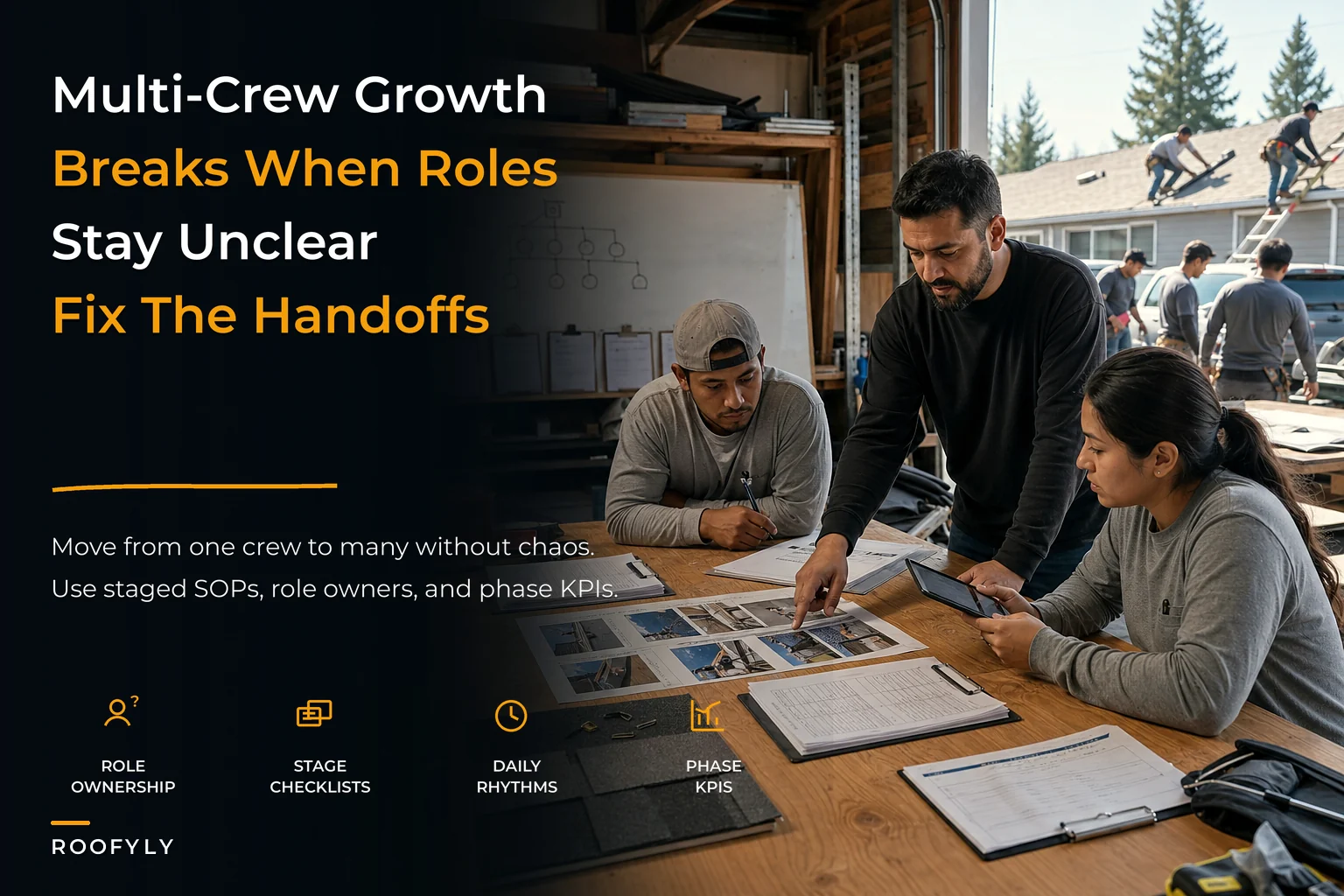

Most roofing contractors hit the same ceiling somewhere between their second and third crew. Revenue looks solid on paper—maybe $1.8M to $2.4M—but margins start shrinking while the owner's stress level goes through the roof. Literally. They're bouncing between jobsites, fielding escalations, wondering why adding more people made everything harder.
The pattern plays out the same way almost every time. You start with one solid crew—six guys who've worked together long enough to anticipate each other's moves. They know your standards, handle most situations without hand-holding, and produce consistent work. Adding a second crew feels manageable: promote your best installer to crew lead, hire a few new guys, stay involved with both teams. That third crew, though? That's where things fall apart.
What breaks usually isn't skills, equipment, or even finding reliable workers. The breakdown happens in the invisible operational layer—communication flows, decision rights, quality checkpoints, and knowledge transfer. Nobody thinks about any of that until it stops working.
Why roofing operations resist standard scaling models
Roofing has characteristics that make off-the-shelf scaling advice mostly useless. Unlike retail or office environments, roofing happens in constantly shifting conditions—weather dependencies, site-specific complications, and zero tolerance for quality shortcuts that could trigger warranty claims two or three years down the line.
The knowledge transfer problem is especially brutal in roofing. You can write a document once in an office setting and expect people to follow it. Roofing knowledge lives in experienced installers' heads—how to handle tricky valley configurations, when to call for additional underlayment on questionable decking, which flashing details prevent callbacks in specific climate patterns. That kind of tacit knowledge doesn't translate cleanly into written SOPs.
Roofing also has layered coordination challenges. Each crew needs materials staged correctly, equipment maintained and available, permits pulled on time, and inspections scheduled precisely. Miss any one piece and you've got guys standing around burning labor hours. One crew, the owner manages this in their head. Two crews, they scramble but get through it. Three crews running simultaneously? Any informal system gets crushed under the weight.
Quality control compounds exponentially too. With one crew, the owner checks every job. With two, they spot-check and lean on their trusted lead. By three crews—especially when jobs overlap—quality gets inconsistent fast. One crew might excel at shingle alignment while another rushes through flashing details. Those variations accumulate into warranty issues, callbacks, and the kind of reputation damage that doesn't show up in revenue until it's too late.
The three growth phases most contractors navigate (or crash into)
Phase 1: Owner-operator with a single crew (roughly $600k-$900k annual)
Keep every roofing job on track and on time.
Roofyly helps you manage, schedule, and communicate every roofing project with precision and ease.
- Centralized project planning
- Real-time crew notifications
- Integrated scheduling & client updates
No credit card required
This phase runs almost entirely on relationships and reputation. The owner works alongside the crew, sells jobs in the evenings, handles estimates on weekends. Quality stays high because the owner touches everything personally. The operation runs lean—maybe a part-time admin handling scheduling and invoicing.
Decision-making is fast because everything routes through one person. The owner knows which supplier has the best pricing this week, which inspector needs specific documentation, which homeowners require extra communication. Even when the hours are brutal, the business feels controllable.
The natural ceiling here is around $900k unless you're charging premium prices. The owner maxes out on selling capacity while trying to stay present in the field. Growth means stepping back from daily installation, which feels genuinely risky when quality depends on personal oversight.
Phase 2: Multiple crews with direct oversight ($1.2M-$2.4M annual)
The move to Phase 2 typically starts when the owner promotes their best installer to run the original crew full-time and starts building a second team. Revenue jumps—maybe hitting $1.5M to $2M fairly quickly.
But complexity multiplies everywhere at once. Scheduling becomes a daily puzzle: matching crews to jobs based on complexity, coordinating deliveries to multiple sites, sharing equipment between teams. The owner spends mornings dispatching, days bouncing between jobsites, evenings handling estimates and customer issues.
Communication breakdowns become routine. The owner tells one crew lead about an installation preference and forgets to loop in the other. Each crew starts developing its own methods. Standards diverge invisibly until a complaint or callback exposes the gap.
Cash flow timing gets trickier too. With two crews running, you might have $200k in receivables but need to make payroll tomorrow. Material costs need tighter tracking as volume discounts become meaningful. One crew burning through materials faster than projected can throw off job costing across the board.
Phase 3: Systematic operations with management layer ($2.5M-$5M annual)
Phase 3 requires fundamentally different operations. You cannot personally oversee three or four crews running at the same time. This phase demands real systems, formal roles, and repeatable processes that function without constant owner involvement.
Successful transitions to Phase 3 happen through deliberate structure, not just headcount. A production manager who owns field operations. An office manager handling administrative flow. SOPs that crews actually use. The owner shifts to sales, strategy, and system refinement.
Most contractors fail at Phase 3 because they try to scale Phase 2 methods instead of rebuilding. They add another crew without adding management infrastructure, assuming they can stretch personal oversight just a bit further. Quality drops. Callbacks spike. Profitable growth turns into expensive chaos.
Building the operational backbone before adding crews
Contractors who scale successfully to multi-crew operations tend to share one habit—they build operational systems before they actually need them. While running two crews, they document processes as if they had five. They create role definitions even when people still wear multiple hats. They set up communication protocols that feel like overkill at the time.
This starts with clear role evolution paths. Your best installer today could be tomorrow's crew lead and eventually a production manager. But without defining what each role actually owns, you get overlap, gaps, and constant confusion. A crew lead needs explicit authority over job sequencing, material ordering thresholds, and minor change approvals—otherwise they're calling the owner for permission on routine things, which defeats the whole point of delegation.
Document one field-facing SOP first—like the morning startup routine—and test it on both crews before expanding the field bible.
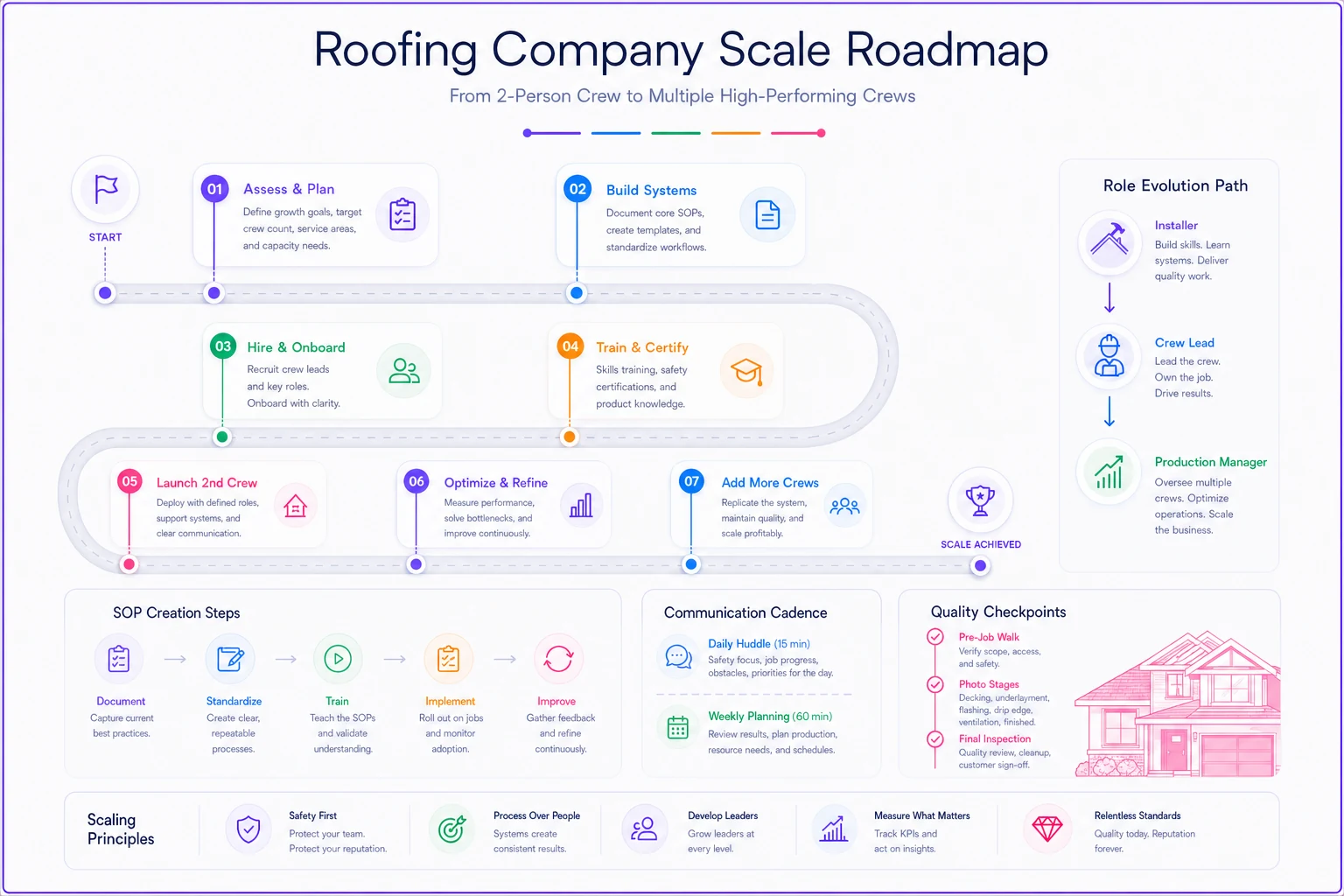
SOPs need to be visual and field-practical, not lengthy documents that nobody reads. Laminated cards showing proper flashing sequences, photo examples of acceptable versus unacceptable work, simple decision trees for common field situations. One contractor put together what he called a "field bible"—a ring-bound visual guide that lived in every crew truck. It covered everything from ladder setup angles to ice dam prevention details specific to their region. Simple, but it worked.
Communication architecture matters more than most contractors expect. Information needs defined channels and cadences, not random texts and parking lot conversations. Daily crew huddles with a standard format: yesterday's completion, today's plan, material needs, safety reminders. Weekly production meetings where crew leads present their status and upcoming needs. Monthly reviews where patterns get identified and systems get refined.
Quality checkpoints need to be embedded in the workflow, not added after problems surface. Photo documentation at specific stages—decking condition after tear-off, underlayment installation, flashing details before shingles. These aren't just for insurance purposes. They create accountability and training material. When a callback happens, you can trace it back to exactly which crew and which stage the issue started.
The org chart evolution that actually works
Single crew structure (6-8 people)
-
Owner
Sales, estimation, customer relations, field oversight, business management
-
Crew lead (working)
Job coordination, quality control, technical decisions
-
Experienced installers (2-3)
Primary installation, mentoring newer workers
-
General installers (2-3)
Installation support, material handling, cleanup
-
Part-time admin
Basic scheduling, invoicing, phone coverage
This flat structure works because communication lines are short and everyone knows their role through experience rather than documentation.
Two crew structure (12-16 people)
-
Owner
Sales, estimation, major customer issues, oversight of both crews, business strategy
-
Senior crew lead
Runs crew 1 independently, handles routine customer questions, trains new hires
-
Junior crew lead
Runs crew 2 with owner support, building independence
-
Office coordinator
Scheduling both crews, permit coordination, material ordering, AR management
-
Installers (8-12)
Divided between crews based on experience and skill mix
The complexity jump here forces the owner to start genuinely delegating customer interaction and field decisions—while maintaining quality through spot checks and crew lead development.
Three-plus crew structure (20+ people)
-
Owner
Business development, strategic planning, key relationship management
-
Production manager
Owns all field operations, crew scheduling, quality standards, equipment management
-
Office manager
Administrative operations, customer service, permits, invoicing, collections
-
Crew leads (3-4)
Full autonomy on routine jobs, escalation for complications
-
Lead installer per crew
Technical expert, quality control, mentoring
-
Sales/estimation role
Sales separated from owner responsibilities
-
Installers (15+)
Organized into stable crews with consistent partnerships
This structure requires formal reporting relationships, clear escalation paths, and defined performance metrics for each role.
Role-specific SOPs that prevent breakdown
Each role needs documentation that actually helps rather than collects dust. Not generic job descriptions—operational guides that answer the "what do I do when" questions that come up daily.
Crew Lead SOPs should cover:
-
Morning startup routine
Crew check-in process, safety brief format, equipment verification, job packet review, material confirmation. Include specific timeframes—arrive 15 minutes before crew, complete truck inspection checklist, review weather for go/no-go decision by 7:15 AM.
-
Customer interaction protocols
Introduction script for arrival, update requirements during the day, walkthrough process at completion, handling unexpected discoveries, change order approval limits ($500 without calling office), complaint escalation triggers.
-
Quality checkpoints
Photo requirements at each stage, measurement verification before starting, critical detail inspections (step flashing, pipe boots, ridge venting), cleanup standards, final walkthrough checklist.
-
Problem escalation
When to continue vs. stop work (discovering rot, structural issues, permit problems), who to call first for different situations, documentation required for insurance claims, weather-related shutdown decisions.
-
End-of-day routine
Tool inventory, material count for next day, truck organization, job status report to office, crew time tracking submission.
Production Manager SOPs should include:
-
Weekly planning process
Reviewing upcoming job queue, matching crew capabilities to job complexity, equipment allocation, material order verification, permit status, weather contingency planning.
-
Crew performance monitoring
Daily production targets by job type, quality metrics to track (callbacks per 100 jobs, customer ratings, punch list items), safety incident tracking, material waste percentages, schedule adherence rates.
-
Problem resolution authority
Budget for emergency equipment rental (up to $2k), authority to reassign crews, customer satisfaction recovery spending ($500 per incident), overtime approval guidelines, subcontractor engagement triggers.
-
Resource optimization
Equipment rotation schedules to prevent breakdowns, supply relationships and backup vendors, inventory management for commonly needed materials, truck maintenance coordination, tool replacement cycles.
Each role needs documentation that actually helps rather than collects dust. Not generic job descriptions—operational guides that answer the "what do I do when" questions that come up daily.
KPIs that signal when you're ready for the next phase
The metrics that matter change significantly as you scale. Revenue per crew tells you about sales effectiveness but almost nothing about operational health. Track indicators that reveal whether your systems can actually handle more complexity.
Phase 1 to Phase 2 Readiness Indicators:
Phase 2 to Phase 3 Readiness Indicators:
| Phase | Indicators |
|---|---|
| Phase 1 to Phase 2 | Owner field time: Less than 50% of working hours on jobsites Crew independence: Current crew completes 80% of jobs without owner on-site Customer callbacks: Under 5% requiring owner involvement Cash position: Three months of operating expenses in reserve Pipeline stability: Four to six weeks of work consistently booked Crew lead capability: Someone who can price simple repairs independently |
| Phase 2 to Phase 3 | Per-crew revenue: Each crew generating $65k-$85k monthly consistently Gross margins: Maintaining 38-45% across all jobs, not just the easy ones Schedule reliability: Completing 85% of jobs on originally scheduled dates Quality consistency: Callback rates similar between both crews (within 2%) Office systems: AR under 45 days, job costing within 5% accuracy Management readiness: An identified production manager who understands numbers and people |
| Phase 3 Optimization | Revenue per employee: $120k-$150k annually including office staff Operating margins: 15-20% after all costs including owner compensation Crew utilization: 75-85% of available days producing revenue Customer acquisition cost: Under $400 per contracted job Warranty claim rate: Less than 2% of completed jobs Employee turnover: Under 25% annually for experienced positions |
The metrics that matter change significantly as you scale. Revenue per crew tells you about sales effectiveness but almost nothing about operational health. Track indicators that reveal whether your systems can actually handle more complexity.
Transition periods and danger zones
The spaces between phases are where most roofing companies stumble. You're not quite Phase 1 anymore but not fully Phase 2 either. Systems that worked yesterday start failing, but replacements aren't ready yet. These windows need deliberate attention.
Moving from Phase 1 to Phase 2 typically takes four to six months of preparation. The owner starts documenting their decision-making, gradually extending more authority to the crew lead. Some contractors run two crews only three or four days a week initially—simpler jobs for the new crew, heavier owner involvement until trust is established.
The danger zone is when you have one and a half crews worth of work—not enough for two full teams, too much for one. Some contractors try to plug the gap with day laborers or part-time workers, but that usually creates quality inconsistencies. Better to keep one strong crew and subcontract overflow than to dilute standards with unstable staffing.
Phase 2 to Phase 3 transitions are more treacherous. The owner has to step back from daily operations before it feels comfortable. Management infrastructure has to be built before it looks clearly profitable on paper. This transition often takes 8-12 months and temporarily compresses margins as you carry overhead before seeing productivity gains.
The critical mistake is advancing when key indicators are yellow instead of green. If your callback rate is already sitting at 8%, adding another crew won't fix anything—it'll multiply the problem. If cash flow is tight with two crews, three crews won't generate enough buffer. They'll create a cash crisis when that large insurance check arrives two weeks late.
Automation and system tools that handle complexity
At some point, manual coordination just doesn't hold up. The contractor managing three crews through group texts and paper schedules will lose critical information, double-book resources, and miss quality issues until they become expensive problems.
Operational software built for construction can automate a lot of what breaks during scaling. Scheduling platforms can match crew assignments based on job complexity, location, and skill mix while keeping utilization rates consistent. Instead of spending two hours each morning figuring out who goes where, the system generates optimized routes accounting for traffic, material delivery windows, and weather.
Document management solves the version control mess that plagues growing companies. When contracts, change orders, and inspection forms live in one centralized system, every crew lead works from current templates. Updates happen immediately—no more discovering that one crew has been using an outdated warranty form for months.
Field communication tools built for construction outperform consumer messaging apps in every practical way. Job-specific threads, automatic logging of customer interactions, searchable history. When a homeowner calls with a warranty question six months after completion, anyone on the team can pull up the full job record—field photos, inspection notes, prior conversations.
The real operational leverage comes from integrated platforms that connect estimation through project completion. When the estimator flags specific job requirements—steep pitch, multiple valleys, specialty flashing—those details flow directly to the crew lead's tablet. No translation errors, no details lost between the office and the truck.
AI-assisted photo workflows and quality tracking can catch issues before they become callbacks. Crews document required stages, the system flags gaps or potential problems for review. Over time, patterns emerge about which situations are most likely to generate issues—and the team can get ahead of them.
That's ultimately what separates contractors who plateau at two crews from those running five or more successfully. One group tried to stretch personal oversight past its natural limit. The other built systems that could carry the operational load so people could focus on relationships, problem-solving, and craftsmanship.
Building for where you're going, not where you are
Scaling multi-crew roofing successfully means building tomorrow's systems today. Document processes while you're still small enough to refine them. Develop people into roles that don't exist yet. Implement tools that feel unnecessary until one day they're the only reason things are still working.
The jump from one crew to many isn't really about adding trucks or bodies. It's about shifting from an owner-dependent operation to one that runs on systems. Each phase demands a different approach to coordination, quality, and decision-making. Try to skip the foundation work and growth becomes chaos. Build deliberately and each new crew adds real capacity instead of compounding stress.
Every large roofing company started as a single crew operation. The ones that scaled successfully and the ones that crashed while trying weren't separated by luck or timing. They were separated by a willingness to rebuild operations for each new phase instead of stretching old methods past their breaking point.
The playbook exists. The tools are available. The question is whether you build the foundation before you add the weight.
Ready to elevate your roofing operations?
Join hundreds of roofing contractors using Roofyly to streamline workflows, improve crew coordination, and enhance client satisfaction.